Understanding 99 Cent .com Domains: What They Are, How They Work, and Why They Matter
A 99 cent .com domain is a promotional first-year registration deal offered by web domain registrars to attract new customers. While it significantly lowers the initial entry cost for launching a website, buyers must evaluate second-ye...
A 99 cent .com domain is a promotional first-year registration deal offered by web domain registrars to attract new customers. While it significantly lowers the initial entry cost for launching a website, buyers must evaluate second-year renewal price spikes, ICANN administrative fees, optional add-on costs, and transfer restrictions to avoid unexpected long-term domain ownership expenses.
Contents
What Is a 99 Cent .com Domain Offer?
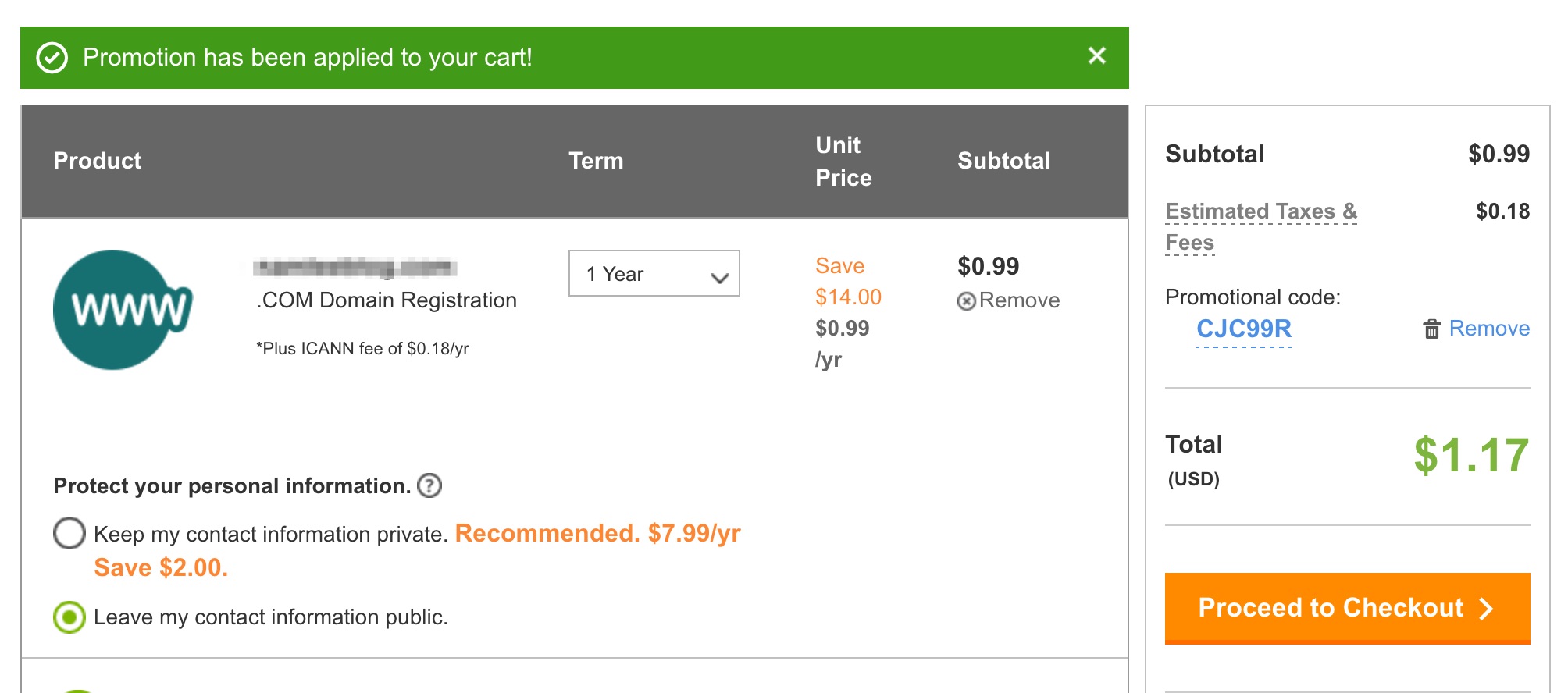
A 99 cent .com domain is a heavily discounted, introductory pricing structure where a domain name registrar sells a top-level domain (TLD) with the .com extension for $0.99 for the first year of ownership. Under standard retail conditions, .com domain registrations typically cost between $10.00 and $20.00 annually depending on the provider.
To understand why registrars offer domain names at such a steep discount, it is necessary to examine the underlying registry economics of the domain name system (DNS). Every .com domain registration incurs mandatory baseline costs:
- Registry Wholesale Fee: Verisign operates the
.comregistry under an exclusive contract with the Internet Corporation for Assigned Names and Numbers (ICANN). Registrars pay Verisign a fixed wholesale fee for every.comregistration and renewal year. - ICANN Transaction Fee: ICANN levies a mandatory $0.18 fee per domain-year on all accredited registrars for top-level domains under its oversight.
Because the wholesale cost from Verisign exceeds $9.00 per year, selling a domain for $0.99 causes the registrar to sustain an immediate financial loss of roughly $9.00 to $10.00 per registration. Consequently, the 99 cent promo functions as a classic loss-leader marketing strategy. Domain registrars absorb this initial loss to acquire new user accounts, anticipating that customers will offset the discount through subsequent domain renewals, premium DNS services, web hosting packages, corporate email subscriptions, or SSL security add-ons.
Why 99 Cent Domain Deals Matter for Web Owners and Businesses
Discounted domain pricing plays an essential role in lowering the barrier to entry across the digital ecosystem. Whether you are an independent web developer, a startup founder, or a small business owner, introductory domain promotions offer distinct tactical and economic advantages.
- Promotional Domain Offer ($0.99 Year 1)
- Strategic Advantages
- Low-risk MVP testing
- Brand security & protection
- Immediate site launch
- Hidden Liabilities
- Price shock at renewal ($18–$25/yr)
- Paid WHOIS privacy add-ons
- 60-day ICANN transfer lock
- Strategic Advantages
1. Minimal Barrier for Minimum Viable Product (MVP) Testing
Entrepreneurship and modern web development depend heavily on rapid experimentation. When testing product hypotheses, temporary marketing campaigns, or micro-software concepts, spending standard retail rates across dozens of speculative domain names quickly accumulates significant capital expenditures. A $0.99 price point allows developers and digital marketers to register multiple domain concepts simultaneously, test market interest with live landing pages, and drop unsuccessful ideas before the end of the first year without committing substantial capital.
2. Low-Cost Brand Protection and Defensive Registrations
Established brands and growing businesses often face risks from cybersquatting or domain typosquatting. Acquiring common misspellings, localized variants, or alternative campaign names protects corporate identity. Securing defensive .com registrations at $0.99 per name keeps initial brand protection campaigns cost-effective, giving legal and brand teams time to determine which secondary domains are worth renewing long-term.
3. Immediate Accessibility for Early-Stage Startups
For bootstrapped founders operating on tight launch budgets, every dollar saved during the pre-revenue phase matters. Shifting web infrastructure expenditure away from domain acquisition frees up immediate capital for essential launch costs, such as software development, content creation, or user acquisition channels.
The Hidden Fine Print Behind $0.99 Domain Promotions
While a 99 cent domain deal provides clear financial savings upfront, domain buyers must carefully review the registrar's terms of service and renewal schedules. Unmet conditions or uncheckboxes during checkout can turn a cheap domain into an expensive long-term liability.
| Checkout Price Breakdown | Price |
|---|---|
| Base .com Promo Registration (Year 1) | $0.99 |
| ICANN Mandatory Assessment Fee | $0.18 |
| Domain Privacy Protection (Standard/Paid) | $9.99 |
| Mandatory Domain Renewal Agreement (Year 2 Scheduled) | $21.99 |
Renewal Price Shock
The primary trade-off of a $0.99 domain is the standard second-year renewal rate. Registrars offering deep introductory discounts often charge higher-than-average renewal fees—frequently between $18.99 and $24.99 per year—to recover their initial customer acquisition costs. Over a three-to-five-year holding period, a domain bought for $0.99 with a $21.99 renewal rate costs significantly more than a domain bought from a flat-rate registrar charging $11.00 per year with no introductory discount.
Ancillary Add-on Fees and WHOIS Privacy Charges
When registering a domain, domain name registries require the submission of valid registrant contact info (name, address, email, phone number) to the public WHOIS directory. To prevent public exposure, spam, and identity theft, registrars offer WHOIS privacy masking. While many modern, transparent registrars offer permanent WHOIS privacy protection free of charge, some promotional providers treat privacy protection as a paid add-on, adding $9.99 to $14.99 per year to the total order.
The ICANN 60-Day Transfer Lock Rule
Under ICANN's Policy on Transfer of Registrations, a domain name cannot be transferred to a new registrar within 60 days of an initial registration or a change in registrant contact information. This policy prevents buyers from purchasing a $0.99 domain at Registrar A and immediately transferring it to a lower-cost Registrar B on day two. Buyers are locked into the original registrar for at least two months, requiring careful monitoring of renewal dates if they plan to migrate before year two.
Promotional Terms and Payment Restrictions
Promotional single-digit domain codes usually enforce strict eligibility constraints:
- New Customer Restrictions: Promotions are almost universally capped at one $0.99 domain per customer account or household address.
- Payment Method Constraints: Discounts often require verified credit card transactions, explicitly excluding anonymous prepaid cards, select digital wallets, or PayPal to prevent deal abuse.
- Pre-Checked Add-ons: Checkout flows frequently pre-select bundled items such as email hosting trials, site builders, or multi-year terms that remove the promo rate if adjusted incorrectly.
Standard vs. Promotional Domain Pricing Comparison
To understand the long-term total cost of ownership (TCO) between a promotional loss-leader registrar and a transparent, flat-rate provider, consider the following structured multi-year fee comparison.
| Pricing Metric / Feature | Promotional Loss-Leader Registrar | Transparent Flat-Rate Registrar | Bundled Hosting Provider |
|---|---|---|---|
| Year 1 Registration Fee | $0.99 | $10.50 – $11.50 | $0.00 (With Hosting Contract) |
| ICANN Administrative Fee | $0.18 (Often billed separately) | Included or $0.18 | Billed separately or included |
| WHOIS Privacy Protection | Billed extra ($9.99/yr) or 1st year free | Always Free | Included with select hosting plans |
| Year 2+ Annual Renewal Fee | $19.99 – $23.99 | $10.50 – $11.50 | $18.99 – $21.99 |
| 60-Day Transfer Lock | Enforced (ICANN Mandate) | Enforced (ICANN Mandate) | Enforced (ICANN Mandate) |
| 3-Year Total Estimated Cost | $40.97 – $68.14 | $31.68 – $34.68 | $37.98 – $43.98 (Excludes Hosting) |
| Ideal Primary Use Case | Single short-term MVPs & campaign sites | Core multi-year business domains | Beginners needing turnkey setup |
Note: Pricing reflects industry-wide average cost models for standard .com domain names. Exact figures vary by registrar.
How to Profitably Leverage 99 Cent Domain Promos
Utilizing $0.99 domain promotions effectively requires active account management and an understanding of domain management workflows. Follow this strategic process to maximize upfront savings while preventing unintended expenses.
- Step 1: Research Renewal & Privacy Terms
- Step 2: Deselect Checkout Add-ons (Hosting, Email, SSL)
- Step 3: Complete $0.99 Purchase & Verify Privacy Status
- Step 4: Set Reminders for Day 61 (Transfer) & Month 11 (Renewal)
Step 1: Verify Renewal Schedules Before Checkout
Before adding a 99 cent domain to your cart, locate the registrar's explicit renewal price schedule. Ensure you know the exact price point you will be charged on day 365. If the renewal rate exceeds acceptable market standards, factor that difference into your project timeline.
Step 2: Uncheck Bundled Services During Checkout
During the multi-step checkout workflow, registrars frequently offer default add-ons:
- Custom Business Email Trials: Often free for 30 days, then auto-renewed at paid monthly subscription rates.
- Website Builders and Hosting: Pre-selected options that add recurring hosting plans to your bill.
- Multi-Year Registration Lengths: Promo discounts generally apply only to Year 1. Selecting a 2-year or 3-year term during initial checkout often calculates Year 2 and Year 3 at standard retail rates automatically. Choose a 1-year registration length to lock in the absolute minimum checkout price.
Step 3: Verify WHOIS Privacy Protection
Once registration completes, check your domain account dashboard to ensure WHOIS Privacy Protection is active. If privacy masking is not active, personal registration details (such as home address and contact number) will be published to global public databases within hours, leading to immediate increases in telemarketing calls and email spam.
Step 4: Manage Auto-Renewal Settings and Set Calendar Alerts
If the domain is intended for a temporary experiment or short-term marketing test:
- Access account settings and disable the Auto-Renew toggle immediately after registration.
- Place a calendar alert for 11 months from the purchase date to re-evaluate whether the project warrants paying the standard renewal fee or letting the domain expire.
Step 5: Execute an Out-Transfer After 60 Days if Keeping Long-Term
If you register a core business domain under a $0.99 promotion but want to avoid high renewal rates in Year 2:
- Maintain the domain at the initial registrar for the required 60-day ICANN lock period.
- On Day 61 or later (and before the year 1 expiration window closes), unlock the domain in your dashboard and request an Authorization Code (Auth-Code / EPP Code).
- Initiate a domain transfer to a lower-cost, wholesale-model registrar. Transferring a domain adds one full year to the existing expiration date at the new registrar's standard rate, effectively neutralizing the original registrar's high renewal pricing.
Strategic Alternatives to First-Year Promo Pricing
While 99 cent domain promotions offer appealing upfront savings, alternative domain registration strategies may offer better long-term value depending on your project scope.
Wholesale and Flat-Rate Registrars
If your project is planned for a multi-year lifespan, registering directly with a flat-rate or cost-plus registrar (such as Cloudflare Registrar, Porkbun, or Spaceship) is often more economical. These providers do not run loss-leader promotions; instead, they sell and renew .com domains at wholesale pricing (registry cost + ICANN fee) year after year. Eliminating renewal markups saves money over any term longer than two years without requiring manual domain transfers.
Bundled Web Hosting Agreements
If your website requires dedicated web hosting, enterprise managed WordPress, or cloud server space, many hosting providers include a free .com domain registration for the first year with an annual hosting subscription. This consolidates domain management and web hosting under a single dashboard while eliminating separate first-year domain charges entirely.
Frequently Asked Questions
Are 99 cent .com domains legitimate and safe to buy?
Yes, 99 cent .com domains are fully legitimate and safe when purchased through ICANN-accredited domain registrars. The domain functions identically to any standard-priced .com domain name on the global DNS network. However, buyers must pay attention to auto-renewal terms, WHOIS privacy coverage, and long-term renewal pricing.
Why do registrars sell .com domains for 99 cents if Verisign charges them more?
Registrars offer 99 cent domains as a loss-leader marketing tactic to attract new user registrations. Because domain ownership requires annual renewal, registrars sustain a short-term loss on year one, expecting to turn a profit through second-year renewals, hosting packages, web security features, and email services.
Can I transfer my $0.99 domain to another registrar right after buying it?
No. Under ICANN rules, all newly registered domain names are subject to a mandatory 60-day transfer lock. You must wait at least 61 days after initial registration before you can transfer the domain to another provider.
What happens if I forget to turn off auto-renewal on a $0.99 domain?
If auto-renewal remains active, the registrar will automatically bill the payment method on file for the second-year registration fee—typically at standard retail rates ($18.99 to $24.99)—roughly 30 to 7 days before the official expiration date.
Is WHOIS privacy always included with a 99 cent .com domain?
No. Some registrars include free lifetime WHOIS privacy protection with every domain, while others charge an additional fee for privacy protection or offer it free for the first year only. Always verify that privacy protection is included at no extra cost before completing checkout.
Practical Recommendations for Domain Buyers
To maximize your savings while maintaining long-term domain stability, implement these clear operational steps based on your current project goals:
- For Short-Term MVPs and Experiments: Use $0.99 domain promotions to minimize immediate expenses. Disable auto-renewal immediately in your account dashboard and set a calendar notification at 11 months to decide whether to keep or drop the domain.
- For Core Corporate Brands and Long-Term Websites: Register directly through a transparent, flat-rate registrar charging standard wholesale fees. Avoiding steep renewal markups saves money over the lifecycle of your site without requiring domain transfers.
- For Existing $0.99 Domain Registrations: If you currently hold a domain acquired under a $0.99 promo that you plan to keep long-term, monitor your calendar for the end of the 60-day ICANN lock period. Once 60 days pass, transfer the domain to a lower-cost provider to secure affordable renewal rates for year two and beyond.
Image Gallery