Auto Insurance Company Comparison Chart: Finding the Right Coverage and Value
Comparing auto insurance companies requires evaluating coverage options, pricing structures, financial stability, and customer satisfaction ratings to identify the policy that aligns with your specific driving profile and budget requir...
Comparing auto insurance companies requires evaluating coverage options, pricing structures, financial stability, and customer satisfaction ratings to identify the policy that aligns with your specific driving profile and budget requirements.
Contents
Navigating the landscape of car insurance can be challenging given the vast array of coverage tiers, deductible levels, and proprietary discount programs available across national and regional providers. When shopping for a policy, relying on structured data rather than marketing claims allows you to isolate the core variables that impact your financial protection and monthly expenditure. An auto insurance company comparison chart serves as a foundational analytical tool, helping drivers juxtapose mandatory state minimum liabilities against robust full-coverage plans that include comprehensive and collision safeguards.
By systematically reviewing carrier metrics—ranging from claims satisfaction scores evaluated by organizations like J.D. Power to financial strength ratings assigned by agencies such as AM Best—policyholders can secure an optimal balance between premium costs and reliable indemnification. Understanding how different insurers price risk, handle roadside assistance, and manage digital claims processing ensures you make an informed decision tailored to your long-term vehicular security.
Understanding the Core Components of Auto Insurance Policies
Before analyzing a provider comparison chart, you must understand the foundational structural elements that constitute an auto insurance contract. Insurance policies are built upon distinct coverage types, each designed to mitigate specific financial liabilities arising from vehicular operation, property damage, and personal injury.
Liability Coverage (Bodily Injury and Property Damage)
Liability coverage is legally mandatory in almost every jurisdiction. It pays for injuries and property damage you cause to others in an at-fault accident.
- Bodily Injury Liability: Covers medical expenses, lost wages, and legal defense costs if you injure someone. It is typically expressed as two limits per person and per accident (e.g., $50,000/$100,000).
- Property Damage Liability: Pays for repairs or replacement of another driver’s vehicle or public property (such as utility poles or guardrails) that you damage during a collision.
Physical Damage Coverage (Collision and Comprehensive)
While liability protects third parties, physical damage coverage safeguards your own vehicle against unforeseen incidents. Lenders typically require these coverages if you finance or lease your car.
- Collision Coverage: Reimburses you for damage to your vehicle resulting from a collision with another vehicle or a stationary object, regardless of fault.
- Comprehensive Coverage: Protects against non-collision perils, including theft, vandalism, fire, weather events (hail, floods), and animal strikes (such as hitting a deer).
Supplemental and Personal Protections
Depending on state laws and personal preference, policies frequently incorporate additional protective layers:
- Personal Injury Protection (PIP) / Medical Payments (MedPay): Covers medical bills, rehabilitation, and sometimes lost wages for you and your passengers, regardless of who caused the accident.
- Uninsured/Underinsured Motorist (UM/UIM) Coverage: Steps in if you are struck by a driver who carries no insurance or lacks adequate limits to cover your medical and repair costs.
Evaluating Major Auto Insurance Providers
Different insurance carriers tailor their services to specific consumer segments. Some companies prioritize low base rates for high-risk drivers, while others focus on white-glove claims service, robust accident forgiveness programs, or advanced telematics apps that track driving habits for discounts.
National Carriers vs. Regional Insurers
National carriers—such as Progressive, State Farm, GEICO, and Allstate—offer extensive digital infrastructure, nationwide network repair shops, and wide-ranging policy customizations. However, regional insurers often provide superior localized customer service and more aggressive pricing in specific geographic zones. Evaluating a diverse cross-section of providers ensures you do not overlook competitive mutual insurance companies that distribute dividends back to policyholders.
Financial Stability and Claims Reputation
The true test of an auto insurance company occurs at the moment of a claim. Financial strength ratings, issued by independent evaluators like AM Best, indicate an insurer's capitalization and capacity to pay out massive claims following regional catastrophes or widespread severe weather events. Simultaneously, consumer satisfaction indices track the speed, fairness, and transparency of the claims adjustment process.
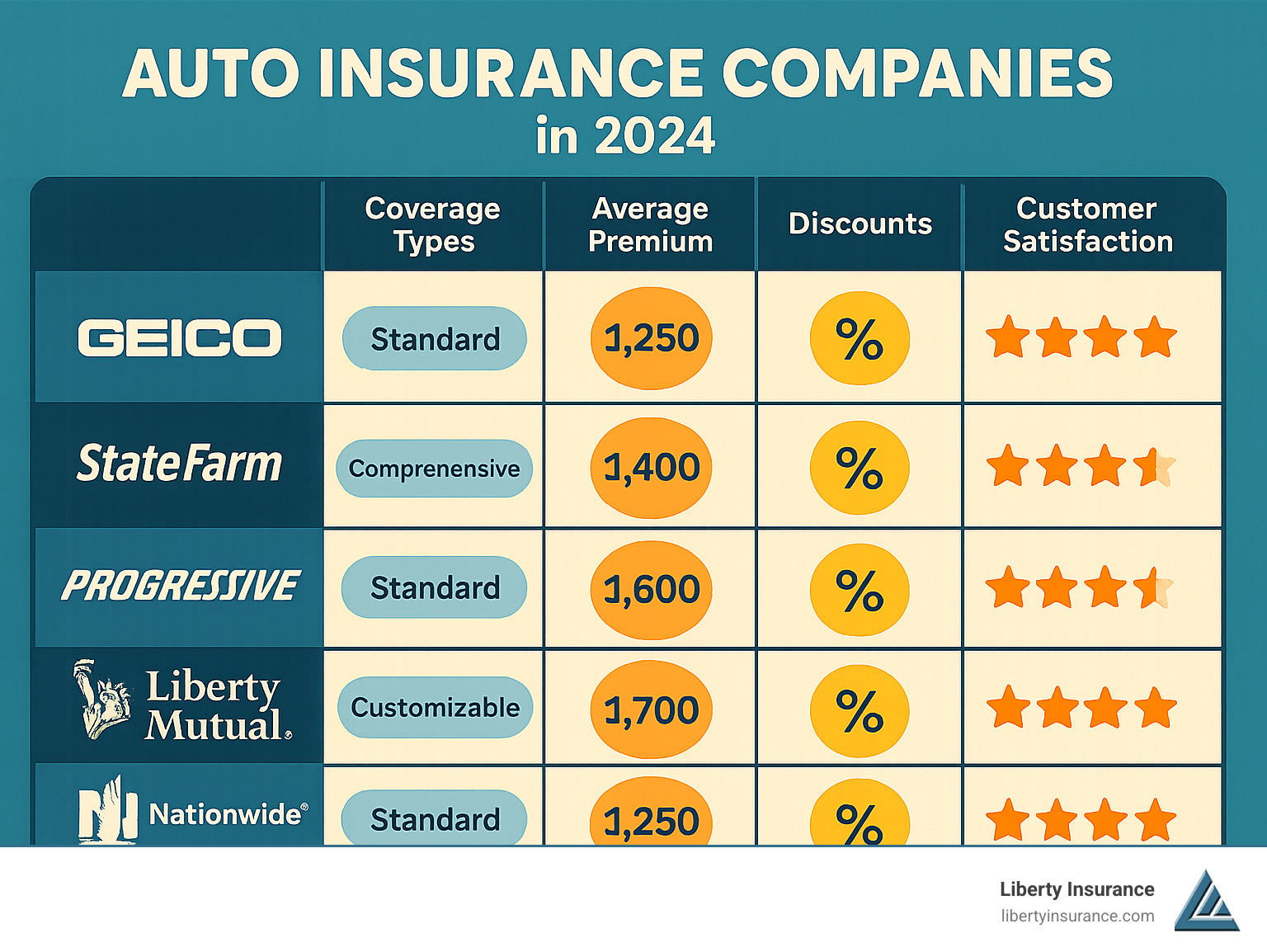
Auto Insurance Company Feature and Coverage Comparison Chart
The following chart compares major aspects of leading auto insurance providers. This comparative framework highlights how carriers differ across standard features, digital accessibility, and policy perks.
| Insurance Company | Average Cost Profile | Best Known For | Telematics Program | Roadside Assistance | Financial Strength (AM Best) |
|---|---|---|---|---|---|
| State Farm | Moderate to Competitive | Local agent network and personalized service | Drive Safe & Save | Optional Add-on | Superior (A++) |
| GEICO | Highly Competitive | Affordable rates and intuitive digital app | DriveEasy | Optional Add-on | Superior (A++) |
| Progressive | Competitive | Name Your Price tool and transparent comparisons | Snapshot | Optional Add-on | Superior (A+) |
| Allstate | Moderate to High | Robust add-on coverages (e.g., safe driving bonus) | Drivewise | Optional Add-on | Excellent (A+) |
| USAA | Highly Competitive | Exclusive coverage for military members and families | USAA SafePilot | Optional Add-on | Superior (A++) |
| Liberty Mutual | Moderate to High | Customizable coverage options and accident forgiveness | RightTrack | Optional Add-on | Excellent (A) |
Note: Premium costs vary substantially based on individual risk profiles, including driving history, age, vehicle make and model, and geographic location. Financial ratings reflect independent assessments current as of 2026.
Key Factors That Influence Your Auto Insurance Rates
When evaluating a comparison chart, remember that published averages rarely reflect your personal quote. Insurance underwriting algorithms assess dozens of distinct rating factors to calculate risk and price policies accordingly.
Driving History and Motor Vehicle Records
Your past driving behavior remains one of the most significant determinants of your premium. Clean driving records free of at-fault accidents, speeding tickets, and driving under the influence (DUI) violations qualify drivers for preferred tier rates. Conversely, moving violations typically trigger surcharges that persist on your record for three to five years.
Vehicle Make, Model, and Safety Rating
The physical characteristics of your car directly impact insurance costs. Underwriters review statistical data concerning repair costs, parts availability, theft rates, and occupant safety performance. Standard commuter sedans with high safety ratings generally cost less to insure than high-performance sports cars or luxury import vehicles equipped with expensive sensor-laden windshields and aluminum body panels.
Coverage Limits, Deductibles, and Location
Your choices regarding policy structure alter your baseline expenditure immediately:
- Deductibles: Opting for a higher deductible (e.g., $1,000 instead of $500) lowers your monthly premium, but increases your out-of-pocket financial burden during a claim.
- Geographic Location: Urban areas with high traffic density, higher rates of vandalism, and elevated litigation frequencies incur steeper premiums than rural ZIP codes with lower accident probabilities.
How to Effectively Use Quotes and Comparison Tools
Gathering multiple quotes is the single most effective strategy for lowering your auto insurance expenses. Because insurers weigh risk factors differently—such as how they penalize credit history or reward continuous coverage—price disparities for identical coverage packages can be substantial.
Steps for Securing Accurate Quotes
- Prepare Your Documentation: Have your current policy declarations page, driver’s license numbers, and Vehicle Identification Numbers (VINs) ready to ensure quote consistency.
- Standardize Coverage Limits: When comparing quotes across different platforms, ensure the liability limits, deductibles, and optional coverages (like rental car reimbursement) match identically. Comparing a state-minimum policy against a full-coverage plan invalidates the price comparison.
- Inquire About Bundling and Discounts: Ask providers about multi-policy discounts (bundling auto with homeowners or renters insurance), paperless billing discounts, defensive driving course credits, and low-mileage programs.
Frequently Asked Questions
What is the primary purpose of an auto insurance company comparison chart?
An auto insurance company comparison chart simplifies the evaluation process by displaying key metrics—such as average rates, customer satisfaction scores, digital tool availability, and coverage availability—side by side. This allows drivers to filter out options that do not meet their specific financial and coverage criteria.
How often should I compare auto insurance companies?
It is advisable to review your auto insurance policy and shop the market at least once a year, or whenever you experience a major life event. Significant life changes include moving to a new ZIP code, adding a teenage driver to your policy, purchasing a new vehicle, or experiencing changes in your credit standing.
Do online comparison charts provide exact pricing for my situation?
No. Comparison charts and online quote aggregators provide generalized estimates or baseline averages based on hypothetical driver profiles. Your actual quote requires a formal underwriting review that evaluates your specific motor vehicle record, claims history, and credit-based insurance score where legally permitted.
What should I look for beyond cheap rates when comparing insurers?
While affordability is vital, you must also examine the insurer's claims handling reputation, customer service accessibility, and financial stability rating. A cheap policy provides little value if the company delays payouts, denies legitimate claims, or lacks the financial capital to absorb regional catastrophic losses.
Are telematics apps mandatory when purchasing car insurance?
Telematics programs—which monitor driving speed, braking habits, smartphone distraction, and mileage via a mobile app or plugged-in device—are generally optional. While opting in can yield substantial discounts for safe drivers, some insurers now utilize telematics data in certain states to adjust baseline renewals based on actual driving behavior.
Conclusion and Next Actions
Selecting the appropriate auto insurance provider requires balancing upfront affordability against reliable protection and dependable customer service. Start by identifying your mandatory coverage baselines and risk tolerance thresholds. Next, request standardized quotes from at least three distinct carriers—incorporating both national brands and well-rated regional alternatives—to benchmark your pricing options. Review independent financial strength ratings and consumer satisfaction metrics to ensure your chosen provider will honor claims efficiently when unexpected vehicular incidents occur.
Image Gallery