The Difference Between a Checking and Savings Account: A Comprehensive Guide for 2026
The fundamental difference between a checking and savings account lies in their intended use: checking accounts are designed for daily transactions and frequent withdrawals, while savings accounts are built for long-term storage and in...
The fundamental difference between a checking and savings account lies in their intended use: checking accounts are designed for daily transactions and frequent withdrawals, while savings accounts are built for long-term storage and interest accumulation. Checking accounts prioritize liquidity and accessibility, whereas savings accounts trade immediate transactional convenience for higher interest rates and capital preservation.
Contents
Defining the Checking Account: Your Daily Financial Hub
A checking account serves as the primary gateway for your personal finances. It is a demand deposit account designed for high-frequency use, allowing you to deposit and withdraw money as often as needed. In 2026, the checking account remains the central "hub" from which most consumers pay bills, receive direct deposits from employers, and manage day-to-day expenses through various digital and physical methods.
The primary utility of a checking account is its versatility. Most providers offer several ways to access funds, including debit cards, electronic fund transfers (EFTs), automated clearing house (ACH) payments, and, though increasingly rare, paper checks. Because these accounts are built for movement, they typically offer very low interest rates, often close to 0%. The bank’s primary goal with a checking account is to provide the infrastructure for your liquidity, not to grow your wealth.
Standard features of modern checking accounts include:
- Debit Card Access: Immediate access to funds for point-of-sale transactions and ATM withdrawals.
- Online Bill Pay: Integrated systems that allow users to schedule payments to utilities, landlords, and service providers.
- Mobile Check Deposit: The ability to scan and deposit checks via smartphone applications.
- Direct Deposit: A seamless way for employers to move wages directly into the account, often bypassing traditional clearing times.
Defining the Savings Account: A Tool for Wealth Accumulation
A savings account is a deposit account held at a retail bank or credit union that pays a modest interest rate. While it provides lower liquidity than a checking account, it serves as a secure place to store money that is not intended for immediate spending. In the financial landscape of 2026, savings accounts are frequently used for emergency funds, short-term goals like a wedding or vacation, or as a "parking spot" for cash during market volatility.
Unlike checking accounts, savings accounts are generally not used for direct payments. You cannot typically swipe a debit card at a grocery store and have it pull directly from your savings, nor can you usually write a check against the balance. Instead, you must first transfer the money to a checking account. This friction is intentional; it encourages the user to keep the money untouched so it can benefit from compounding interest.
The most attractive feature of a savings account is the Annual Percentage Yield (APY). While traditional "brick-and-mortar" banks may offer nominal rates, online-only banks and high-yield savings accounts (HYSAs) provide significantly higher returns. These rates fluctuate based on the federal funds rate set by the Federal Reserve, making savings accounts a variable-yield investment.
Key Functional Differences and Purpose
Understanding the divergence between these two accounts requires looking at how they handle transactions, interest, and accessibility. While both are "deposit accounts," their roles in a healthy financial plan are distinct.
Transaction Volume and Liquidity
Checking accounts are designed for volume. There are generally no limits on how many times you can deposit or withdraw money in a month. This makes them ideal for the "ebb and flow" of monthly income and expenses. If you have 50 transactions in a month—ranging from buying a coffee to paying a mortgage—the checking account is the appropriate vehicle.
Savings accounts, conversely, are designed for "stagnant" capital. Historically, federal regulations limited certain types of withdrawals from savings accounts to six per month. While the Federal Reserve's Regulation D was amended in 2020 to allow banks more flexibility, many institutions still maintain internal limits or charge "excessive withdrawal fees" if you move money out of savings too frequently. This reinforces the account's purpose as a reservoir rather than a river.
Interest Earning Potential (APY)
The "cost" of the high liquidity in a checking account is the lack of interest. In a typical 2026 banking environment, a standard checking account might earn 0.01% to 0.10% APY, which rarely keeps pace with inflation. Some "rewards checking" accounts exist that offer higher rates, but they often require a minimum number of debit card transactions per month.
Savings accounts are specifically structured to pay the depositor for the use of their money. Banks use the deposits in savings accounts to fund loans for other customers, and they share a portion of that interest with you. A High-Yield Savings Account in 2026 remains one of the safest ways to earn a return on cash without the risk of the stock market.
Access and Convenience
Checking accounts offer the widest array of access points. Between peer-to-peer (P2P) app integrations (like Zelle or Venmo), debit cards, and digital wallets, your checking balance is essentially "cash in hand" at all times. Savings accounts are more insulated. Accessing savings usually requires an internal transfer to checking (which is instant at the same bank) or an external transfer (which can take 1-3 business days between different institutions).
Understanding Fees and Maintenance Costs
Both account types can carry fees, but the nature of these charges differs. Being aware of these can prevent "fee leakage," where small monthly charges erode your balance over time.
Checking Account Fees
- Monthly Maintenance Fees: Many banks charge a flat fee (e.g., $12) unless you meet certain criteria, such as a minimum daily balance or a monthly direct deposit total.
- Overdraft Fees: If you spend more than you have, the bank may cover the transaction for a fee, often ranging from $30 to $35.
- ATM Fees: Using an ATM outside your bank’s network can result in charges from both your bank and the ATM owner.
Savings Account Fees
- Excessive Withdrawal Fees: As noted, if you exceed a certain number of monthly withdrawals, you may be charged per transaction (e.g., $10 per withdrawal over the limit).
- Minimum Balance Fees: Some savings accounts require a minimum balance (e.g., $300 or $1,000) to avoid a monthly service fee.
- Dormancy Fees: If a savings account sees no activity for a long period (typically 12 to 24 months), the bank may charge a fee to keep the account open.
Security and Protection: FDIC and NCUA Insurance
One area where checking and savings accounts are identical is their security. In the United States, both types of accounts are protected by federal insurance. This is a critical distinction from investment accounts (like brokerage accounts or IRAs), which can lose value.
The Federal Deposit Insurance Corporation (FDIC) provides insurance for banks, while the National Credit Union Administration (NCUA) provides the same for credit unions. As of 2026, the standard insurance amount is $250,000 per depositor, per insured bank, for each account ownership category. This means that if your bank were to fail, the federal government guarantees that you will receive your money back up to that limit. This insurance covers both the principal and any accrued interest.
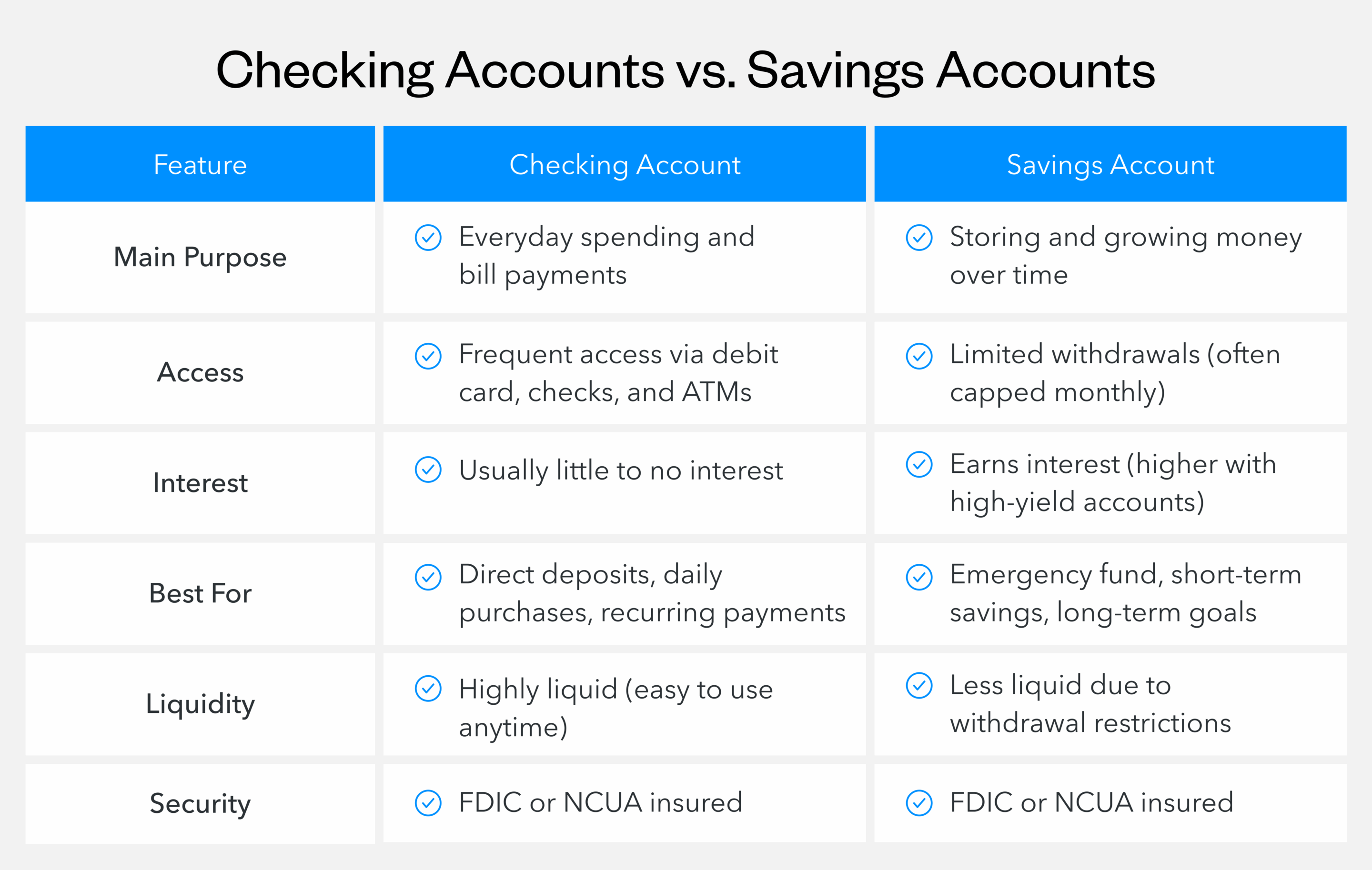
Comparison Table: Checking vs. Savings at a Glance
| Feature | Checking Account | Savings Account |
|---|---|---|
| Primary Purpose | Daily spending and bill payments | Long-term saving and emergency funds |
| Interest (APY) | Typically low or zero | Higher (especially in HYSAs) |
| Withdrawal Limits | Unlimited | Often capped (internal bank policy) |
| Access Methods | Debit card, checks, ATM, EFT | Transfer to checking, ATM (sometimes) |
| Debit Card | Standard feature | Rare / ATM-only cards |
| Direct Deposit | Common for wages | Common for "pay yourself first" |
| Security | FDIC / NCUA Insured | FDIC / NCUA Insured |
Strategic Integration: Using Both Accounts Together
For most consumers in 2026, the question is not whether to have a checking or a savings account, but how to use them in tandem. A common strategy is the "Hub and Spoke" model.
- The Hub (Checking): All income (salary, freelance pay, dividends) is deposited here. All fixed expenses (rent, utilities) and variable expenses (groceries, entertainment) are paid from here. You should keep a "buffer" in this account—typically one to two months of expenses—to avoid overdrafts.
- The Spoke (Savings): At the start of the month, or whenever you receive a paycheck, a portion of the "Hub" funds is moved to the "Spoke." This is often automated. This money is categorized for specific goals: an emergency fund (3-6 months of expenses), a down payment for a home, or a major upcoming purchase.
By separating these funds, you create a psychological barrier to spending your savings. It is much easier to stay within a budget when your "spendable" money is clearly delineated from your "saved" money. Furthermore, keeping the bulk of your extra cash in a savings account ensures that it is working for you by earning interest, rather than sitting idle in a checking account.
Frequently Asked Questions
Can I have a savings account without a checking account? Yes, it is possible to open a standalone savings account. However, accessing your money may be more difficult. Without a linked checking account, you would typically need to visit a physical bank branch, use an ATM (if a card is provided), or wait for an external transfer to another institution to use the funds for purchases.
Do savings accounts have debit cards? Generally, no. Most savings accounts do not come with a traditional debit card for point-of-sale purchases. Some banks provide "ATM cards" for savings accounts, which allow you to withdraw cash or check balances at an ATM but cannot be used at retailers. This lack of a card is a security and budgeting feature designed to keep your savings intact.
Is my money safer in a savings account than a checking account? From a regulatory standpoint, both are equally safe as they are both FDIC/NCUA insured. However, from a fraud perspective, savings accounts can be slightly "safer" because they are not linked to a debit card that you swipe at various locations. Since checking account details are shared more frequently (for bill pay, P2P apps, and retailers), they are statistically more exposed to potential data breaches or skimming.
How many of each account should I have? There is no one-size-fits-all answer, but many financial experts recommend at least one checking account for daily operations and multiple "sub-savings" accounts for different goals. For example, you might have one savings account for your emergency fund and another for a "vacation fund." This helps with organization without adding significant complexity, as most 2026 banking apps allow you to view all accounts under one login.
Do checking accounts ever pay high interest? Yes, there are "High-Yield Checking" accounts, often offered by online banks or local credit unions. These usually require you to meet certain monthly requirements, such as making 10-15 debit card transactions and receiving at least one direct deposit. If you don't meet these requirements in a given month, the interest rate usually drops to a very low base rate.
Final Recommendation
To manage your finances effectively in 2026, you should utilize both account types according to their strengths. Use a checking account as your transactional engine for all incoming and outgoing cash flow. Simultaneously, maintain a savings account—preferably a high-yield option—to house your emergency fund and short-term savings goals. By automating the transfer from checking to savings each month, you ensure that your wealth grows through interest while maintaining the liquidity necessary for your daily life.
Image Gallery