Understanding Dominant Strategy in a Payoff Matrix
A dominant strategy in a payoff matrix is a strategic choice that provides a player with the highest possible reward regardless of the actions taken by their opponents. It represents the ultimate "best move" because its effectiveness d...
A dominant strategy in a payoff matrix is a strategic choice that provides a player with the highest possible reward regardless of the actions taken by their opponents. It represents the ultimate "best move" because its effectiveness does not depend on predicting or reacting to the specific decisions of other participants in the game.
Contents
The Foundation of Strategic Decision-Making
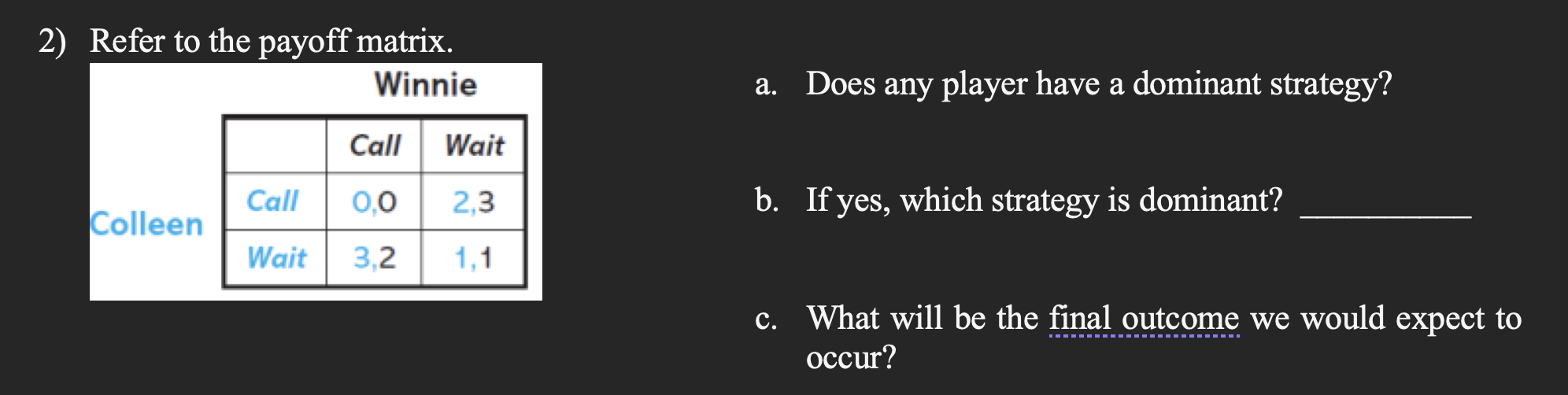
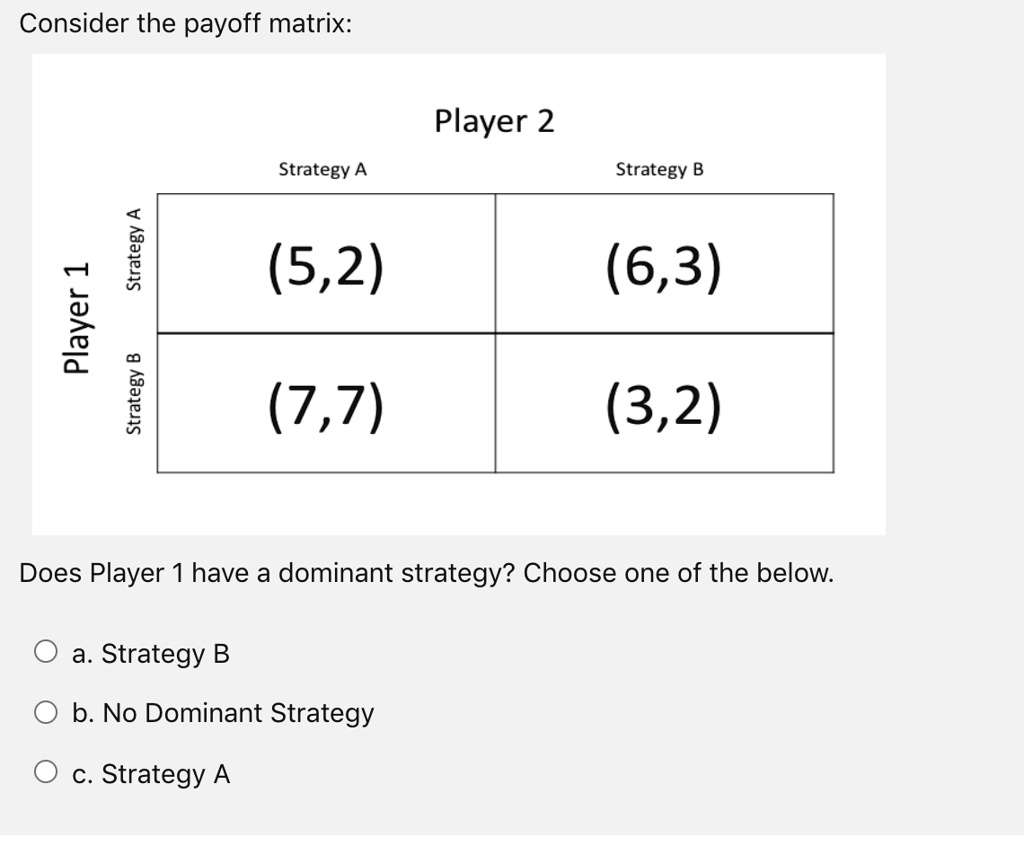
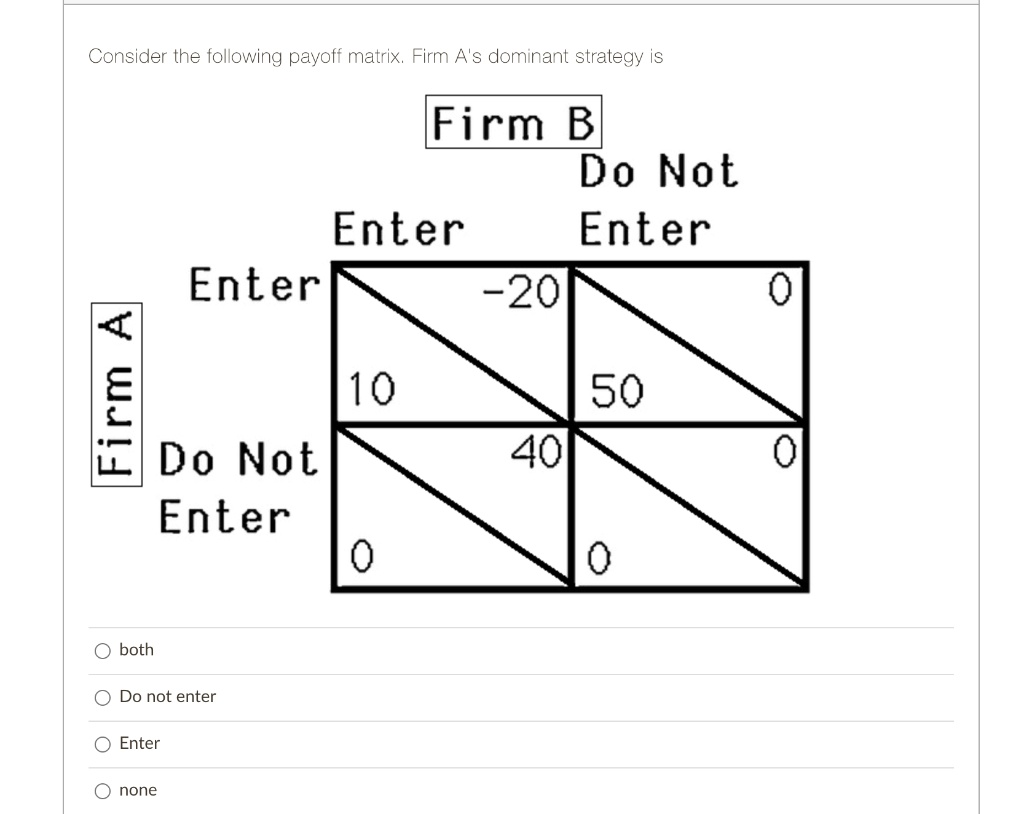
To understand a dominant strategy, one must first grasp the structure of a payoff matrix, often referred to as a normal-form game. In game theory, a payoff matrix is a visual representation of the possible outcomes of a strategic interaction. It typically features two or more players, a set of strategies for each player, and the resulting "payoffs" (utility, profit, or points) for every possible combination of those strategies.
As of 2026, the application of payoff matrices has expanded beyond traditional economics and military strategy into fields like machine learning, decentralized finance (DeFi), and environmental policy. Despite these modern applications, the core logic remains unchanged: players are rational actors attempting to maximize their own utility. When a player identifies a strategy that is better than all other available options, no matter what the other players do, they have found a dominant strategy.
Components of the Matrix
Every payoff matrix consists of three fundamental elements:
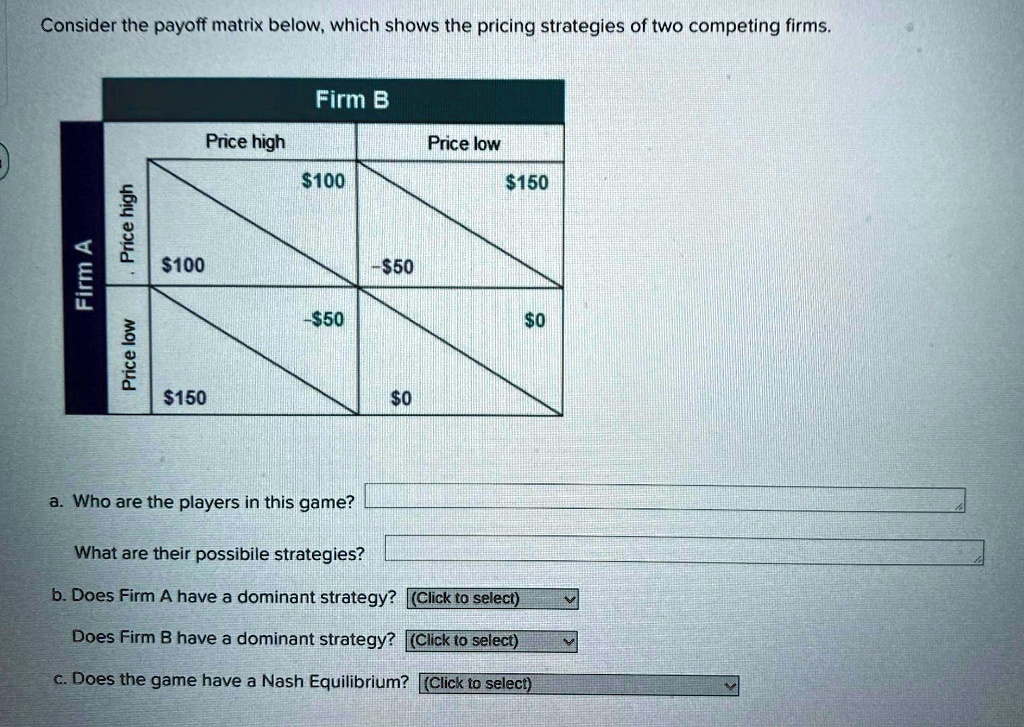
- Players: The decision-makers in the game (e.g., Company A and Company B).
- Strategies: The choices available to each player (e.g., "Price High" or "Price Low").
- Payoffs: The numerical values representing the outcome for each player. In a standard two-player matrix, these are usually written as pairs $(x, y)$, where $x$ is the payoff for the row player and $y$ is the payoff for the column player.
Strictly Dominant vs. Weakly Dominant Strategies
In technical analysis, we distinguish between two types of dominance. This distinction is crucial for predicting how a game will resolve and whether a stable equilibrium can be reached.
Strictly Dominant Strategies
A strategy is strictly dominant if the payoff for that strategy is strictly greater than the payoff for any other strategy, regardless of the opponent's choice. If a player has a strictly dominant strategy, they will always play it, assuming they are rational.
For example, if Player A receives a payoff of 10 by choosing "Up" and only 5 by choosing "Down" when Player B chooses "Left," and also receives 8 for "Up" and 4 for "Down" when Player B chooses "Right," then "Up" is strictly dominant. The math is simple: $10 > 5$ and $8 > 4$.
Weakly Dominant Strategies
A strategy is weakly dominant if it provides a payoff that is at least as high as any other strategy for all possible moves by the opponent, and strictly better for at least one move. In other words, there is no scenario where the strategy performs worse, but there might be scenarios where it performs exactly the same as another option.
| Comparison Feature | Strictly Dominant | Weakly Dominant |
|---|---|---|
| Performance | Always better than other choices. | Better than or equal to other choices. |
| Equilibrium Stability | Leads to a very stable equilibrium. | Can lead to multiple potential outcomes. |
| Rational Choice | The only logical choice for a rational player. | One of the logical choices, but others may tie. |
| Mathematical Condition | $U(s^*, s_o) > U(s, s_o)$ for all $s, s_o$ | $U(s^*, s_o) \geq U(s, s_o)$ and strictly $>$ for at least one $s_o$. |
How to Identify a Dominant Strategy: A Step-by-Step Guide
Identifying a dominant strategy requires a systematic comparison of payoffs across the matrix. Follow these steps to determine if a player has a dominant move.
Step 1: Analyze the Row Player
Look at the first player (usually on the left side of the matrix). Compare their payoffs for each strategy by looking across the columns.
- Assume the Column Player chooses their first strategy. Which of the Row Player’s options gives the highest number?
- Assume the Column Player chooses their second strategy. Does the same option for the Row Player still give the highest number?
- Repeat this for all columns. If the same row always yields the highest payoff, that row is a dominant strategy.
Step 2: Analyze the Column Player
Repeat the process for the second player (usually at the top).
- Assume the Row Player chooses their first strategy. Which of the Column Player’s options (the second number in each cell) is highest?
- Assume the Row Player chooses their second strategy. Is the same column choice still the best?
- If the same column is always the best response, the Column Player has a dominant strategy.
Step 3: Check for Dominant Strategy Equilibrium
If both players have a dominant strategy, the cell where these two strategies intersect is the Dominant Strategy Equilibrium. This is a powerful prediction tool because it suggests a high level of certainty regarding the game's outcome.
The Prisoner's Dilemma: The Classic Case Study
The most famous illustration of a dominant strategy is the Prisoner's Dilemma. In this scenario, two criminals are interrogated separately. They each have two choices: "Confess" or "Remain Silent."
- If both remain silent, they both get 1 year in prison.
- If both confess, they both get 5 years.
- If one confesses and the other remains silent, the confessor goes free (0 years) while the silent one gets 10 years.
When we look at the matrix, we see that for Player A, if Player B stays silent, confessing is better (0 years vs. 1 year). If Player B confesses, confessing is still better (5 years vs. 10 years). Therefore, "Confess" is a strictly dominant strategy for both players.
Even though both players would be better off collectively if they both stayed silent (the Pareto optimal outcome), rational self-interest leads them both to confess, resulting in a worse outcome for both. This demonstrates how dominant strategies can sometimes lead to inefficient societal results.
Iterative Elimination of Dominated Strategies (IEDS)
In many complex matrices, a player may not have a dominant strategy immediately visible. However, they might have a dominated strategy—a choice that is always worse than at least one other option.
The process of Iterative Elimination of Dominated Strategies (IEDS) involves:
- Identifying a strategy that a rational player would never choose (a dominated strategy).
- Removing that row or column from the matrix.
- Re-evaluating the remaining, smaller matrix for new dominated strategies.
- Repeating until the matrix is simplified.
This method relies on the assumption of common knowledge of rationality: I know you are rational, you know I know you are rational, and so on. By eliminating what a rational opponent would never do, you can often uncover a dominant strategy that wasn't apparent in the original, larger payoff matrix.
Dominant Strategy vs. Nash Equilibrium
It is essential to distinguish between a dominant strategy and a Nash Equilibrium. While they are related, they are not identical.
- Dominant Strategy: A player’s best move regardless of what others do.
- Nash Equilibrium: A situation where no player can benefit by changing their strategy while the other players keep theirs unchanged.
Key Rule: If every player in a game has a dominant strategy and plays it, the resulting outcome is always a Nash Equilibrium. However, a game can have one or more Nash Equilibria even if no player has a dominant strategy. In a Nash Equilibrium, a player's best move is contingent on the opponent's move; in a dominant strategy, it is independent.
Real-World Applications in 2026
By 2026, the use of automated agents has made the identification of dominant strategies a requirement for software developers and business strategists alike.
1. Corporate Competition and Advertising
Companies often face a version of the Prisoner's Dilemma when deciding on advertising budgets. If both firms spend heavily, they split the market but have high costs. If neither spends, they split the market with low costs. However, if one spends and the other doesn't, the big spender captures the market. Spending is often the dominant strategy, leading to "advertising wars" that deplete profits for the entire industry.
2. Cybersecurity and Defense
In cybersecurity, network administrators must choose between high-cost encryption or standard protocols. If attackers have a dominant strategy to use a specific type of exploit, the administrator's "best response" is to implement the corresponding defense. Payoff matrices help in modeling these interactions to ensure that the cost of defense is lower than the expected loss from an attack.
3. International Relations (Climate Policy)
Global climate agreements are often modeled as games where "Polluting" is a dominant strategy for individual nations because they reap the economic benefits while the environmental costs are shared globally. Understanding this allows policymakers to design treaties that change the payoffs (through carbon taxes or sanctions), thereby eliminating the dominance of the harmful strategy.
Common Pitfalls in Identifying Dominance
When working with payoff matrices, students and professionals often make several recurring errors:
- Confusing Payoffs: Ensure you are always comparing Player A’s payoffs with Player A’s other options, not with Player B’s payoffs.
- Assuming Cooperation: In non-cooperative game theory, you must assume players act in their own self-interest unless a formal contract or mechanism exists to enforce cooperation.
- Ignoring Weak Dominance: While strict dominance is easier to spot, weak dominance often exists in pricing models where two options might result in a "tie" under certain conditions.
- Misreading the Matrix: Always double-check which number in the $(x, y)$ pair belongs to which player. Standard convention puts the Row player first, but this can vary in some textbooks or software outputs.
Frequently Asked Questions
Can a game have more than one dominant strategy for a single player?
No, a single player cannot have more than one dominant strategy. By definition, a dominant strategy is the "best" among all alternatives. If two strategies provided the same highest payoff in every scenario, they would be equally "good," and thus neither would be strictly dominant over the other, though they could both be considered part of a set of weakly dominant strategies if they outperform all other options.
What happens if no player has a dominant strategy?
If no dominant strategy exists, players must look for a Nash Equilibrium. This involves looking for "best responses" to specific moves. In some cases, players may need to use a mixed strategy, where they randomize their choices based on certain probabilities (e.g., Rock-Paper-Scissors) to prevent an opponent from exploiting a predictable pattern.
Why is the dominant strategy equilibrium often sub-optimal?
As seen in the Prisoner's Dilemma, the dominant strategy equilibrium is based on individual rationality. Because players cannot trust each other or coordinate perfectly, they choose the "safe" dominant move to avoid the worst-case scenario. This individual logic often fails to account for the collective benefit that could be achieved through cooperation.
Is a dominant strategy the same as a "Maximin" strategy?
Not necessarily. A Maximin strategy is a conservative approach where a player chooses the option that makes their "worst-case scenario" as good as possible (maximizing the minimum payoff). While a dominant strategy will always satisfy the Maximin criteria (since it is the best in all cases), a Maximin strategy is not always dominant.
Practical Recommendations
When you are faced with a strategic decision that can be modeled in a payoff matrix, your first step should always be to search for dominance.
- Map the Payoffs: Be honest about the values. If you are a business, use actual projected profits. If you are in a negotiation, use a scale of 1-10 to represent your preferences.
- Look for Strict Dominance: If you have a move that is always better, your decision is made. There is no need to overthink the opponent's psychology.
- Simplify via IEDS: If the choice isn't clear, eliminate the "obviously bad" moves first. This often clarifies the remaining choices.
- Consider Long-Term Play: If the "game" is going to be played many times (a repeated game), the dominant strategy in a single round might change as players build trust or seek to punish previous defections.
Image Gallery