Homeowners Coverage of Foundation Repair: When Insurance Pays and When It Doesn't
Standard homeowners insurance covers foundation repair only when the damage stems directly from an insured, sudden peril—such as a burst plumbing line, fire, explosion, or falling tree. Insurance policies specifically exclude foundatio...
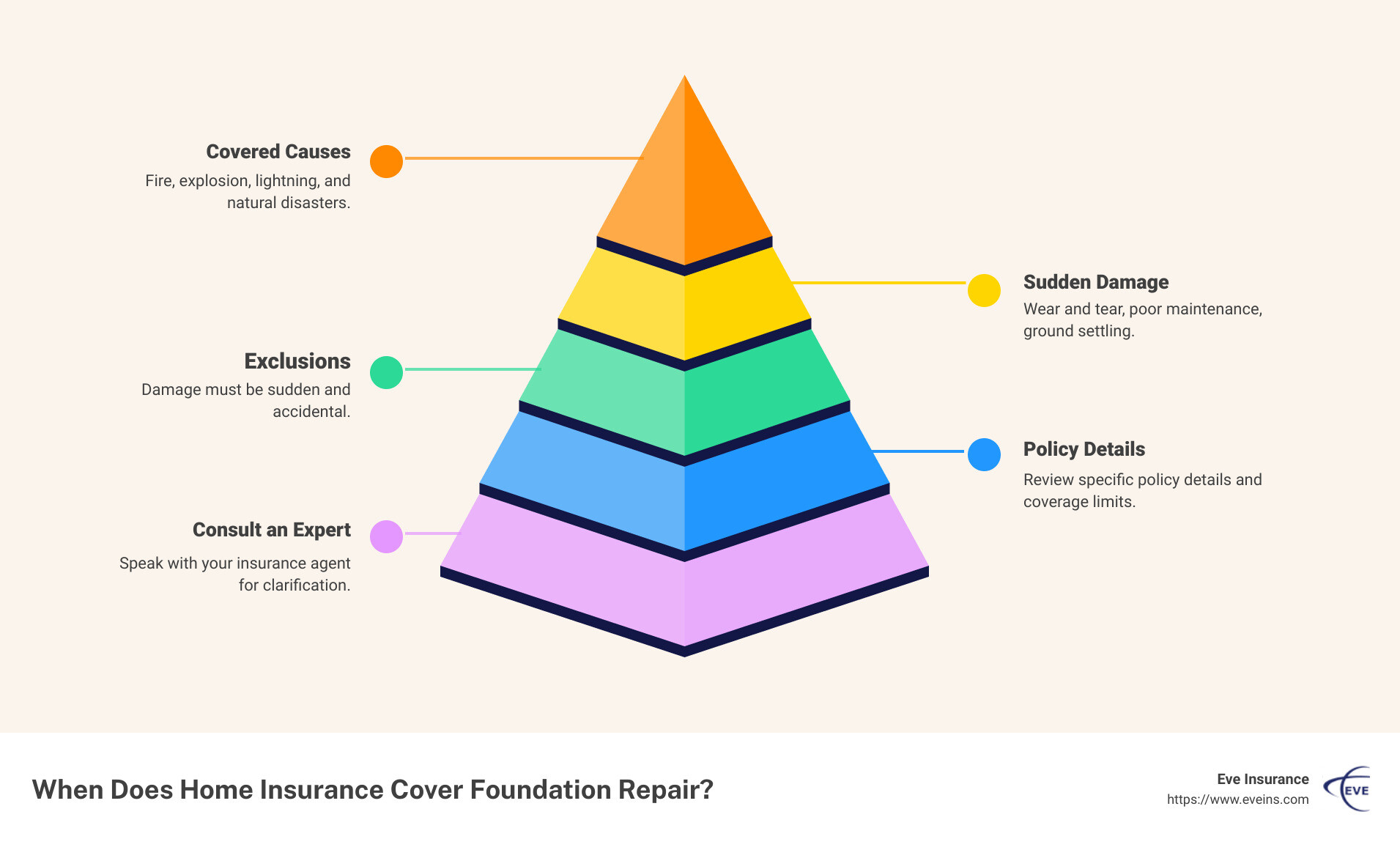
Standard homeowners insurance covers foundation repair only when the damage stems directly from an insured, sudden peril—such as a burst plumbing line, fire, explosion, or falling tree. Insurance policies specifically exclude foundation damage resulting from earth movement, soil settling, hydrostatic pressure, regional flooding, tree root intrusion, and general wear and tear over time.
Contents
Understanding Foundation Coverage in Standard Homeowners Policies
Foundation damage is among the most financially devastating issues a property owner can encounter. Because structural remediation often involves underpinning, hydraulic jacking, or extensive excavation, repair costs routinely reach tens of thousands of dollars. Whether an insurer participates in these costs depends entirely on the legal doctrine of proximate cause and the specific peril that triggered the movement or crack.
Under a standard residential insurance contract—most commonly an HO-3 Special Form or an HO-5 Comprehensive Form—the foundation falls under Coverage A (Dwelling). Coverage A protects the physical structure of the home, including the footings, poured concrete walls, concrete slabs, and crawl space piers.
However, coverage does not operate on a blanket basis. Under an HO-3 policy, the dwelling structure is insured on an "open perils" (or "all-risk") basis, meaning all causes of loss are covered except those explicitly excluded in the policy contract. Unfortunately for homeowners, the exclusions section in virtually every standard insurance policy directly targets the most common causes of foundation distress: settling, ground expansion, water infiltration, and gradual deterioration.
When Homeowners Insurance Typically Covers Foundation Repair
For an insurer to accept a foundation repair claim, the physical damage must trace directly back to an abrupt, accidental hazard covered by the policy.
- Covered Peril (e.g., Burst Supply Line)
- Direct Physical Damage (Erosion Under Slab)
- Foundation Failure (Cracked / Dropped Slab)
- Claim Approved (Subject to Policy Deductible)
Sudden and Accidental Plumbing Failures
The most common scenario where insurance contributes to foundation repair involves interior plumbing. If a freshwater supply line beneath a concrete slab bursts unexpectedly, the pressurized water can wash away supportive subsoil, leading to slab cracking or differential settlement.
In this case, insurers typically recognize the sudden plumbing rupture as a covered peril. However, coverage often contains structural nuances:
- Tear-Out Coverage: The policy typically pays to break through the concrete slab to access and expose the damaged pipe.
- Structural Repair: The policy pays to repair the damaged foundation elements caused directly by the escaped water.
- The Pipe Itself: Insurers routinely exclude the plumbing pipe that failed, meaning the owner pays for the plumbing clamp, replacement copper, or PEX fitting out of pocket.
Collapse Caused by Specified Perils
Modern policies contain a limited structural collapse provision. If a foundation gives way suddenly due to the weight of rain, ice, or snow on a roof that transfers excessive load downward, or due to hidden insect decay (such as subterranean termites) that was unknown to the homeowner, partial or complete foundation coverage may trigger. The collapse must be a sudden and complete falling down or caving in; progressive sagging, bowing, or cracking does not meet the legal threshold for collapse.
Fire, Explosions, and Lightning
If a residential fire causes thermal shock to concrete footings, or if a municipal gas line explosion compromises the home's structural integrity, the foundation repairs are covered up to the Coverage A policy limit.
Falling Objects and Impact
If a large mature tree falls during a severe windstorm and impacts the home with enough kinetic force to fracture the perimeter grade beam or basement wall, the resulting structural repairs fall under covered perils. Similarly, if an errant vehicle strikes the exterior wall and cracks the masonry foundation, the damage is covered (often pursued via subrogation against the driver's auto liability insurance).
Common Foundation Exclusions: Why Most Claims Are Denied
The vast majority of foundation insurance claims are denied because foundations interact directly with the earth, and residential property contracts strictly exclude geological and ground-related hazards.
Earth Movement
The standard earth movement exclusion is absolute in baseline property forms. It bars coverage for:
- Soil Settling and Consolidation: The gradual downward movement of the home as underlying fill dirt compacts.
- Subsidence and Sinkholes: Unless specific state statutes mandate sinkhole coverage (such as in Florida), catastrophic ground collapse requires dedicated endorsements.
- Expansive Soils: In regions with heavy clay soils, seasonal moisture shifts cause the earth to expand when wet and shrink when dry. This cyclic swelling exerts lateral and vertical stress on footings, causing widespread cracking. Insurers categorize this as uninsurable natural soil movement.
- Earthquakes: Damage from seismic ground shaking is excluded across all standard HO policies and requires a standalone earthquake policy or rider.
Hydrostatic Pressure and Water Seepage
During heavy precipitation, water accumulates in the backfill soil surrounding basement walls. This water creates severe hydrostatic pressure, pushing inward against concrete block or poured walls, leading to horizontal fractures, inward bowing, and water infiltration. Standard insurance policies expressly exclude damage caused by subsurface water pressure or water seeping through foundations, basement walls, or floors.
Wear, Tear, and Inadequate Maintenance
A foundation is expected to age alongside the house. Insurers view hair-line shrinkage cracks, minor spalling from age, deterioration of parge coats, and normal seasonal expansion as deferred home maintenance. If an owner fails to maintain working gutters, downspouts, and proper ground sloping away from the perimeter, any subsequent foundation deterioration is deemed homeowner neglect.
Faulty Design or Construction
If a builder failed to install rebar correctly, poured substandard concrete mixtures, or failed to conduct proper soil compaction tests before pouring footings, the foundation may crack prematurely. Standard policies contain exclusions for faulty, inadequate, or defective planning, zoning, design, workmanship, or construction materials.
Foundation Repair Coverage Matrix
The following table outlines how standard property policies, endorsements, and standalone policies treat common foundation failure scenarios:
| Failure Scenario / Cause | Standard Policy Coverage Status | Applicable Policy Section or Endorsement | Coverage Caveats and Limitations |
|---|---|---|---|
| Slab Leak (Sudden Burst) | Covered (Structural & Access) | Dwelling (Coverage A) / Tear-Out | Access and consequential damage covered; repair to the pipe itself is excluded. |
| Expansive Clay Soil Settling | Excluded | None (Standard Uninsurable Risk) | Standard exclusion for earth movement, settling, and shrinking. |
| Earthquake Shock / Faulting | Excluded | Standalone Earthquake Policy / CEA | Requires a high deductible (typically 10%–25% of Coverage A). |
| External Flood / River Overflow | Excluded | National Flood Insurance Program (NFIP) / Private Flood | Foundation coverage under NFIP applies only if directly caused by floodwaters. |
| Hydrostatic Wall Bowing | Excluded | None | Excluded under subsurface water and earth pressure clauses. |
| Sump Pump Failure / Backflow | Excluded (Standard) | Water Backup & Sump Overflow Rider | Pays for interior cleanup; rarely covers underpinning or structural wall replacement. |
| Fire or Gas Explosion | Covered | Dwelling (Coverage A) | Subject to baseline dwelling policy deductible. |
| Tree Impact (Windstorm) | Covered | Dwelling (Coverage A) | Covers structural repairs; tree removal may have separate sub-limits. |
Supplemental Endorsements and Specialized Policies
Homeowners seeking protection against excluded foundation perils must turn to non-standard endorsements or dedicated specialty lines.
| Policy | Complete Property Protection |
|---|---|
| Standard HO-3 Policy | Fire, Falling Objects, Sudden Slab Pipe Ruptures |
| NFIP / Private Flood | Inundation, Rising Surface Water Foundation Scour |
| Earthquake Endorsement | Seismic Faulting, Ground Shaking, Epicenter Shifts |
| Water Backup Rider | Sump Failure, Drain Overrun |
Earthquake Insurance
Standard policies do not cover seismic destruction. Homeowners can secure protection through private surplus lines or state-managed facilities, such as the California Earthquake Authority (CEA). Earthquake policies include coverage for foundation repairs, but they carry percentage-based deductibles (usually 5% to 25% of the total dwelling limit), meaning the homeowner absorbs a substantial initial out-of-pocket sum before coverage applies.
Flood Insurance via NFIP or Private Markets
Standard policies exclude damage from rising surface water, storm surges, or river overflows. If floodwaters scour the earth from beneath a foundation or structural hydrostatic force shifts the footings, repairs are only accessible through a policy from the National Flood Insurance Program (NFIP) or an equivalent private flood underwriter. NFIP policies have strict dwelling coverage caps of $250,000 for residential properties, which may prove insufficient for combined structural and foundational replacement on high-value homes.
Water Backup and Sump Pump Overflow Endorsement
A standard policy excludes water entering the dwelling through drains, sewers, or failing sump pumps. Adding a Water Backup and Sump Discharge Endorsement covers interior cleanup and property loss when a pump stops functioning. However, verify the wording: while these endorsements pay for finished basement restoration (drywall, carpet, mechanicals), they rarely pay to stabilize or reconstruct shifting foundation walls caused by high water tables.
Indicators of Foundation Distress
Recognizing foundation failure early allows property owners to address root causes before costs escalate or insurance dispute windows expire.
Exterior Symptoms
- Stair-Step Cracking: Diagonal, step-like fissures running through exterior brick mortar joints indicate differential settlement.
- Separation Around Openings: Gaps developing between exterior masonry and window or door trim casings.
- Fascia and Chimney Separation: Chimneys pulling cleanly away from the exterior siding or rooflines shifting out of horizontal alignment.
- Foundation Upheaval: Portions of the exterior grade beam pushing upward due to localized soil expansion.
Interior Symptoms
- Door and Window Latching Issues: Doors sticking inside jambs, self-opening, or displaying unequal margins along the head jamb.
- Corner Wall Radiations: Drywall cracks projecting upward at 45-degree angles from the upper corners of door frames and windows.
- Flooring Irregularities: Gaps between the floorboards and baseline baseboards, uneven or sloping subfloors, and hollow-sounding or cracked ceramic tiles along a consistent fracture plane.
- Basement Wall Deflection: Visible horizontal cracks running midway up a poured or block basement wall, often paired with inward bowing (deflection).
Step-by-Step Guide to Filing a Foundation Insurance Claim
If you suspect foundation damage stems from an insured event—such as a subterranean plumbing leak or vehicle impact—proceed methodically to protect your claim.
1. Document the Immediate Damage
Photograph all structural symptoms before undertaking alterations. Capture broad room angles showing floor slope, close-ups of cracks with a ruler to demonstrate width, and documentation of any pooling water or pipe damage.
2. Contract an Independent Structural Engineer
Before filing a claim, consider hiring an independent, licensed professional engineer (PE) who specializes in residential structural systems.
- Avoid relying solely on foundation repair sales contractors, whose reports are routinely challenged by insurers as commercially biased.
- A certified structural engineer charges an independent flat fee (typically $500 to $1,500) and provides an unbiased forensic report identifying the proximate cause of failure.
- If the engineer determines the cause was a sudden slab leak or falling object, their sealed structural report serves as evidentiary support during insurance reviews.
3. Mitigate Secondary Damage
Policy contracts impose a strict duty on the insured to mitigate further harm. If a pipe is leaking beneath the slab, shut off the primary water supply immediately and hire a licensed plumber to isolate the line. Keep all service invoices, receipts, and sections of replaced piping.
4. Initiate the Claim
Contact your insurer's claims department and report the direct cause of loss. Use neutral, precise language: describe the event as "consequential foundation movement caused by a sudden underground plumbing failure," rather than stating "my foundation is settling," which triggers immediate automated earth-movement denials.
5. Navigate the Adjuster Inspection
The insurer will deploy a claims adjuster or an insurance-retained forensic engineer. Accompany the adjuster during their physical walkthrough. Provide them with your independent engineer's report and the plumber's diagnostic invoice.
If the insurer issues a denial citing earth movement, evaluate whether the "anti-concurrent causation" clause applies. In many jurisdictions, if an excluded peril (soil movement) and a covered peril (plumbing burst) occur together, the wording of the policy dictates whether partial coverage survives. If substantial amounts are disputed, consulting an attorney specializing in bad faith insurance claims or an accredited public adjuster may become necessary.
Foundation Repair Methods and Realistic Costs
Foundation remediation requires commercial-grade engineering interventions. Insurance payouts, if secured, rarely cover preventative upgrades, leaving homeowners responsible for non-covered repair scopes.
Common Remediation Methods:
Deep Underpinning (Push / Helical Piers)
- Transfers load to bedrock
Polyurethane Foam Injection / Mudjacking
- Elevates sunken slabs
Carbon Fiber Reinforcement Straps
- Stops inward wall deflection
External Waterproofing & French Drains
- Relieves hydrostatic pressure
Push or Helical Pier Underpinning: Steel piers driven deep into the ground until they hit load-bearing strata or bedrock, then hydraulically jacked to stabilize the footings. Typically costs $1,500 to $3,000 per pier, with total residential underpinning often running between $10,000 and $35,000.
Slabjacking and Polyurethane Foam Injection: For interior slab dips caused by washouts, technicians pump dense polyurethane foam or cementitious grout underneath the concrete to raise it level. Costs typically range from $2,500 to $8,000.
Carbon Fiber Strapping or Steel I-Beams: Basement walls bowed inward by hydrostatic soil pressure are stabilized using structural carbon-fiber grid straps bonded with epoxy, or vertical structural steel beams anchored to the floor slab and floor joists. Costs range from $5,000 to $15,000.
Waterproofing and Hydrostatic Pressure Relief: Installing an exterior French drain system, applying waterproof elastomeric coatings to exterior subterranean concrete, and installing dual sump pits. Expect expenditures of $8,000 to $20,000.
Frequently Asked Questions
Does insurance cover foundation repair caused by tree roots?
No. Standard homeowners insurance policies exclude foundation distress caused by tree roots. Root intrusion is classified as a gradual, preventable biological process rather than an accidental, sudden peril. Homeowners are expected to manage property landscaping to prevent roots from undermining footings or drying out sub-foundation clay.
Will insurance pay for a structural engineer to inspect my foundation?
If your claim involves a covered peril and the insurer requires a forensic review, the insurer will pay for their own hired engineer. However, the insurer will not reimburse you for your independent structural engineer unless agreed upon in writing during an ongoing dispute resolution, appraisal process, or litigation.
Does a home warranty cover foundation problems?
Standard home warranties explicitly exclude structural components, foundations, and earth movement. Home warranties cover mechanical systems and major appliances (such as HVAC units, water heaters, and electrical panels). Structural warranties, typically provided exclusively by builders on new construction homes, may cover load-bearing structural defects for up to 10 years after initial construction.
What is tear-out coverage, and does it apply to foundations?
Tear-out coverage is a provision in standard property policies that pays the cost of tearing out and subsequently replacing building elements—such as a concrete slab foundation—to access and repair a failed plumbing, heating, or air conditioning system. While the insurer pays the heavy excavation and concrete pouring costs associated with accessing the pipe, the owner remains responsible for the plumbing parts themselves.
Can I buy a specific insurance rider for foundation settling?
No. Insurance underwriters do not offer standalone endorsements or riders covering natural settling, ground shrinkage, or soil consolidation. Because soil settling is virtually inevitable over extended periods in many geographical locations, insurers view it as an uninsurable operational maintenance risk rather than an unpredictable fortuity.
Practical Next Steps for Property Owners
- Verify Your Foundation's Baseline: If you notice new interior drywall fractures or sticking exterior doors, hire a licensed professional engineer to perform a baseline elevation survey using an altimeter or manometer.
- Audit Subterranean Plumbing: If you suspect an active under-slab leak, monitor your municipal water meter during a three-hour window where zero household water is used. If the leak indicator dial moves, contact a specialized electronic leak-detection service immediately.
- Control Moisture Uniformity: Ensure all gutter downspouts discharge runoff a minimum of six to ten feet away from the foundation perimeter. Maintain a positive slope (at least 6 inches of drop over the first 10 feet) around the entire home footprint to prevent water from saturating expansive soil or generating hydrostatic pressure.
- Review Policy Declarations: Check your current property policy for water backup limits and specific exclusions concerning slab leaks. Consider acquiring supplemental flood insurance or an earthquake endorsement if you reside within geologically vulnerable regions.
Disclaimer: Insurance coverage rules, policy contract provisions, and statutory definitions vary by state, underwriter, and policy edition. Always review your specific policy documents and consult a licensed insurance broker or attorney for jurisdictional legal and financial determinations regarding structural property claims.
Image Gallery