How to Identify the Strongest VPN: Technical Benchmarks and Security Standards
To identify the strongest VPN, you must prioritize audited no-logs policies, post-quantum encryption standards, and RAM-only server architecture. Evaluate "strength" by testing protocol efficiency—such as WireGuard or MASQUE—checking t...
To identify the strongest VPN, you must prioritize audited no-logs policies, post-quantum encryption standards, and RAM-only server architecture. Evaluate "strength" by testing protocol efficiency—such as WireGuard or MASQUE—checking the provider’s legal jurisdiction, and verifying consistent performance through frequent independent security audits rather than relying on unverified marketing claims or speed test snapshots.
Contents
Identifying the "strongest" Virtual Private Network (VPN) in 2026 requires looking beyond surface-level metrics like download speeds. As cyber threats evolve and quantum computing moves closer to breaking traditional encryption, the definition of strength has shifted toward cryptographic resilience, infrastructure transparency, and jurisdictional integrity. A strong VPN does more than mask an IP address; it creates an impenetrable tunnel that remains secure even if the physical server is seized or the provider is legally compelled to share data.
Evaluating Encryption Standards and Future-Proofing
The foundation of any VPN’s strength is its encryption suite. In the current landscape, the industry standard has moved beyond simple AES-256 bit encryption. While AES-256 remains virtually uncrackable by brute force, the "strongest" VPNs now incorporate Post-Quantum Cryptography (PQC). This is a critical factor because of the "harvest now, decrypt later" strategy used by state actors, where encrypted data is collected today with the intent of decrypting it once quantum computers become sufficiently powerful.
When assessing a provider, look for the use of PQC handshakes (such as those based on the Kyber algorithm). Additionally, verify the use of Perfect Forward Secrecy (PFS). PFS ensures that even if a private key for a specific session is compromised, it cannot be used to decrypt past or future sessions. This is achieved by generating unique session keys for every new connection. If a provider cannot explicitly confirm the use of PFS and a roadmap for post-quantum resistance, it cannot be classified as one of the strongest options available.
Protocol Efficiency and Obfuscation Capabilities
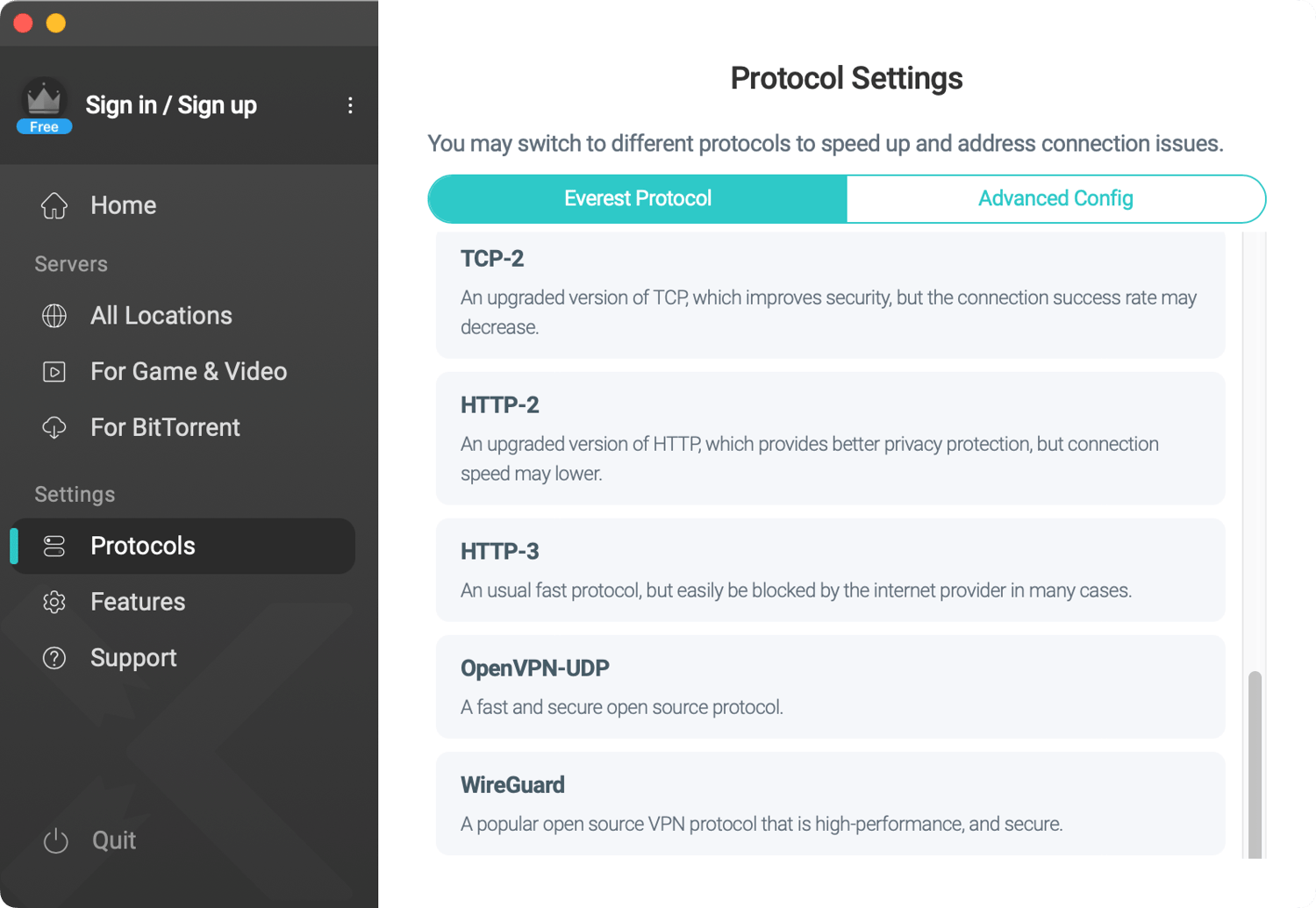
The protocol is the set of instructions that determines how data is packaged and sent through the VPN tunnel. For years, OpenVPN was the gold standard for security, but it often sacrificed speed. In 2026, the strongest VPNs primarily utilize WireGuard or proprietary variations like ExpressVPN’s Lightway. WireGuard is preferred for its lean code base (approximately 4,000 lines compared to OpenVPN’s 100,000+), which makes it significantly easier to audit for vulnerabilities and offers superior performance on mobile devices.
However, a strong VPN must also handle restrictive environments. This is where obfuscation (or "stealth") technology comes in. Obfuscation disguises VPN traffic as standard HTTPS traffic, allowing users to bypass Deep Packet Inspection (DPI) used by corporate firewalls or national censors. The most advanced providers have integrated the MASQUE protocol, which leverages HTTP/3 to provide better performance and harder-to-detect tunneling. When identifying a strong VPN, ensure it offers multiple protocol options to balance raw speed with the ability to bypass sophisticated blocking.
The Necessity of RAM-Only Server Infrastructure
Physical security is often the weakest link in the VPN chain. Traditional VPN servers store data on hard drives, which means that even if the provider claims not to log data, residual information could potentially be recovered if a server is physically seized by authorities or compromised by hackers.
The strongest VPNs have transitioned entirely to RAM-only servers (often marketed as TrustedServer technology or diskless booting). In this configuration, the operating system and all necessary software run entirely in the volatile memory (RAM). Because RAM requires power to retain data, every time a server is rebooted or loses power, all data—including any potential session fragments—is instantly and permanently wiped. This architectural choice provides a hardware-level guarantee that no logs can exist after a session ends. When vetting a provider, check their technical documentation for a "diskless" or "RAM-only" server certificate.
Jurisdictional Safety and the "Eyes" Alliances
A VPN’s technical strength is irrelevant if the provider is legally obligated to spy on its users. Jurisdiction refers to the country where the VPN company is incorporated. You should generally avoid providers based in countries that are members of the 5/9/14 Eyes Alliances. these are international intelligence-sharing agreements between nations like the United States, United Kingdom, Canada, Australia, and several European countries.
The strongest VPNs are typically headquartered in "privacy havens" such as Panama, the British Virgin Islands, or Switzerland. These regions have strict data protection laws and do not have mandatory data retention requirements for VPN providers. If a provider is subpoenaed in these jurisdictions, they often have no data to hand over because their local laws do not require them to keep it, and their technical infrastructure (RAM-only servers) ensures it doesn't exist.
Verifying No-Logs Claims Through Independent Audits
Every VPN provider claims a "no-logs" policy, but these claims are meaningless without verification. To identify a truly strong VPN, look for reports from reputable third-party auditing firms like Deloitte, PwC, or Cure53.
A comprehensive audit should cover:
- Configuration Audits: Ensuring the servers are actually configured to prevent logging.
- Privacy Policy Audits: Confirming that the company’s internal practices align with their public claims.
- Infrastructure Penetration Tests: Identifying if there are any backdoors or vulnerabilities in the server network.
Do not trust a "self-audit" or a simple statement of intent. The strongest providers undergo these audits annually and publish the results (or at least a summary) for public review. If a provider has never been audited by a big-four firm or a recognized cybersecurity specialist, their privacy claims remain unproven.
Technical Feature Comparison for High-Strength VPNs
The following table outlines the minimum technical requirements for a VPN to be considered among the "strongest" in 2026.
| Feature | Minimum Requirement | "Strongest" Standard |
|---|---|---|
| Encryption | AES-256-GCM | AES-256 + Post-Quantum (Kyber) |
| Protocols | WireGuard, OpenVPN | WireGuard, MASQUE, Proprietary (e.g., Lightway) |
| Server Hardware | Encrypted Hard Drives | 100% RAM-only (Diskless) |
| Logging Policy | "No-Logs" Statement | Audited No-Logs (Annual/Bi-Annual) |
| Kill Switch | App-level Kill Switch | System-level / Firewall-based Kill Switch |
| Jurisdiction | Non-EU/US if possible | Privacy Havens (Panama, BVI, Switzerland) |
| Network Speed | 1 Gbps Ports | 10 Gbps to 40 Gbps Software-defined Ports |
Advanced Security Features: Kill Switches and Multi-Hop
A VPN is only as strong as its ability to handle failure. Even the best connection can drop. When this happens, your device might revert to its default ISP connection, exposing your real IP address and data. A Kill Switch prevents this by immediately cutting all internet traffic if the VPN connection fails. The strongest VPNs use a system-level kill switch that integrates with the operating system’s firewall, ensuring that not a single packet of data escapes unencrypted.
Another indicator of a strong VPN is the availability of Multi-Hop (Double VPN). This feature routes your traffic through two or more different VPN servers in different jurisdictions. For example, your traffic might go from your home to a server in Switzerland and then to a server in Iceland before reaching the internet. This adds an extra layer of encryption and makes it exponentially more difficult for anyone to trace the traffic back to your original IP address, as no single server knows both the source and the final destination of the data.
Practical Steps to Verify VPN Strength
Once you have narrowed down your choices based on the criteria above, you should perform your own verification to ensure the VPN is performing as expected.
- DNS Leak Testing: Use tools like
dnsleaktest.comto ensure your DNS queries are being handled by the VPN and not leaking to your ISP. A strong VPN will always show its own DNS servers. - WebRTC Leak Testing: Check if your browser is leaking your real IP address through WebRTC. Strong VPNs include "WebRTC Leak Protection" in their browser extensions or desktop apps.
- IPv6 Leak Protection: Many ISPs are moving to IPv6, but some VPNs only tunnel IPv4. Ensure the VPN either provides an IPv6 tunnel or completely blocks IPv6 traffic to prevent leaks.
- Speed vs. Latency: Use a speed test but look closely at "Jitter" and "Ping." A strong, stable network will have low jitter, indicating a high-quality server network that isn't overcapacity.
Troubleshooting Common Weaknesses
Even a strong VPN can be undermined by poor configuration or external factors. If you notice your connection is "weak"—meaning it drops frequently or leaks data—consider the following:
- Conflict with Antivirus: Some aggressive firewalls or antivirus programs interfere with VPN protocols. Ensure your VPN client is whitelisted.
- Outdated Protocols: If you are using OpenVPN on a modern connection, you may experience bottlenecks. Switching to WireGuard often resolves speed and stability issues.
- ISP Throttling: Some ISPs throttle VPN traffic. If this happens, use the VPN's obfuscation settings to hide the fact that you are using a VPN.
- Wrong Server Selection: Strength is often location-dependent. Connecting to a server with a high load percentage will decrease performance. Always choose servers with less than 50% load for the strongest connection.
FAQ
What is the difference between a "No-Logs" policy and a "Zero-Knowledge" policy? A "No-Logs" policy means the provider does not record your activity (sites visited, IPs used). A "Zero-Knowledge" policy usually applies to DNS or dedicated IP services, meaning the provider has no way to link a specific action back to a specific user identity because of the way the data is partitioned or encrypted. The strongest VPNs aim for both.
Is a free VPN ever considered "strong"? In almost all cases, no. Maintaining a high-strength infrastructure (RAM-only servers, 10Gbps ports, audits) is expensive. Free VPNs often monetize by selling user data or using weaker encryption and shared, overloaded servers, which contradicts the primary goal of using a VPN for security.
Does a VPN protect me from all types of hacking? No. A VPN secures your data in transit and hides your IP. It does not protect you from downloading malware, falling for phishing attacks, or your accounts being compromised due to weak passwords. A strong VPN is one layer of a broader cybersecurity strategy.
Why does the server count matter for VPN strength? Server count matters because it prevents congestion. A provider with 5,000+ servers can distribute user load more effectively than one with 500. When servers are overcrowded, encryption processing can slow down, and connection stability drops, weakening the overall utility of the service.
Can I use a VPN for banking safely? Yes, and it is often recommended on public Wi-Fi. However, ensure the VPN is "strong" (audited and leak-proof). Some banks may flag logins from VPN IP addresses as suspicious, so using a "Dedicated IP" feature offered by some high-end providers can help mitigate this.
Summary and Next Steps
To identify the strongest VPN, look beyond the marketing and focus on the architecture. Prioritize providers that use post-quantum encryption, run RAM-only servers, and are located in privacy-friendly jurisdictions. Verify these technical features by checking for recent third-party audits from firms like Deloitte or PwC. For immediate action, check your current VPN for DNS and WebRTC leaks; if it fails these basic tests, it is time to upgrade to a provider that meets the 2026 standards for high-level security.
Image Gallery