What the USMCA Treaty Means for Trade
The United States-Mexico-Canada Agreement (USMCA) replaced NAFTA to reshape North American commerce by tightening rules of origin, establishing strict digital trade regulations, enforcing robust labor and environmental standards, and m...
The United States-Mexico-Canada Agreement (USMCA) replaced NAFTA to reshape North American commerce by tightening rules of origin, establishing strict digital trade regulations, enforcing robust labor and environmental standards, and modernizing intellectual property protections for modern industries.
Contents
The transition from the North American Free Trade Agreement (NAFTA) to the United States-Mexico-Canada Agreement (USMCA)—which entered into force on July 1, 2020—marked a fundamental shift in how trilateral commerce operates across North America. Designed to rebalance economic incentives, protect domestic manufacturing sectors, and address 21st-century economic realities like digital commerce and intellectual property, the USMCA significantly alters the compliance landscape for importers, exporters, and multinational corporations. Understanding what the USMCA treaty means for trade requires analyzing its core chapters, sector-specific rules, regulatory enforcement mechanisms, and practical operational impacts for businesses operating within the North American free trade zone.
Historical Context and Structural Evolution from NAFTA
To understand the practical weight of the USMCA, stakeholders must examine why NAFTA was renegotiated. Implemented in 1994, NAFTA eliminated most tariffs between the United States, Mexico, and Canada, integrating supply chains across the continent. However, over a quarter-century, global trade dynamics shifted dramatically. Manufacturing shifted toward lower-cost regions, digital trade emerged as a massive economic driver, and labor and environmental standards faced criticism for lacking enforceable teeth.
The renegotiation process, culminating in the signing of the USMCA (known in Canada as CUSMA and in Mexico as T-MEC), aimed to address these structural vulnerabilities. Rather than scrapping continental free trade entirely, the treaty preserved zero-tariff market access for qualifying goods while introducing higher regulatory thresholds. Policymakers built the agreement around modernizing provisions for services, digital assets, and regulatory transparency, aiming to insulate North American supply chains from external market distortions.
Core Pillars of the USMCA
The agreement spans numerous chapters, but its economic impact is driven by several pivotal pillars. These provisions dictate how goods are manufactured, how data moves across borders, and how labor disputes are resolved.
Rules of Origin and Automotive Sector Transformation
The most complex and consequential changes within the USMCA center on the automotive industry. Under NAFTA, vehicles needed 62.5% regional content to qualify for duty-free status. The USMCA raised this threshold significantly:
- Regional Value Content (RVC): Passenger vehicles and light trucks must have at least 75% of their net cost originating within the USMCA region to qualify for preferential tariff treatment.
- Labor Value Content (LVC): A specified percentage of a vehicle (40% to 45%) must be produced by workers earning at least $16 per hour. This rule aims to incentivize production in higher-wage areas within the United States and Canada while influencing labor practices in Mexico.
- Steel and Aluminum Sourcing: Core automotive manufacturers must purchase at least 70% of their steel and aluminum from North American sources, reinforcing domestic metals industries.
- Traceability Requirements: Strict tracing rules apply to core automotive parts, requiring producers to document the exact origin of individual components down to raw material inputs.
These stringent rules of origin have forced automotive supply chains to re-evaluate procurement strategies. While the goal is to drive domestic manufacturing, the administrative burden of tracking compliance has increased operational overhead for logistics and procurement teams.
Intellectual Property and Digital Trade Modernization
Unlike its predecessor, the USMCA incorporates comprehensive chapters addressing the modern digital economy and advanced intellectual property (IP) protections.
In digital trade, the treaty prohibits customs duties on digital products transmitted electronically, such as software, e-books, and digital music. It also protects cross-border data flows, preventing member countries from imposing data localization mandates that force companies to build costly local data centers as a condition of market access. Furthermore, the agreement maintains liability protections for internet intermediaries (similar to Section 230 in the United States), shielding platforms from liability for third-party content.
Regarding intellectual property, the USMCA extends copyright terms across all three nations to life of the author plus 70 years. It also requires longer data protection periods for biologic pharmaceuticals and strengthens criminal and civil enforcement mechanisms against trade secret theft and digital piracy, aligning international standards more closely with United States domestic law.
Labor and Environmental Standards Enforcement
A major critique of NAFTA was the perceived weakness of its side agreements on labor and environment. The USMCA integrates these provisions directly into the core text of the agreement and couples them with enforceable dispute resolution mechanisms.
The treaty establishes the Rapid Response Labor Mechanism (RRM), allowing the United States and Canada to target specific manufacturing or service facilities in Mexico suspected of denying workers' freedom of association and collective bargaining rights. If an independent panel finds violations, the importing country can suspend preferential tariff treatment for goods produced at that specific facility or impose penalties. This mechanism introduces facility-specific enforcement that bypasses traditional, protracted state-to-state dispute procedures.
Similarly, the environmental chapter commits all three nations to enforce multilateral environmental agreements, combat illegal logging and fishing, and improve air and water quality. Failure to enforce domestic environmental laws in a manner affecting trade can trigger formal dispute settlement panels.
Comparative Overview: NAFTA vs. USMCA
To clarify the structural differences governing North American trade, the following table compares key areas under the legacy NAFTA framework versus the updated USMCA terms.
| Trade Dimension | NAFTA (1994–2020) | USMCA (2020–Present) |
|---|---|---|
| Automotive Regional Content | 62.5% RVC requirement | 75% RVC requirement, plus strict tracing |
| Labor Wage Requirements | None | 40%–45% of auto content made by workers earning $\ge $16$/hour |
| Digital Trade & Data | Minimal coverage; largely unaddressed | Prohibits digital customs duties; ensures cross-border data flows |
| Pharmaceuticals | 5-year data protection for biologics | 10-year data protection for biologics |
| Dispute Resolution | State-to-state panels could be blocked | Enforceable RRM and streamlined panel mechanisms |
| Sunset Clause | Permanent until renegotiated | 16-year lifespan with mandatory joint reviews every 6 years |
Practical Compliance and Operational Impact for Businesses
Navigating the USMCA requires businesses to move beyond traditional customs brokerage and adopt sophisticated supply chain auditing protocols. Importers can no longer rely on blanket certificates of origin issued by suppliers. Instead, the agreement allows for a certification of origin to be completed by the exporter, importer, or producer, provided they possess verifiable documentation proving that the goods meet the applicable rules of origin.
Failure to substantiate origin claims can result in retroactive tariff assessments, interest payments, and severe penalties from customs authorities such as U.S. Customs and Border Protection (CBP). Consequently, supply chain managers must implement rigorous software solutions and data collection frameworks to track bill-of-materials data across tiered suppliers.
Sunset Clause and Regulatory Predictability
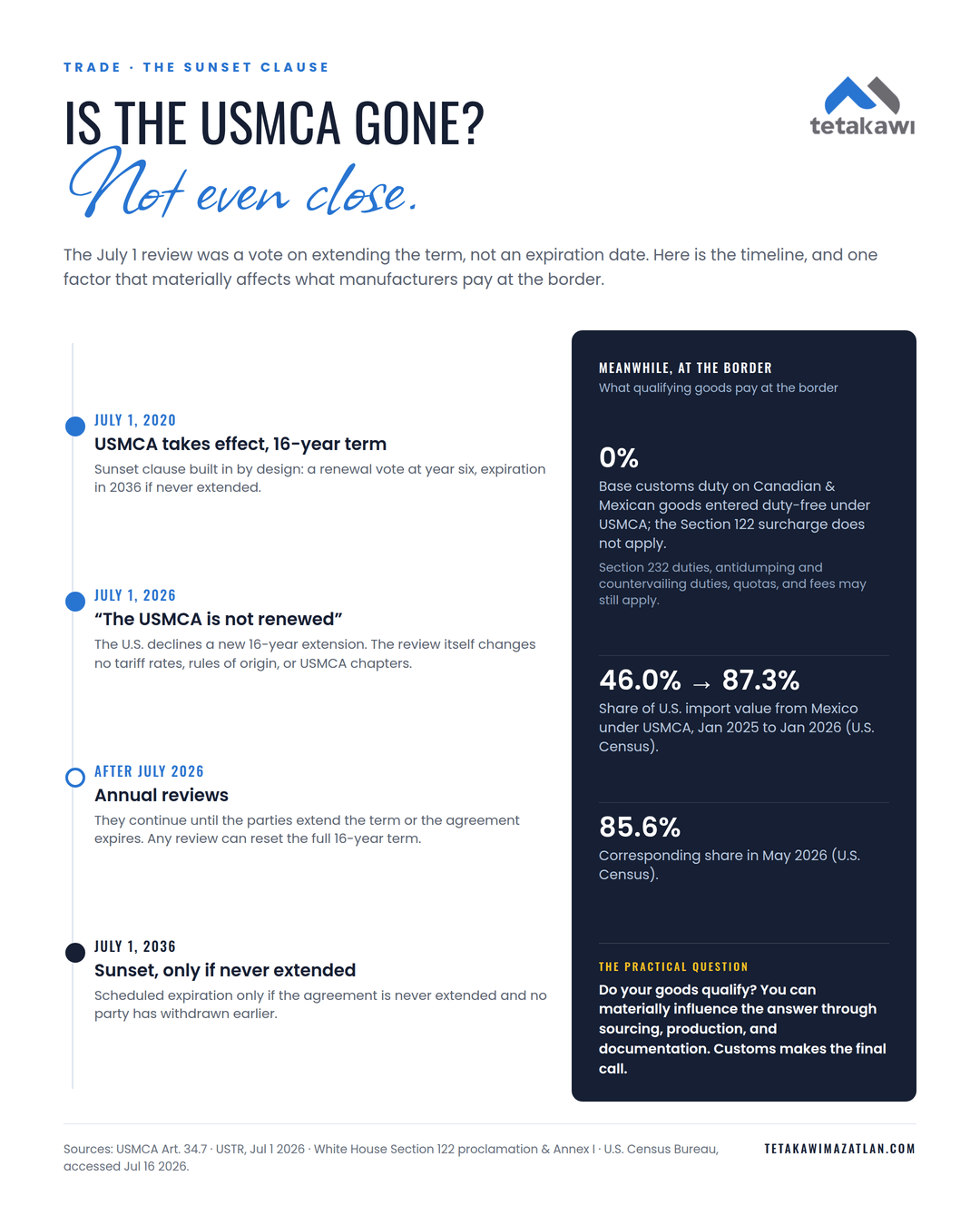
The USMCA introduces a novel 16-year sunset clause. The treaty expires automatically at the end of 16 years unless all three member nations agree to extend it during joint six-year reviews. While this provision ensures periodic evaluation of the trade pact, it also introduces a degree of regulatory uncertainty for long-term capital investments. Enterprises making multi-million-dollar investments in cross-border infrastructure must factor this review cycle into their risk management strategies.
Frequently Asked Questions
What replaced NAFTA, and when did it take effect?
The North American Free Trade Agreement (NAFTA) was replaced by the United States-Mexico-Canada Agreement (USMCA). The treaty officially entered into force on July 1, 2020, following ratification by the legislative bodies of all three participating nations.
How do USMCA rules of origin affect vehicle manufacturing?
The USMCA raises the regional value content requirement for automobiles from 62.5% under NAFTA to 75%. Additionally, it mandates that a significant portion of the vehicle must be manufactured by workers earning at least $16 per hour and requires strict sourcing thresholds for regional steel and aluminum.
What is the Rapid Response Labor Mechanism?
The Rapid Response Labor Mechanism is an enforcement tool within the USMCA that allows a member country to investigate labor rights violations at specific factories or facilities. If violations of freedom of association or collective bargaining are confirmed, the importing nation can block shipments or penalize goods from that specific facility.
Does the USMCA regulate digital commerce?
Yes. The USMCA features a dedicated digital trade chapter that prohibits customs duties on digital products transmitted electronically, guarantees cross-border data transfers, and protects digital service providers from certain forms of liability regarding third-party content.
How long does the USMCA last before expiring?
The agreement includes a 16-year sunset clause. However, the trade pact is subject to mandatory joint reviews by the United States, Mexico, and Canada every six years, at which point the nations can agree to extend the lifespan of the agreement.
How do companies claim preferential tariff treatment under the USMCA?
Importers, exporters, or producers can issue a certification of origin. Unlike NAFTA's rigid certificate format, the USMCA does not require a specific form, but the certification must include nine mandatory data elements demonstrating that the imported product meets all qualifying rules of origin.
Conclusion and Next Actions
The USMCA fundamentally reshapes North American commerce by replacing passive tariff elimination with active regulatory management. For businesses engaged in cross-border trade, success requires transitioning from basic customs compliance to comprehensive supply chain transparency. Organizations should immediately audit their bill of materials, verify wage compliance across tier-one and tier-two suppliers, and establish robust digital record-keeping practices to withstand increased regulatory scrutiny from customs authorities across the United States, Mexico, and Canada.
Image Gallery