Understanding the Accrual Accounting Concept for Reliable Financial Reporting
Accrual accounting is a financial reporting framework that records revenues when earned and expenses when incurred, regardless of when cash changes hands. This method provides a comprehensive view of an organization's financial health...
Accrual accounting is a financial reporting framework that records revenues when earned and expenses when incurred, regardless of when cash changes hands. This method provides a comprehensive view of an organization's financial health by matching economic events to specific time periods, ensuring that financial statements accurately reflect current obligations and future resource inflows.
Contents
Accrual accounting serves as the bedrock of modern corporate finance. Unlike cash-basis accounting, which only tracks the movement of currency, the accrual method focuses on economic substance. As we navigate the complex fiscal landscape of 2026, understanding this concept is vital for stakeholders—ranging from internal management to external investors—who require a precise representation of a company’s performance over a specific period.
Note on Professional Advice: The following information is for educational and informational purposes. Accounting standards, including GAAP and IFRS, are subject to change. Consult with a Certified Public Accountant (CPA) or a qualified financial advisor regarding specific regulatory compliance and tax implications for your jurisdiction.
The Fundamental Pillars: Revenue Recognition and the Matching Principle
To master the accrual accounting concept, one must first grasp the two primary principles that govern it: the Revenue Recognition Principle and the Matching Principle. These guidelines ensure that the income statement is not a mere record of bank deposits, but a narrative of value creation and resource consumption.
The Revenue Recognition Principle
Under the accrual method, revenue is recognized when it is "earned" and "realizable." In 2026, most entities follow the refined standards established by the Financial Accounting Standards Board (FASB) under ASC 606, which outlines a five-step model for recognizing revenue from contracts with customers. The core idea is that a company records revenue when it satisfies a performance obligation—such as delivering a product or completing a service—even if the customer has not yet paid the invoice.
The Matching Principle
The matching principle dictates that expenses must be recorded in the same period as the revenues they helped generate. This is the cornerstone of "reliable" reporting. For instance, if a company pays $10,000 for inventory in December 2025 but doesn't sell those goods until January 2026, the expense is not recognized until January. This synchronization prevents profit distortion, allowing analysts to see the true cost of generating specific revenue streams. Without this principle, a company might appear highly profitable in one month (when it collects cash) and insolvent in the next (when it pays suppliers), despite consistent operations.
Accrual vs. Cash Accounting: A Structural Comparison
While small businesses or sole proprietorships often start with cash-basis accounting due to its simplicity, it rarely suffices for entities seeking external funding or scalability. Cash accounting provides a "snapshot" of the checkbook, but it fails to account for "hidden" liabilities or anticipated income.
In contrast, accrual accounting offers a long-term "video" of the business's operations. By including Accounts Receivable (money owed to the company) and Accounts Payable (money the company owes), the accrual method highlights future cash flows. This distinction is critical for reliability because it prevents management from manipulating financial results by simply delaying the payment of bills or accelerating the collection of invoices at year-end.
| Feature | Cash-Basis Accounting | Accrual-Basis Accounting |
|---|---|---|
| Revenue Timing | When cash is received. | When the service/product is delivered. |
| Expense Timing | When cash is paid out. | When the expense is incurred. |
| Complexity | Low; mirrors a bank statement. | High; requires adjusting entries and tracking. |
| Accuracy | Short-term liquidity focus only. | Long-term profitability and health focus. |
| Compliance | Generally not allowed for large Corps. | Required by GAAP and IFRS. |
| Tax Implications | Taxes paid on cash held. | Taxes paid on income earned (even if unpaid). |
Key Components of the Accrual System
To implement accrual accounting for reliable reporting, several specific account types must be managed. These accounts bridge the gap between the actual business activity and the physical movement of money.
Accounts Receivable (A/R) and Accounts Payable (A/P)
These are the most common accrual accounts. Accounts Receivable represents the credit extended to customers. When a sale is made on credit, the company debits A/R and credits Revenue. This informs stakeholders that the company has a legal right to receive cash in the future. Conversely, Accounts Payable tracks obligations to vendors. Recording an expense as an A/P entry ensures that the company’s liabilities are transparently reported on the balance sheet, even before a check is written.
Accrued Expenses and Prepaid Assets
Accrued expenses are costs that have been incurred but not yet billed or paid. A common example is employee wages or interest on a loan. If an employee works the last week of December but isn't paid until January, the company must "accrue" that payroll expense in December to keep the year's financial reports accurate.
Prepaid assets (or deferrals) represent cash paid in advance for a service not yet received. Insurance premiums are a classic example. If a firm pays for a 12-month policy in advance, that cash outflow is recorded as an asset (Prepaid Insurance). Each month, a portion of that asset is moved to the "Insurance Expense" account, ensuring that the cost is spread evenly over the period the coverage is actually used.
The Role of Adjusting Journal Entries
Reliable financial reporting requires an "end-of-period" process known as adjusting journal entries. This phase is where the "accrual" truly happens. Because daily business transactions often don't align perfectly with the end of a month or year, accountants must manually adjust accounts to ensure accuracy.
- Depreciation: This is a non-cash accrual. It allocates the cost of a tangible asset (like machinery or vehicles) over its useful life. By recording depreciation expense, a company acknowledges that its assets are wearing out as they produce revenue.
- Unearned Revenue: If a customer pays upfront for a two-year software subscription, the company cannot claim all that money as revenue today. Instead, it is recorded as "Unearned Revenue" (a liability). As the service is provided each month, a portion of that liability is "earned" and moved to the income statement.
- Bad Debt Provision: Accrual accounting requires estimating how much of the Accounts Receivable might never be collected. Recording an "Allowance for Doubtful Accounts" ensures that the asset value on the balance sheet is not overstated.
Why Accrual Accounting Enhances Reliability for Stakeholders
For investors, creditors, and regulators, the accrual method is the gold standard because it provides "predictive value."
Transparency and Comparability
When every company in an industry uses accrual accounting, stakeholders can compare them "apples-to-apples." If Company A uses cash accounting and Company B uses accrual, Company A could look much healthier simply because they haven't paid their suppliers yet. Accrual accounting removes this veil, forcing companies to disclose their true obligations.
Facilitating Audits and Compliance
Publicly traded companies and those seeking significant bank loans are mandated to follow Generally Accepted Accounting Principles (GAAP) or International Financial Reporting Standards (IFRS). Both frameworks require the accrual method. For an auditor, the "paper trail" created by accrual entries—matching contracts to invoices and invoices to payments—provides the evidence necessary to verify the integrity of the financial statements.
Managing Working Capital
Management uses accrual data to manage "working capital." By seeing the ratio of A/R to A/P, leaders can identify bottlenecks. If receivables are growing much faster than revenue, it indicates a collection problem that cash accounting would likely miss until the bank account actually ran dry.
Potential Challenges and the Importance of the Cash Flow Statement
While accrual accounting is superior for measuring profitability, it does have a significant blind spot: liquidity. A company can be highly profitable on an accrual basis (high revenue, low expenses) but literally go bankrupt because they cannot collect cash fast enough to pay their debts.
This is why "reliable reporting" always includes a Statement of Cash Flows. This report reconciles the accrual-based net income back to actual cash. It "adds back" non-cash expenses like depreciation and adjusts for changes in A/R and A/P. In 2026, sophisticated investors look at the "Quality of Earnings"—a metric that compares accrual profit to operating cash flow. If the two diverge significantly over time, it may signal that the company’s reported "accrual" revenue is aggressive or unreliable.
Frequently Asked Questions
Can a small business switch from cash to accrual accounting?
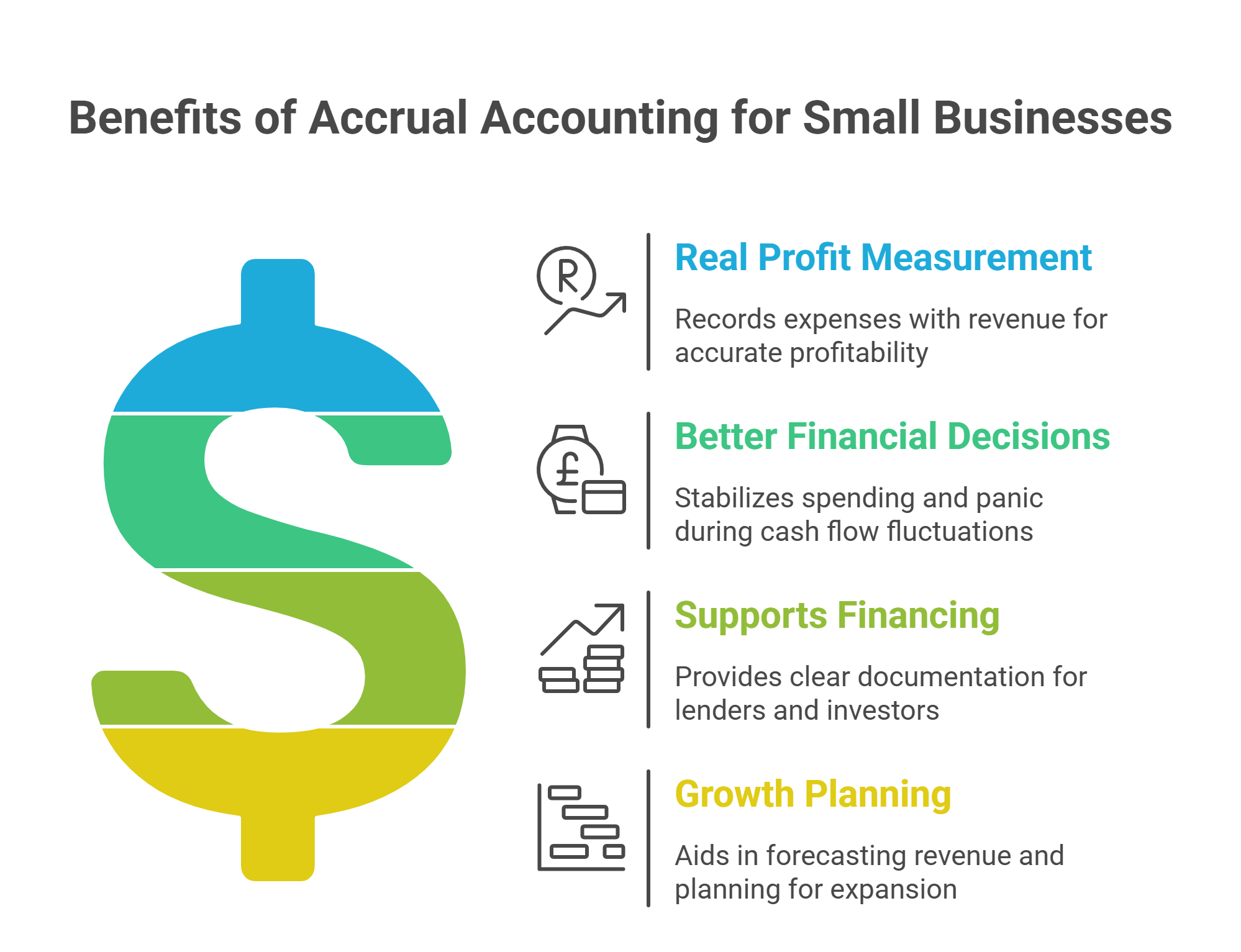
Yes, businesses can switch, though it often requires an "adjusting period" where previous cash transactions are converted to the accrual basis. For tax purposes in many jurisdictions, once a business reaches a certain revenue threshold, the switch to accrual accounting becomes mandatory to prevent tax avoidance through timing manipulations.
Does accrual accounting mean I pay taxes on money I haven't received?
In many cases, yes. Because you recognize revenue when the "performance obligation" is met (the sale is made), that income is taxable in the period it was earned, even if the customer hasn't paid the invoice yet. This is why cash flow management is critical for companies using the accrual method.
Why is depreciation considered part of accrual accounting?
Depreciation is a form of "cost allocation" that follows the matching principle. Since a piece of equipment helps generate revenue over many years, accrual accounting dictates that its cost should be spread over those same years, rather than being "expensed" entirely on the day it was purchased.
Is accrual accounting more expensive to maintain?
Generally, yes. It requires more sophisticated bookkeeping, a deeper understanding of accounting standards, and often specialized software to track aging receivables and payables. However, the cost is typically offset by better access to credit and more informed decision-making.
What is the biggest risk of accrual accounting?
The primary risk is the use of "estimates." Because accrual accounting relies on management's estimates for things like bad debt, asset lifespans, and the percentage of completion on long-term projects, there is a risk of "earnings management" or unintentional errors that can mislead investors if not properly audited.
Next Actions for Implementation
To ensure your financial reporting is reliable via the accrual method, start by reviewing your current revenue recognition policies. Ensure they align with ASC 606 or IFRS 15 standards. Next, implement a robust month-end closing process that specifically addresses adjusting entries for accruals, deferrals, and depreciation. Finally, always present your Income Statement and Balance Sheet alongside a Statement of Cash Flows to provide the full context of your organization’s financial position.
Image Gallery