How to Use Proper Spanish Grammar: A Complete Structural Guide
Using proper Spanish grammar requires mastering foundational agreement rules between nouns and adjectives, navigating regular and irregular verb conjugations across indicative and subjunctive moods, applying correct pronoun placement,...
Using proper Spanish grammar requires mastering foundational agreement rules between nouns and adjectives, navigating regular and irregular verb conjugations across indicative and subjunctive moods, applying correct pronoun placement, and adhering to orthographic accent mark (tilde) rules. Following standards established by the Real Academia Española (RAE) ensures clarity, precision, and formality in written and spoken communication.
Contents
Foundational Pillars: Noun Gender and Number Agreement
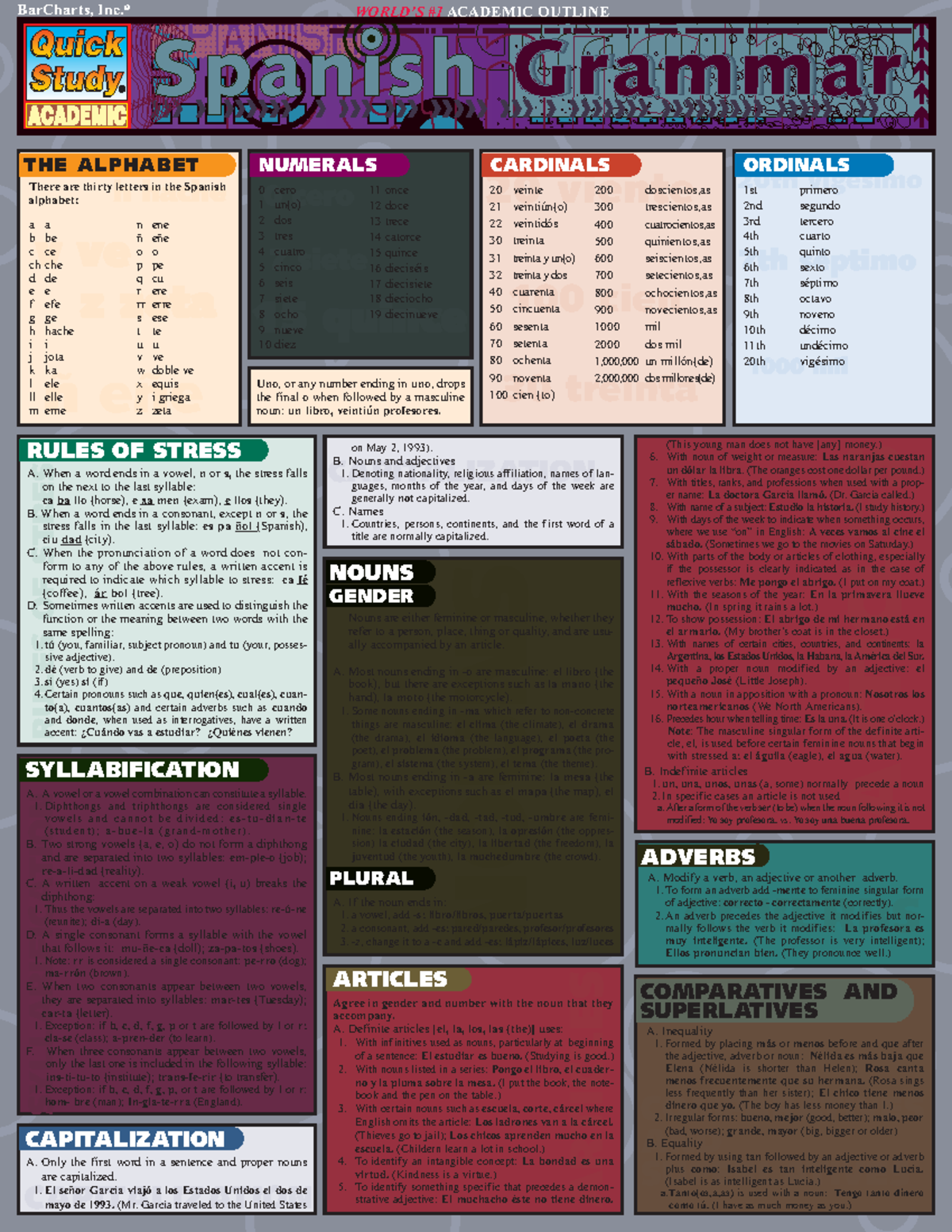
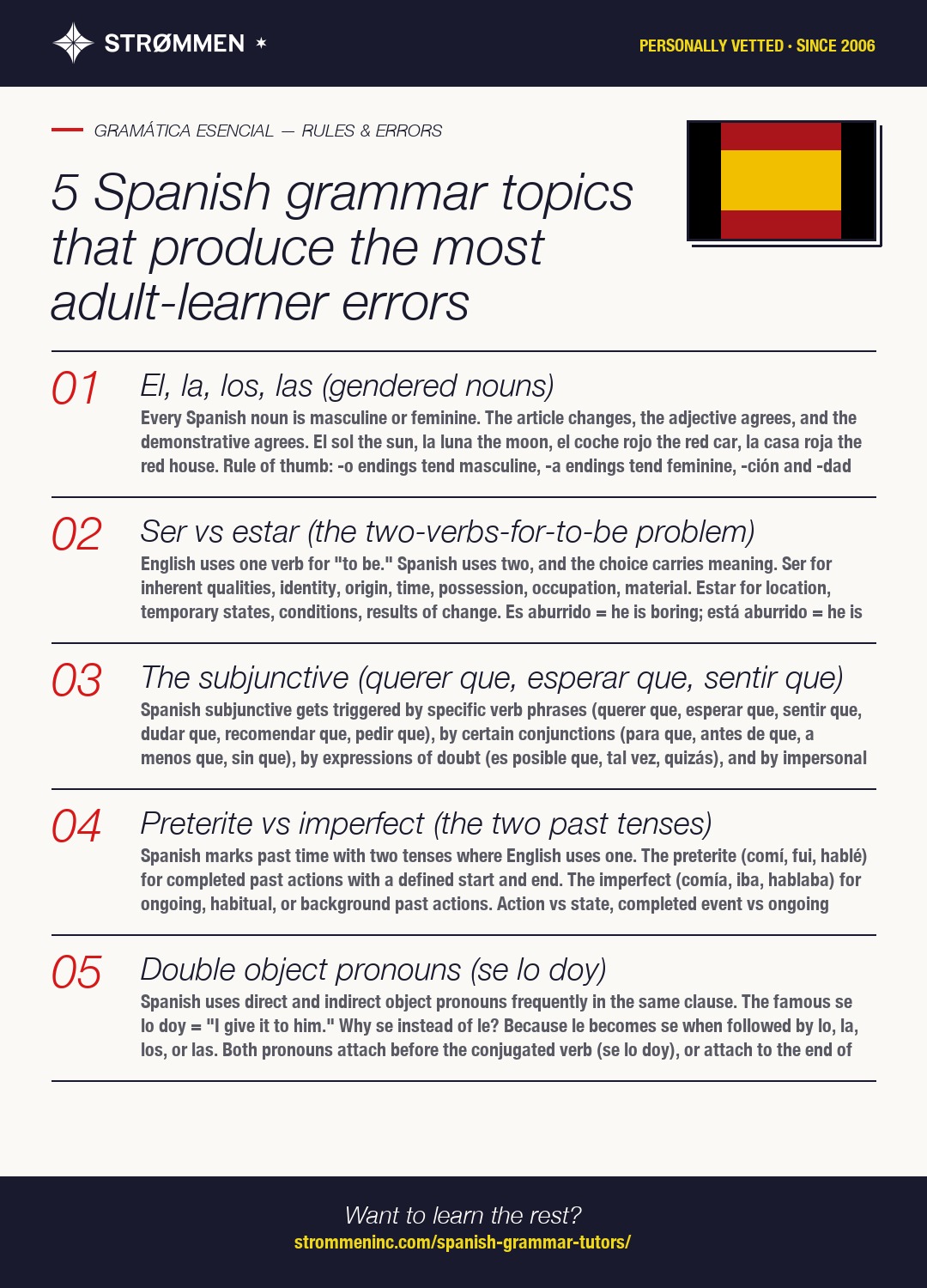
In Spanish grammar, every noun possesses an inherent grammatical gender—either masculine or feminine—and a grammatical number (singular or plural). Adjectives, articles, and demonstratives modifying a noun must agree with it in both gender and number. Misalignment in agreement is one of the most frequent errors for non-native speakers.
Determining Noun Gender
While word endings often indicate gender, exceptions exist based on etymology and historical linguistic development:
- Masculine Nouns: Typically end in -o (el libro), an accented vowel (el sofá), or consonants such as -r, -l, -n, -e, and -s (el calor, el árbol, el pan). Nouns of Greek origin ending in -ma, -pa, or -ta are also masculine (el problema, el mapa, el sistema, el planeta).
- Feminine Nouns: Typically end in -a (la mesa), -ción (la canción), -sión (la decisión), -dad (la ciudad), -tad (la libertad), and -tud (la actitud).
- Irregularities and Exceptions: Certain nouns defy standard visual cues. For example, la mano (the hand) and la foto (short for la fotografía) are feminine, while el día (the day) is masculine. Words beginning with a stressed a- or ha- sound use the masculine singular article el solely to prevent hiatus (el agua fría, el águila rápida), but remain grammatically feminine in their plural forms (las aguas frías) and when modified by adjectives.
Agreement Mechanics for Adjectives and Articles
Adjectives must adapt to the gender and number of the noun they modify.
- Four-Form Adjectives: Adjectives ending in -o have four distinct forms: masculine singular (nuevo), feminine singular (nueva), masculine plural (nuevos), and feminine plural (nuevas).
- Two-Form Adjectives: Adjectives ending in -e or most consonants alter their form only for number, not gender (el libro interesante vs. la clase interesante; los estudiantes inteligentes).
- Nationalities and Adjectives Ending in Consonants: Adjectives of nationality ending in a consonant add an -a for the feminine form (español / española, inglés / inglesa).
Pluralization follows strict orthographic rules: add -s to nouns and adjectives ending in an unstressed vowel (casas, libros); add -es to words ending in a consonant or stressed vowel other than -e (ciudades, rubíes). Words ending in -z change to -ces in the plural (el lápiz becomes los lápices).
Verb Systems: Conjugation, Tenses, and Mood Selection
Spanish is a pro-drop (pronoun-dropping) language because verb inflections encode person, number, tense, aspect, and mood directly into the verb stem and suffix. Understanding verb mechanics requires categorizing verbs by their infinitives (-ar, -er, -ir) and identifying their structural function.
Infinitival Ending -> Stem + Inflectional Suffix -> Person / Tense / Mood
The Indicative Mood: Fact and Certainty
The indicative mood describes objective statements, factual actions, real events, and established truths. Master these core past tenses to prevent common narrative confusions:
- Preterite (Pretérito Indefinido): Expresses completed actions that took place at a specific point in time or within a bounded duration. Example: Ayer escribí una carta (Yesterday I wrote a letter).
- Imperfect (Pretérito Imperfecto): Sets the background scene, describes ongoing past actions without a defined end point, expresses habits, or states age/time in the past. Example: Cuando era niño, leía cada noche (When I was a child, I read every night).
Distinction Between Ser and Estar
Both ser and estar translate to the English verb "to be," but they are not interchangeable. Substituting one for the other changes the meaning of a sentence entirely.
| Verb Aspect | Primary Function | Contexts of Use | Example Sentences |
|---|---|---|---|
| Ser | Essential qualities, permanent identity, origin, composition, and time. | Personality traits, professions, nationality, material composition, event locations, hours/dates. | Ella es abogada. (She is a lawyer.)La reunión es en la oficina. (The meeting takes place in the office.) |
| Estar | Temporary states, conditions, locations, and ongoing actions. | Physical conditions, emotional states, spatial position, continuous progressive tenses (estar + gerund). | El informe está listo. (The report is ready.)Madrid está en España. (Madrid is in Spain.) |
The Subjunctive Mood: Subjectivity, Uncertainty, and Influence
Unlike English, which uses the subjunctive sparingly, standard Spanish requires the subjunctive mood whenever a main clause expresses emotion, doubt, denial, recommendation, necessity, or non-existent entities.
The subjunctive is triggered when two conditions are met:
- Multiple Clauses: A main clause connected to a subordinate clause by the conjunction que.
- Subject Change: The subject of the main clause differs from the subject of the subordinate clause.
Common triggers follow the WEIRDO framework:
- Wishes/Wants: Quiero que estudies (I want you to study).
- Emotions: Me alegra que vengas (I am glad you are coming).
- Impersonal Expressions: Es necesario que firmes el documento (It is necessary that you sign the document).
- Recommendations: Sugiero que leas este capítulo (I suggest that you read this chapter).
- Doubt/Denial: No creo que sea verdad (I do not believe that it is true).
- Ojalá: Ojalá apruebes el examen (I hope you pass the exam).
Pronoun Mechanics and Placement Rules
Proper usage of direct, indirect, and reflexive pronouns streamlines communication and avoids redundancy. Spanish enforces precise order and positioning rules for object pronouns.
Object Pronoun Types and Forms
- Direct Object Pronouns (DOP): Replace the entity directly receiving the action of the verb (me, te, lo/la, nos, os, los/las).
- Indirect Object Pronouns (IOP): Indicate to whom or for whom the action is performed (me, te, le, nos, os, les).
Pronoun Order and Double Pronoun Placement
When both an indirect object pronoun and a direct object pronoun appear in the same sentence, the indirect object pronoun always precedes the direct object pronoun (RID rule: Reflexive, Indirect, Direct).
- Correct: Me lo dio (He gave it to me).
- Incorrect: Lo me dio.
The "Le/Les" to "Se" Transformation
When an indirect pronoun (le or les) immediately precedes a third-person direct pronoun (lo, la, los, las), the indirect pronoun changes to se to avoid cacophony.
- Incorrect: Le lo dije.
- Correct: Se lo dije (I said it to him/her).
Positional Syntax: Enclitic vs. Proclitic
- Before Conjugated Verbs (Proclitic): Pronouns sit separately before a finite conjugated verb.
- Example: Se la envié ayer (I sent it to her yesterday).
- Attached to Verb Forms (Enclitic): Pronouns must attach directly to the end of infinitives, gerunds, and affirmative imperatives.
- Infinitive: Voy a decírselo (I am going to tell it to him).
- Gerund: Estoy escribiéndosela (I am writing it to her).
- Affirmative Command: Dáselo ahora (Give it to him now).
- Negative Command: No se lo des (Do not give it to him—pronoun remains before the verb in negative commands).
Note that attaching pronouns to gerunds and infinitives often creates a word with more syllables, requiring an orthographic accent mark to preserve the original stress pattern.
Mastering Spanish Accentuation (Acentuación) and Punctuation
Orthographic accent marks (tildes) in Spanish indicate phonetic stress and distinguish words with identical spellings but different meanings. Every written accent mark in Spanish is an acute accent (´).
Syllable Stress Classification Rules
Words are classified into four categories based on where the spoken stress falls. Accent marks are applied according to strict rules:
- Palabras Agudas (Stress on the Last Syllable): Require a tilde only if the word ends in a vowel, -n, or -s.
- Accented: can-CIÓN, co-me-RÍA, pa-PÁ.
- Unaccented: co-MER, or-de-na-DOR, pa-PA-ray.
- Palabras Graves / Llanas (Stress on the Second-to-Last Syllable): Require a tilde if the word ends in any consonant other than -n or -s, or ends in a consonant cluster.
- Accented: LÁ-piz, ÁR-bol, CÁR-cel.
- Unaccented: ME-sa, CA-sa, EX-a-men.
- Palabras Esdrújulas (Stress on the Third-to-Last Syllable): Always require an accent mark.
- Examples: GRA-má-ti-ca, PÁ-ja-ro, MÉ-di-co.
- Palabras Sobreesdrújulas (Stress on the Fourth-to-Last Syllable or Earlier): Always require an accent mark; usually formed by attaching pronouns to verbs.
- Examples: DÍ-ga-me-lo, CÓM-pra-te-lo.
Diacritical Accents (Acento Diacrítico)
Diacritical marks differentiate homonyms that share spelling but serve different grammatical functions.
- el (definite article: the) vs. él (personal pronoun: he)
- tu (possessive adjective: your) vs. tú (subject pronoun: you)
- mi (possessive adjective: my) vs. mí (prepositional pronoun: me)
- si (conditional conjunction: if) vs. sí (affirmative adverb/pronoun: yes/himself)
- se (reflexive/indirect pronoun) vs. sé (conjugated verb form of saber or ser)
- te (object pronoun: you) vs. té (noun: tea)
Spanish-Specific Punctuation Requirements
Spanish uses inverted question marks (¿) and inverted exclamation points (¡) at the exact start of an interrogative or exclamatory clause, even if that clause begins mid-sentence.
- Example: Si tienes tiempo, ¿puedes ayudarme con la revisión? (If you have time, can you help me with the revision?)
Prepositions: Managing Por vs. Para and Structural Dependents
Prepositions connect clauses and show relationships between elements. The distinction between por and para represents a frequent grammar challenge due to their distinct conceptual roles.
Structural Comparison: Por vs. Para
POR --> Cause / Agent / Means / Exchange / Duration / Motivation PARA --> Destination / Recipient / Purpose / Deadline / Comparison
- Use Por for:
- Cause or Reason: Lo hice por amor (I did it out of love).
- Duration of Time: Estudié por tres horas (I studied for three hours).
- Means of Transportation/Communication: Envié el informe por correo (I sent the report by email).
- Exchange or Money: Pagué veinte euros por el libro (I paid twenty euros for the book).
- Passive Voice Agent: El libro fue escrito por Cervantes (The book was written by Cervantes).
- Use Para for:
- Purpose or Goal (Para + Infinitive): Estudio para aprender (I study in order to learn).
- Recipient: Este regalo es para ti (This gift is for you).
- Deadline or Future Point: La tarea es para el lunes (The homework is due by Monday).
- Destination: Salgo para Madrid mañana (I am leaving for Madrid tomorrow).
- Employment: Trabajo para una empresa internacional (I work for an international company).
Verbs with Mandatory Prepositions
Certain verbs require specific prepositions before an infinitive or noun phrase to form correct syntactic structures:
- Pensar en (to think about): Pienso en mi futuro.
- Soñar con (to dream of/about): Sueño con viajar.
- Aprender a (to learn to): Aprendo a programar.
- Depender de (to depend on): Depende del clima.
- Quedar en (to agree on): Quedamos en vernos a las cuatro.
Comprehensive Spanish Grammar Reference Matrix
This reference matrix summarizes essential Spanish grammar concepts, application rules, correct usages, and common pitfalls.
| Grammar Category | Core Rule / Principle | Correct Application Example | Common Error to Avoid |
|---|---|---|---|
| Gender Agreement | Nouns ending in -ma of Greek origin are masculine. | El problema principal fue resuelto. | La problema principal... (Incorrect gender assignment) |
| Pluralization Stress | Adding -es to words ending in -en shifts stress position, requiring a tilde. | El examen (no tilde) -> Los exámenes (requires tilde) | Los me examen / Los examenes (Omitting required tilde) |
| Object Pronoun Order | Indirect pronouns precede direct pronouns; le/les becomes se before lo/la/los/las. | Se lo compré ayer. (I bought it for him.) | Le lo compré... (Failing to change le to se) |
| Subjunctive Mood | Expressing doubt or denial in the main clause requires subjunctive in the subordinate clause. | No creo que ellos vengan hoy. | No creo que ellos vienen hoy. (Using indicative after denial) |
| Ser vs. Estar | Location of events uses ser; location of physical entities uses estar. | La conferencia es en el auditorio.El auditorio está en el centro. | La conferencia está en... (Confusing event location with physical position) |
| Preposition Choice | Expressing deadlines or clear targets requires para. | El proyecto debe estar listo para el viernes. | ...por el viernes. (Using por for deadlines) |
| Diacritical Marks | Monosyllabic words use accent marks to distinguish grammatical function. | Tú tienes tu propio coche. | Tu tienes tu propio coche. (Omitting accent on subject pronoun) |
Frequently Asked Questions
What is the best strategy to memorize verb conjugations in Spanish?
Focus on grouping verbs by their patterns rather than memorizing individual charts isolated from context. Master the regular conjugation patterns for -ar, -er, and -ir verbs in the present, preterite, and imperfect tenses first. Next, identify stem-changing patterns (such as e -> ie, o -> ue, and e -> i) and learn common irregular verbs (ser, estar, ir, tener, hacer) in context through active writing and reading.
Why do some words starting with "a" use the masculine article "el" even though they are feminine?
Feminine singular nouns that begin with a stressed a- or ha- sound take the masculine singular article el to prevent hiatus—the awkward combination of two identical vowel sounds back-to-back (euphony). Examples include el agua, el águila, and el área. However, these words remain grammatically feminine, meaning modifiers remain feminine (el agua fría) and plural forms revert to las (las aguas frías).
What is "leísmo" and is it grammatically acceptable according to the RAE?
Leísmo is the practice of using the indirect object pronoun le or les instead of the direct object pronoun lo or los to refer to male human direct objects. The RAE considers single male person leísmo (Le vi ayer instead of Lo vi ayer) acceptable in standard Spanish, particularly in Spain. However, using le for inanimate direct objects (Le compré el libro instead of Lo compré) or using la as an indirect pronoun (laísmo) remain non-standard forms.
When should I use "qué" versus "cuál"?
Use qué when asking for a definition, open explanation, or before a noun (¿Qué es esto?, ¿Qué libro quieres?). Use cuál (or cuáles) when choosing from a limited or implied set of options, or before es/son when not seeking a definition (¿Cuál de estos prefieres?, ¿Cuál es tu dirección?). Never place cuál directly before a noun in standard Spanish; use qué instead (¿Qué coche prefieres?).
How do I know if a verb requires the subjunctive in the past tense?
If the governing verb in the main clause expresses a past recommendation, wish, doubt, or emotion, the subordinate verb requires the imperfect subjunctive (Pretérito Imperfecto de Subjuntivo). For example, Quería que vinieras (I wanted you to come) uses the imperfect subjunctive vinieras because the main clause verb quería is in the past indicative and sets a condition of past desire.
Practical Steps to Master Spanish Grammar
- Perform Daily Agreement Audits: When writing in Spanish, double-check that every adjective matches its noun's gender and number. Verify that irregular nouns (el mapa, la mano, el agua) use correct article forms.
- Map Out Clause Relationships: Identify the main clause and subordinate clause in your sentences. Determine whether the main verb expresses certainty (indicative) or emotion, uncertainty, or influence (subjunctive).
- Apply Phonetic Accent Rules Methodically: Categorize multisyllabic words as agudas, graves, or esdrújulas based on spoken stress. Apply a tilde only when RAE orthographic rules require it.
- Consult Official Resources: Use authoritative reference databases such as the RAE's Diccionario panhispánico de dudas to verify prepositional verb requirements and regional syntactic standards.
Image Gallery