How 5 on 5 Flag Football Trick Plays Work
5 on 5 flag football trick plays work by exploiting defensive man-to-man assignments and zone coverages through misdirection, hidden ball mechanics, option pitches, and unconventional player alignments designed to deceive defenders abo...
5 on 5 flag football trick plays work by exploiting defensive man-to-man assignments and zone coverages through misdirection, hidden ball mechanics, option pitches, and unconventional player alignments designed to deceive defenders about the true point of attack. Because 5 on 5 flag football eliminates interior linemen and heavy blocking, offensive success relies entirely on spatial manipulation, timing, and deceptive pre-snap motion to create open receivers and running lanes.
Contents
The Foundations of Deception in 5 on 5 Flag Football
Unlike traditional tackle football, which relies on physical line play and blocking schemes to open gaps, 5 on 5 flag football is a game of speed, spacing, and geometric angles. With only five players on the field for the offense, every individual assignment carries massive weight. If a defense can diagnose a standard passing or running play pre-snap, the lack of blockers makes it exceptionally easy for defenders to chase down and pull the ball carrier's flags.
Trick plays bridge this gap by weaponizing the defense's own aggressiveness and visual tracking against them. When a defense reads keys—such as the quarterback’s eyes, the running back’s path, or the receiver's initial release—they commit their momentum in a specific direction. Trick plays are engineered to exploit this commitment. By the time the defense realizes the ball has gone elsewhere, the offensive player has already secured open space.
To understand how these designs function, one must look at the structural mechanics of 5 on 5 flag football rules. Most recreational and competitive leagues enforce strict regulations regarding contact, line-of-scrimmage formations, and forward pass eligibility. Because blocking is either prohibited entirely or limited to passive screening, trick plays cannot rely on traditional play-action fakes where a lineman pulls to trick linebackers. Instead, deception must come from skill-position players exchanging the ball invisibly, utilizing reverse mechanics, or executing sudden changes of direction behind the line of scrimmage.
Core Mechanics Behind Effective Trick Plays
Successful trick plays are built upon a foundation of fundamental execution. If the initial fake looks unconvincing, disciplined defenders will ignore the decoy and lock onto the actual ball carrier. Therefore, understanding the mechanics of execution is vital for any team attempting to install these schemes.
1. Selling the Initial Fake
The primary rule of any trick play is that the primary decoy must act as though they are the focal point of the play. If a running back executes a fake handoff on a counter play, they must sell the run with the same body posture, hand pocket, and burst they would use if they actually possessed the ball. The quarterback must place the ball securely into the runner's gut, forcing the defense to commit their eyes to the exchange.
2. Maintaining Proper Spacing and Timing
In 5 on 5 formats, field dimensions are compressed compared to traditional outdoor football. Plays develop rapidly. If a trick play requires multiple handoffs or a reverse, the timing must be precise to the millisecond. A fraction of a second delay allows edge rushers—who often have a direct path in non-blocking leagues—to disrupt the play in the backfield before the misdirection can take effect.
3. Exploitation of Defensive Keys
Defenders in flag football usually read either their assigned man or a designated offensive triangle. Trick plays deliberately distort these keys. For example, if a defender is assigned to mirror the slot receiver, sending that receiver on a deep clearing route while a running back leaks out underneath on a delayed wheel route creates an immediate conflict in coverage responsibility.
Popular 5 on 5 Trick Play Concepts Explained
Coaches and quarterbacks utilize several staple trick play concepts in 5 on 5 flag football. Each design targets specific weaknesses in common defensive alignments like Cover 2 zone or tight man-to-man coverage.
| Play Concept | Primary Mechanism | Best Against | Vulnerability / Risk |
|---|---|---|---|
| The Flea Flicker | Complete a short pass, then pitch backward to the QB or trailing runner. | Aggressive Man Coverage | High risk of a fumbled lateral or sack. |
| The Reverse | Hand off to a wide receiver running across the backfield. | Over-pursuing Zone Defenses | Loss of yardage if the edge defender stays home. |
| The Double Pass | Receiver catches a pass, stops, and throws downfield. | Flat-footed Secondary | Requires a non-QB with a reliable throwing arm. |
| The Fake Reverse Pass | Hand off fake to a receiver, freezing the defense while the QB rolls out. | Disciplined Linebackers | Defense ignores the fake and rushes the passer. |
The Reverse and Double Reverse
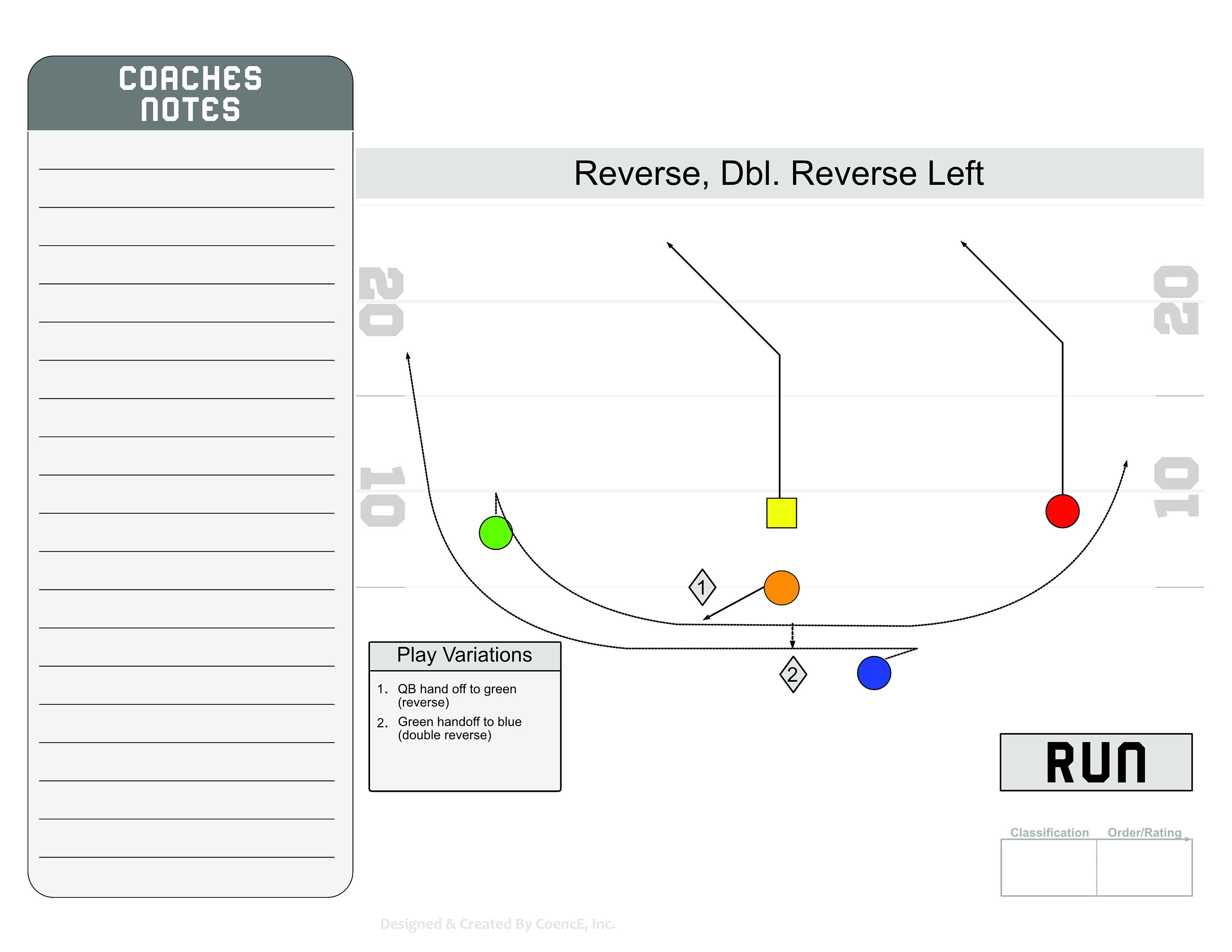
The reverse is the most fundamental trick play in flag football. The quarterback snaps the ball and hands it off or pitches it to a running back, who then hands it off in the opposite direction to a wide receiver sweeping across the formation. This exploits defenses that flow hard toward the initial movement of the play.
In a double reverse, the ball changes hands a third time, bringing it back to the original side of the field. While visually effective, double reverses carry higher risks of mishandled handoffs and lost yardage due to the time required to develop.
The Flea Flicker
Adapted from tackle football, the flag football flea flicker begins with what looks like a routine run or a short flat pass. The quarterback hands the ball off to a running back. Instead of attacking the line, the running back stops, turns, and flips or pitches the ball back to the quarterback. Meanwhile, downfield receivers who initially blocked or ran short routes break deep. Defenses often bite on the run fake, stepping up to pull the flag, which leaves the secondary entirely uncovered downfield.
The Center Sneak / Hidden Ball Play
Because the center is an eligible receiver in most flag football rule sets, creative offenses use the center-qb exchange to confuse the defense. In some variations, the quarterback takes the snap, turns their back instantly to shield the ball, and hands it right back to the center or a stepping guard while pretending to roll out to the flank. Defenders tracking the quarterback's empty hands pursue the rollout, leaving the center wide open in the middle of the field.
Prerequisites and Operational Requirements
Installing and executing trick plays effectively requires more than just drawing lines on a playbook. Teams must meet specific operational requirements to prevent trick plays from backfiring into negative yardage or turnovers.
- Personnel Versatility: At least one non-quarterback on the field must possess the ability to throw an accurate pass if the playbook includes double passes or option throws.
- Ball Security Discipline: Flag football requires clean exchanges. Players must secure the ball with two points of contact during handoffs and reverses.
- Pre-Snap Communication: Because trick plays often rely on silent counts or subtle cadence variations to avoid tipping off the defense, the offense must be entirely synchronized before the snap.
- Field Awareness: Play callers must evaluate field positioning. Trick plays that require lateral movement or deep development should be avoided deep inside one's own territory, where a tackle for a loss results in a safety or severe field-position disadvantage.
Common Mistakes and Troubleshooting
Even well-designed trick plays fail when execution falters. Recognizing common errors helps teams troubleshoot issues during practice before taking them to competitive games.
Overcomplicating the Design
The most common mistake is adding too many moving parts. A play that requires three handoffs and a backward lateral in 5 on 5 flag football has too many points of failure. If an execution link breaks, the play collapses. Simplifying the misdirection down to a single clean fake yields a higher success rate.
Telegraphing the Play Through Alignment
Defenders watch player alignment closely. If a wide receiver who normally runs deep routes suddenly creeps into a tight, bunched backfield stance right before a reverse, observant defenders will alert their teammates. Offenses must disguise their intentions by maintaining standard formations until the moment of the snap.
Impatience with Timing
Quarterbacks and ball carriers often rush trick plays out of anxiety. If a reverse runner cuts inside before the initial flow of the defense has fully committed, they run directly into unblocked defenders. Patience is required to let the defense over-pursue before the counter-attack begins.
Frequently Asked Questions
Are trick plays legal in all 5 on 5 flag football leagues?
Most recreational and competitive leagues permit trick plays, provided they comply with standard rule sets regarding forward passes, illegal blocking, and lateral rules. However, certain youth leagues restrict certain types of handoffs or require specific player positions to handle the initial snap. Always review local league rule books before implementation.
When is the best time to call a trick play?
Trick plays are most effective on high-leverage downs, such as second-and-short or early-down situations where the defense expects a standard play. Using them immediately after a predictable sequence (like three consecutive runs) maximizes the element of surprise. Avoid calling them when backed up against your own end zone.
What happens if a trick play results in a fumble?
In 5 on 5 flag football, a dropped handoff or a backward pass (lateral) that hits the ground is typically ruled a dead ball at the spot where it lands, resulting in a turnover on downs or a change of possession depending on league-specific fumble rules. Forward passes that fall incomplete simply result in a dead ball at the previous line of scrimmage.
Do I need a dual-threat quarterback to run trick plays?
No. While a dual-threat quarterback enhances options, many effective trick plays—such as standard reverses, receiver screens with delayed handoffs, and flea flickers—rely entirely on skill-position players executing fakes while the quarterback acts as a decoy or passer.
Practical Next Actions
To successfully integrate trick plays into your team's offensive strategy, start by mastering one reliable concept, such as a simple receiver reverse. Practice the handoff mechanics at full speed repeatedly until the exchange is automatic. Once the baseline execution is consistent, test the play during practice scrimmages against an active defense to observe how linebackers and cornerbacks react. Introduce secondary options only after the primary concept yields consistent positive yardage.
Image Gallery