Forms Needed for Work Incident Reporting and Workers' Compensation: A Complete Guide
When a workplace accident or job-related illness occurs, navigating the paperwork requires handling two distinct tracks: state workers’ compensation insurance reporting and federal or state OSHA compliance recordkeeping. The primary fo...
When a workplace accident or job-related illness occurs, navigating the paperwork requires handling two distinct tracks: state workers’ compensation insurance reporting and federal or state OSHA compliance recordkeeping. The primary forms needed for work incident reporting include the Employee’s Claim Form, the Employer’s First Report of Injury (FROI), attending physician reports, and federal OSHA Forms 301, 300, and 300A.
Contents
Understanding the Dual-Track Incident Reporting Framework
Workplace injuries trigger compliance obligations under two separate regulatory frameworks: workers' compensation administration and occupational safety recordkeeping. Failing to recognize the distinction between these two systems is one of the most common mistakes risk managers, HR professionals, and injured employees make.
- Workplace Incident Occurs
- Track 1: Workers' Comp (Benefits, Liability & Medical)
- Employee Claim Form
- Employer's FROI
- Physician Report (C-4/PR-2)
- Track 2: OSHA Recordkeeping (Safety Compliance & Statistics)
- OSHA Form 301 (Incident Report)
- OSHA Form 300 (Log)
- OSHA Form 300A (Summary)
- Track 1: Workers' Comp (Benefits, Liability & Medical)
Workers' compensation is a state-regulated insurance system designed to provide medical benefits and wage replacement to injured workers while granting employers immunity from civil lawsuits for accidental injuries. Each jurisdiction establishes its own mandatory forms, reporting deadlines, and administrative procedures.
Conversely, the Occupational Safety and Health Administration (OSHA) enforces federal safety standards aimed at tracking trends, identifying hazard patterns, and preventing future injuries. OSHA recordkeeping rules apply nationwide, though state-plan states may impose additional requirements. While some information overlaps, submitting an OSHA log does not initiate a workers' compensation claim, and filing an insurance claim does not fulfill OSHA injury logging obligations.
Disclaimer: This guide is provided for educational and administrative planning purposes. Workers' compensation laws and mandatory reporting forms vary by state and jurisdiction. For specific legal obligations or active claims, consult a qualified labor attorney or licensed risk management professional.
Essential State Workers' Compensation Forms
Every state workers' compensation board requires specific documentation to initiate, evaluate, and process a claim. Although form names and code numbers vary by state, the fundamental functions of these documents remain standardized across the United States.
| Form Type | Purpose | Primary Initiator |
|---|---|---|
| Employee Claim Form | Formally requests benefits | Injured Employee |
| Employer's FROI | Reports incident to carrier | Employer / Risk Manager |
| Physician Medical Report | Establishes causal link | Treating Healthcare Provider |
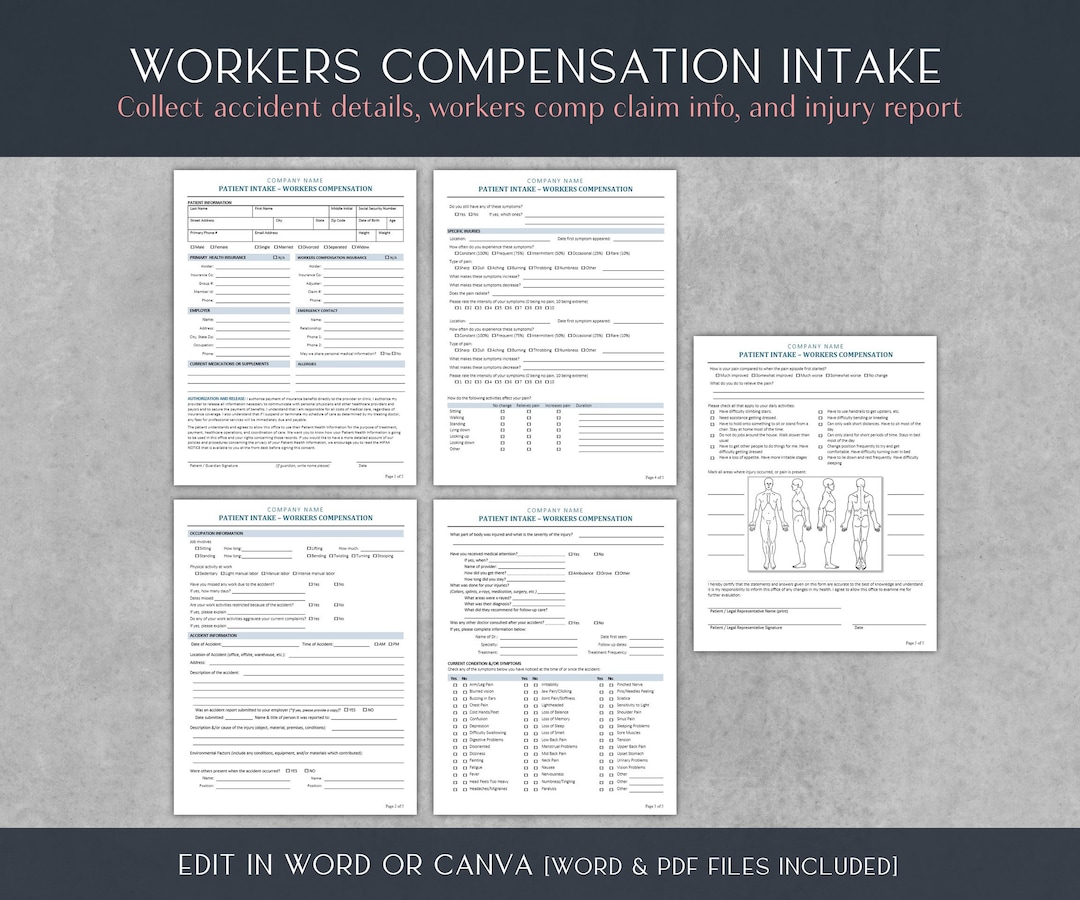
1. Employee’s Notice of Injury and Claim Form
The Employee’s Claim Form is the foundational document that officially opens a workers' compensation case. The injured worker must complete and sign this form to describe how, when, and where the incident occurred.
Key details collected on this form include:
- Personal identification details, wage history, and job classification.
- Date, time, and precise physical location of the incident.
- A detailed narrative describing the mechanism of injury (e.g., falling off a ladder, repetitive strain, chemical exposure).
- Affected body parts and immediate physical symptoms.
- Names of any witnesses present during the event.
States utilize different standardized designations for this form. For example, California uses Form DWC-1, New York uses Form C-3, and Texas utilizes DWC Form-041. In most jurisdictions, the employer must provide this form to the employee within 24 to 48 hours of learning about the workplace injury.
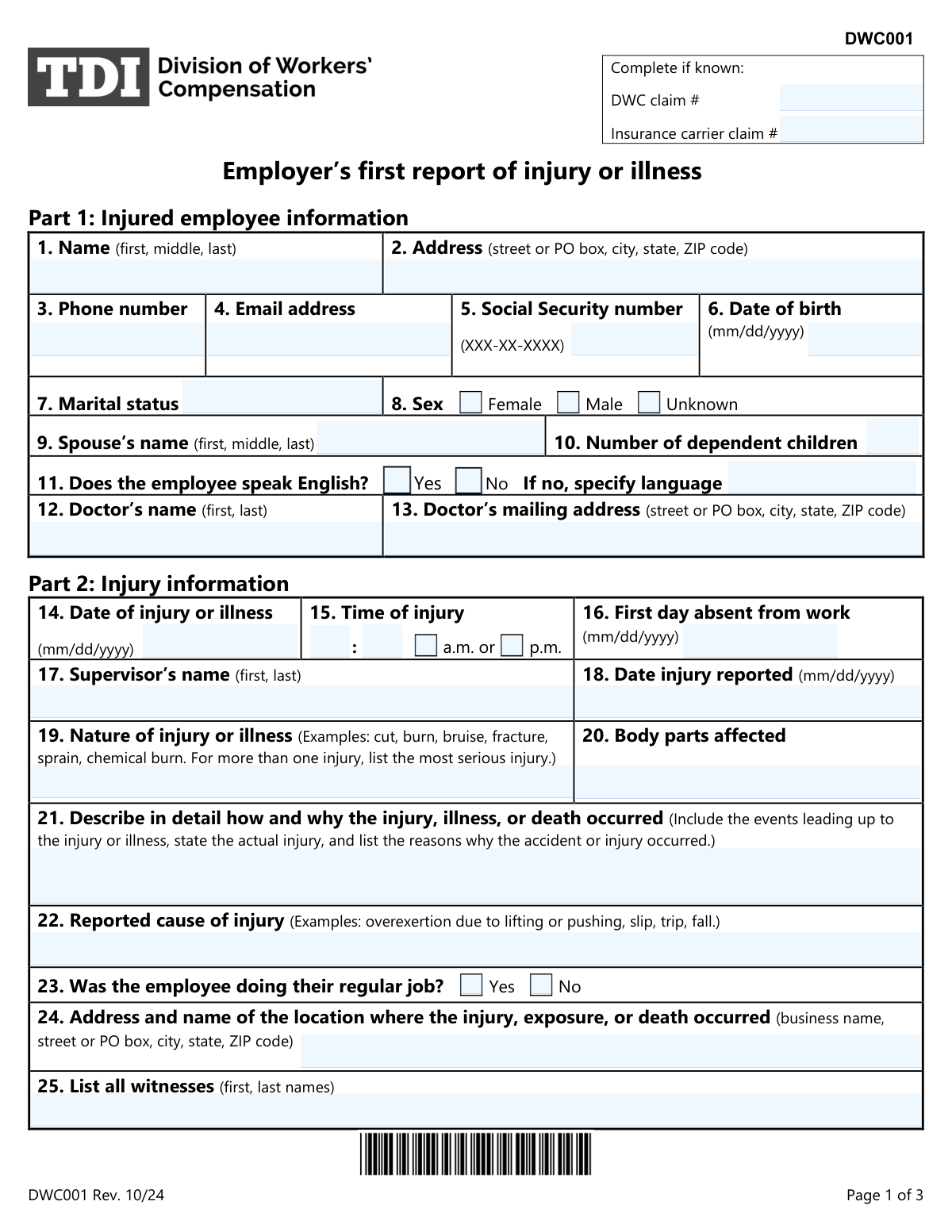
2. Employer’s First Report of Injury or Illness (FROI)
The Employer’s First Report of Injury (FROI) is the formal notification submitted by the employer to their workers' compensation insurance carrier and the state workers' compensation board. This form confirms that the employer has been informed of an alleged workplace injury and initiates the insurer's formal claim investigation.
The FROI requires human resources or safety personnel to supply details including:
- Company identification, policy numbers, and North American Industry Classification System (NAICS) codes.
- Employee payroll data used to calculate the Average Weekly Wage (AWW) for temporary total disability benefits.
- Employer’s verified account of the incident and preliminary safety measures taken.
- Notification of whether the claim is accepted, under investigation, or disputed based on initial evidence.
State laws mandate strict filing windows for the FROI, typically ranging from 24 hours to 10 calendar days following notice of the injury. Failure to submit the FROI within the statutory deadline can result in administrative fines from the state board and potential penalties from insurance regulators.
3. Attending Physician’s Report and Work Status Forms
Medical evidence is the cornerstone of any workers' compensation claim. The treating medical provider must complete standardized medical forms to establish causality, outline necessary treatment plans, and document work restrictions.
Common medical forms include:
- Initial Attending Physician Report: (e.g., New York Form C-4 or California Form PR-2). Completed by the initial evaluating physician to state whether, in their medical opinion, the diagnosed condition was directly caused by the reported workplace incident.
- Progress and Functional Capacity Reports: Completed during ongoing treatment to evaluate medical improvement, outline functional limitations, and justify physical therapy or surgical interventions.
- Work Status / Light-Duty Authorization Form: Documents specific physical restrictions (e.g., "no lifting over 10 pounds," "seated work only for 4 hours daily") required for safe return-to-work programs.
Without completed physician reports, insurance carriers cannot authorize wage replacement checks or pay medical bills, often leading to immediate claim delays.
Federal OSHA Recordkeeping and Reporting Forms
Employers with more than 10 employees (and not in a low-hazard exempt industry classification) are required by federal law under 29 CFR 1904 to maintain detailed records of work-related injuries and illnesses. Three primary forms form the backbone of OSHA's recordkeeping system.
| Form Number | Form Name | Main Function |
|---|---|---|
| OSHA Form 301 | Injury & Illness Incident Report | Deep-dive into single incident |
| OSHA Form 300 | Log of Work-Related Injuries | Continuous running record |
| OSHA Form 300A | Annual Summary of Work Injuries | Year-end employee posting |
OSHA Form 301: Injury and Illness Incident Report
OSHA Form 301 is the individual incident report completed for every single recordable injury or illness that occurs in the workplace. An injury is considered "recordable" if it results in death, days away from work, restricted work or transfer to another job, medical treatment beyond first aid, loss of consciousness, or a significant injury/illness diagnosed by a physician.
Form 301 requires safety officers to document:
- What the employee was doing immediately before the incident occurred (e.g., "lifting a 50 lb box off a pallet").
- Exactly how the injury occurred and what tools, equipment, or materials were involved.
- Specific diagnosis and body parts affected.
- Healthcare facility details if emergency care was administered.
Employers must complete OSHA Form 301—or an approved equivalent state workers' comp form that contains all required OSHA fields—within 7 calendar days after receiving information that a recordable case has occurred.
OSHA Form 300: Log of Work-Related Injuries and Illnesses
OSHA Form 300 serves as a centralized, continuous log of all recordable incidents occurring within a establishment during a calendar year. Rather than treating each incident in isolation, Form 300 tracks collective workplace safety data across the entire organization.
The log entries detail:
- Employee name and job title.
- Date of injury or onset of illness.
- Specific location where the event occurred.
- Categorization of the case (Death, Days Away From Work, Job Transfer/Restriction, or Other Recordable Cases).
- Number of days the worker was away from work or on job restriction.
- Classification of the illness (Injury, Skin Disorder, Respiratory Condition, Poisoning, Hearing Loss, All Other Illnesses).
Because the Log contains privacy-sensitive information, OSHA mandates strict confidentiality management, including substituting "Privacy Case" for the employee's name in cases involving sensitive conditions (such as sexual assault, mental illness, or bloodborne pathogen exposures).
OSHA Form 300A: Summary of Work-Related Injuries and Illnesses
OSHA Form 300A is the annual summary compiled at the close of each calendar year. It condenses all entries from the OSHA 300 Log into aggregate totals, showing total recordable injuries, total days away from work, total restricted-duty days, and total hours worked by all employees during that year.
Key requirements for Form 300A include:
- Executive Certification: Must be reviewed and signed by a company executive (such as an officer of the corporation, highest-ranking site official, or owner).
- Workplace Posting Mandate: Employers must post a physical copy of the completed Form 300A in a conspicuous location where employee notices are customarily kept from February 1 through April 30 of the year following the recordkeeping year.
- Electronic Submission Requirements: Specific establishments meeting size and industry risk thresholds must submit their Form 300A (and Form 300/301 details for larger high-hazard facilities) electronically via OSHA’s Injury Tracking Application (ITA) annually.
Severe Injury Immediate Reporting Protocols
While routine recordable injuries are documented on Forms 301 and 300 within 7 days, severe workplace incidents trigger mandatory direct notification rules to OSHA that operate outside standard paperwork timelines:
- Workplace Fatalities: Must be reported to OSHA verbally or electronically within 8 hours.
- Inpatient Hospitalizations, Amputations, or Loss of an Eye: Must be reported to OSHA within 24 hours.
Failing to meet these emergency notification deadlines carries severe administrative financial penalties regardless of whether internal forms were eventually completed.
Internal Workplace Investigation and Administration Forms
Beyond regulatory state and federal forms, risk management departments rely on internal documentation to control liability, maintain safety protocols, and manage return-to-work transitions.
| Document Name | Core Purpose & Value |
|---|---|
| Supervisor Investigation | Identifies root causes, unsafe conditions, corrective ops. |
| Witness Statement Form | Captures unbiased first-hand accounts of the event. |
| Refusal of Care Form | Protects liability if worker declines medical treatment. |
| Light-Duty Release Form | Outlines safe work modifications approved by treating MD. |
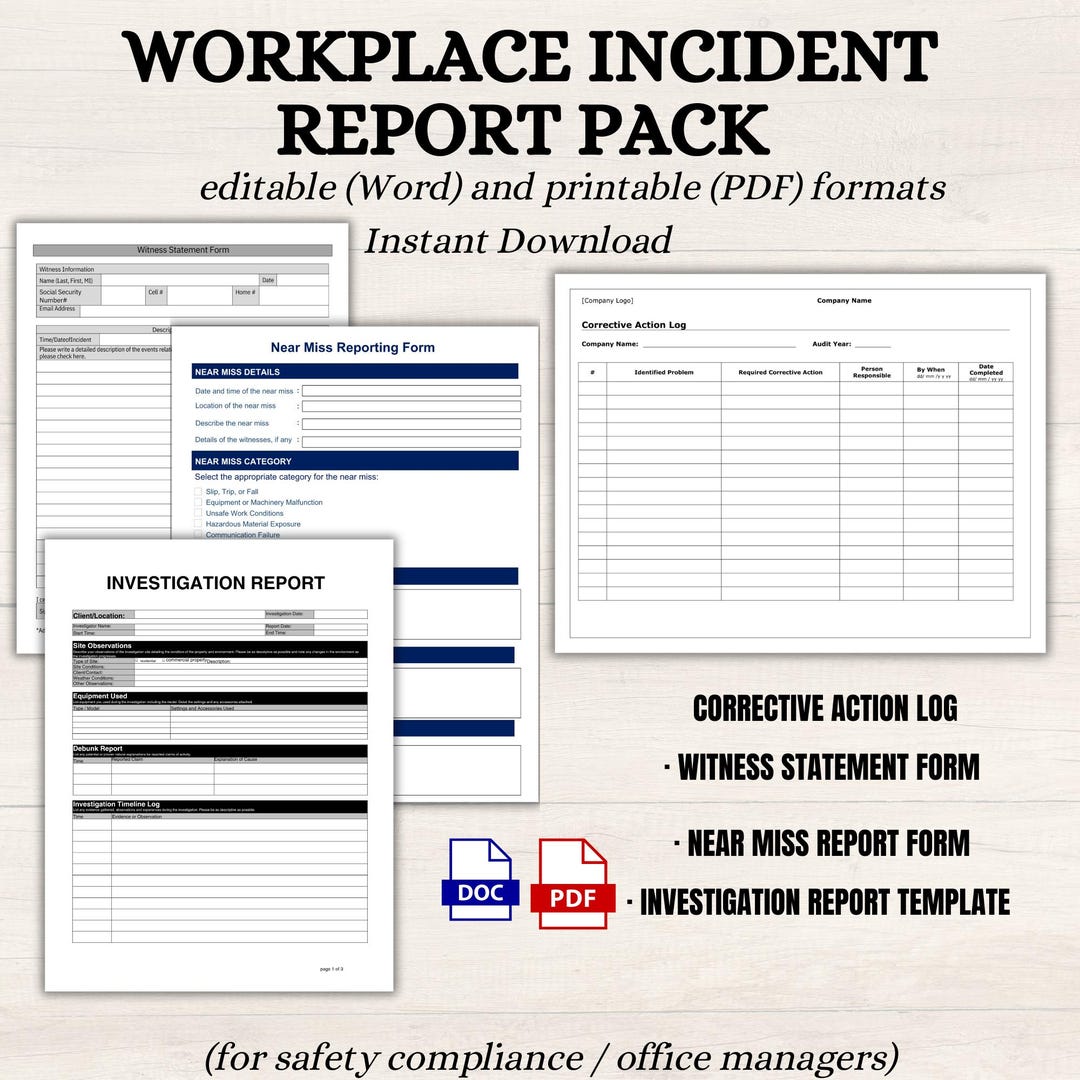
Supervisor Incident Investigation Report
Completed by the immediate manager or safety manager, this internal form focuses on root-cause analysis rather than fault allocation. It asks critical operational questions:
- Were safety protocols, personal protective equipment (PPE), and machine guards being utilized properly?
- Did environmental conditions (e.g., poor lighting, wet floors, extreme cold) contribute to the incident?
- What specific corrective actions, equipment repairs, or retrainings must be implemented immediately to prevent recurrence?
Witness Statement Form
Capturing contemporaneous statements from coworkers who observed the incident is critical for establishing an accurate timeline. A structured witness statement form collects independent observations while memories are fresh, helping clear up conflicting statements during insurance claims investigations.
Refusal of Medical Treatment Form
If an employee reports a minor workplace incident (such as a minor scrape or bump) but declines professional medical evaluation, the employer should request that the employee sign a formal Refusal of Medical Care Form. This document confirms that the worker was offered medical care, elected to decline treatment at that time, and understands their right to request medical evaluation later if symptoms deteriorate. This protects employers against claims of medical neglect or failure to provide access to care.
Transitional Duty / Return-to-Work Acceptance Form
When a physician approves an injured worker for modified or light-duty work, the employer should issue a formal Transitional Duty Offer Letter and Acceptance Form. This document clearly outlines the temporary job duties, physical accommodations, working hours, and wage rates, ensuring both parties agree to the modified work assignment within the doctor's restrictions.
Master Comparison: Essential Incident & Workers' Comp Forms
To streamline administrative workflow, the following reference table details the primary forms, responsible parties, deadlines, and submission targets required for workplace incident management.
| Form Name | Category | Primary Purpose | Prepared By | Submission / Action Deadline | Receiving Entity |
|---|---|---|---|---|---|
| Employee Claim Form (e.g., DWC-1, C-3) | Workers' Comp | Formally opens insurance claim for benefits | Injured Employee | State specific (Often 30 days to 1 year) | Employer & State WC Board |
| First Report of Injury (FROI) | Workers' Comp | Reports incident to insurer and state | Employer / HR | 24 hours to 10 days post-notice | Insurer & State Board |
| Physician Report (e.g., C-4, PR-2) | Medical | Establishes diagnosis, causality, restrictions | Treating Doctor | 48 hours to 14 days post-exam | Insurer, Employer, Employee |
| OSHA Form 301 | Federal Record | Detailed single-incident record | Safety / HR | Within 7 calendar days | Maintained internally on file |
| OSHA Form 300 | Federal Record | Continuous log of recordable injuries | Safety / HR | Updated within 7 calendar days | Maintained internally on file |
| OSHA Form 300A | Federal Record | Annual summary of workplace injuries | Corporate Executive | Post Feb 1–Apr 30; Submit online annually | Employees (Posted) / OSHA ITA |
| Supervisor Incident Report | Internal | Root-cause analysis and hazard prevention | Supervisor | Within 24 hours of incident | Internal Risk Management |
| Refusal of Care Form | Internal | Documents employee declination of treatment | Employee / HR | Same day as incident | Internal HR File |
Common Reporting Mistakes and Timelines to Avoid Claim Denial
Navigating workplace incident documentation under tight statutory deadlines frequently leads to administrative errors. Avoiding these common mistakes helps ensure compliance and smooth claim processing:
| Common Error | Operational & Legal Impact |
|---|---|
| Delaying FROI for Investigation | Administrative fines & delayed insurance processing |
| Confusing First Aid with OSHA Case | Unnecessary OSHA log entries & skewed safety metrics |
| Vague Mechanism Descriptions | Increased insurance claim denials & legal disputes |
| Incomplete Return-to-Work Forms | Exposure to re-injury claims & disability pay gaps |
1. Delaying Claims Submission Pending Internal Investigation
Employers often make the mistake of withholding the First Report of Injury (FROI) while conducting internal investigations to determine if a claim is valid or fraudulent. Statutorily, the employer must submit the FROI based on the employee's notice, regardless of whether the employer agrees with the worker's account. Investigatory findings can be submitted separately to the insurance adjuster to dispute liability. Withholding the initial form exposes the business to state fines and interest penalties on delayed medical payments.
2. Misclassifying First Aid vs. OSHA Recordable Incidents
A frequent point of confusion involves distinguishing between standard medical treatment and basic First Aid. Under OSHA 29 CFR 1904.7(b)(5)(ii), First Aid is explicitly defined and limited to 14 specific treatments (such as using non-prescription medications at non-prescription strength, cleaning superficial wounds, using hot/cold therapy, or using eye patches).
If a doctor provides treatment strictly limited to these 14 items, the incident is not recordable on OSHA Forms 300 and 301, even if a doctor administered the care. Logging non-recordable first-aid cases inflates an organization's Total Recordable Incident Rate (TRIR), which can negatively impact bidding eligibility for commercial contracts.
3. Vague Incident Narratives
Providing generalized descriptions on employee claim forms or OSHA 301 reports—such as writing "back hurt while working" instead of "felt sudden lower back pain while lifting a 60 lb steel beam without assistance"—often triggers immediate claim denials by insurance adjusters. Precise, descriptive physical narratives clarify the causal link between employment duties and the resulting medical diagnosis.
Frequently Asked Questions
What is the difference between an OSHA 301 form and a Workers' Compensation FROI form?
OSHA Form 301 is a federal recordkeeping document used solely for internal safety tracking, hazard analysis, and federal regulatory compliance. The Employer's First Report of Injury (FROI) is a state-level legal and insurance document submitted directly to insurance carriers and state administrative boards to process medical payment claims and wage-loss compensation. While some states permit an completed FROI to substitute for an OSHA 301, they fulfill distinct regulatory functions.
How long must an employer keep OSHA injury forms on file?
Employers must retain OSHA Forms 300, 300A, and 301 (along with any supporting privacy case lists or equivalent state forms) for five (5) years following the end of the calendar year that the records cover. These records must be made available to OSHA inspectors or authorized employee representatives upon request within designated regulatory timeframes.
What forms are required if an injured employee refuses medical treatment?
If an employee reports a workplace incident but refuses medical attention, the employer should document the event using an internal Supervisor Incident Report alongside a signed Refusal of Medical Treatment Form. If the injury meets OSHA recordability criteria (for instance, if it involved loss of consciousness or mandated job restrictions), it must still be logged on OSHA Forms 300 and 301, even if the worker declines formal medical care.
Can an employer use state workers' compensation forms instead of federal OSHA forms?
Yes, under OSHA recordkeeping regulations, employers may substitute state workers' compensation forms (such as a state FROI) for the OSHA Form 301 only if the substitute state form contains every single data field required by OSHA Form 301. Employers cannot substitute state forms for the centralized OSHA Form 300 Log or the OSHA Form 300A Annual Summary.
What forms must be filed when an employee returns to work on modified duty?
When an employee returns under modified work conditions, key documentation includes the Attending Physician’s Work Status Report (detailing exact medical restrictions) and a written Transitional Duty Offer/Acceptance Form signed by both employer and employee. Additionally, the supervisor must record total days of restricted work activity on the organization's OSHA Form 300 Log.
Practical Implementation Steps for Employers
To maintain full compliance and streamline administrative responses to workplace incidents, organizations should establish a clear reporting checklist:
- Immediate Care and Notification: Administer required first aid or facilitate emergency medical transport. Issue the state-mandated Employee Claim Form (e.g., DWC-1) within 24 hours of notification.
- Execute Emergency OSHA Protocols: If the incident involves a fatality, hospitalization, amputation, or loss of an eye, contact OSHA directly within statutory windows (8 hours for fatalities; 24 hours for severe injuries).
- Submit Insurer Documentation: Complete and transmit the Employer's First Report of Injury (FROI) to your workers' compensation insurance carrier within the mandated state window.
- Complete Internal Safety Records: Conduct a root-cause investigation, complete the internal Supervisor Incident Report, and fill out OSHA Form 301 within 7 calendar days for recordable cases.
- Update Continuous Logs: Record the case specifics on OSHA Form 300, ensuring proper tracking of any subsequent lost workdays or job restrictions.
- Annual Review and Certification: Conclude annual tracking by summarizing data on OSHA Form 300A, securing executive certification, posting the summary publicly from February 1 through April 30, and submitting electronic files to OSHA if mandated by establishment size.
Image Gallery