Life Insurance Premium Tax Rate in the United States: State Rates and Tax Rules
In the United States, there is no single federal life insurance premium tax rate. Instead, individual states levy a gross premium tax on insurance companies operating within their borders, with state rates typically ranging between 0.5...
In the United States, there is no single federal life insurance premium tax rate. Instead, individual states levy a gross premium tax on insurance companies operating within their borders, with state rates typically ranging between 0.5% and 3.5%. While insurers pay this tax directly, the cost is ultimately factored into policy pricing. Meanwhile, individual policyholders do not pay direct taxes on life insurance premiums, nor can they deduct premiums on federal tax returns.
Contents
Understanding the State Life Insurance Premium Tax
The life insurance premium tax is an excise tax assessed by U.S. state governments on the gross amount of insurance premiums written by insurers within that state. Unlike sales taxes, which are added directly to a consumer's receipt at the point of sale, the premium tax is levied directly on the underwriting insurance carrier.
State governments utilize premium taxes as a primary revenue source to fund state operations and finance state insurance regulatory bodies, such as state insurance departments. Because insurance companies are generally exempt from standard state corporate income taxes in many jurisdictions, the gross premium tax serves as the primary state tax mechanism for the insurance industry.
Gross Premiums Written in State × State Premium Tax Rate = Tax Liability Paid by Insurer
Although insurers bear the legal liability for paying state premium taxes, the financial burden is indirectly passed on to consumers. Insurance actuaries incorporate state premium tax rates into policy expense loads when calculating premiums for term life, whole life, and universal life products. As a result, policyholders residing in states with higher premium tax rates effectively pay slightly higher overall life insurance costs.
State-by-State Life Insurance Premium Tax Rates
Premium tax rates, statutory exemptions, and tax credits vary significantly across all 50 states and the District of Columbia. Most states impose a flat rate on gross premiums, though some offer rate reductions for insurers that maintain significant capital investments or home office facilities within the state.
The following table summarizes the life insurance gross premium tax rates, primary governing authorities, and key structural features across key U.S. jurisdictions:
| State | Base Life Premium Tax Rate | Statutory Reference | Key Features & Deductions |
|---|---|---|---|
| California | 2.35% | Cal. Rev. & Tax. Code § 12202 | Flat rate applied to gross life insurance premiums written; retaliatory tax applies to foreign insurers. |
| Texas | 1.60% | Tex. Ins. Code § 222.003 | Applies to life, accident, and health premiums; tax credits available for qualifying state investments. |
| Florida | 1.75% | Fla. Stat. § 624.509 | 1.75% base rate; salary tax credits and regional home office credits can lower effective rates. |
| New York | 1.50% - 2.00% | N.Y. Tax Law Art. 33 | Tiered structure based on life vs. non-life lines and cap mechanisms under franchise tax provisions. |
| Illinois | 0.50% | 215 ILCS 5/409 | Low baseline rate of 0.50% for life insurance; offset by corporate income tax integration rules. |
| Pennsylvania | 2.00% | 72 P.S. § 7902 | Flat 2% premium tax on life policies written on Pennsylvania residents. |
| Ohio | 1.40% | Ohio Rev. Code § 5725.18 | Applied to domestic and foreign life insurers with statutory minimum assessment thresholds. |
| Georgia | 2.25% | O.C.G.A. § 33-8-4 | Base state rate of 2.25%; local municipalities may levy additional local premium taxes up to 1%. |
| North Carolina | 1.90% | N.C. Gen. Stat. § 105-228.5 | Standard rate applied to life insurance gross premiums written. |
| Delaware | 2.00% | 18 Del. C. § 702 | Sliding scale for high-volume premiums (rates drop for premiums exceeding $10 million). |
Note: Rates reflect baseline statutory schedules for life insurance policies. Specific rules for annuity considerations, group life, and variable policies may differ within each jurisdiction.
Retaliatory Taxes and Domiciliary Impact
A critical element of state premium taxation in the United States is the legal doctrine of retaliatory taxation. Enacted by nearly all U.S. states, retaliatory tax laws are designed to protect domestic insurance carriers from discriminatory taxation by other states.
Under retaliatory tax statutes, if State A imposes a higher premium tax rate (or stricter regulatory fees) on an insurance carrier domiciled in State B than State B charges to out-of-state insurers, State B will automatically increase its tax rate on carriers from State A to match that higher rate.
How Retaliatory Tax Mechanics Work
- Domestic Domicile: An insurance company is domiciled in State A, where the domestic life premium tax rate is 1.5%.
- Foreign Business: The company sells life insurance policies to residents in State B, where the local premium tax rate is 2.5%.
- Retaliatory Calculation: State B taxes the company at 2.5% for business written within State B. Furthermore, if State A charges State B's insurers 2.5% when operating in State A, State B enforces matching conditions.
Retaliatory taxation encourages state legislatures to keep baseline life insurance premium tax rates competitive. If a state raises its domestic premium tax rate significantly, its home-domiciled insurers face increased tax burdens across every other state in which they do business.
Federal Tax Treatment of Life Insurance Premiums
While states govern premium taxes on insurance carriers, the Internal Revenue Service (IRS) regulates how life insurance premiums and death benefits are treated for individual and business federal income tax purposes.
- Federal Tax Treatment Summary
- Individual Policy
- Premiums: Non-deductible
- Cash Value: Tax-deferred
- Death Benefit: Tax-free
- Business Premium
- Premiums: Non-deductible (if business is beneficiary)
- Key Person Proceeds: Tax-free
- Individual Policy
Are Life Insurance Premiums Tax-Deductible for Individuals?
Under Section 262 of the Internal Revenue Code (IRC), life insurance premiums paid by individuals are classified as personal, living, or family expenses. Consequently, individuals cannot deduct life insurance premiums from their federal adjusted gross income (AGI).
Are Premiums Tax-Deductible for Businesses?
For corporate entities and business owners, IRC Section 264 governs the deductibility of life insurance premiums:
- Non-Deductible Premiums: Premium payments are not tax-deductible if the business is directly or indirectly a beneficiary under the contract. This rule applies to key person life insurance, buy-sell agreement funding, and split-dollar arrangements where the business retains an interest.
- Deductible Exception: Businesses may deduct life insurance premiums as a standard business expense only if the payment qualifies as compensation to an employee (such as executive bonus plans under IRC Section 162), provided the employer is not a beneficiary under the policy and total compensation remains reasonable.
Tax Treatment of Death Benefits and Cash Value Growth
Understanding the tax implications of life insurance extends beyond premium tax rates to include cash surrender growth and distribution proceeds.
Tax-Free Death Benefits (IRC Section 101(a))
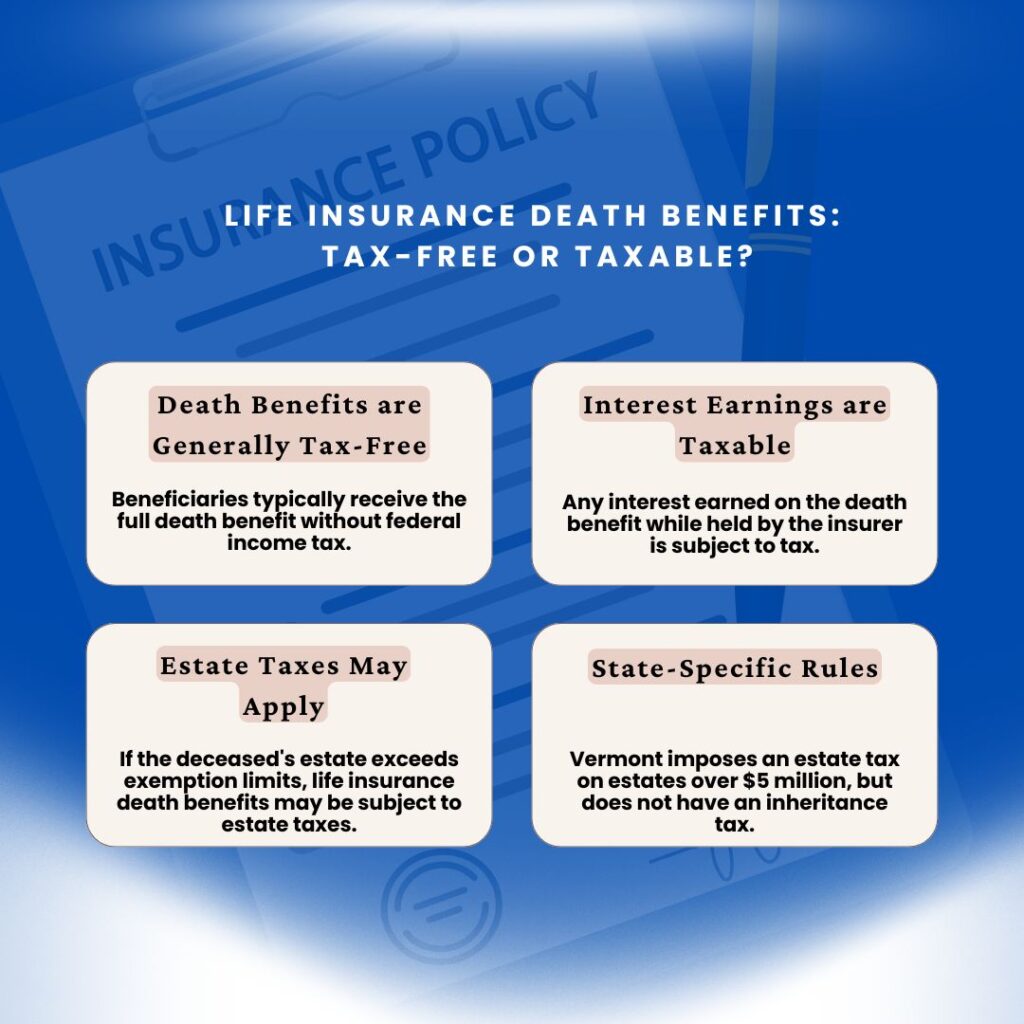
Under IRC Section 101(a), gross income generally does not include amounts received under a life insurance contract if such amounts are paid by reason of the death of the insured. Beneficiaries receive the lump-sum death benefit free from federal income tax.
However, interest earned on death benefit proceeds that are held by the insurer under an installment settlement option is subject to standard federal and state income tax.
Tax-Deferred Cash Value Accumulation
Permanent life insurance policies—such as whole life, universal life, and variable universal life—build internal cash value over time. Under federal tax law:
- Tax-Deferred Growth: Interest, dividends, and capital gains realized within the policy's cash value grow tax-deferred under IRC Section 7702. Policyholders do not report annual gains on their tax returns.
- FIFO Withdrawals: Cash surrenders or partial withdrawals are taxed on a First-In, First-Out (FIFO) basis. Distributions up to the policyholder's total premium basis (cost basis) are returned tax-free. Any withdrawal exceeding the cost basis is taxable as ordinary income.
- Policy Loans: Borrowing against policy cash value is generally non-taxable, provided the policy remains active and avoids lapsing with an outstanding loan balance higher than the basis.
Special Tax Classifications and Exceptions
Certain structural modifications to life insurance policies can alter their tax status and subject policyholders to unexpected tax obligations.
Modified Endowment Contracts (MECs)
To prevent life insurance from being utilized purely as a tax-sheltered investment vehicle, Congress introduced the 7-Pay Test under IRC Section 7702A. If total premium payments made into a permanent policy during its first seven years exceed the cumulative amount needed to fund a paid-up policy, the policy becomes classified as a Modified Endowment Contract (MEC).
If a policy becomes a MEC:
- Withdrawals and policy loans are taxed on a Last-In, First-Out (LIFO) basis, meaning earnings are withdrawn first and taxed as ordinary income.
- Taxable distributions taken prior to age 59½ are subject to an additional 10% federal penalty tax.
- The policy's death benefit remains tax-free to beneficiaries under IRC Section 101(a).
Transfer-for-Value Rule
If a life insurance policy is transferred or sold to another party for valuable consideration (such as cash, property, or debt relief), the death benefit loses its complete income tax exemption under IRC Section 101(a)(2).
Upon the insured's death, the transferee can only exclude from gross income an amount equal to the actual value of consideration paid plus subsequent premiums paid. The remaining death benefit balance is taxed as ordinary income.
Exceptions to the Transfer-for-Value rule include transfers to:
- The insured individual.
- A partner of the insured or a partnership in which the insured is a partner.
- A corporation in which the insured is an officer or shareholder.
- A recipient whose tax basis is determined in whole or in part by reference to the transferor's basis (such as tax-free corporate reorganizations).
Frequently Asked Questions
What is the average life insurance premium tax rate in the U.S.?
The average state life insurance gross premium tax rate ranges between 1.5% and 2.25%. While states like Illinois set baseline rates as low as 0.5%, others like California impose rates of 2.35%, and certain municipalities in states like Georgia levy local add-on taxes.
Do I have to report life insurance premium tax on my tax return?
No. Individual policyholders do not report state premium taxes on their income tax returns. The premium tax is paid directly by insurance companies to state tax authorities, though it is indirectly built into the overall policy premiums quoted by insurers.
Are life insurance premiums tax-deductible for individuals?
No. Under IRC Section 262, life insurance premium payments are considered non-deductible personal expenses for individuals.
How does state premium tax affect policy cash value growth?
State premium taxes are included in the insurer's expense deductions (often called policy load charges) deducted from premium payments before net cash is allocated to the policy's cash value account. Higher state premium tax loads slightly reduce the initial cash allocation.
Are group life insurance premiums paid by an employer taxable to the employee?
Under IRC Section 79, an employer can provide up to $50,000 of group term life insurance coverage to an employee without triggering taxable income. If coverage exceeds $50,000, the cost of the coverage in excess of $50,000 (calculated using IRS Uniform Premium Table I rates) must be included in the employee's gross income as taxable wages.
Strategic Guidance for Consumers and Businesses
When evaluating life insurance products, policyholders and business planners should account for both state premium tax dynamics and federal tax structures:
- Compare Total Policy Cost Loads: When shopping for permanent life insurance, review the policy illustration to see how policy expense loads (which include state premium tax allocations) affect early-year cash value accumulation.
- Structure Business Coverage Correctly: Ensure key person policies, buy-sell funding mechanisms, and executive benefits are properly drafted to preserve tax-free death benefit proceeds and maintain compliance with IRC Section 101(g) and Section 264.
- Monitor 7-Pay Limits: Avoid accidentally turning a permanent life insurance contract into a Modified Endowment Contract (MEC) by consulting with an insurance professional or financial advisor before making large, lump-sum premium payments.
Disclaimer: Tax laws, state premium tax statutes, and IRS regulations change periodically. Consult a licensed insurance professional, certified public accountant (CPA), or tax attorney for specific advice tailored to your tax situation.
Image Gallery