Why the Six Sigma Online Certification Matters for Modern Professionals
A Six Sigma online certification validates a professional's expertise in applying structured, data-driven methodologies to eliminate defects, reduce process variation, and streamline operations. Earning this credential online delivers...
A Six Sigma online certification validates a professional's expertise in applying structured, data-driven methodologies to eliminate defects, reduce process variation, and streamline operations. Earning this credential online delivers flexible access to globally recognized frameworks like DMAIC (Define, Measure, Analyze, Improve, Control). It demonstrates to employers that an individual can deliver quantifiable financial savings, optimize workflows, and drive organizational quality across diverse industries.
Contents
The Value of Six Sigma in Data-Driven Business Environments
Six Sigma is a disciplined, data-centric methodology developed to minimize process variation and achieve near-perfect quality operational outputs. Mathematically, achieving a Six Sigma quality level means an enterprise operation produces no more than 3.4 defects per million opportunities (DPMO). While originally established in manufacturing by Motorola in the 1980s and popularized by General Electric in the 1990s, the application of Six Sigma has expanded into almost every sector, including healthcare, financial services, software engineering, logistics, and executive management.
In modern enterprise environments, gut-feel decision-making has been replaced by statistical evidence and systematic problem-solving. Organization leaders rely on structured frameworks to manage operational risk, optimize supply chains, and maintain strict service-level agreements (SLAs). Possessing a Six Sigma credential signals that a practitioner understands how to translate unstructured business problems into quantifiable metrics, isolate root causes, and deploy controls that protect the bottom line.
The online delivery model for Six Sigma education has democratized access to these advanced methodologies. Rather than taking weeks of unpaid leave or incurring substantial travel costs for on-site seminars, working professionals can complete rigorous coursework, participate in statistical simulations, and take proctored examinations from anywhere in the world.
Primary Career and Financial Benefits of Online Certification
1. Distinct Advantage in Applicant Tracking Systems (ATS) and Recruitment
Hiring managers routinely screen resumes for specialized keywords, process engineering competencies, and professional credentials. Holding an accredited online Six Sigma certification instantly differentiates an applicant from peers. It serves as objective proof of analytical capability, project management experience, and continuous improvement mindsets.
For professionals seeking promotions or transitioning across industries, the certification demonstrates portable expertise. A Green Belt or Black Belt credential shows an interviewer that the candidate speaks the universal language of operational excellence, regardless of whether their background is in healthcare administration, retail operations, or information technology.
2. Quantifiable Salary Premiums and Career Advancement
Professional credentials directly correlate with higher compensation structures. Compensation surveys in management and industrial engineering consistently highlight that certified Six Sigma professionals earn higher average salaries than non-certified peers in equivalent roles.
Because Six Sigma projects directly affect financial metrics—such as scrap reduction, yield improvement, cycle-time shortening, and customer churn reduction—certified practitioners can quantify their exact monetary contribution to an employer. This tangible proof of return on investment (ROI) provides leverage during annual performance reviews, salary negotiations, and executive promotion discussions.
3. Cross-Functional Leadership and Change Management Skills
Six Sigma training extends beyond statistical formulas and control charts; it fundamentally alters how professionals lead teams and manage enterprise change. Implementing process improvements requires navigating organizational culture, aligning stakeholders, establishing key performance indicators (KPIs), and overcoming employee resistance to new workflows. Earning a credential equips practitioners with soft skills in change management alongside hard skills in statistical analysis.
Evolving Beyond Traditional Classroom Learning
The transition of Six Sigma training to digital formats has expanded access while maintaining academic and professional rigor. Online platforms leverage interactive simulations, automated grading of statistical problem sets, and cloud-based software integration (such as Minitab, JMP, or R) to replicate real-world problem-solving environments.
| DEFINE | MEASURE | ANALYZE | IMPROVE | CONTROL |
|---|---|---|---|---|
| Identify project scope and metrics | Collect baseline data & validate measurement system | Pinpoint root causes using hypothesis testing | Implement and validate root-cause solutions | Standardize workflows & monitor key metrics for long-term sustainability |
Key features driving the relevance of online delivery include:
- Self-Paced Learning vs. Cohort Bootcamps: Online programs accommodate working schedules by offering asynchronous modules or intensive live virtual bootcamps, eliminating work disruptions.
- Immediate Software Application: Online learners perform data analysis directly on their desktop systems, using real datasets within statistical software tools alongside lecture video instructions.
- On-Demand Proctored Examinations: Modern accreditation providers utilize secure online proctoring services, ensuring exam integrity while allowing candidates to sit for certification exams at home or at work.
- Digital Verification and Micro-Badging: Online certifications typically issue secure digital badges that can be validated by employers via blockchain or direct verification links on professional platforms such as LinkedIn.
Decoding Six Sigma Belt Levels and Program Requirements
Six Sigma certifications follow a belt hierarchy modeled after martial arts, indicating the practitioner’s level of technical expertise, statistical proficiency, and project leadership capacity. Selecting the appropriate online belt level depends on your current career stage, analytical skill set, and operational responsibilities.
- Master Black Belt: Enterprise Strategy & Mentorship
- Black Belt: Full-time Project Leaders & Advanced Stats
- Green Belt: Part-time Project Leads & DMAIC Execution
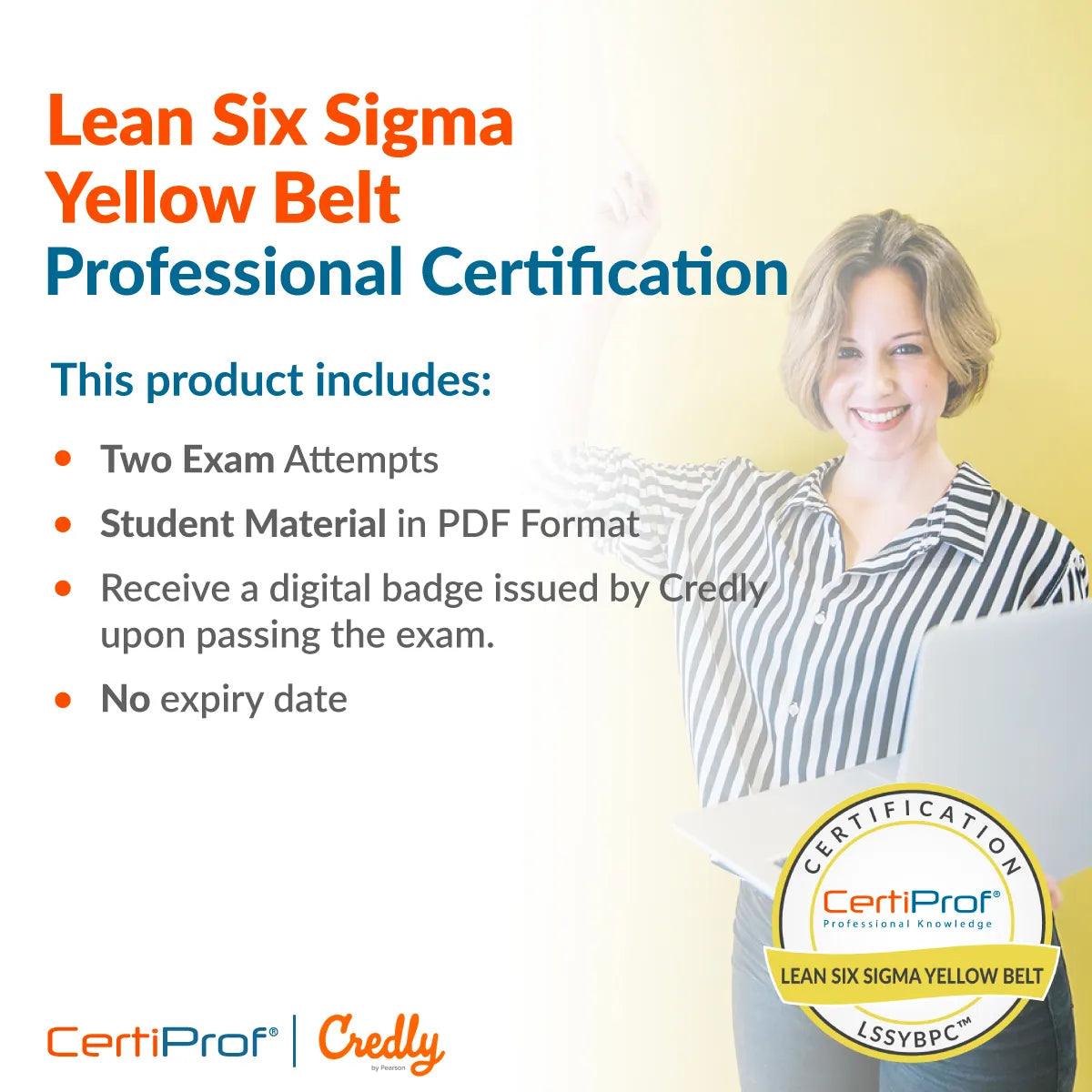
- Yellow Belt: Process Awareness & Data Collection
- White Belt: Basic Foundational Concepts
White Belt and Yellow Belt
- White Belt: Introduces foundational concepts, terminology, and the basic goals of process improvement. It is ideal for general employees participating in enterprise-wide Lean Six Sigma initiatives.
- Yellow Belt: Focuses on practical data collection, process mapping (SIPOC diagrams), basic cause-and-effect tools (Ishikawa diagrams), and supporting Green and Black Belts on larger projects.
Green Belt
The Green Belt is the primary functional operational credential for mid-level managers, engineers, analysts, and project managers. Green Belts lead smaller continuous improvement projects within their immediate departments and act as key team members on enterprise-wide initiatives led by Black Belts. Online Green Belt curricula cover hypothesis testing, process capability analysis ($C_p$ and $C_{pk}$), confidence intervals, and the complete DMAIC workflow.
Black Belt and Master Black Belt
- Black Belt: Denotes an expert practitioner capable of executing complex, multi-departmental projects, performing advanced multivariate regression, designing experiments (DOE), and managing organizational change. Black Belts often serve as internal consultants and full-time project leaders.
- Master Black Belt: Represents the highest level of technical expertise and executive leadership. Master Black Belts train and mentor Green and Black Belts, advise C-suite executives on operational deployment, and oversee global continuous improvement strategy.
Belt Hierarchy Comparison
| Belt Level | Primary Target Audience | Core Analytical Tools Covered | Practical Project Requirement | Typical Completion Window |
|---|---|---|---|---|
| Yellow Belt | Team members, support staff, entry-level analysts | Process mapping, Pareto charts, basic metrics, 5-Whys | Optional / Awareness project | 1 to 2 weeks |
| Green Belt | Department managers, process engineers, project leads | Hypothesis testing, ANOVA, control charts ($X$-bar and $R$), DMAIC | Often required (1 real or simulated project) | 1 to 3 months |
| Black Belt | Senior operations managers, continuous improvement leads | Design of Experiments (DOE), regression models, advanced SPC | Required (1 to 2 completed live enterprise projects) | 3 to 6 months |
| Master Black Belt | Executive directors, enterprise directors of quality | Strategic portfolio management, advanced coaching, deployment metrics | Portfolio of successful enterprise-wide programs | 6 to 12 months |
Navigating Accreditation and Governing Standards
Unlike medicine, law, or public accounting, Six Sigma does not have a single, centralized global governing body. This decentralized structure makes choosing a credible online certification provider critical. Certificates issued by unaccredited "diploma mills" carry little weight with hiring teams, whereas credentials backed by recognized standards bodies hold significant value globally.
When evaluating an online certification program, look for alignment with established standards organizations:
- American Society for Quality (ASQ): Widely recognized as one of the premier quality standards institutions globally. ASQ Six Sigma certifications require verified work experience and rigorous proctored examinations.
- International Association for Six Sigma Certification (IASSC): An independent accreditation body focused exclusively onLean Six Sigma standards. The IASSC standard relies on proctored exams to verify theoretical and practical knowledge without requiring mandatory course enrollment through a single vendor.
- The Council for Six Sigma Certification (CSSC): An accredited provider offering open-source training materials and certification frameworks used by higher education institutions and corporate entities globally. The CSSC framework provides standardized Bodies of Knowledge across all belt levels.
- ISO 18404 Standard: Published by the International Organization for Standardization, the ISO 18404 standard specifies competencies for personnel and organizations in Lean Six Sigma, setting formal benchmark criteria for training institutions.
Red Flags When Selecting an Online Provider
- Guaranteed Passing Rates Without Assessment: Programs promising guaranteed certification in exchange for a fee without proctored testing or project submission.
- Unreasonably Short Completion Times: Claims that a Black Belt credential can be earned in a single weekend.
- Lack of Clear Alignment with a Body of Knowledge: Programs that fail to publish their curriculum map against ASQ, IASSC, or ISO 18404 standards.
Applying Six Sigma Across Non-Manufacturing Sectors
While Six Sigma originated on factory floors, its core strength lies in reducing variation in any measurable business process. Understanding how online training applies to non-manufacturing fields highlights its broad industry utility.
Healthcare Operations
Hospitals and health systems utilize Six Sigma to improve patient outcomes, reduce medical errors, decrease patient wait times in emergency departments, and streamline billing procedures. For instance, applying DMAIC methodologies can reduce surgical site infection rates by standardizing pre-operative preparation protocols.
Financial Services and Banking
In corporate banking, mortgage underwriting, and asset management, transaction errors and processing delays carry severe financial penalties. Six Sigma projects focus on reducing error rates in loan documentation processing, shortening transaction processing cycles, and ensuring regulatory compliance across customer onboarding workflows.
Information Technology and Software Development (DevOps)
In software architecture and cloud infrastructure management, system downtime, bug density, and deployment delays represent operational waste. Combining Six Sigma root-cause analysis with Agile software development frameworks allows engineering managers to isolate systemic defects in software code release pipelines, minimizing unplanned outages and lowering total cost of ownership.
Key Challenges and Implementation Pitfalls to Avoid
While obtaining a Six Sigma online certification offers clear career advantages, practitioners must avoid common pitfalls when deploying these methodologies within real-world organizations:
- Confusing Theory with Practical Execution: Passing a multiple-choice exam does not guarantee operational success. Students should choose online programs that feature practical case studies, real-world data analysis, or guided project execution.
- Over-Engineering Simple Operational Problems: Applying complex statistical hypothesis tests to straightforward administrative issues can create unnecessary delays. A key part of Six Sigma mastery is knowing when to use simple root-cause analysis tools versus advanced statistical modeling.
- Neglecting Cultural and Change Management Aspects: Process improvement projects often fail due to employee resistance rather than statistical miscalculations. Technical proficiency must be paired with clear communication, stakeholder alignment, and practical leadership strategies.
Action Plan: Selecting the Right Online Program
To maximize the return on your investment, follow a structured decision path when enrolling in a Six Sigma online course:
Define Career Goal
Assess Current Level
Verify Accreditation
Confirm Project Scope
Enroll & Apply
Define Your Career Objectives: Determine if your immediate goal is departmental process improvement (Green Belt) or full-time organizational leadership (Black Belt).
Verify Accreditation Alignments: Ensure the provider's body of knowledge aligns with ASQ, IASSC, CSSC, or ISO 18404 standards to guarantee industry recognition.
Evaluate Software Tools Used: Ensure the course includes practical training in standard statistical tools such as Minitab, SigmaXL, R, or Python.
Confirm the Project Assessment Requirement: For Green and Black Belts, choose programs that require a applied project submission or interactive project simulation alongside theoretical testing.
Review Recertification Policies: Check whether the credential requires ongoing professional development units (PDUs), periodic re-examination, or project logging to maintain active status over time.
Frequently Asked Questions
Does an online Six Sigma certification hold the same value as an in-person credential?
Yes, provided the online program is accredited by a recognized organization (such as ASQ, IASSC, or CSSC) and includes rigorous online proctored examinations. Employers evaluate credentials based on the issuing institution's standards and your demonstrated project experience, rather than whether coursework occurred in a classroom or online.
What is the difference between Six Sigma and Lean Six Sigma?
Traditional Six Sigma focuses primarily on reducing process variation, eliminating defects, and improving quality using statistical tools. Lean focuses on identifying non-value-added steps (waste) and accelerating process speed. Modern online certifications generally combine both into Lean Six Sigma, offering a comprehensive methodology for operational speed and accuracy.
Do online Six Sigma certifications expire?
Recertification rules depend on the issuing body. Certifications issued by ASQ typically require recertification every three years through professional development units (PDUs) or re-examination. Credentials issued by IASSC or CSSC may offer non-expiring certifications or specific recertification intervals based on their individual program policies.
What statistical software tools are required during an online course?
Most online Green and Black Belt courses utilize dedicated statistical software like Minitab, SigmaXL, or JMP. Some modern programs also incorporate open-source statistical programming tools like R or Python (specifically libraries like Pandas and SciPy) for automated statistical process control and data analysis.
Can I skip directly to a Black Belt certification online without earning a Green Belt first?
Requirements vary by provider. IASSC allows candidates to sit for the Black Belt examination directly if they possess the requisite knowledge. Conversely, institutions like ASQ require verified proof of completed projects or prerequisite certifications before granting Black Belt status. Review your target certifying body's eligibility requirements prior to enrollment.
Practical Recommendation
If you are beginning your journey in continuous process improvement, start by assessing your current quantitative skills and career objectives. If you lead projects or manage teams, select an accredited Lean Six Sigma Green Belt online program that requires a proctored examination and includes a live or simulated practical project. Ensure the curriculum incorporates hands-on statistical software training, and verify that the certification body aligns with recognized frameworks like ASQ, IASSC, CSSC, or ISO 18404 standards.
Image Gallery