Phases of the Calvin Cycle: How Plants Turn Light into Sugar
The Calvin cycle is a series of light-independent chemical reactions in plant chloroplasts that convert carbon dioxide and hydrogen carrier compounds into glucose. Often called the "dark reactions" because they do not require photons d...
The Calvin cycle is a series of light-independent chemical reactions in plant chloroplasts that convert carbon dioxide and hydrogen carrier compounds into glucose. Often called the "dark reactions" because they do not require photons directly, these phases use the energy stored in ATP and NADPH from the light-dependent reactions to fix inorganic carbon into organic sugar.
Contents
While the name "dark reactions" suggests these processes occur at night, the Calvin cycle is most active during the day when the supply of ATP and NADPH is abundant. In the context of 2026 botanical research and climate science, understanding this cycle is more critical than ever as scientists look for ways to enhance carbon sequestration and crop yields to feed a growing global population. The cycle takes place within the stroma, the fluid-filled space of the chloroplast surrounding the thylakoid membranes.
The Foundation of Life: Photosynthesis and the Calvin Cycle
To understand the phases of the Calvin cycle, one must first view it as the second half of the photosynthetic "hand-off." During the first half—the light-dependent reactions—chlorophyll absorbs solar energy to split water molecules, releasing oxygen as a byproduct and creating two high-energy molecules: ATP (Adenosine Triphosphate) and NADPH (Nicotinamide Adenine Dinucleotide Phosphate).
The Calvin cycle serves as the "synthesis" portion of photosynthesis. It is a regenerative loop where the starting material is reconstructed at the end of each sequence. For every three molecules of carbon dioxide ($CO_2$) that enter the cycle, one molecule of a three-carbon sugar called Glyceraldehyde-3-phosphate (G3P) is produced. This G3P is the literal "sugar" that plants use to build glucose, starch, and cellulose.
The Location: The Chloroplast Stroma
The machinery of the Calvin cycle is housed in the stroma. Unlike the thylakoid membranes where light is harvested, the stroma contains the enzymes necessary for carbon fixation. The most famous of these is RuBisCO (Ribulose-1,5-bisphosphate carboxylase/oxygenase), which is widely considered the most abundant protein on Earth. Its primary job is to "fix" inorganic carbon from the atmosphere into an organic form that the plant can use for growth.
Phase 1: Carbon Fixation
The first phase of the Calvin cycle is Carbon Fixation. In this stage, inorganic carbon dioxide molecules from the atmosphere are "fixed" into organic molecules. This is the bridge between the non-living world of gases and the living world of biological tissues.
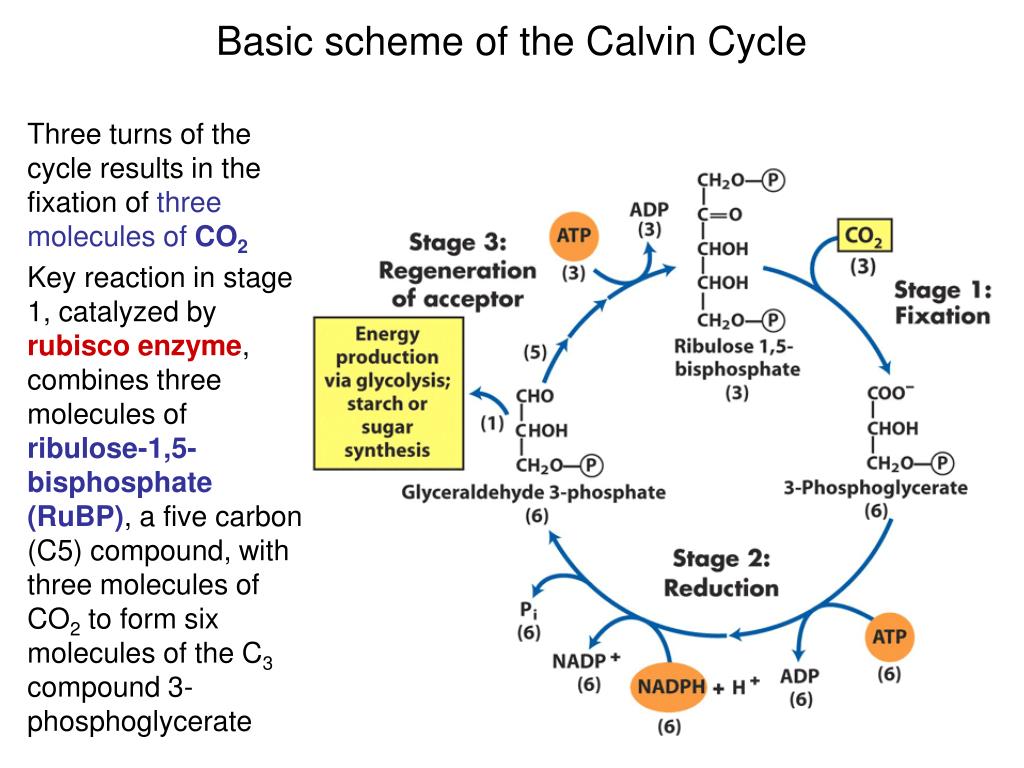
The process begins with a five-carbon sugar called Ribulose-1,5-bisphosphate (RuBP). An enzyme, RuBisCO, catalyzes a reaction between $CO_2$ and RuBP. This reaction creates a highly unstable six-carbon intermediate that almost immediately splits into two molecules of a three-carbon compound called 3-phosphoglycerate (3-PGA).
Because the first stable product of this reaction is a three-carbon molecule (3-PGA), this standard version of the cycle is often referred to as C3 photosynthesis. For every three molecules of $CO_2$ that enter the cycle, six molecules of 3-PGA are produced. This phase is energy-neutral in terms of ATP consumption but is the critical "gatekeeper" for bringing carbon into the biosphere.
Phase 2: The Reduction Phase
The second phase, known as Reduction, is where the actual "work" of turning carbon into sugar happens. This phase requires the energy and electrons harvested during the light-dependent reactions.
- Phosphorylation: Each molecule of 3-PGA receives a phosphate group from ATP (becoming 1,3-bisphosphoglycerate). In this step, ATP is converted into ADP, releasing energy to power the chemical transformation.
- Reduction: Next, NADPH donates electrons (reduces) these molecules to create a three-carbon sugar called Glyceraldehyde-3-phosphate (G3P). During this process, NADPH is oxidized back into $NADP+$, and a phosphate group is released.
At the end of this phase, the plant has produced six molecules of G3P. However, there is a catch: only one of these G3P molecules is considered "profit" that the plant can use to make glucose or other carbohydrates. The other five molecules must remain in the cycle to ensure the process can continue. This high energy cost is why plants require significant sunlight to produce even small amounts of sugar.
Phase 3: Regeneration of RuBP
The final phase is the Regeneration of Ribulose-1,5-bisphosphate (RuBP). This is the most complex stage of the cycle from a structural chemistry perspective. To keep the cycle running, the plant must take the five remaining G3P molecules (which contain a total of 15 carbon atoms) and rearrange them back into three molecules of RuBP (which also contain 15 carbon atoms).
This rearrangement is not a simple swap; it involves a complex series of reactions often called the "sugar shuffle." This phase requires additional ATP—specifically, three molecules of ATP for every three $CO_2$ molecules fixed. Once RuBP is regenerated, the cycle is ready to accept more $CO_2$ and begin the process again.
Without this regeneration phase, the plant would quickly run out of the "acceptor" molecules needed to capture $CO_2$, and photosynthesis would grind to a halt. This emphasizes the "cycle" nature of the process; it is a continuous loop of investment and reinvestment.
The Molecular Balance Sheet
To understand the efficiency of the Calvin cycle as of 2026, we look at the chemical inputs and outputs. To produce a single "net" G3P molecule (which can then be used to build half a glucose molecule), the cycle must turn three times.
| Input/Output Component | Amount for 1 G3P (Net) | Amount for 1 Glucose ($C_6H_{12}O_6$) |
|---|---|---|
| Carbon Dioxide ($CO_2$) | 3 Molecules | 6 Molecules |
| ATP (Energy) | 9 Molecules | 18 Molecules |
| NADPH (Electrons) | 6 Molecules | 12 Molecules |
| RuBP (Recycled) | 3 Molecules | 6 Molecules |
| Net Sugar Output | 1 G3P | 1 Glucose (via 2 G3P) |
As shown in the table, the energy requirements are steep. This is why plants are sensitive to light availability; if the light-dependent reactions cannot supply 18 ATP and 12 NADPH, the plant cannot produce a single molecule of glucose.
RuBisCO: The Efficient Inefficiency
A major focus of plant biology in 2026 remains the enzyme RuBisCO. While essential, it is notoriously "lazy" and inefficient. RuBisCO can sometimes mistake oxygen ($O_2$) for carbon dioxide ($CO_2$). When it fixes oxygen instead of carbon, a wasteful process called photorespiration occurs.
Photorespiration consumes ATP and releases $CO_2$, effectively undoing the work of the Calvin cycle. In hot, dry conditions, plants close their stomata (pores) to prevent water loss. This causes $CO_2$ levels inside the leaf to drop while $O_2$ levels (from the light reactions) rise, significantly increasing the rate of photorespiration. This has led to the evolution of alternative pathways:
- C4 Plants: (e.g., corn, sugarcane) Use a spatial separation technique to concentrate $CO_2$ around RuBisCO, minimizing oxygen contact.
- CAM Plants: (e.g., cacti, pineapples) Use temporal separation, opening stomata at night to store $CO_2$ as an acid and then processing it through the Calvin cycle during the day.
Practical Importance: Beyond the Textbook
The Calvin cycle is not just a theoretical concept; it is the engine of the Earth’s food supply and the primary mechanism for mitigating atmospheric carbon. In 2026, agricultural technology is increasingly focused on "hacking" the Calvin cycle.
Current research into C3-to-C4 conversion aims to engineer rice and wheat varieties that use the more efficient C4 pathway, potentially increasing yields by up to 50%. Furthermore, synthetic biology initiatives are attempting to create "super-RuBisCO" enzymes that are less prone to fixing oxygen, which would drastically reduce the energy waste in major food crops.
For the average gardener or farmer, understanding these phases highlights the importance of three factors: light (for ATP/NADPH), water (the source of electrons for NADPH), and temperature (which affects RuBisCO’s specificity).
FAQ
Does the Calvin cycle happen at night?
While the Calvin cycle does not require light directly, it relies on ATP and NADPH, which are short-lived products of light-harvesting. Consequently, the cycle typically slows down or stops shortly after dark once these energy stores are depleted. In most plants, the enzymes of the Calvin cycle are actually light-activated to prevent wasting energy at night.
What is the difference between G3P and Glucose?
G3P is a three-carbon sugar, while glucose is a six-carbon sugar. The Calvin cycle specifically produces G3P. The plant then exports G3P from the chloroplast to the cytoplasm, where two G3P molecules are combined to create one glucose molecule. G3P is versatile; it can also be used to make lipids and amino acids.
Why is RuBisCO so important if it is inefficient?
Despite its flaws, RuBisCO is the only widespread enzyme capable of fixing inorganic carbon on a scale that supports the global food web. Its prevalence—making up nearly 50% of the protein in a single leaf—is the plant's way of compensating for the enzyme's slow speed.
Can humans replicate the Calvin cycle artificially?
As of 2026, "artificial photosynthesis" is a burgeoning field. Scientists have developed synthetic cycles that can fix $CO_2$ into alcohols or fuels using solar cells, but these systems are not yet as self-regulating or resilient as the biological Calvin cycle found in plants.
What happens if a plant doesn't get enough $CO_2$?
If $CO_2$ is limited, the first phase (Carbon Fixation) cannot occur. The cycle stalls, and the excess ATP and NADPH produced by the light reactions can lead to the formation of reactive oxygen species, which damage the plant’s cellular machinery.
Summary of Actionable Steps
For those looking to apply this knowledge to plant care or biological study, remember that the Calvin cycle thrives on balance. To maximize sugar production (and thus plant growth), ensure that:
- Light intensity is sufficient to keep the ATP and NADPH supply lines full.
- $CO_2$ levels are maintained (especially in greenhouse settings) to prevent RuBisCO from switching to photorespiration.
- Temperature is regulated, as excessive heat increases the likelihood of RuBisCO fixing oxygen instead of carbon.
Image Gallery