Why the Architecture Developer Role Matters for Modern Software Teams
The architecture developer role bridges the gap between high-level system design and day-to-day code implementation. By maintaining an active presence in the codebase while overseeing structural integrity, these specialists ensure that...
The architecture developer role bridges the gap between high-level system design and day-to-day code implementation. By maintaining an active presence in the codebase while overseeing structural integrity, these specialists ensure that complex software remains scalable, maintainable, and aligned with long-term business goals, preventing the common "ivory tower" disconnect in modern engineering.
Contents
The Evolution of Software Architecture in 2026
For decades, the industry fluctuated between two extremes: the "Ivory Tower Architect" who produced massive diagrams but never touched code, and the "Agile Free-for-All" where individual teams built silos that failed to integrate. As we move through 2026, the complexity of distributed systems, edge computing, and AI-integrated backends has made both extremes obsolete. Modern software requires a middle ground: the architecture developer.
An architecture developer is not a manager, nor is it a traditional "enterprise architect" role. Instead, it is a hands-on engineering position dedicated to the structural health of the product. This individual spends a significant portion of their time (often 50-70%) writing code, but their focus is on the "paved path"—the core frameworks, APIs, and shared infrastructure that every other developer on the team relies upon.
The necessity of this role stems from the sheer scale of modern tech stacks. In 2026, a typical enterprise application might leverage serverless functions, a variety of specialized databases (vector, graph, and relational), and multiple third-party AI models. Without a dedicated architecture developer to standardize how these components interact, technical debt accumulates at an unsustainable rate.
Bridging the Gap Between Vision and Implementation
One of the primary reasons the architecture developer role matters is its ability to solve the "lost in translation" problem. When a high-level architect designs a system without understanding the nuances of the underlying language or framework, the implementation team often encounters unforeseen roadblocks. This leads to "hacks" that compromise the system's integrity.
The architecture developer solves this by participating in the implementation. If they propose a microservices transition, they are the ones writing the initial boilerplate, setting up the service discovery mechanisms, and ensuring the CI/CD pipeline supports the new paradigm. Because they deal with the friction of the development environment firsthand, they are better equipped to make realistic architectural decisions.
Enhancing Developer Experience (DevEx)
In 2026, the competition for engineering talent remains fierce. A major factor in developer retention is the "Developer Experience." If an engineer spends four hours a day fighting with a convoluted build process or trying to understand a poorly documented internal API, their productivity and morale plummet.
Architecture developers act as internal product managers for the development team. They build the tools and abstractions that allow feature developers to focus on business logic rather than boilerplate infrastructure. By creating "golden paths"—standardized, well-documented ways to perform common tasks—they reduce cognitive load across the entire organization.
Mitigating Technical Debt and System Erosion
Every software system naturally tends toward entropy. Without constant vigilance, architectural patterns degrade as teams prioritize speed over structure. The architecture developer serves as the custodian of the system’s long-term health.
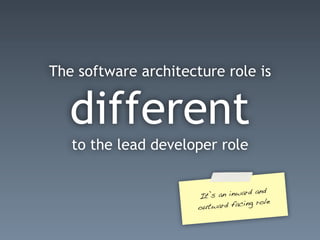
Unlike a standard Senior Developer, whose primary metric for success is often the delivery of specific features, the architecture developer is measured by the stability and "evolvability" of the system. They identify when a "quick fix" has become a systemic risk and advocate for necessary refactoring before the codebase becomes unmanageable.
In the current landscape of 2026, where many teams are integrating autonomous AI coding agents, this role is more vital than ever. AI agents are excellent at generating snippets but often lack a holistic view of system architecture. The architecture developer provides the constraints and "architectural guardrails" that ensure AI-generated code fits into a cohesive whole rather than creating a fragmented "spaghetti" of functions.
Architecture Developer vs. Traditional Engineering Roles
To understand why this role is distinct, it is helpful to compare it to existing titles within a standard engineering organization.
| Feature | Traditional Architect | Senior Developer | Architecture Developer |
|---|---|---|---|
| Primary Output | Diagrams, Whitepapers, Standards | Feature Code, Bug Fixes | Core Frameworks, Shared Libraries, Prototypes |
| Coding Frequency | Low to None | High | Moderate to High |
| Focus Area | Enterprise-wide alignment | Sprint-specific features | Cross-team structural integrity |
| Stakeholders | C-Suite, Product Owners | Product Managers, Peers | Engineering Teams, CTO |
| Technical Debt | Identifies it theoretically | Manages it within a module | Manages it across the system |
Core Responsibilities of the Architecture Developer
The architecture developer carries a unique set of responsibilities that require a blend of deep technical expertise and strategic thinking.
1. Designing and Maintaining "The Paved Road"
The architecture developer is responsible for the internal platform that other developers use. This includes selecting the foundational tech stack, setting up standardized logging and observability, and ensuring that security protocols are baked into the base code rather than added as an afterthought.
2. Conducting Architectural Spikes
When a team needs to adopt a new technology—such as shifting from a REST-based architecture to an event-driven model using Apache Kafka—the architecture developer performs the "spike." They build a functional prototype to prove the concept, identify potential pitfalls, and establish the patterns that the rest of the team will follow.
3. Mentorship and Socializing Patterns
Architecture is as much about people as it is about code. An architecture developer spends significant time mentoring other engineers, explaining the "why" behind certain structural choices. They ensure that architectural knowledge is distributed across the team, preventing any single person from becoming a "bottleneck" for technical decisions.
4. Balancing Innovation with Stability
Modern software teams are often tempted by the "shiny new object." In 2026, this might be a niche framework or an experimental database. The architecture developer evaluates these technologies through the lens of long-term supportability. They serve as the gatekeeper who ensures the team adopts technologies that provide genuine value without introducing unnecessary complexity.
The Economic Impact of the Role
From a business perspective, the architecture developer is a force multiplier. While it may seem expensive to have a senior-level engineer who isn't dedicated to shipping consumer-facing features, the return on investment (ROI) is realized through:
- Reduced Time-to-Market: Standardized patterns allow feature teams to move faster because they don't have to reinvent the wheel for every new service.
- Lower Maintenance Costs: Clean architecture is cheaper to maintain. By preventing "spaghetti code," the organization avoids the massive "rewrite" projects that often sink software companies.
- Improved Reliability: A system designed with intentionality by someone who understands the code is less prone to catastrophic failures and is easier to debug when issues arise.
Prerequisites for the Role
Not every senior engineer is suited for the architecture developer role. It requires a specific temperament and skill set:
- Polyglot Programming: Proficiency in multiple languages and paradigms is essential for choosing the right tool for the job.
- System Design Mastery: A deep understanding of distributed systems, CAP theorem, and data modeling.
- Communication Skills: The ability to explain complex technical trade-offs to non-technical stakeholders and persuade skeptical engineers.
- Pragmatism: A refusal to be dogmatic. An architecture developer must be willing to choose a "boring" technology if it is the most reliable choice for the business.
Frequently Asked Questions
Is an architecture developer the same as a Staff Engineer?
While there is significant overlap, they are not identical. A Staff Engineer is often a broader leadership role that may involve more organizational strategy and cross-departmental coordination. An architecture developer is more specifically focused on the structural implementation and the "developer-facing" codebase. In many 2026 organizations, "Architecture Developer" is a specialized track within the Staff Engineering level.
How does this role interact with DevOps and Platform Engineering?
The roles are complementary. While Platform Engineers focus on the infrastructure (Kubernetes, cloud providers, networking), the architecture developer focuses on the code that runs on that infrastructure. They collaborate to ensure the application architecture is "cloud-native" and takes full advantage of the platform's capabilities.
Can a small startup afford an architecture developer?
In a small startup, this role is usually filled by the CTO or a founding engineer. However, as soon as the team grows beyond 10-15 developers, the lack of a dedicated architectural focus usually leads to a "technical debt wall." Identifying a lead engineer to take on architecture developer responsibilities early can prevent this.
What are the biggest mistakes an architecture developer can make?
The most common mistake is over-engineering—building complex abstractions for problems that don't exist yet. Another significant risk is becoming "disconnected" from the feature teams, leading to the creation of frameworks that are technically impressive but difficult or frustrating for other developers to use.
Strategic Recommendation
For organizations looking to scale their software delivery in 2026, the transition from "incidental architecture" to "intentional architecture" is mandatory. Leaders should identify high-performing senior engineers who demonstrate an interest in structural health and "developer experience" and empower them to step into the architecture developer role.
This transition should begin by carving out 30% of their time to focus exclusively on shared tooling, documentation, and cross-team architectural reviews. As the complexity of your systems grows, this role will prove to be the most critical safeguard against the technical stagnation that halts innovation.
Image Gallery