Most Affordable MBA Programs in the USA: Costs, Accreditation, and ROI
Finding an affordable Master of Business Administration (MBA) in the United States does not require sacrificing academic quality or regional accreditation. Several accredited public and non-profit universities offer complete online and...
Finding an affordable Master of Business Administration (MBA) in the United States does not require sacrificing academic quality or regional accreditation. Several accredited public and non-profit universities offer complete online and on-campus MBA degrees for total tuition costs ranging between $6,000 and $15,000. Evaluating programmatic accreditation, tuition structures, and hidden fees ensures maximum career return on investment.
Contents
The demand for cost-effective graduate business education has driven higher education institutions to restructure their pricing models. While elite private universities often charge upwards of $100,000 to $200,000 for a two-year degree, accredited regional public universities and innovative non-profit colleges deliver comparable foundational business curricula at a fraction of that price.
Navigating the landscape of low-cost MBA programs requires an understanding of how tuition is calculated, how accreditation impacts degree utility, and how program formats affect overall expenses.
Accreditation Matters: Distinguishing Quality from Cost
When evaluating low-cost MBA programs, verifying institutional and programmatic accreditation is the critical first step. Accreditation ensures that the institution meets rigorous academic standards and that employers, state licensing boards, and other educational institutions recognize your degree.
Institutional vs. Programmatic Accreditation
Every legitimate university in the U.S. holds institutional accreditation recognized by the U.S. Department of Education or the Council for Higher Education Accreditation. Formerly divided into regional bodies (such as the Higher Learning Commission or the Southern Association of Colleges and Schools), institutional accreditation validates the university as a whole and allows students to access federal financial aid.
Programmatic accreditation specifically evaluates the business school or department within an institution. The three main business accrediting bodies in the U.S. include:
- AACSB (Association to Advance Collegiate Schools of Business): Widely considered the gold standard in business education. AACSB accreditation is held by fewer than 6% of business schools worldwide. It is heavily favored by major consulting firms, investment banks, and Fortune 500 corporations.
- ACBSP (Accreditation Council for Business Schools and Programs): Focused primarily on teaching excellence and student learning outcomes rather than academic research. ACBSP-accredited programs offer strong practical preparation for mid-level management and entrepreneurial roles.
- IACBE (International Accreditation Council for Business Education): A outcomes-based accrediting organization that focuses on academic quality and institutional effectiveness in business programs.
Choosing a program accredited by AACSB, ACBSP, or IACBE ensures your degree maintains market currency regardless of total tuition cost.
Key Factors That Determine MBA Program Tuition
The advertised sticker price per credit hour rarely represents the exact cost of an MBA. Understanding how public and private institutions structure their pricing helps prevent unexpected financial burdens during enrollment.
Total Program Cost = (Credit Hours x Cost Per Credit) + Mandatory Fees + Levelling Courses - Financial Aid
In-State vs. Out-of-State Tuition Rates
Public universities traditionally charge significantly higher rates for non-resident students. However, many state institutions have established flat-rate tuition models for their online graduate programs. Under a flat-rate model, all students pay the same per-credit tuition rate regardless of their geographic location or state residency.
Credit Count Requirements
Standard MBA programs typically require between 30 and 36 credit hours for completion. Some specialized or STEM-designated MBAs require 45 to 60 credits. A program with a lower per-credit cost may ultimately cost more if it requires significantly more credit hours to graduate.
Prerequisite and Levelling Courses
Students who enter an MBA program without an undergraduate background in business (such as accounting, finance, statistics, or microeconomics) are often required to complete prerequisite foundation courses. These "levelling" modules add extra credit hours and fees to the total cost. Seeking programs that offer self-paced, low-cost levelling modules or waive prerequisites based on work experience can save thousands of dollars.
Comparison of Most Affordable Accredited MBA Programs
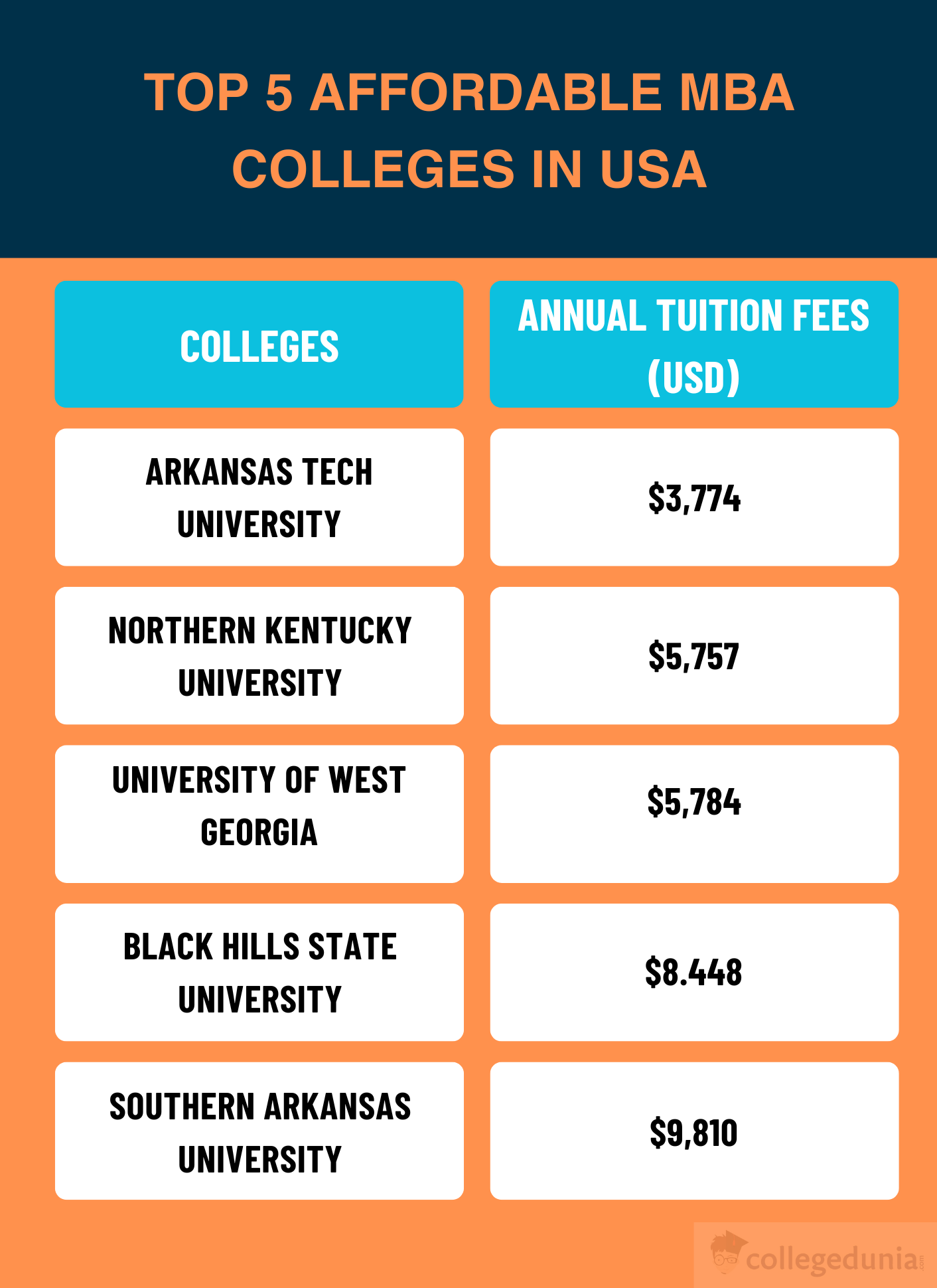
The following table highlights established public and non-profit U.S. universities offering some of the lowest total tuition rates for accredited MBA degrees.
| University | Institutional Location | Primary Business Accreditation | Estimated Total Tuition | Format | Required Credits |
|---|---|---|---|---|---|
| University of North Carolina at Pembroke | Pembroke, NC | AACSB | ~$7,500 - $9,500 | Online | 36 |
| Georgia Southwestern State University | Americus, GA | AACSB | ~$9,000 - $10,500 | Online / Hybrid | 30 |
| Western Governors University (WGU) | Salt Lake City, UT | ACBSP | ~$9,000 - $11,000 | Online (Competency) | 33 (11 courses) |
| Louisiana State University Shreveport | Shreveport, LA | AACSB | ~$13,000 - $14,000 | Online | 30 |
| Fitchburg State University | Fitchburg, MA | IACBE | ~$12,500 - $13,500 | Online | 30 |
| Valdosta State University | Valdosta, GA | AACSB | ~$9,500 - $11,500 | Online | 30 |
| University of West Florida | Pensacola, FL | AACSB | ~$14,000 - $15,500 | Online | 36 |
Note: Estimated tuition figures represent base program costs and may exclude technology fees, textbooks, or required prerequisite coursework. Tuition rates reflect standard pricing structures.
Top Low-Cost U.S. MBA Programs Analyzed
1. University of North Carolina at Pembroke (UNCP)
UNCP's School of Business offers one of the lowest-cost AACSB-accredited online MBA degrees in the United States. The program requires 36 credit hours and offers concentrations in topics such as Finance, Healthcare Administration, Supply Chain Management, and Business Analytics.
Because UNCP participates in state-level educational affordability initiatives, it maintains an exceptionally low per-credit tuition rate for both North Carolina residents and out-of-state students enrolled in online programs. The curriculum is delivered fully online in accelerated 7-week terms, enabling students to finish the degree in 12 to 18 months.
2. Georgia Southwestern State University (GSW)
Georgia Southwestern State University provides an AACSB-accredited MBA program designed for working professionals. Requiring 30 credit hours, GSW emphasizes applied business concepts, managerial decision-making, and strategic management.
The university charges a flat online tuition rate, making it equally affordable for out-of-state students. Prospective applicants with solid undergraduate GPAs or relevant professional management experience may qualify for GMAT/GRE waivers, reducing upfront application expenses.
3. Western Governors University (WGU)
Western Governors University operates on an innovative competency-based learning model. Instead of paying per credit hour, students pay a flat fee per six-month term ($4,500 to $5,000 per term including fees). Students can complete as many courses as they can master within a single term.
WGU’s MBA program holds ACBSP accreditation. For self-motivated students capable of moving quickly through material they already know from workplace experience, completing the 11-course degree in one or two terms yields an total cost under $10,000.
4. Louisiana State University Shreveport (LSUS)
LSUS offers an AACSB-accredited online MBA program with wide industry recognition. The 30-credit curriculum includes core modules in organizational behavior, managerial economics, marketing strategy, and financial management.
LSUS offers specialized concentrations such as Data Analytics, Project Management, Hospitality and Casino Management, and Entrepreneurship. The tuition structure is uniform for in-state and out-of-state residents, positioned around $440 per credit hour, leading to a total program tuition of roughly $13,200.
5. Fitchburg State University
Fitchburg State University’s online MBA carries IACBE accreditation and delivers a 30-credit curriculum focused on practical leadership skills. Terms run in accelerated 7-week blocks, allowing full-time working adults to take one or two courses per session.
Fitchburg State offers competitive per-credit rates across all concentrations, including Management, Human Resources, and Healthcare Management. Prerequisites can often be satisfied through free or low-cost online bridge modules prior to matriculation.
Identifying and Managing Hidden Costs
Calculating the true cost of an MBA requires looking beyond basic per-credit tuition rates. Mandatory university fees and learning materials can add 10% to 25% to the final cost of a graduate degree.
True MBA Budget = Base Tuition + Distance Learning/Tech Fees + Registration & Graduation Fees + Textbooks & Software Licenses + Proctored Exam Fees
- Technology and Distance Learning Fees: Many institutions assess an additional fee per credit hour or per term specifically for online learners to support virtual learning platforms, digital library access, and 24/7 technical support.
- Exam Proctoring Fees: Programs that utilize third-party online proctoring services (such as Examity or Honorlock) may require students to pay individual proctoring fees per exam.
- Course Materials and Software: Textbooks, case study permissions (such as Harvard Business Publishing case bundles), and software licensing (e.g., SPSS, Tableau, or advanced financial modeling packages) can add $100 to $300 per course.
- Graduation and Matriculation Fees: Most universities charge a mandatory diploma, administrative, or graduation fee during the final term of enrollment.
Strategies to Further Reduce MBA Expenses
Budget-conscious students can utilize several practical financial strategies to minimize out-of-pocket costs while pursuing an MBA.
Employer Tuition Assistance
Many corporations offer tuition reimbursement as part of their standard employee benefits package. Under Section 127 of the Internal Revenue Code, U.S. employers can provide up to $5,250 per year in tax-free educational assistance to employees. Details on federal education assistance policies can be reviewed via the Internal Revenue Service.
Prior Learning Assessment and Transfer Credits
If you have completed post-baccalaureate coursework, executive training certificates, or professional certifications (such as a PMP, CPA, or SHRM-SCP), check if your prospective university accepts transfer credits or awards credit through Prior Learning Assessments (PLA). Transferring even 3 to 6 credits directly reduces your required tuition obligation.
Utilizing FAFSA and Institutional Aid
Graduate students who are U.S. citizens or eligible non-citizens can complete the Free Application for Federal Student Aid (FAFSA) to access Direct Unsubsidized Loans and Grad PLUS loans. While loans must be repaid, federal student aid programs offer income-driven repayment plans and Public Service Loan Forgiveness (PSLF) options for individuals working in government or qualifying 501(c)(3) non-profit organizations.
How to Select the Right Low-Cost MBA
Choosing the best affordable MBA program requires balancing financial realities with personal career objectives.
Identify Career Goals
Verify Institutional & Programmatic Accreditation
Calculate Total All-In Cost (Tuition + Tech Fees + Materials + Levelling)
Assess Delivery Model & Flexibility (Accelerated, Self-Paced, Scheduled Live Classes)
Submit Final Applications
Define Career Ambitions: If your goal is to work at a bulge-bracket investment bank or top-tier management consulting firm (e.g., McKinsey, BCG, Bain), an elite full-time program may still offer the highest pipeline value despite high tuition. However, if your goal is mid-to-senior management, career advancement within your current company, or entrepreneurship, a low-cost accredited online MBA provides high ROI.
Confirm Accreditation Eligibility: Verify that the program’s programmatic accreditation aligns with your industry expectations (AACSB for traditional corporate/academic prestige; ACBSP/IACBE for general management application).
Verify GMAT/GRE Waiver Terms: GMAT testing fees, prep courses, and score reporting add significant upfront costs. Choose programs that offer automatic waivers based on undergraduate GPA or verified professional work experience.
Frequently Asked Questions
Are low-cost online MBA degrees respected by employers?
Yes. Employers evaluate degrees primarily based on institutional reputation, regional accreditation, and programmatic accreditation (such as AACSB or ACBSP). Most diplomas awarded to online graduates are identical to those awarded to on-campus students and do not state "online" on the physical diploma.
What is the absolute cheapest accredited MBA program in the USA?
Total costs vary based on enrollment speed and state residency, but programs at institutions like the University of North Carolina at Pembroke, Georgia Southwestern State University, and Western Governors University frequently post total tuition rates under $10,000.
Is AACSB accreditation necessary for a successful business career?
AACSB accreditation is beneficial for competitive fields like corporate strategy, high-level investment banking, and academic research. However, for general corporate management, healthcare leadership, municipal administration, and entrepreneurship, ACBSP- or IACBE-accredited programs provide sufficient credentialing at a lower price point.
Can international students enroll in low-cost U.S. online MBA programs?
Yes, many U.S. public universities offer their online MBA programs to international students located abroad at the standard flat online tuition rate. However, online programs generally do not qualify international students for F-1 student visas or Optional Practical Training (OPT) within the U.S.
How long does it take to complete an affordable online MBA?
Most accelerated online MBA programs permit students to complete the 30-to-36 credit requirements within 12 to 18 months of continuous enrollment. Competency-based models like WGU allow self-motivated students to finish in under 12 months if they can demonstrate mastery of the course material quickly.
Next Steps for Prospective Students
To begin your application process for an affordable MBA:
- Gather Official Transcripts: Request academic records from all previously attended colleges to evaluate your cumulative undergraduate GPA and determine if you meet entry requirements or GMAT waiver thresholds.
- Verify Prerequisite Coursework: Identify whether your undergraduate degree satisfies introductory accounting, economics, and statistics requirements.
- Submit FAFSA Applications: If seeking federal aid or institutional grants, submit your financial aid paperwork early to meet institutional priority deadlines.
- Connect with Admissions Counselors: Contact the graduate admissions offices at 3 to 4 target low-cost universities to request comprehensive fee schedules and verify current tuition rates for upcoming academic terms.
Image Gallery