Palazzo Odescalchi: Architectural History, Venetian Masterpieces, and Visitor Guide
Palazzo Chigi-Odescalchi is a monumental Roman palace in Piazza dei Santi Apostoli, renowned for Gian Lorenzo Bernini’s groundbreaking Baroque facade. While located in Rome, the building is historically linked to Venetian art through P...
Palazzo Chigi-Odescalchi is a monumental Roman palace in Piazza dei Santi Apostoli, renowned for Gian Lorenzo Bernini’s groundbreaking Baroque facade. While located in Rome, the building is historically linked to Venetian art through Prince Livio Odescalchi’s legendary collection of Venetian Renaissance masterpieces by Titian, Veronese, and Tintoretto, making it a pivotal site in Italian cultural history.
Contents
Disambiguating Palazzo Odescalchi: Location, History, and Venetian Connections
Understanding Palazzo Odescalchi requires distinguishing between the physical monument, its architectural heritage, and its historic association with Venetian art. Art historians, travelers, and architecture students occasionally conflate the building's identity due to its historic housing of one of Europe’s finest private collections of Venetian Renaissance paintings.
The palace itself—officially known as Palazzo Chigi-Odescalchi—stands in central Rome along the western side of the Piazza dei Santi Apostoli. It is not situated along the Grand Canal of Venice, nor was its primary structural elevation built in the Venetian Gothic or Venetian Renaissance style. Instead, it represents a high point of Roman Baroque civic architecture designed by Gian Lorenzo Bernini and later expanded by Nicola Salvi and Luigi Vanvitelli.
The connection between Palazzo Odescalchi and Venetian artistic genius is rooted in the late 17th and 18th centuries. When Prince Don Livio Odescalchi acquired the legendary art collection of Queen Christina of Sweden in 1692, he brought dozens of world-renowned Venetian masterworks into the palace halls. For over a generation, Palazzo Odescalchi served as the primary repository for monumental canvases created by Venetian masters such as Titian, Paolo Veronese, Tintoretto, and Palma il Giovane.
Consequently, scholarly references to the "Odescalchi Venetian masterpieces" refer to this monumental collection, while architectural studies focus on Bernini's revolutionary facade design, which profoundly influenced civil architecture across Europe, including later noble residences built in the Republic of Venice and beyond.
The Architectural Evolution of Palazzo Chigi-Odescalchi
- Early 17th Century: Colonna / Ludovisi Residence (Original Structure)
- 1661–1665: Acquired by Cardinal Flavio Chigi
- Redesigned by Gian Lorenzo Bernini (7-Bay Giant Order Facade)
- 1745: Acquired by Prince Baldassarre Odescalchi
- 1745–1750s: Expanded by Nicola Salvi & Luigi Vanvitelli (Symmetrical 16-Bay Facade)
The Original Structure and Bernini’s Redesign (1665)
The site original belonged to the Colonna family before passing to Cardinal Ludovico Ludovisi in the early 17th century. In 1661, Cardinal Flavio Chigi, nephew of Pope Alexander VII, purchased the property and sought to transform it into a palace worthy of his family’s papal stature.
In 1665, Flavio Chigi commissioned Gian Lorenzo Bernini to design a new exterior facade facing Piazza dei Santi Apostoli. Bernini’s design was radical for its time:
- Rusticated Ground Floor: A heavy, stone-worked base provided a sense of solid foundation and structural gravity.
- Colossal Order Pilasters: Bernini introduced giant Composite pilasters that spanned both upper floors (the piano nobile and second story), unifying the verticality of the facade.
- Central Focus: The original facade was seven bays wide, anchored by a central double portal topped by the Chigi family crest.
- Roofline Balustrade: Instead of a traditional heavy Italian cornice, Bernini finished the top with an open balustrade adorned with decorative statues and urns.
This arrangement created a sense of theatrical grandeur without relying on excessive ornament, establishing a archetype for aristocratic palatial facades throughout Western Europe.
The 1745 Odescalchi Expansion by Salvi and Vanvitelli
In 1745, Prince Baldassarre Odescalchi purchased the palace from the Chigi family. To accommodate the space requirements of the Odescalchi court and maintain a dominating presence on the square, the prince commissioned architects Nicola Salvi (famous for designing the Trevi Fountain) and Luigi Vanvitelli (renowned for the Royal Palace of Caserta) to enlarge the building.
Salvi and Vanvitelli faced a delicate architectural challenge: how to double the width of the facade without ruining Bernini’s tightly proportioned geometry. Their solution was to replicate Bernini’s giant order design across sixteen bays while creating a symmetrical central bay system flanked by two portal entrances. Although some contemporary critics argued that doubling the width diminished the vertical tension of Bernini’s original composition, the expanded facade gave Palazzo Odescalchi its impressive, unified presence seen today.
The Odescalchi Art Collection: Repository of Venetian Masterpieces
While the building is a triumph of Roman architectural engineering, its reputation in European art history was secured by the Odescalchi Art Collection, particularly its staggering array of Venetian Renaissance paintings.
Livio Odescalchi and the Queen Christina Collection
In 1692, Don Livio Odescalchi, Duke of Bracciano and nephew of Pope Innocent XI (Benedetto Odescalchi), executed one of the most famous art acquisitions in history. He purchased the vast collection left behind by Queen Christina of Sweden, who had lived in Rome following her abdication.
Queen Christina’s collection contained dozens of premier masterworks looted from Prague during the Thirty Years' War, many of which had originally belonged to Holy Roman Emperor Rudolf II. A significant portion of these works originated from 16th-century Venice.
Key Venetian Artists in the Collection
During the late 17th and early 18th centuries, the galeries of Palazzo Odescalchi showcased:
- Titian (Tiziano Vecellio): Major mythological scenes and royal portraits, including works from his late period characterized by loose brushwork and dramatic light.
- Paolo Veronese: Large-scale allegorical compositions and religious narratives distinguished by rich fabrics, architectural backgrounds, and luminous color palettes.
- Tintoretto (Jacopo Robusti): Dynamic, highly dramatic canvases featuring bold foreshortening and intense chiaroscuro contrast.
- Palma il Giovane and Schiavone: Late Venetian Mannerist compositions that bridged High Renaissance techniques with Baroque drama.
The 1721 Sale to the Duke of Orléans
Following Livio Odescalchi’s death without direct heirs, the financial pressures on the family led to the sale of the picture gallery in 1721. The majority of the painting collection was purchased by Philippe II, Duke of Orléans, Regent of France.
This historic transfer formed the core of the famous Orléans Collection. Following the French Revolution, the collection was dispersed across public institutions and private holdings in Great Britain. Today, many of the Venetian masterpieces that once graced Palazzo Odescalchi can be seen in major global museums, including the National Gallery in London and the National Galleries of Scotland.
Comparative Analysis: Roman Baroque vs. Venetian Palatial Architecture
To understand how Palazzo Chigi-Odescalchi differs from authentic Venetian palatial architecture, it is helpful to examine structural, contextual, and material differences. Venetian palaces along the Grand Canal were engineered for marine environments and commercial functions, whereas Roman palaces were designed as urban power seats facing open public piazzas.
| Architectural Feature | Palazzo Chigi-Odescalchi (Rome) | Venetian Masterpiece Palaces (e.g., Ca' Rezzonico, Ca' Pesaro) |
|---|---|---|
| Primary Location Setting | Facing an open urban piazza (Piazza dei Santi Apostoli) | Directly fronting a water canal (Grand Canal, Venice) |
| Primary Structural Style | High Roman Baroque (Bernini, Salvi, Vanvitelli) | Venetian Baroque / Venetian Gothic |
| Ground Floor Function | Heavy stone rustication, carriage portals, administration | Androne (water-level entrance hall), boat docks, warehouse storage |
| Facade Composition | Giant order pilasters unifying upper stories | Tripartite facade with central open loggias (polifora windows) |
| Building Materials | Travertine stone, brick with stucco coating | Istrian stone facade cladding over brick structural walls |
| Internal Layout | Central enclosed quadrangle courtyard with arcades | Long central hall (portego) flanked by smaller living chambers |
| Roofline Character | Balustrade with decorative urns and statues | Decorative crests, obelisks, or traditional overhanging eaves |
Current Status, Ownership, and Visitor Access Guidelines
As of 2026, Palazzo Chigi-Odescalchi remains a predominantly private building owned by the Odescalchi family and associated commercial enterprises, with portions leased for private corporate offices and institutional events.
Viewing the Exterior
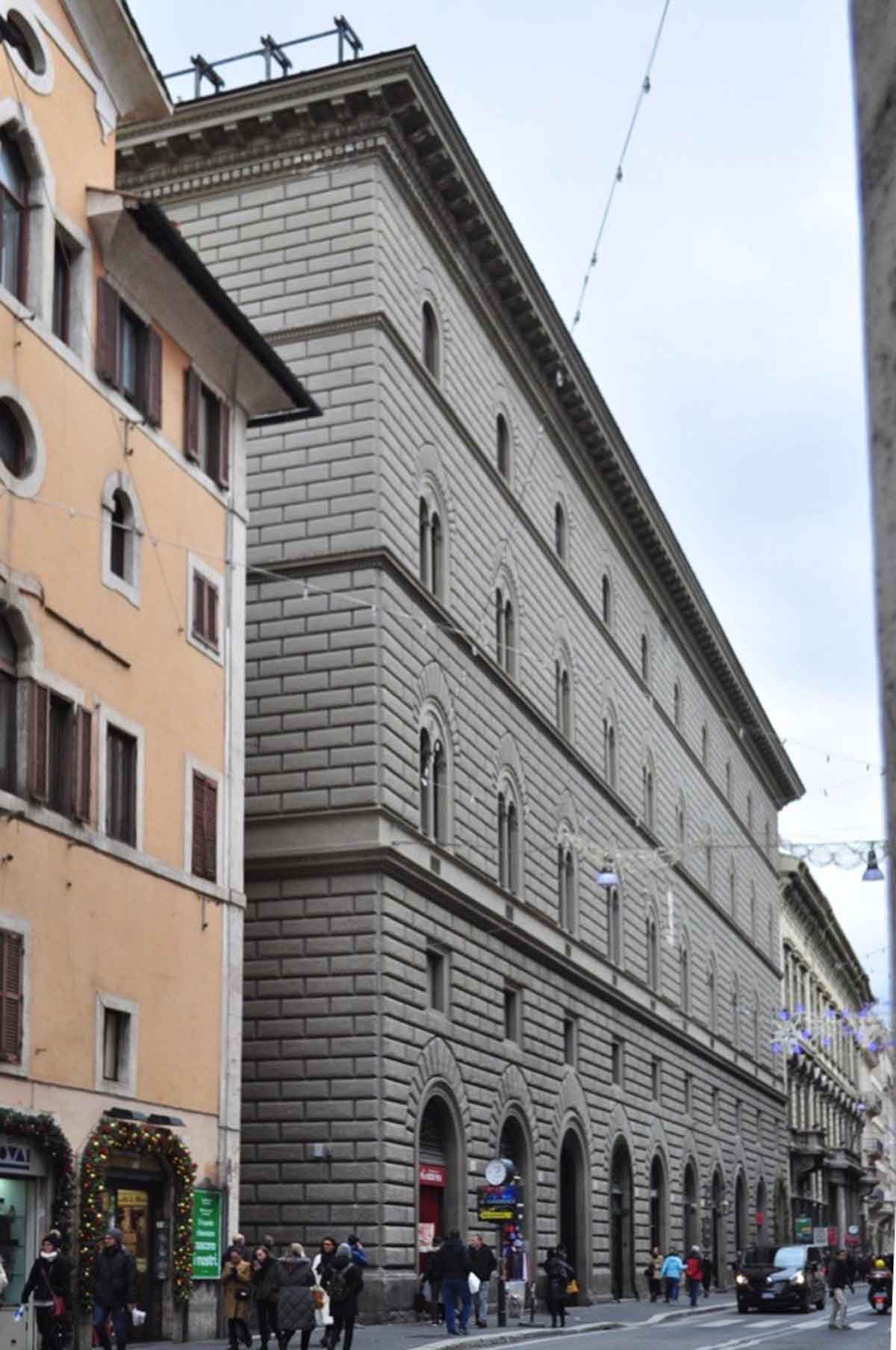
Visitors can view and photograph Bernini and Salvi’s facade directly from Piazza dei Santi Apostoli. Because the square is largely pedestrianized and less congested than major thoroughfares like Via del Corso, it offers excellent sightlines for studying the giant pilaster order, rusticated base, and intricate window pediments.
Interior Access & Private Events
- Public Tours: The interior of Palazzo Chigi-Odescalchi is not open for daily, walk-in public museum tours.
- Special Exhibitions & Events: Portions of the noble floor (piano nobile) and courtyard are occasionally accessible during pre-arranged academic tours, architectural conferences, or private cultural galas.
- Architectural Etiquette: Visitors viewing the exterior should maintain respect for private tenants and security guidelines around building entrances.
Nearby Art Historical Destinations
Visitors interested in experiencing the grand palatial collections of Rome that mirror the historical Odescalchi collection can visit adjacent institutions:
- Galleria Doria Pamphilj: Located within walking distance on Via del Corso, offering an intact private palatial art gallery featuring masterworks by Titian, Caravaggio, and Velázquez.
- Palazzo Colonna: Situated nearby in Piazza SS. Apostoli, featuring one of Rome’s largest intact Baroque private galleries.
Common Misconceptions Regarding Palazzo Odescalchi
- Misconception: Palazzo Odescalchi is located in Venice.Fact: Palazzo Chigi-Odescalchi is situated in Rome. Confusion arises from historical literature discussing the Odescalchi family's acquisition of famous Venetian art collections.
- Misconception: The facade was designed entirely by Gian Lorenzo Bernini.Fact: Bernini designed the original 7-bay central facade in 1665. The current 16-bay symmetrical facade is the result of an extension designed by Nicola Salvi and Luigi Vanvitelli in 1745.
- Misconception: The Venetian paintings remain inside the palace today.Fact: The major Venetian paintings were sold in 1721 to the Duke of Orléans and subsequently dispersed to international museums worldwide during the late 18th century.
Frequently Asked Questions
Where is Palazzo Odescalchi located?
Palazzo Chigi-Odescalchi is located in Rome, Italy, facing the Piazza dei Santi Apostoli in the Trevi district, near Via del Corso and the Colonna Palace.
Why is Palazzo Odescalchi linked to Venetian art?
The palace was historically famous for housing the art collection of Don Livio Odescalchi, who acquired Queen Christina of Sweden's collection in 1692. This collection contained world-renowned Venetian Renaissance paintings by artists such as Titian, Veronese, and Tintoretto.
Who designed the facade of Palazzo Chigi-Odescalchi?
The original facade was designed by Gian Lorenzo Bernini in 1665. It was later expanded and lengthened by architects Nicola Salvi and Luigi Vanvitelli in 1745, who doubled its size while preserving Bernini's style.
Can tourists visit the inside of Palazzo Odescalchi?
The interior of Palazzo Chigi-Odescalchi is privately owned and closed to regular public tourism. However, the exterior facade can be freely viewed from Piazza dei Santi Apostoli, and select spaces are occasionally opened for private cultural events.
How did Bernini’s design for Palazzo Odescalchi influence world architecture?
Bernini introduced a colossal order of composite pilasters over a rusticated ground base, crowned by a roofline balustrade. This structural layout became the standard blueprint for European palace facades, directly influencing designs like the East Facade of the Louvre in Paris.
Practical Recommendations for Art and Architecture Enthusiasts
For travelers, art historians, and students planning an itinerary focused on Italian Baroque architecture and Venetian art:
- Study the Facade in Daylight: Visit Piazza dei Santi Apostoli during morning hours when natural light illuminates the travertine pilasters and detailed window pediments on the western side of the square.
- Pair with Nearby Palazzi: Combine your visit to Palazzo Chigi-Odescalchi with a pre-booked visit to Palazzo Colonna across the square, allowing you to experience an intact Roman Baroque palatial interior containing period art collections.
- Locate the Dispersed Masterpieces: To view the actual Venetian paintings once housed in Palazzo Odescalchi, consult the collections of the National Gallery in London, the Scottish National Gallery in Edinburgh, and the Louvre Museum in Paris, where the former Orléans Collection resides.
Image Gallery