Understanding Cryptocurrency Exchange-Traded Funds: Availability, Mechanics, and Market Access
Yes, cryptocurrency exchange-traded funds (ETFs) exist and are actively traded on major traditional financial exchanges. These regulated investment products allow institutional and retail investors to gain exposure to digital assets li...
Yes, cryptocurrency exchange-traded funds (ETFs) exist and are actively traded on major traditional financial exchanges. These regulated investment products allow institutional and retail investors to gain exposure to digital assets like Bitcoin and Ethereum through standard brokerage accounts without the technical complexities of purchasing, securing, and storing the underlying cryptocurrency on a digital wallet.
Contents
The Evolution of Cryptocurrency ETFs in Traditional Finance
The pathway toward mainstream cryptocurrency exchange-traded funds has been marked by significant regulatory scrutiny, structural evolution, and shifting legal interpretations. For years, financial regulators expressed consistent concerns regarding market manipulation, custody security, surveillance-sharing agreements, and investor protection within digital asset markets. Early applications for spot cryptocurrency products faced repeated delays and rejections from regulatory bodies such as the U.S. Securities and Exchange Commission (SEC).
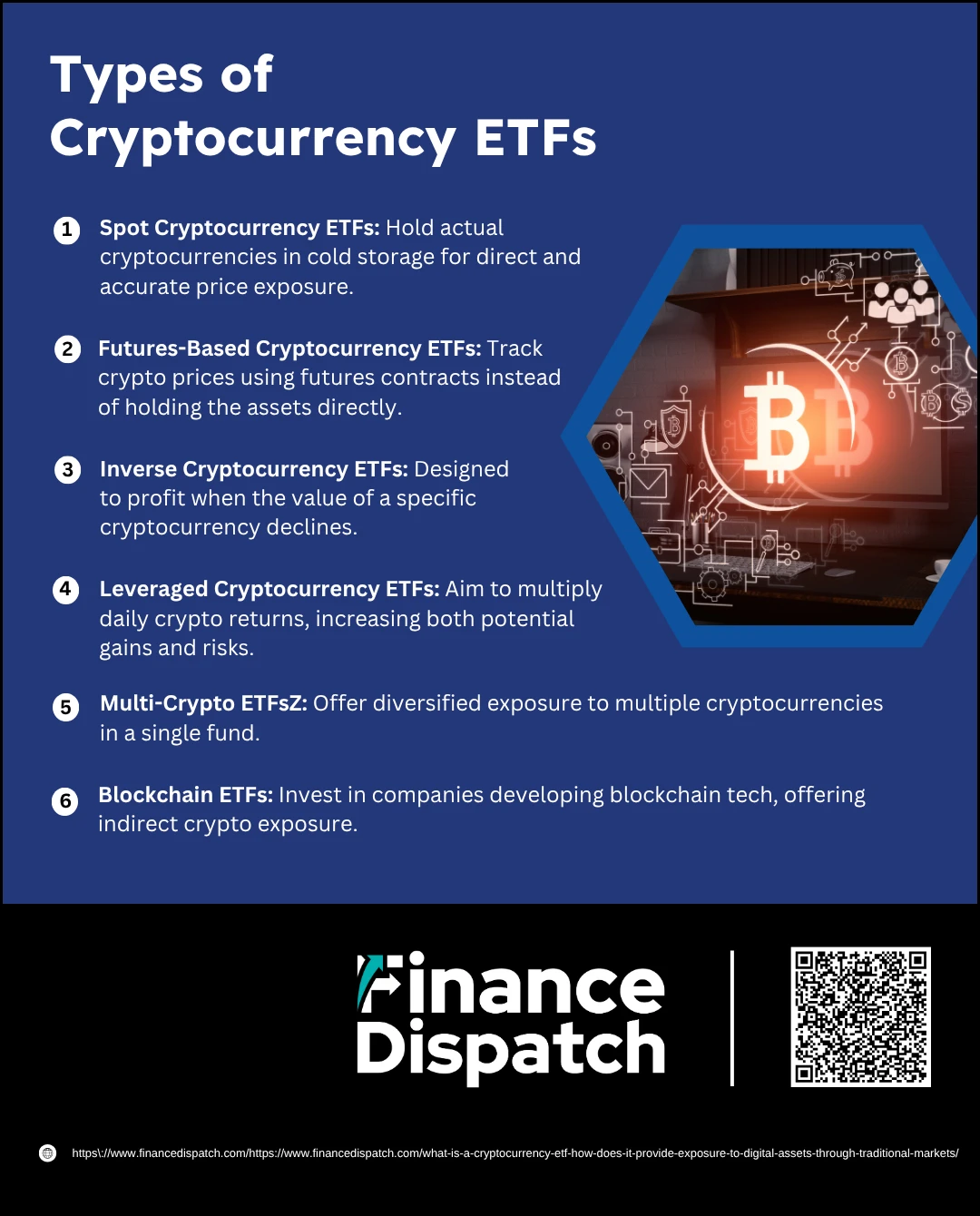
Initially, market access was limited to futures-based products. These financial instruments hold futures contracts traded on regulated platforms rather than the underlying spot asset itself. While futures-based vehicles provided a regulated wrapper, they introduced structural inefficiencies, most notably contango and backwardation effects—collectively known as roll yield costs—which can cause the fund's performance to diverge significantly from the spot price of the cryptocurrency over extended holding periods.
The regulatory landscape experienced a watershed shift following landmark legal rulings and subsequent administrative approvals that permitted spot cryptocurrency ETFs to launch. A spot exchange-traded fund holds the actual digital asset directly in secure institutional custody. This development eliminated the performance drag associated with futures roll costs, providing investors with a more direct tracking mechanism for the underlying market value of assets like Bitcoin and Ethereum.
How Cryptocurrency ETFs Operate and Structure Themselves
Understanding the mechanics of a cryptocurrency exchange-traded fund requires a clear look at how these financial products are structured, managed, and traded throughout the traditional market day. Unlike open-end mutual funds, which price their shares once per day after the market closes, ETFs trade continuously on public exchanges, allowing investors to buy and sell shares throughout regular trading hours at fluctuating market prices.
Creation and Redemption Mechanisms
The foundation of any ETF lies in its creation and redemption mechanism, which is managed by authorized participants (APs)—typically large financial institutions or market-making firms.
- Creation Process: When market demand for an ETF drives its share price above its net asset value (NAV), authorized participants step in. They purchase the underlying digital assets (or cash equivalents, depending on the fund's structure) and deliver them to the ETF custodian in exchange for creation units—large blocks of ETF shares. These new shares are then sold on the open market, increasing supply and aligning the market price back toward the NAV.
- Redemption Process: Conversely, if the ETF trades at a discount to its net asset value, authorized participants buy up ETF shares on the open market, bundle them into creation units, and redeem them with the fund for the underlying digital assets. This reduces share supply on the secondary market and pushes the price back up toward the true net asset value.
Custody and Security Infrastructure
Unlike traditional equities backed by corporate balance sheets, spot cryptocurrency ETFs require specialized, institutional-grade custody solutions. Because digital assets exist purely as cryptographic data on a decentralized ledger, securing them involves managing public and private cryptographic keys.
- Cold Storage Solutions: Reputable fund issuers partner with qualified institutional custodians that utilize offline, air-gapped cold storage facilities. This protects the primary pool of assets from online cyber threats and malicious intrusions.
- Multi-Signature Protocols: Custodians often employ multi-signature authorization requirements, ensuring that no single individual can initiate a transfer or liquidation of the fund's digital holdings.
- Insurance and Auditing: Institutional custodians typically maintain robust crime and specie insurance policies covering digital assets in transit or storage, alongside regular third-party audits to verify asset reserves.
Spot Versus Futures-Based Cryptocurrency ETFs
Investors evaluating cryptocurrency funds must distinguish between spot-based and futures-based structures. Each vehicle serves different strategic purposes and carries distinct operational mechanics.
| Feature / Attribute | Spot Cryptocurrency ETFs | Futures-Based Cryptocurrency ETFs |
|---|---|---|
| Underlying Asset | Direct ownership of the physical digital asset (e.g., Bitcoin, Ethereum) held in cold storage. | Futures contracts traded on regulated commodity exchanges (e.g., CME). |
| Price Tracking | Tracks the real-time spot market price of the underlying asset closely, minus management fees. | Tracks futures indices; subject to contango and roll yield divergence over time. |
| Regulatory Standing | Permitted and actively traded following regulatory approval milestones. | Established earlier due to existing derivatives oversight frameworks. |
| Complexity | Straightforward structural model mirroring traditional commodity ETFs (like gold or silver). | Involves complex contract expiration management and capital allocation strategies. |
Key Benefits of Investing Through an ETF Wrapper
For many market participants, utilizing an exchange-traded fund offers distinct operational advantages over establishing direct accounts on cryptocurrency exchanges.
- Regulatory and Tax Compliance: Holding digital assets within an IRA, 401(k), or taxable brokerage account simplifies record-keeping. Investors receive standard tax reporting documents, eliminating the intricate tracking requirements associated with decentralized transactions, airdrops, and hard forks.
- Elimination of Self-Custody Risks: Direct crypto ownership requires managing private keys, seed phrases, and hardware wallets. A single security lapse, lost password, or phishing attack can result in permanent asset loss. ETFs transfer this security burden to regulated institutional custodians.
- Brokerage Integration: Investors can execute trades within their existing traditional brokerage platforms alongside stocks, bonds, and mutual funds without needing to open, verify, and fund an account on a specialized crypto exchange.
- Liquidity and Intraday Trading: Investors can execute limit orders, stop-loss orders, and margin trades during standard market hours, benefiting from the deep liquidity provided by institutional market makers.
Limitations, Risks, and Cost Considerations
Despite their convenience, cryptocurrency ETFs introduce specific costs, structural limitations, and market risks that every investor should carefully evaluate.
- Management Fees (Expense Ratios): Issuers charge an annual management fee, expressed as a percentage of assets under management (AUM). While traditional equity index funds feature very low expense ratios, cryptocurrency ETFs often carry higher fees to cover specialized custody, security, and administrative overhead.
- Trading Hours Disconnect: Traditional financial markets operate during specific weekday hours and close on weekends and holidays. Cryptocurrency markets, however, operate 24 hours a day, 365 days a year. If a major market-moving event occurs over the weekend, ETF investors must wait until market open on Monday to execute trades, potentially exposing them to significant gap risk.
- Tracking Error: Although creation and redemption mechanisms minimize discrepancies, management fees and administrative costs cause the fund's performance to trail the actual spot price of the cryptocurrency over time.
- Counterparty and Custodial Risk: Investors are exposed to the operational stability of the fund issuer, the authorized participants, and the institutional custodian holding the private keys.
Frequently Asked Questions
Can I buy fractional shares of a cryptocurrency ETF?
Most major traditional brokerages allow investors to purchase fractional shares of ETFs and equities. This means you can gain exposure to high-value assets like Bitcoin even with a modest capital allocation, investing dollar amounts rather than purchasing full whole shares.
Do cryptocurrency ETFs pay dividends or staking rewards?
Currently, standard spot cryptocurrency ETFs do not distribute dividends or pass along staking rewards generated by proof-of-stake protocols like Ethereum. The digital assets held within the fund are secured purely for price appreciation, and any protocol-level rewards generated are typically retained within the fund or used to offset operational expenses.
Are cryptocurrency ETFs subject to capital gains taxes?
Yes. Selling shares of a cryptocurrency ETF within a taxable brokerage account constitutes a taxable event. Depending on your holding period, gains will be classified as either short-term or long-term capital gains and subject to applicable tax rates. Holding these funds inside tax-advantaged accounts like a Roth IRA or traditional IRA may alter your tax liability depending on account rules.
Can I redeem my ETF shares for actual cryptocurrency?
Most retail investors cannot redeem ETF shares for physical or digital cryptocurrency. The creation and redemption mechanism is restricted to authorized participants who transact in large institutional blocks. Individual retail investors liquidate their ETF shares for fiat currency on the secondary market.
How do ETF management fees impact long-term returns?
Management fees are deducted continuously from the fund's assets. Over long-term holding periods, an annual expense ratio of 0.25% to over 1.00% will create a drag on cumulative performance compared to holding the underlying asset directly, though this must be weighed against the convenience and security of the wrapper.
Summary and Practical Next Steps
Cryptocurrency exchange-traded funds bridge the gap between traditional financial infrastructure and digital asset markets, offering regulated, secure, and tax-efficient exposure for institutional and retail investors alike.
Before investing, review your personal portfolio allocation strategy, risk tolerance, and tax situation. Consult with a qualified financial advisor to determine whether spot or futures-based products align with your broader financial goals, and examine the expense ratios and liquidity metrics of specific fund offerings across your preferred brokerage platform.
Image Gallery