Understanding the Clinical Research Salary Landscape
Understanding the clinical research salary landscape requires evaluating key roles across sponsor companies, contract research organizations (CROs), and site-level institutions. Compensation varies significantly based on therapeutic sp...
Understanding the clinical research salary landscape requires evaluating key roles across sponsor companies, contract research organizations (CROs), and site-level institutions. Compensation varies significantly based on therapeutic specialty, geographic region, advanced certification, and operational experience, ranging from entry-level research coordinators earning $55,000 annually to senior clinical trial managers and medical directors earning between $160,000 and $250,000 or more.
Contents
Core Factors Driving Compensation in Clinical Research
The clinical trial enterprise is a highly regulated, capital-intensive sector where specialized expertise commands premium remuneration. While job titles across different organizations may appear similar, total compensation packages differ substantially based on several structural levers within the life sciences industry.
Employer Organization Type
Where a professional sits within the clinical research ecosystem is often the single largest determinant of base salary and variable incentives:
- Sponsor Companies (Biopharmaceutical & Medical Device Firms): Pharmaceutical and biotechnology sponsors generally offer the highest base salaries, substantial performance bonuses, and long-term incentives such as Stock Options or Restricted Stock Units (RSUs). Sponsors shoulder the financial risk of drug development and prioritize retaining top-tier talent to ensure regulatory compliance and pipeline execution.
- Contract Research Organizations (CROs): CROs serve as service providers managing trials on behalf of sponsors. Base pay at CROs is highly competitive—often matching or occasionally exceeding sponsor base salaries for high-demand roles like Clinical Research Associates (CRAs)—to offset high travel demands and intensive billable-hour targets. However, equity incentives are typically less common unless the CRO is a publicly traded entity or pre-IPO enterprise.
- Academic Medical Centers and Site-Level Organizations: Dedicated research sites, university hospitals, and health systems typically offer lower base salaries than industry sponsors or CROs. However, academic institutions frequently counterbalance lower cash compensation with comprehensive public benefits, tuition assistance, generous retirement matching, and predictable working hours.
Geographic Location and Remote Compensation Dynamics
Geographic variance remains a critical pillar of compensation modeling. Historically, clinical research hubs such as the Greater Boston Area, the San Francisco Bay Area, the Research Triangle Park (North Carolina), and the Mid-Atlantic bio-corridor commanded 15% to 35% salary premiums to account for local cost of living and dense talent competition.
In recent years, the widespread adoption of remote monitoring, decentralized clinical trials (DCTs), and centralized data management has established hybrid compensation frameworks. While localized cost-of-living adjustments still apply for site-based staff, decentralized field roles—such as home-based CRAs—are increasingly compensated against national benchmarks, regardless of their residence.
Therapeutic Area Specialization and Trial Complexity
Salary structures heavily reflect the technical complexity and regulatory rigor required by specific disease areas. Clinical professionals managing trials in complex, high-stakes domains earn higher base pay than those in general medicine or consumer health:
- High-Tier Compensation Domains: Oncology, Immuno-Oncology, Cell and Gene Therapies (CAR-T, CRISPR-based therapeutics), Central Nervous System (CNS) disorders, and Rare/Orphan Diseases.
- Standard-Tier Compensation Domains: Cardiovascular, Gastroenterology, Dermatology, Infectious Diseases, and General Internal Medicine.
Complex protocols require specialized knowledge of surrogate endpoints, intensive patient safety monitoring, and intricate laboratory assay processing, elevating the market value of clinical personnel experienced in these fields.
Primary Clinical Research Roles and Pay Benchmarks
To navigate the clinical research salary landscape effectively, professionals must understand the distinct career tracks and progression tiers within trial operations, site management, regulatory compliance, and data analytics.
- Site-Level Operations
- Clinical Research Coordinator (CRC)
- Senior / Lead CRC / Site Director
- Clinical Research Coordinator (CRC)
- Sponsor / CRO Track
- Clinical Research Associate (CRA)
- Senior CRA / Principal Monitor
- Clinical Trial Manager (CTM)
- Director of Clinical Operations
- Clinical Trial Manager (CTM)
- Senior CRA / Principal Monitor
- Clinical Research Associate (CRA)
1. Site-Level Operations: Clinical Research Coordinator (CRC) Track
Clinical Research Coordinators handle daily protocol execution at study sites, including patient recruitment, informed consent administration, study visits, source document entry, and investigational product accountability.
- Entry-Level CRC (0–2 years): Base compensation ranges from $52,000 to $65,000. Entry-level coordinators generally hold a bachelor’s degree in life sciences or allied health and focus on basic data entry, patient scheduling, and sample handling.
- Senior / Lead CRC (5+ years): Base compensation ranges from $75,000 to $98,000. Senior CRCs oversee complex multi-center protocols, mentor junior staff, manage sponsor audits, and coordinate budget negotiations alongside Principal Investigators.
- Site Research Manager / Director: Base compensation ranges from $95,000 to $135,000, with performance bonuses tied to site enrollment metrics, protocol completion rates, and financial margins.
2. Field Operations: Clinical Research Associate (CRA) Track
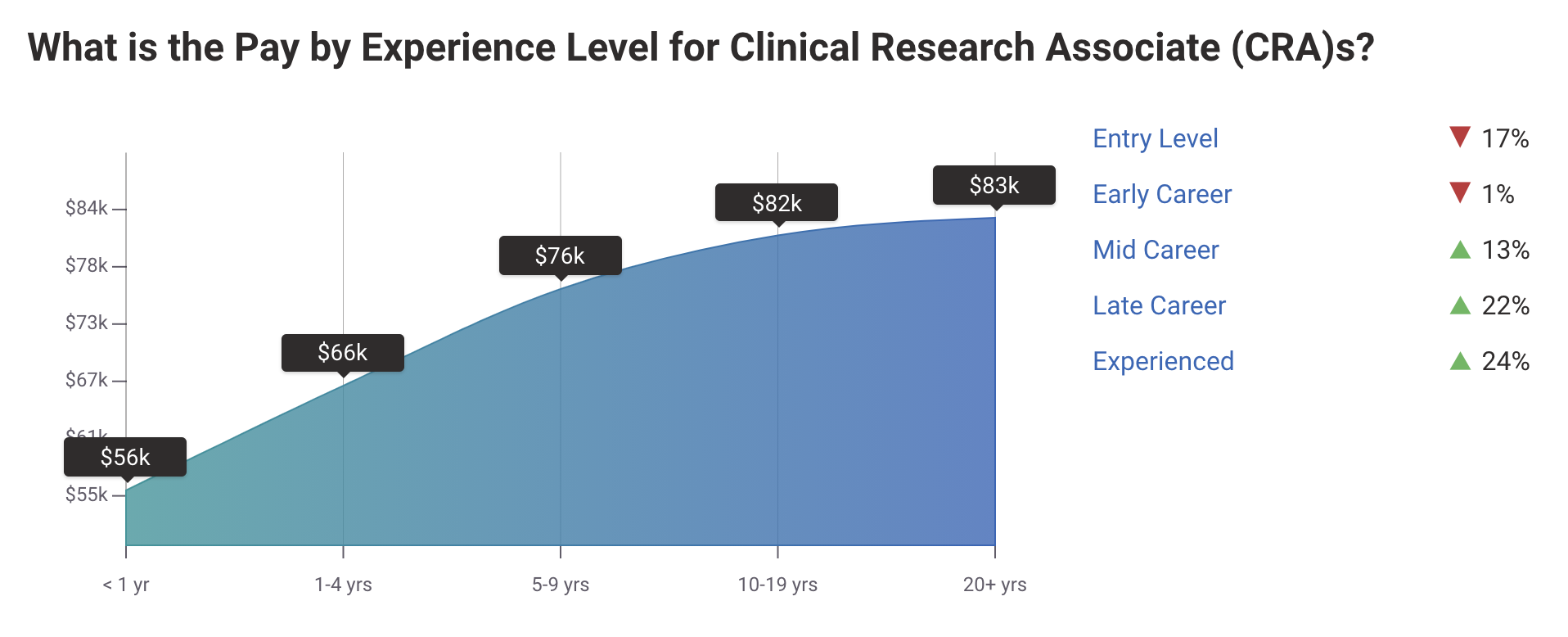
Clinical Research Associates (also known as monitors) act as the vital communication link between trial sponsors and clinical trial sites. They verify protocol adherence, inspect source documents, audit data integrity, and ensure compliance with Good Clinical Practice (GCP) guidelines. Because CRA roles require extensive travel (often 50% to 75%), compensation packages reflect both technical capability and lifestyle demands.
- CRA I (Entry to 2 years): Base compensation ranges from $75,000 to $92,000. Often transitioning from CRC roles or bridging programs, CRA I professionals focus on co-monitoring and routine site visits under senior supervision.
- CRA II (2–4 years): Base compensation ranges from $95,000 to $120,000. Independent monitors responsible for site initiation, interim monitoring, and close-out visits across multiple protocols.
- Senior / Lead CRA (5+ years): Base compensation ranges from $125,000 to $155,000. Senior CRAs handle complex protocols, conduct site feasibility assessments, train junior monitors, and frequently earn protocol-completion bonuses or travel stipends.
3. Trial Leadership: Clinical Trial Manager (CTM) & Project Directors
Clinical Trial Managers (CTMs) and Clinical Project Managers (CPMs) hold operational accountability for study timelines, vendor coordination, regulatory filings, and multi-million-dollar trial budgets across multiple sites globally.
- Clinical Trial Manager (CTM): Base compensation ranges from $135,000 to $170,000, accompanied by annual cash bonuses averaging 10% to 15%.
- Senior CTM / Associate Director of Clinical Operations: Base compensation ranges from $165,000 to $205,000, featuring expanded equity awards and variable performance bonuses.
- Director / Senior Director of Clinical Operations: Total compensation ranges from $210,000 to $280,000+, with executive incentive plans, equity options, and milestone-based bonuses representing a significant portion of annual earnings.
4. Data Management and Biostatistics Tiers
Data integrity and statistical analysis are foundational to regulatory approval by agencies like the U.S. Food and Drug Administration (FDA) and the European Medicines Agency (EMA). Specialized technical expertise commands elevated salaries in data science units.
- Clinical Data Manager (CDM): Base compensation spans $80,000 to $115,000 for mid-level professionals, while Senior CDMs and Data Management Leads earn $125,000 to $160,000.
- Biostatistician / Clinical Data Scientist: Entry-level biostatisticians holding a Master’s degree earn $90,000 to $110,000, while Ph.D.-level Lead Biostatisticians and Principal Data Scientists earn between $145,000 and $210,000.
Comprehensive Clinical Research Salary Comparison Matrix
The following matrix outlines standard compensation ranges, bonus structures, and primary earning drivers across key clinical research designations. Data reflects industry benchmarks across North American biopharmaceutical sectors.
| Role Title | Target Experience Level | Base Salary Range (USD) | Average Bonus / Equity Range | Primary Compensation Drivers |
|---|---|---|---|---|
| Clinical Research Coordinator (CRC) | 1–3 Years | $55,000 – $72,000 | 2% – 5% (Limited Equity) | Patient recruitment volume, site capacity, therapeutic domain |
| Senior CRC / Site Manager | 5+ Years | $78,000 – $105,000 | 5% – 10% | Audit performance, financial site profitability, complex oncology protocols |
| Clinical Research Associate I (CRA I) | 1–2 Years | $75,000 – $92,000 | 5% – 8% | Travel availability, monitoring quality, basic protocol familiarity |
| Senior CRA (CRA III / Lead) | 5+ Years | $125,000 – $155,000 | 8% – 15% + Sign-on Bonus | On-site monitoring capability, oncology/rare disease focus, CRO vs. Sponsor |
| Clinical Trial Manager (CTM) | 4–7 Years | $135,000 – $170,000 | 10% – 18% + Equity | Global protocol delivery, vendor management, budget containment |
| Regulatory Affairs Manager | 5–8 Years | $130,000 – $175,000 | 10% – 20% + Equity | FDA/EMA submission history, IND/NDA filing experience, strategy |
| Senior Clinical Data Manager | 5+ Years | $120,000 – $160,000 | 8% – 15% + Equity | EDC platform mastery, CDISC/SDTM standard expertise, database lock history |
| Director of Clinical Operations | 10+ Years | $210,000 – $280,000+ | 20% – 35% + Long-term Equity | Pipeline management, cross-functional leadership, regulatory success |
Sponsor vs. CRO vs. Academic Site: Structural Pay Trade-Offs
When comparing job offers or mapping career growth, evaluating base salary alone is insufficient. Candidates must account for the distinct value propositions offered by different organization types.
- SPONSOR (Biotech / Pharma)
- Highest Total Compensation (Base + Bonus + Equity)
- Strategic focus on company pipeline
- CRO (Contract Research Org)
- High Base Salary & Travel Allowances
- Rapid exposure to diverse therapeutic areas and protocols
- ACADEMIC MEDICAL CENTER / SITE
- Stable work schedules & low travel requirements
- High non-cash value: Pensions, education tuition, public service benefits
Direct Sponsor Employment
Sponsors offer superior long-term wealth accumulation potential through stock grants, stock purchase plans (ESPPs), and annual incentive payouts. A Senior CRA or Manager at a major pharmaceutical company might receive an annual base salary of $150,000 alongside a 15% target bonus and $20,000 to $40,000 in annual RSU grants. However, competition for direct-sponsor roles is intense, and biotech positions carry risk dependent on clinical trial outcomes and funding rounds.
Contract Research Organizations (CROs)
CROs hire continuously to support global trial demands. To attract experienced monitors and managers, CROs offer high base salaries, signing bonuses, retention bonuses, and quarterly travel allowances. The trade-off often involves strict billable-hour metrics, higher study loads, and potential exposure to sudden program cancellations if a sponsor terminates a contract. Nonetheless, CROs offer unparalleled career velocity, enabling professionals to advance roles faster than in traditional sponsor environments.
Academic Research Centers and Health Systems
While cash compensation at academic sites typically trails industry standards by 15% to 30%, these roles offer critical advantages. Academic institutions provide strong job security, minimal business travel, manageable working hours, public pension options, and institutional tuition remission for employees and their dependents. They serve as an exceptional entry point for gaining foundational trial experience.
Practical Strategies to Maximize Earning Potential
Moving into higher compensation bands in clinical research requires deliberate skill accumulation, strategic positioning, and understanding operational dependencies.
1. Earn Recognized Industry Certifications
Professional credentials demonstrate independent verification of competency, knowledge of federal regulations (such as 21 CFR Parts 11, 50, 54, 56, and 312), and mastery of Good Clinical Practice standards. Certified professionals routinely command 10% to 15% higher compensation than non-certified peers.
- Certified Clinical Research Coordinator (CCRC): Offered by the Association of Clinical Research Professionals (ACRP).
- Certified Clinical Research Professional (CCRP): Offered by the Society of Clinical Research Associates (SOCRA).
- Certified Clinical Research Associate (CCRA): ACRP certification tailored specifically for monitors.
- Regulatory Affairs Certification (RAC): Offered by the Regulatory Affairs Professionals Society (RAPS), highly valued for regulatory strategy tracks.
2. Develop Expertise in High-Complexity Therapeutic Areas
Transitioning from general medicine studies to specialized therapeutic areas directly expands market value. Oncology, cell therapy, gene therapy, and rare disease trials involve complex endpoints, adaptive trial designs, and specialized regulatory pathways (such as Accelerated Approval and Breakthrough Therapy designations). Developing competence in these fields establishes candidates as high-value specialists capable of managing intricate protocols.
3. Transition from Site-Level to Field Monitor or Sponsor Roles
Site coordinators looking to increase their compensation often achieve significant salary gains by transitioning to a CRO or sponsor role as a CRA or In-House CRA. Moving from a site-level CRC position ($60,000 average) to a entry-level CRA role ($80,000+ average) often represents a 30% or higher increase in base earning potential within a single transition.
4. Evaluate Contract / Independent Consulting Frameworks
For seasoned professionals with 7+ years of experience—particularly Senior CRAs, Senior Data Managers, and Regulatory Consultants—transitioning from W-2 employment to 1099 or W-2 contract consulting offers significant earning upside. Contract CRAs can command hourly rates between $90 and $150 per hour depending on therapeutic discipline and travel demands. However, contractors must self-manage health insurance, retirement planning, self-employment taxes, and potential gap periods between study contracts.
Frequently Asked Questions
What is the average starting salary for an entry-level Clinical Research Coordinator?
Entry-level Clinical Research Coordinators (CRCs) at academic medical centers or independent site networks generally earn between $52,000 and $65,000 per year. Starting compensation depends on geographic location, education (such as a Bachelor of Science), and previous healthcare experience in nursing or medical assisting.
How much do professional certifications like CCRC or CCRP increase earning potential?
Holding an industry certification from ACRP (CCRC/CCRA) or SOCRA (CCRP) typically yields a 10% to 15% premium in base compensation compared to non-certified colleagues. Certifications often serve as a mandatory prerequisite for promotion into senior coordinator, lead monitor, or management roles.
Why do pharmaceutical sponsors pay more than academic trial sites?
Pharmaceutical sponsors operate as commercial entities focused on bringing proprietary therapeutics to market. Their business models rely on rapid trial execution to maximize patent protection windows, allowing them to offer higher base pay, performance bonuses, and equity grants. Academic sites are often constrained by institutional pay scales, grant-based budgets, and non-profit operating models.
Are clinical research associate (CRA) salaries affected by remote work?
While CRA roles historically required up to 75% regional travel to conduct physical site audits, the growth of remote monitoring platforms and centralized monitoring has created dedicated In-House CRA and Remote Monitor positions. Purely remote monitoring roles typically pay 5% to 10% less in base salary compared to high-travel field CRAs, reflecting reduced travel obligations.
What are the highest-paying non-physician roles in clinical research?
Outside of Principal Investigators and Medical Directors holding an M.D. or D.O., the highest-paying positions include Directors/VPs of Clinical Operations ($210,000–$280,000+), Principal Biostatisticians / Data Science Leads ($160,000–$220,000), and Senior Directors of Regulatory Affairs ($190,000–$260,000+ plus incentive equity).
Recommended Next Steps
To evaluate your position within the clinical research salary landscape and build a plan for professional advancement:
- Conduct a Value Audit: Compare your current compensation against national and regional benchmarks, factoring in base pay, annual bonus percentage, retirement contributions, and equity grants.
- Identify Skill Gaps: Evaluate whether advancing your career requires credentialing (such as CCRC, CCRP, or RAC), formal training in electronic data capture systems (EDC), or experience in specialized fields like oncology or cell therapy.
- Target High-Growth Sectors: If maximizing cash earning potential is your priority, map career pathways toward CRO or biopharmaceutical sponsor roles, or consider field monitoring tracks that reward specialized technical skills and travel flexibility.
Image Gallery