Finding the Best Budget Adjustable Bed for Comfort and Cost
The best budget adjustable bed balances smooth, independent head and foot articulation with a durable steel base and quiet motor operation, typically priced between $300 and $700. Prioritizing essential ergonomic positions like Zero-Gr...
The best budget adjustable bed balances smooth, independent head and foot articulation with a durable steel base and quiet motor operation, typically priced between $300 and $700. Prioritizing essential ergonomic positions like Zero-Gravity and anti-snore modes over luxury add-ons like built-in massage or ambient lighting ensures maximum sleep quality and long-term reliability at an accessible price point.
Contents
What Defines a High-Value Budget Adjustable Bed?
An adjustable bed base allows users to elevate their upper body and legs to customizable angles. Historically considered medical equipment or high-end luxury items, modern manufacturing improvements have made ergonomic bed bases accessible to budget-conscious shoppers. Selecting the right low-cost base requires understanding which structural components contribute to comfort and longevity, and which features simply inflate the price tag.
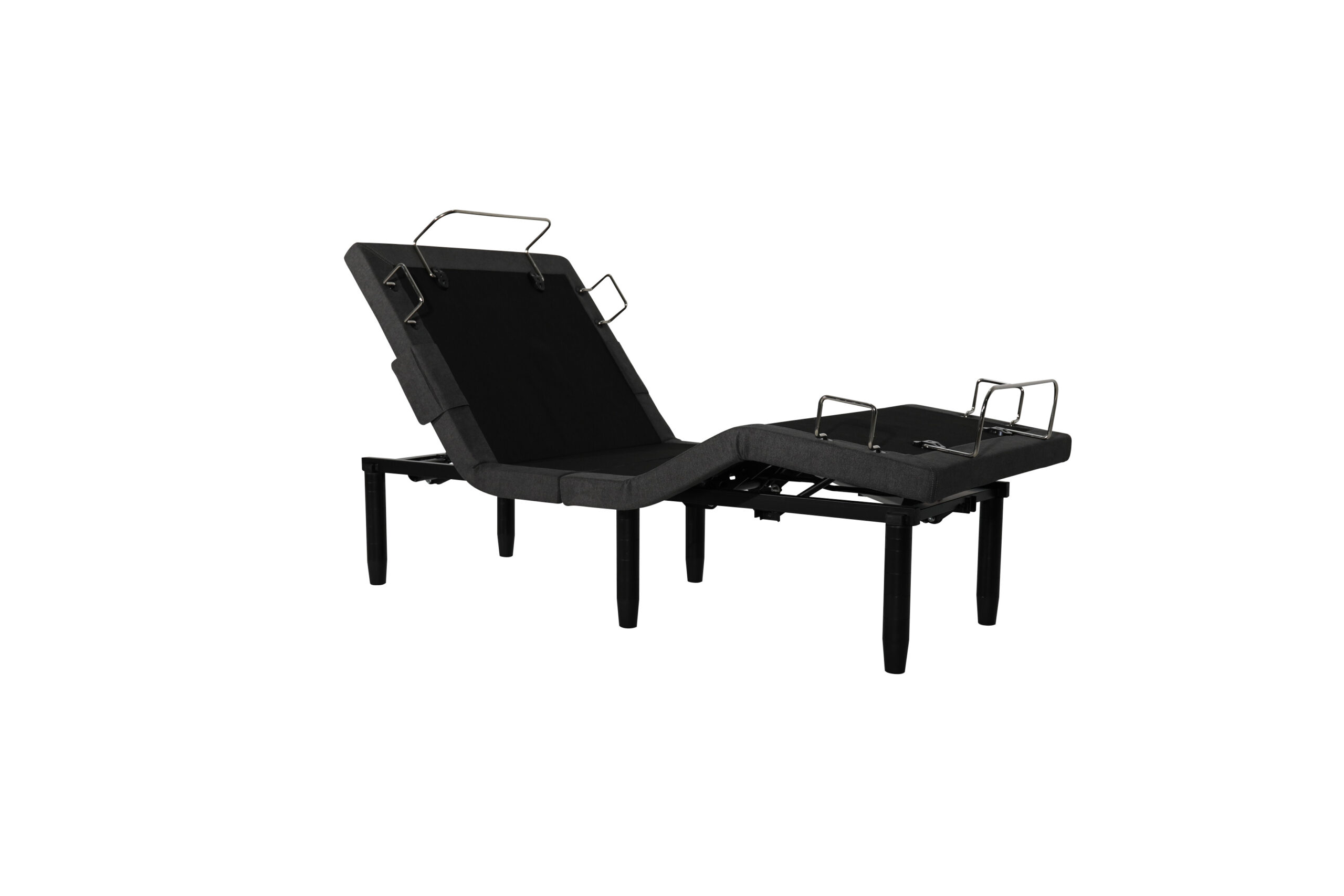
At its core, a budget adjustable bed consists of a heavy-duty steel frame, one or two electric linear actuators (motors), a articulated deck (typically split into two to four moving panels), and a control interface. High-value budget models do not compromise on structural safety or motor reliability; instead, they cut costs by omitting cosmetic enhancements, high-end upholstery, and non-essential electronic features.
- Typical Budget Adjustable Base
- Head Panel: 0°–60°: Linear Actuator 1 (Upper Body)
- Fixed Hip Deck: Center Support & Control Box
- Foot Panel: 0°–45°: Linear Actuator 2 (Lower Body)
Understanding the mechanical foundation helps prevent buying underpowered units that strain under weight or fail after short-term use.
Dual-Motor vs. Single-Motor Drive Systems
The most critical distinction in affordable adjustable frames lies in the motor setup:
- Single-Motor Systems: Found in ultra-budget models (often under $300). A single linear actuator drives the head incline only, or uses a mechanical linkage to lift the head and foot simultaneously at fixed ratios. While inexpensive, single-motor systems lack customizability.
- Dual-Motor Systems: The standard recommendation for practical comfort. Dual-motor bases feature separate actuators for the upper body and lower body, allowing independent adjustment of head elevation (typically 0° to 60°) and foot elevation (typically 0° to 45°).
Look for bases utilizing established motor suppliers, such as Okin or Dewert actuators. These German-designed motors are widely used across the bedding industry for their low noise output (below 50 decibels) and high thermal protection ratings, which prevent motor burnout during prolonged operation.
Essential Features vs. Cost-Adding Extras
Manufacturers differentiate budget frames from premium models by tiered feature sets. Knowing which features drive up prices enables you to focus your spending exclusively on rest and physical alignment.
Must-Have Features for Comfort and Usability
- Independent Head and Foot Elevation: Crucial for target relief. Elevating the head alleviates symptoms of Gastroesophageal Reflux Disease (GERD), sleep apnea, and snoring, while elevating the legs reduces lower back strain and improves venous circulation.
- Zero-Gravity (Zero-G) Preset: A preset position that lifts the legs slightly higher than the heart while angling the torso at roughly 15 to 20 degrees. This position minimizes gravitational pressure on the spine and distributes body weight evenly across the mattress.
- Flat Button / One-Touch Reset: Instantly returns the bed to a horizontal position without holding down adjustment keys.
- Emergency Battery Backup: A low-voltage battery box (usually powered by two 9-volt batteries) connected to the main control unit, allowing you to lower the bed during a household power outage.
- Retention Rail / Mattress Retainer Bar: A metal bracket at the foot of the bed that keeps the mattress from sliding off the frame when the head or foot deck is raised.
Optional Features That Drive Up Costs
- Sonic or Vibrational Massage: Dual-zone motor vibrations integrated into the deck can provide light muscular relaxation, but they often add $150 to $300 to the total cost without offering true physical therapy benefits.
- Wall-Hugging Technology: Premium frames utilize sliding track systems that push the mattress backward toward the wall as the head rises, keeping your body adjacent to nightstands. Budget frames eliminate this complex track system, lifting upward and forward on a fixed pivot hinge. While this means nightstands sit slightly behind your shoulders when fully elevated, omitting wall-hugging mechanics cuts manufacturing costs significantly.
- Under-Bed LED Lighting & USB-C Ports: Convenience additions that increase electronic points of failure. External wall plugs or smart nightstand outlets easily replace these features at a fraction of the cost.
Comparing Budget Adjustable Bed Categories and Specifications
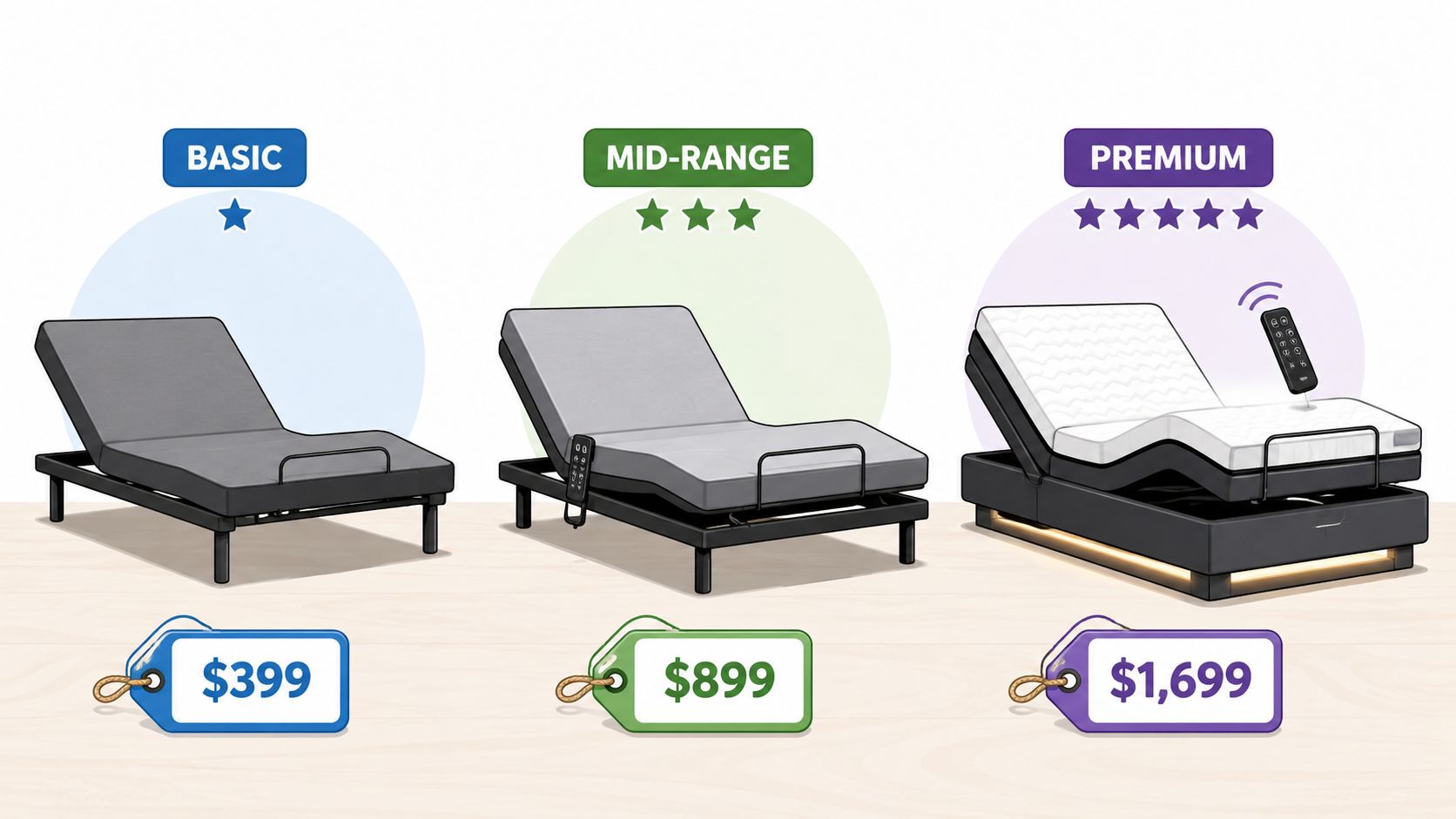
When shopping, adjustable bases generally fall into three distinct price tiers within the budget classification. The table below outlines the core specifications, average price ranges, and mechanical characteristics expected across these tiers:
| Feature / Metric | Entry-Level Budget ($250 – $399) | Mid-Range Budget ($400 – $599) | Advanced Budget ($600 – $799) |
|---|---|---|---|
| Motor Configuration | Single motor (Head only or sync tilt) | Dual motor (Independent Head & Foot) | Dual DC motors (High-torque Okin/Dewert) |
| Head Incline Range | 0° to 50° | 0° to 60° | 0° to 60° |
| Foot Incline Range | N/A or fixed link | 0° to 45° | 0° to 45° |
| Weight Capacity | 400 – 600 lbs | 650 – 750 lbs | 750 – 850 lbs |
| Remote Type | Tethered wired remote | Wireless RF remote | Wireless RF backlit remote |
| Programmable Presets | Flat button only | Zero-G, TV, Flat | Zero-G, Anti-Snore, Custom Memory |
| Design / Clearance | Standard legs (Fixed height) | Adjustable legs (3-in-1 modular) | Zero-clearance platform compatible |
| Frame Warranty | 1–3 years limited | 5–10 years structural frame | 10–20 years structural frame |
Mattress Compatibility and System Requirements
Buying an adjustable bed base requires verifying that your current or intended mattress can withstand continuous bending without structural damage.
- Mattress Compatibility Quick Check:
- Memory Foam: EXCELLENT (Flexes smoothly, maintains shape)
- Latex Foam: EXCELLENT (Highly elastic, conforms easily)
- Pocketed Hybrid: GOOD (Flexes well if coils are independent)
- Innerspring: POOR (Border wires warp; DO NOT USE)
Compatible Mattress Types
- Memory Foam: Highly pliable, memory foam adapts instantly to the contours of an articulated frame without forming permanent creases or resistance against the motors.
- Latex Foam: Natural or synthetic latex offers exceptional elasticity and resilience, bending smoothly while providing responsive support across varying incline angles.
- Hybrid Mattresses with Pocketed Coils: Hybrids containing individually encased (pocketed) wire coils move independently, allowing the mattress to bend smoothly at the hinge points of the adjustable base.
Incompatible Mattress Types
- Traditional Innerspring (Bonnell / Offset Coils): Mattresses constructed with interconnected wire coils or rigid perimeter border wires cannot flex. Attempting to bend a traditional innerspring mattress on an adjustable frame will permanently deform the steel springs, ruin the mattress, and potentially burn out the frame's electric motors.
- Ultra-Thick Extra-Firm Mattresses: Mattresses exceeding 14 inches in depth with high-density foam padding can resist articulation, creating gaps between the mattress bottom and the articulated deck.
Base Footprint and Structural Clearances
Before purchasing, consider how the base will integrate with your existing bed frame:
- Freestanding Setup: Budget bases usually ship with threaded steel legs. They stand independently inside a decorative wooden or upholstered bed frame (with slatted support systems removed).
- Zero-Clearance Bases: Higher-end budget bases feature a flat bottom design with no dangling motor components below the steel side rails. Zero-clearance models can sit directly on top of platform beds, storage beds, or flat foundations without using legs. Standard budget models, however, require clearance underneath for the linear actuator arms to travel down during adjustment. Ensure you have at least 6 to 10 inches of unblocked space under the bed deck.
Step-by-Step Selection and Buying Process
To select the best budget frame tailored to your comfort requirements and physical space, follow this structured evaluation process:
- Step 1: Identify Health & Physical Needs
- GERD/Snoring?: Prioritize 60° head elevation.
- Lower Back Pain?: Prioritize dual-motor Zero-Gravity leg lift.
- Step 2: Measure Mattress & Frame Clearance
- Measure inner frame dimensions and weight limits.
- Step 3: Calculate Total Weight Requirements
- Combined weight of sleepers + mattress weight.
- Ensure base capacity exceeds total load by at least 150 lbs.
- Step 4: Verify Warranty & Technical Support
- Look for non-prorated motor coverage (at least 2–3 years).
1. Match Articulation Specs to Health and Comfort Needs
If your primary reason for buying an adjustable bed is respiratory relief, acid reflux mitigation, or reading in bed, focus on models with 0° to 60° head inclines. If you suffer from lower back pain, spinal stenosis, or leg swelling (edema), prioritize dual-motor systems with independent foot elevation up to 45° to achieve accurate Zero-Gravity positioning.
2. Verify Total Load Capacity
Always calculate the total weight load placed on the base: $$\text{Total Load} = \text{Sleeper 1 Weight} + \text{Sleeper 2 Weight} + \text{Mattress Weight}$$
Standard budget frames support between 650 and 750 pounds of distributed weight. If using a heavy latex mattress (which can weigh 120–150 lbs) along with two adults, choose a base rated for at least 800 pounds to prevent strain on the motor gears.
3. Evaluate Warranty Conditions
Electric bases combine mechanical linkages with low-voltage power electronics. Inspect the warranty terms closely:
- Full (Non-Prorated) Coverage: Ideally, electronics and motors should be fully covered for parts and labor during the first 1 to 3 years.
- Limited (Prorated) Coverage: Structural steel frame members are often covered for 10 to 20 years. Avoid manufacturers that do not offer clearly documented customer support phone lines or replacement motor assemblies.
Unboxing, Setup, and Troubleshooting
Most budget adjustable beds are sold online and ship directly to your door in a heavy, single-box package ("bed-in-a-box" format). Understanding the assembly and troubleshooting procedures ensures long-term operational success.
Assembly Best Practices
- Two-Person Lift: The packaging for a Queen-size budget frame weighs between 100 and 140 pounds. Always use two people to move and unbox the frame.
- Unfold Flat: Most budget frames ship folded in half on a central hinge. Lay the frame flat, face down on a carpeted floor or blanket before attaching the hardware.
- Secure Leg Bolts and Brackets: Thread the adjustable legs tightly into the threaded mounting plates. If the frame uses center support legs or stabilization cross-bars, ensure all bolts are tightened with the provided hex keys to avoid lateral sway and frame squeaking.
- Cable Routing: Ensure motor power cords and control module cables are routed away from moving steel linkages. Loose cables caught in scissor hinges can strip insulation or cause short circuits.
Common Troubleshooting Procedures
- Motor Unresponsive: Check the main AC power transformer brick. Ensure the green LED light on the power supply is lit. If unlit, test the wall outlet. If the outlet works, press the Pairing Button on the main control box to re-sync the wireless RF remote to the receiver board.
- Uneven Elevation: If one side of the head deck lifts faster than the other, check for obstructions in the sliding track under the deck. Confirm that all frame-hinge pin cotter pins are fully inserted into the actuator clevis mounts.
- Squeaking or Mechanical Noise: Apply a light coating of dry silicone lubricant spray (avoid sticky grease or WD-40, which attracts dust) to the pivot pins and hinge joints once a year.
Frequently Asked Questions
Do budget adjustable beds work with standard bed frames?
Yes, most budget adjustable beds are designed to fit inside standard decorative bed frames (such as panel beds or four-poster beds). You must remove the existing wooden slats and support rails from the decorative frame, allowing the adjustable base to stand on its own steel legs directly over the floor inside the decorative surround.
Is a zero-gravity preset worth paying extra for on a budget bed?
Yes. Zero-Gravity positioning neutralizes pressure points on the lower spine and improves circulation by elevating the legs slightly above the level of the heart. Even basic budget models with dual motors can manually simulate this position, even if they lack a pre-programmed single-touch "Zero-G" button on the remote control.
How long do linear actuator motors last on affordable adjustable frames?
With normal residential use within rated weight limits, high-quality linear actuators (such as Okin or Dewert motors) typically last between 8 and 12 years. Motor failure in budget beds is most commonly caused by exceeding weight limits or allowing cords to bind in the frame's moving hinges.
What is the difference between a zero-clearance base and a traditional adjustable base?
A traditional adjustable base requires 6 to 10 inches of open vertical space underneath the frame to accommodate the movement of down-facing motor housing arms. A zero-clearance base features flat, low-profile internal mechanisms, allowing the unit to lay completely flat on platform surfaces, platform beds with built-in storage drawers, or flat box springs without clearance issues.
Will using an adjustable base void my mattress warranty?
Not usually, provided the mattress is an adjustable-friendly model (such as all-foam, latex, or pocketed-coil hybrid). However, placing a traditional bonded-innerspring mattress on an adjustable base will ruin the internal wire grid and void the mattress warranty. Always check the mattress manufacturer’s warranty documentation to confirm compatibility.
Practical Recommendation
When selecting a budget adjustable bed frame, prioritize dual-motor designs with a steel frame, 700+ lb weight capacity, and a wireless remote over aesthetic luxuries.
For the vast majority of sleepers, a mid-range budget base priced between $400 and $600 provides the optimal intersection of price, durability, and health benefits—delivering independent head and foot articulation without forcing you to pay for expensive massage features or complex wall-hugging tracks. Verify that your mattress is constructed from memory foam, latex, or pocketed coils, clear out existing bed frame slats before setup, and ensure the manufacturer provides at least a 2-year non-prorated electrical component warranty.
Image Gallery