5 Factors to Choose the Best Hand Mirrors: A Professional Buyer's Guide
Selecting the best hand mirror requires evaluating optical clarity, magnification accuracy, structural ergonomics, integrated illumination, and frame durability. High-quality mirrors utilize distortion-free float glass with silver nitr...
Selecting the best hand mirror requires evaluating optical clarity, magnification accuracy, structural ergonomics, integrated illumination, and frame durability. High-quality mirrors utilize distortion-free float glass with silver nitrate backing, offer true-to-scale magnification without peripheral blurring, feature balanced handles to minimize wrist fatigue, and incorporate high-CRI LED lighting for accurate color presentation.
Contents
Hand mirrors serve as indispensable tools across professional salon environments, clinical skincare settings, aesthetic practices, and daily personal grooming routines. While a basic mirror simply reflects light, an optically sound, well-engineered hand mirror delivers absolute fidelity, enabling precise cosmetic application, detailed skin analysis, and thorough hair styling verification. Selecting an inferior mirror often leads to visual distortion, eye strain, premature silver backing oxidation, or uncomfortable physical handling.
To select a hand mirror that meets professional and personal standards, buyers must look beyond aesthetic frame design and evaluate five core technical and structural factors.
1. Optical Glass Quality, Reflective Coatings, and Image Clarity
The underlying substrate and chemical reflective layer dictate the optical fidelity of any mirror. Inferior hand mirrors frequently rely on thin sheet glass or low-grade acrylic with basic aluminum backings, resulting in warped reflections, wave distortion, and color tinting.
Float Glass vs. Acrylic Substrates
- Precision Float Glass: High-grade hand mirrors utilize float glass, manufactured by floating molten glass over a bed of molten tin. This process creates exceptionally parallel surfaces, eliminating microscopic surface wave distortion. Float glass provides optimal stiffness, scratch resistance, and optical purity.
- Low-Iron Glass: Premium optical mirrors use low-iron glass formulations. Standard glass contains iron oxide impurities that create a faint green edge tint and alter reflected skin tones. Low-iron glass maximizes light transmission and yields true color reproduction.
- Acrylic and Polycarbonate Substrates: Flexible plastic mirrors are shatterproof and lightweight, making them useful for travel or safety-restricted environments. However, plastic substrates easily flex and scratch, introducing noticeable optical distortion over wide viewing angles.
Silver Nitrate vs. Aluminum Reflective Backings
- Silver Coating (Silvered Mirrors): High-end mirrors apply a thin film of silver nitrate to the back of the glass, sealed with copper and protective paint layers. Silver offers higher reflectivity across the visible light spectrum (approximately 95% to 99% light reflectance), delivering brighter, sharper images with superior contrast.
- Aluminum Coating: Standard commercial mirrors use vacuum-deposited aluminum. While cost-effective and resistant to corrosion, aluminum reflects slightly less light (typically 85% to 90%) and can cast a slightly cooler, bluer undertone compared to silver.
Environmental resistance is equally important. In humid bathroom settings or salon backwash areas, non-sealed silver backings can suffer from edge oxidation—commonly known as "mirror rot"—where moisture degrades the backing, creating black spots around the perimeter. High-performance hand mirrors feature moisture-sealed protective paint backings to prevent atmospheric oxidation.
2. Magnification Levels, Focal Distances, and Dual-Sided Functionality
Magnification alters the focal geometry of a mirror, turning a flat reflective surface into a concave curve that converges light rays. Selecting the correct magnification depends entirely on the intended application and the user's visual requirements.
Mirror Focal Distance Mechanics: [ Flat Mirror (1x) ] --> Parallel Light Rays --> Infinite Focal Length (Natural View) [ Concave Mirror (5x) ] --> Converging Light --> Short Focal Distance (~8 to 10 Inches) [ Concave Mirror (10x)] --> Steep Curve --> Ultra-Short Focal Distance (~4 to 6 Inches)
Understanding Magnification Power and Focal Lengths
- 1x (True Scale): A 1:1 flat reflection without magnification. Essential for evaluating overall hairstyle balance, facial symmetry, and wide-angle cosmetic assessment.
- 3x to 5x (Moderate Magnification): Provides a comfortable enlargement of facial features. Ideal for everyday makeup application, skincare routines, and contact lens insertion. The focal distance remains comfortable (typically 8 to 12 inches away from the face), allowing users to view their entire face without moving extremely close.
- 10x to 15x (Precision Magnification): Designed for detailed work such as eyebrow shaping, pore extraction, lash application, or micro-dermabrasion checks. Highly magnified mirrors require a very steep concave curvature. Consequently, the usable focal distance drops to between 3 and 6 inches.
Managing Optical Distortion and Focal Inversion
A common user mistake with high-magnification hand mirrors (10x or higher) is expecting a clear image from a standard arm's length distance. Outside the strict focal zone of a strong concave lens, the reflected image turns upside down or suffers from severe peripheral distortion (spherical aberration). High-quality magnified mirrors control spherical aberration by precision-grinding the concave glass curve to maintain clarity across the entire lens surface.
Dual-Sided Reversible Designs
For maximum versatility, many professional hand mirrors incorporate a 360-degree swivel frame featuring 1x true-scale glass on one side and a magnified concave surface (3x, 5x, or 10x) on the reverse. When buying a dual-sided mirror, verify that the swivel mechanism uses smooth friction hinges or locking detents to hold the mirror at the desired angle without slipping over time.
3. Ergonomics, Weight Distribution, and Frame Durability
A hand mirror must feel balanced in the hand, especially during prolonged cosmetic work or salon consultations. Poor weight distribution forces the user's wrist and fingers to strain, leading to accidental drops and reduced control.
Frame Materials and Physical Characteristics
- Impact-Resistant ABS Plastic: Molded ABS (Acrylonitrile Butadiene Styrene) provides an excellent strength-to-weight ratio. ABS frames absorb shock upon impact, resisting cracks and chipping if dropped. It is non-porous, highly resistant to salon chemicals, hairsprays, and moisture, and easily sanitized.
- Natural Hardwood: Beech, walnut, and bamboo offer a classic aesthetic and comfortable tactile grip. However, wooden mirrors require protective sealants to withstand high humidity without warping, swelling, or splitting over time.
- Reinforced Metals (Aluminum Alloy / Brass): Metallic frames provide exceptional durability and premium styling. However, solid metal significantly increases the mirror's total weight. An overly heavy hand mirror becomes tiring to hold during extended grooming tasks.
Handle Design and Center of Gravity
The geometry of the handle determines its physical usability:
- Contoured Finger Grips: Ergonomic handles feature subtle grooves or tapered profiles that conform to the hand's natural resting grip, reducing required pinch force.
- Center-Weighted Balance: A top-heavy hand mirror constantly wants to tip forward, straining the forearm muscles. High-quality designs counterbalance the heavy glass plate with a weighted or extended handle base.
- Non-Slip Coatings: Soft-touch rubberized coatings or matte textured finishes prevent the mirror from slipping when operated with wet or lotion-covered hands.
4. Integrated LED Illumination and Color Rendering Accuracy
Ambient indoor lighting is rarely neutral or evenly distributed. Overhead bathroom lights cast harsh downward shadows under the eyes and chin, while standard tungsten bulbs introduce a yellowish color cast. Integrated LED lighting converts a basic hand mirror into a self-contained, color-accurate grooming workstation.
Color Temperature Spectrum for Mirror LEDs: [ 2700K - Warm Yellow ] ---> Ambient / Evening Setup [ 4000K - Neutral White ] -> Daylight Balanced / Skincare Standard [ 6500K - Cool Daylight ] --> Precision Detail / Bright Daylight
Color Rendering Index (CRI)
The single most critical lighting specification is the Color Rendering Index (CRI), which measures how accurately a light source reveals true object colors compared to natural daylight (rated at 100 CRI).
- Standard LEDs (CRI < 80): Wash out subtle skin tones, making foundation matching and color blending difficult.
- High-CRI LEDs (CRI 90–97+): Essential for accurate cosmetic application. High-CRI lighting reveals precise skin pigmentation, subtle redness, makeup hue subtleties, and hair dye undertones.
Color Temperature Options (Kelvin Ratings)
Optimal mirror illumination offers adjustable color temperatures measured in Kelvins (K):
- 3000K (Warm Light): Simulates evening indoor environments and restaurant lighting.
- 4500K to 5000K (Neutral Daylight): Represents natural, unbiased daylight. This is the industry standard for daily makeup application and aesthetic skin evaluation.
- 6000K+ (Cool White): Provides high-contrast, intense brightness suited for fine detail work, though it can appear clinical.
Power Systems and Battery Management
Modern illuminated hand mirrors rely on built-in rechargeable Lithium-Ion (Li-ion) batteries charged via standard USB-C interfaces. When evaluating illuminated models, look for capacitive touch-dimming switches, automatic shutoff timers to conserve battery power, and minimum battery runtimes of 2 to 4 hours on continuous maximum brightness.
5. Surface Area, Field of View, and Portability Features
The size and shape of the mirror surface define the field of view (FOV) and determine how portable the mirror will be for travel or mobile work.
Circular vs. Rectangular Fields of View
- Circular Mirrors: The classic shape for personal grooming. A circle naturally focuses attention toward the center of the face. A 6-inch to 8-inch diameter circular hand mirror balances adequate facial coverage with easy handling.
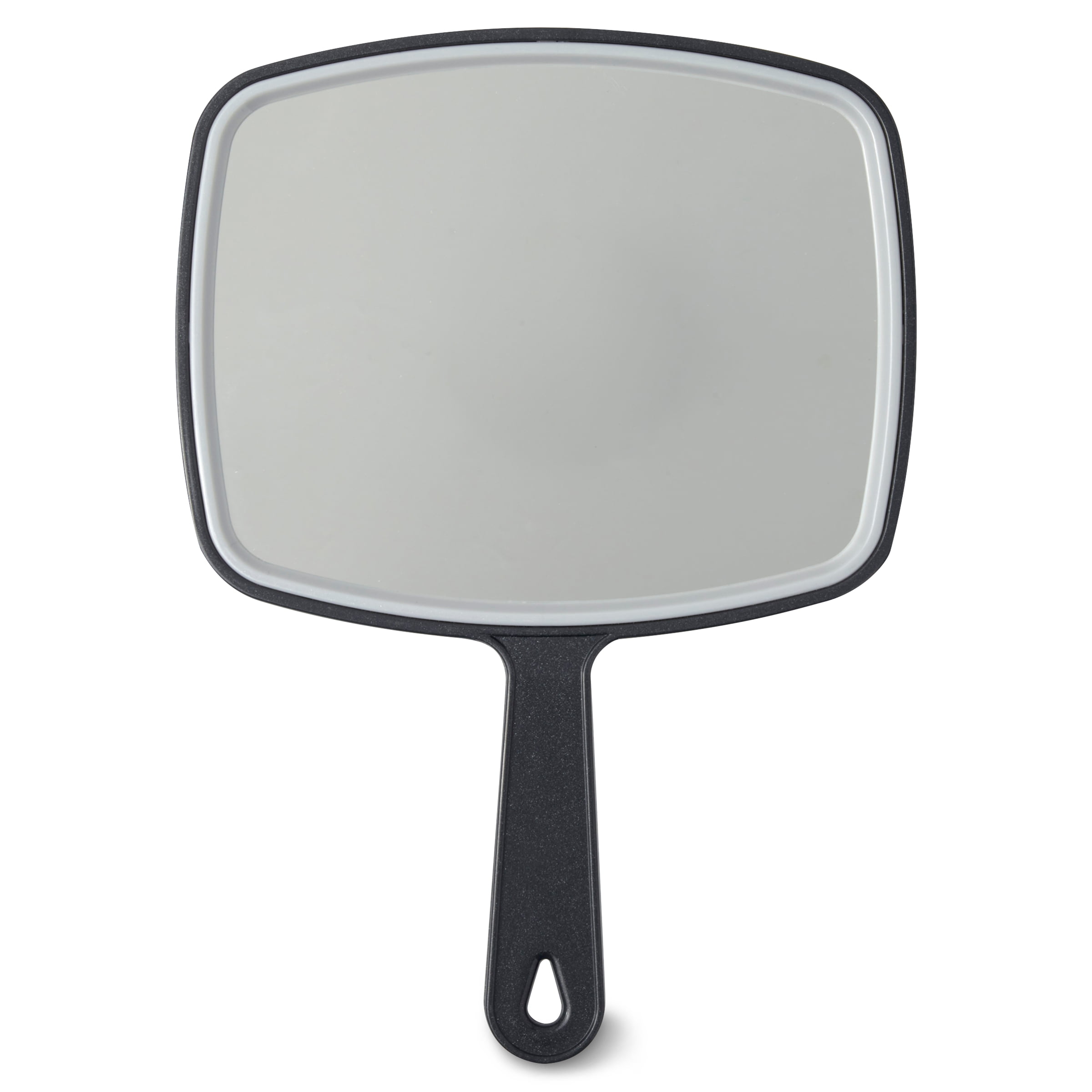
- Rectangular and Square Mirrors: Offer a wider horizontal field of view. Rectangular hand mirrors are favored by professional hairstylists and barbers because they allow clients to see the full width of their shoulders, haircut edges, and back-of-head styling with minimal repositioning.
Hybrid Folding and Stand Options
To bridge the gap between fixed vanity mirrors and mobile hand mirrors, many modern designs feature multi-articulating handles:
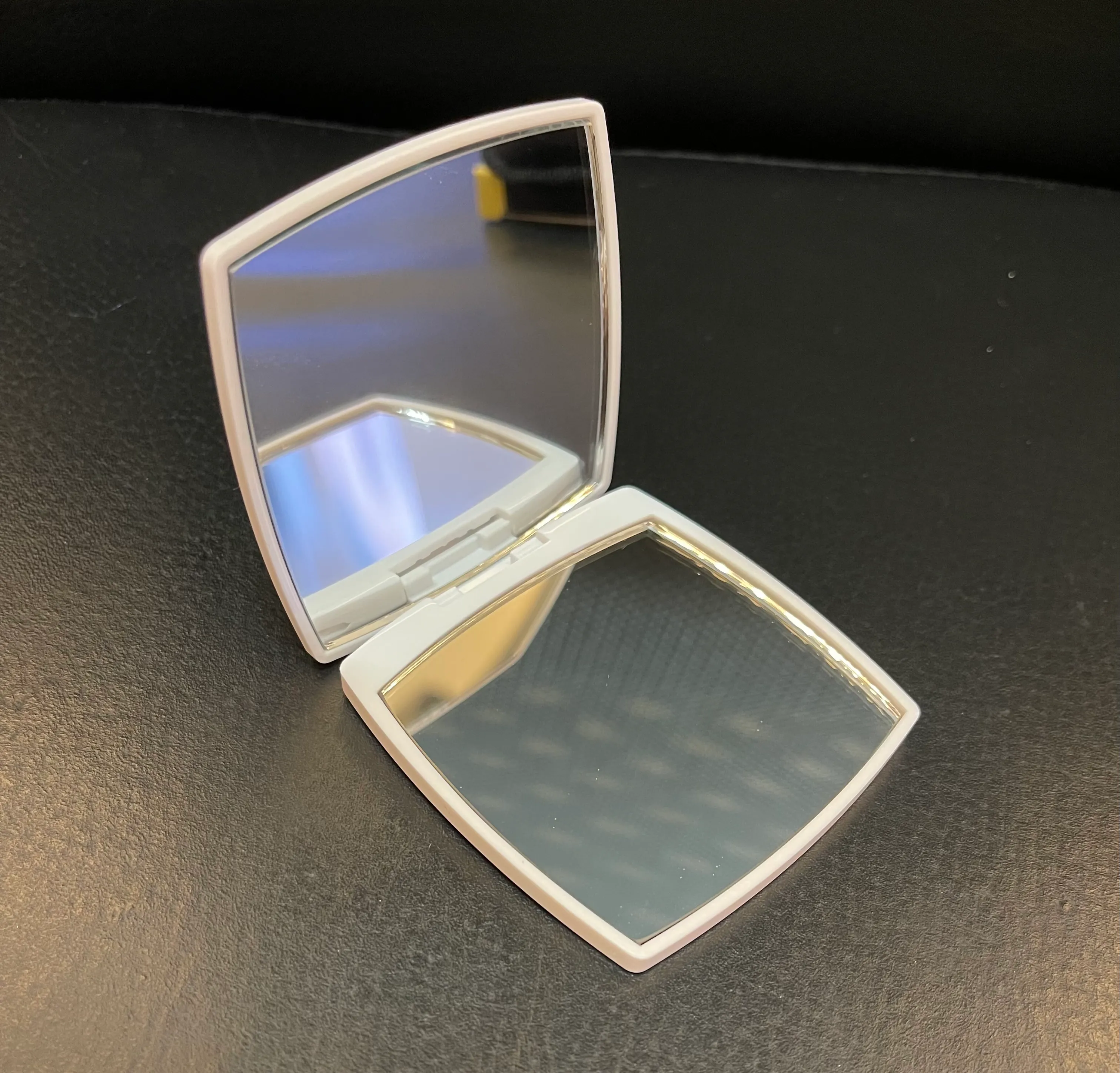
- 2-in-1 Folding Handles: The handle rotates 180 degrees backwards to form a stable desktop kickstand, allowing hands-free operation when necessary.
- Wall-Mounting Slots: Integrated hanging holes or magnetic mounting bases allow the mirror to be stored safely off counter surfaces when not in use.
- Travel Protective Covers: For users on the move, rigid protective covers or padded travel sleeves prevent glass breakage and scratch damage inside baggage.
Technical Comparison of Hand Mirror Categories
The following matrix compares common hand mirror configurations based on key specifications, ideal usage scenarios, and performance characteristics.
| Mirror Category | Primary Substrate & Reflective Coating | Magnification Options | Weight Range | Recommended CRI / Lighting | Key Operational Advantage |
|---|---|---|---|---|---|
| Professional Salon Back-View | Float Glass / Silver Nitrate with Moisture Seal | 1x (True Scale) Flat | 450g – 750g | Unlit (relies on ambient salon lighting) | Extra-large rectangular FOV for showing back-of-head hair styling. |
| Precision LED Beauty Mirror | Low-Iron Float Glass / High-Reflective Silver | Dual-Sided: 1x / 5x or 10x | 300g – 500g | CRI 95+, Adjustable (3000K–5000K) | Self-illuminated, true color accuracy for detailed cosmetics and skincare. |
| Compact Travel Mirror | Polycarbonate / Acrylic or Thin Glass / Aluminum | Dual-Sided: 1x / 3x | 100g – 200g | Optional single-temp LED ring | Lightweight, shatter-resistant frame designed for portability. |
| Ergonomic Hardwood Hand Mirror | Standard Float Glass / Silver Nitrate | 1x (True Scale) | 350g – 600g | Unlit | Premium natural tactile feel, high impact resistance against minor drops. |
How to Test and Care for a Hand Mirror
To maximize the service life and optical performance of a hand mirror, follow these professional maintenance guidelines:
Testing Optical Flatness upon Purchase
- Hold the mirror at arm's length in a brightly lit room with straight architectural lines (such as a door frame or tile grout line).
- Slowly tilt and pan the mirror horizontally and vertically while looking at the reflected line.
- If the reflected straight line appears to wave, bow, or bend, the glass substrate or reflective silver coating suffers from surface distortion.
Preventative Maintenance and Cleaning
- Clean with Microfiber: Never use abrasive pads or paper towels, which contain wood fibers that create microscopic scratches on glass and plastic frames.
- Avoid Ammonia-Based Cleaners: Harsh chemical cleaners containing ammonia can run down the edge of the glass and dissolve the protective paint backing over time, triggering silver oxidation (black edge decay). Instead, use a soft microfiber cloth dampened with warm water or a specialized optical glass cleaner.
- Store in Low-Humidity Environments: Keep silver-backed mirrors in well-ventilated areas to prevent long-term moisture buildup around frame seams.
Frequently Asked Questions
Why does a 10x magnification mirror look upside down from a distance?
A 10x magnified mirror uses a strongly curved concave lens to converge reflected light. Concave mirrors have a very short focal point (typically within 4 to 6 inches). When you stand further away than this focal distance, the light rays cross over each other before reaching your eye, causing the reflected image to appear inverted or severely blurred. To get a sharp, upright image, you must position your face within the mirror's specific focal zone.
What is the difference between a silver mirror and an aluminum mirror?
Silver nitrate coatings reflect roughly 95% to 99% of visible light, producing a brighter, warmer, and more true-to-life color reflection. Vacuum-deposited aluminum coatings reflect about 85% to 90% of light, which can create a slightly dimmer image with a subtle cool or bluish tint. Silver mirrors provide higher optical quality but require protective backing seals to prevent humidity-induced oxidation.
Is an LED-lit hand mirror worth the extra weight?
For precise makeup application, micro-grooming, or working in rooms with poor overhead lighting, an LED-lit mirror with high color rendering (CRI 90+) is significantly better than an unlit mirror. It eliminates harsh overhead shadows and reveals true cosmetics pigment shades. However, if the mirror is primarily used for quick back-of-head haircut checks in a brightly lit salon, an unlit, lightweight model may be more comfortable to hold.
What causes black spots around the edge of a hand mirror?
Black spots around mirror perimeters are caused by a process called silver oxidation or "mirror rot." This occurs when moisture, cleaning chemicals, or high humidity penetrate the protective paint backing on the rear of the glass, causing the silver nitrate layer to react chemically and break down. Choosing mirrors with moisture-sealed backings and avoiding ammonia-based glass cleaners prevents this issue.
How do I choose between a circular and rectangular hand mirror?
Choose a circular mirror (typically 5 to 7 inches in diameter) for personal facial grooming, skincare routines, and makeup application, as the circular shape naturally focuses your field of view on central facial features. Choose a wide rectangular mirror if you need to evaluate broader areas, such as full hairstyles, shoulder alignments, or back-of-head cuts in a salon setting.
Practical Recommendations and Next Actions
To select the ideal hand mirror for your exact requirements, execute the following step-by-step evaluation:
- Define Your Primary Use Case: If you need a mirror for detailed skincare, eyebrow shaping, or cosmetics, prioritize a dual-sided LED mirror with 1x/5x magnification and a CRI rating of 90+. If you are a barber or hair stylist, choose an unlit, large rectangular float-glass mirror with an ABS shock-resistant frame.
- Verify Glass and Coating Specs: Confirm the manufacturer specifies float glass or low-iron glass rather than thin acrylic, ensuring a flat, wave-free reflection.
- Test the Weight and Ergonomics: Ensure the total weight does not exceed 500 grams (17.6 oz) for continuous hand-held use, and check for a center-balanced handle featuring a soft-touch or textured non-slip grip.
- Check Lighting Control: If choosing an illuminated model, ensure it charges via standard USB-C, provides continuous dimming, and offers a natural daylight color setting between 4500K and 5000K.
Image Gallery