How to Read Livestock Brands for Accurate Identification
Reading a livestock brand requires following three primary directional rules: left to right, top to bottom, and outside to inside. By identifying the sequence of letters, numbers, and symbols—and accounting for their orientation, such...
Reading a livestock brand requires following three primary directional rules: left to right, top to bottom, and outside to inside. By identifying the sequence of letters, numbers, and symbols—and accounting for their orientation, such as "lazy," "flying," or "swinging"—you can accurately decode the unique legal mark used for animal ownership and identification.
Contents
The Language of the Open Range
Livestock branding is one of the oldest forms of identification, serving as a permanent mark of ownership that cannot be easily lost, altered, or removed. In 2026, despite the widespread adoption of electronic identification (EID) and RFID ear tags, the physical brand remains the "gold standard" for proof of ownership in many jurisdictions. It is a legal title held on the hide of the animal.
To the uninitiated, a brand might look like a chaotic jumble of lines and letters. However, branding is a sophisticated language with its own grammar, syntax, and regional dialects. Accurate identification is critical for brand inspectors, law enforcement, and ranchers to prevent theft, settle ownership disputes, and manage livestock movement across state or provincial lines.
Understanding how to "call" a brand is a prerequisite for anyone involved in the agricultural industry. This process involves translating visual symbols into a standardized verbal string that can be cross-referenced with official brand books.
The Three Fundamental Rules of Brand Literacy
The sequence in which you read a brand is non-negotiable. If you read the characters out of order, you are identifying a completely different brand, which could belong to a different ranch entirely. There are three primary rules for reading any livestock brand.
1. Left to Right
If characters are arranged horizontally, read them from left to right. This is the most common arrangement for ranch names or initials. For example, a brand featuring a capital "R" followed by a "T" is read simply as the R T. If the characters are touching, they are referred to as "connected." An "R" and "T" that share a vertical line would be read as the R T Connected.
2. Top to Bottom
When characters are stacked vertically, the top character is read first. A brand with a "7" positioned directly above a "B" is read as the 7 B. In some regions, this may be called as 7 over B. The vertical relationship is vital; a "7 B" (horizontal) and a "7 over B" (vertical) are distinct legal entities and are registered separately.
3. Outside to Inside
If a character is placed within a geometric shape, such as a circle, square, or triangle, the outside shape is read first. For instance, a letter "M" inside a circle is read as the Circle M. If the "M" were inside a triangle, it would be the Triangle M. This rule applies regardless of how many layers of symbols are used.
Decoding Common Brand Symbols and Characters
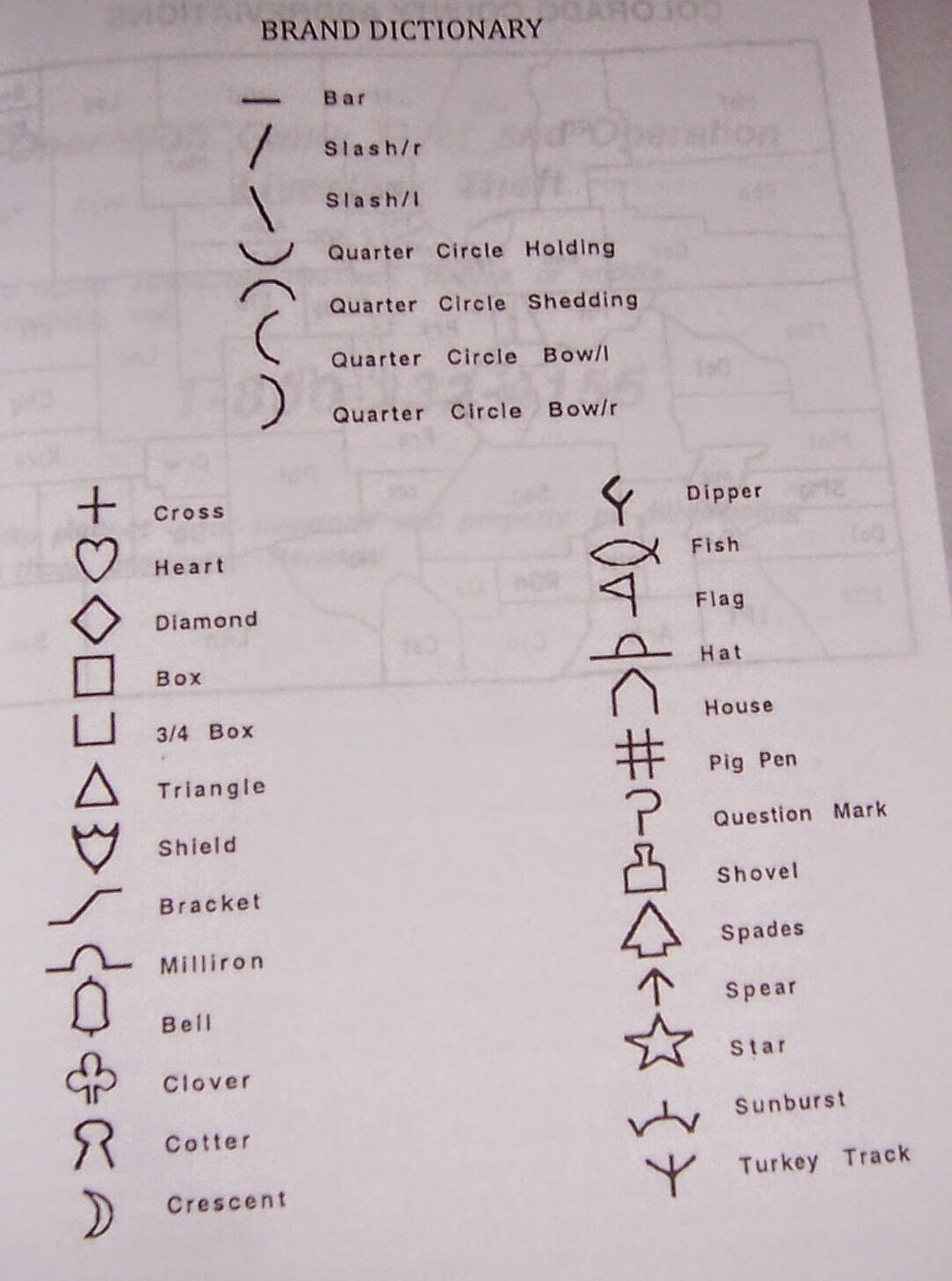
While letters and numbers form the backbone of most brands, ranchers frequently use lines and geometric shapes to create unique identifiers. These symbols have specific names that must be used during identification.
Lines and Bars
- The Bar: A short horizontal line. A brand with a bar over the letter A is the Bar A.
- The Rail: A longer horizontal line, often used to separate or underline multiple characters. Two horizontal lines, one above the other, are called Two Rails.
- The Slash: A diagonal line. A slash leaning to the right (top to bottom) is a Slash. If it leans to the left, it is often called a Backslash.
- The Stripe: Similar to a rail but typically refers to a vertical mark or a series of marks on the ribs or thigh.
Geometric Shapes
Shapes are used to "house" characters or stand alone.
- Circle: A full circle. A "C" is not a circle; a circle must be closed.
- Half Circle: A semi-circle, usually with the open side facing down (called a Half Circle) or up (called a Cup).
- Box/Square: A four-sided square.
- Diamond: A square rotated 45 degrees.
- Triangle: A three-sided shape, usually sitting on its base. If inverted, it is called an Inverted Triangle.
- Heart: A standard heart shape, often used in family-run operations.
Understanding Character Orientation and Modifiers
The orientation of a letter or number completely changes its name. Ranchers use these modifiers to create thousands of variations using the same basic alphabet.
The "Lazy" Position
When a character is turned 90 degrees onto its side, it is called "lazy." A capital "A" lying on its side with the peak pointing to the left is the Lazy A. The direction the character "faces" can also be a distinguishing factor in some registries, though usually, "lazy" is the standard term regardless of which side it rests on.
Tumbling and Hanging
- Tumbling: A character leaning at a 45-degree angle is "tumbling." This is less common than the lazy orientation but is used to distinguish brands in crowded registries.
- Hanging: When a character is attached to the bottom of another, it is "hanging." For example, a "J" attached to the bottom of a "Bar" is the Bar Hanging J.
Walking, Flying, and Swinging
These modifiers add "limbs" or "motion" to a character:
- Walking: Adding two short lines to the bottom of a letter (like legs) makes it "walking." A "W" with legs is the Walking W.
- Flying: Adding short horizontal lines (serifs) to the top of a character's ends makes it "flying." A "V" with these marks is the Flying V.
- Swinging: Adding a curved line (a half circle) underneath a character, but not touching it, makes it "swinging." An "S" with a curve below it is the Swinging S. If the curve touches the letter, it becomes a Rocking S.
| Symbol/Modifier | Visual Description | Verbal Translation |
|---|---|---|
| - | Short horizontal line | Bar |
| — | Long horizontal line | Rail |
| A (90° tilt) | Letter on its side | Lazy A |
| ( A ) | Letter inside a circle | Circle A |
| A | Letter with a curve underneath (touching) | Rocking A |
| A (non-touching) | Letter with a curve underneath (separated) | Swinging A |
| / * | Diagonal line | Slash |
| A+ | Letter with feet | Walking A |
The Legal Importance of Brand Registration
In 2026, the legal framework surrounding brands is more integrated than ever. A brand is not just a mark; it is a registered trademark and a deed of ownership. In the United States and Canada, brands are registered with state or provincial Brand Boards (such as the Texas and Southwestern Cattle Raisers Association or the Alberta Brand Office).
Brand Inspection Requirements
When livestock are sold or transported across certain jurisdictional lines (often called "brand inspection areas"), a brand inspector must verify the mark. The inspector compares the physical brand on the animal's hide to the "Bill of Sale" or the registered brand in the official Brand Book. If the brand is read incorrectly—for example, calling a Lazy 5 a 5—the movement of the cattle can be legally halted until the discrepancy is resolved.
Placement Matters
A brand's location on the animal's body is as important as the design itself. The same "Circle S" brand can be registered to one rancher for the left shoulder and to a different rancher for the right hip. When identifying a brand, you must note the location:
- Shoulder (Left or Right)
- Ribs (Left or Right)
- Hip (Left or Right)
Common Challenges in Accurate Identification
Even for experts, reading brands in the field presents challenges. Several factors can obscure a mark, leading to misidentification.
Hair Growth and Grooming
In winter months, heavy hair coats can obscure the fine lines of a brand. Inspectors often have to clip the hair or apply water/oil to the hide to make the scar tissue stand out. A "Bar" can easily be hidden under thick winter fur, leading an observer to see only the letter beneath it.
Blotched Brands
A "blotched" brand occurs when the branding iron was held against the hide too long, causing the heat to spread and create a blurred or smeared scar. This can also happen if the animal moves during the branding process. Identifying a blotched brand requires looking for the "skeleton" of the original mark or cross-referencing with other identification like ear tags or EIDs.
Freeze Branding vs. Hot Branding
- Hot Branding: Uses a heated iron to create a permanent scar by destroying hair follicles and damaging the skin. It is more common in beef cattle and is readable year-round.
- Freeze Branding: Uses liquid nitrogen or dry ice to kill the pigment-producing cells in the hair follicle, causing the hair to grow back white. This is popular for horses and black-hided cattle. On white-hided animals, the iron is held longer to kill the follicle entirely, leaving a "bald" brand similar to a hot brand.
Frequently Asked Questions
What is the difference between a "Rocking" and "Swinging" brand?
A Rocking brand features a curved line (half-circle) that is physically attached to the bottom of the character. A Swinging brand features the same curved line, but it is detached and sits slightly below the character. This distinction is legally significant in brand registries.
Can two people have the same brand?
Yes, but only if they are in different jurisdictions or if the brand is placed on a different part of the animal. For example, one rancher may own the "Diamond T" on the left hip in Wyoming, while another owns the "Diamond T" on the right shoulder in the same state.
How do you read a brand that is flipped backward?
A character that is flipped horizontally (mirror image) is called "reverse" or "speculated." A backward "K" would be called a Reverse K. This is a common way to create a unique mark when the standard version of the letter is already registered.
Are brand symbols read before or after letters?
This depends on the placement. Follow the standard rules: if the symbol is to the left of the letter, read it first (Bar K). If the symbol is above the letter, read it first (Bar over K). If the letter is inside the symbol, read the symbol first (Circle K).
What is a "Running Iron" brand?
A running iron is a straight rod with a curve at the end, used like a pen to "draw" a brand rather than pressing a pre-formed stamp. Brands made this way are often more cursive or custom. While legal in some places, many states have historically restricted their use to prevent "brand blotting" (altering another person's brand).
Next Actions for Accurate Identification
To master the art of reading brands, your next step should be to obtain a copy of your state or province’s Official Brand Book. Most jurisdictions in 2026 offer digital, searchable databases. Practice "calling" brands by looking at ranching advertisements or visiting local livestock auctions.
If you are purchasing livestock, always ensure the brand on the animal matches the Brand Inspection Certificate exactly. If you encounter an unfamiliar brand in the field that appears altered or unreadable, contact a local brand inspector or the Department of Agriculture. Accurate identification is the first line of defense in maintaining the integrity of livestock ownership and the agricultural economy.
Image Gallery