Comprehensive Guide to Number Sequence Examples: Patterns, Formulas, and Applications
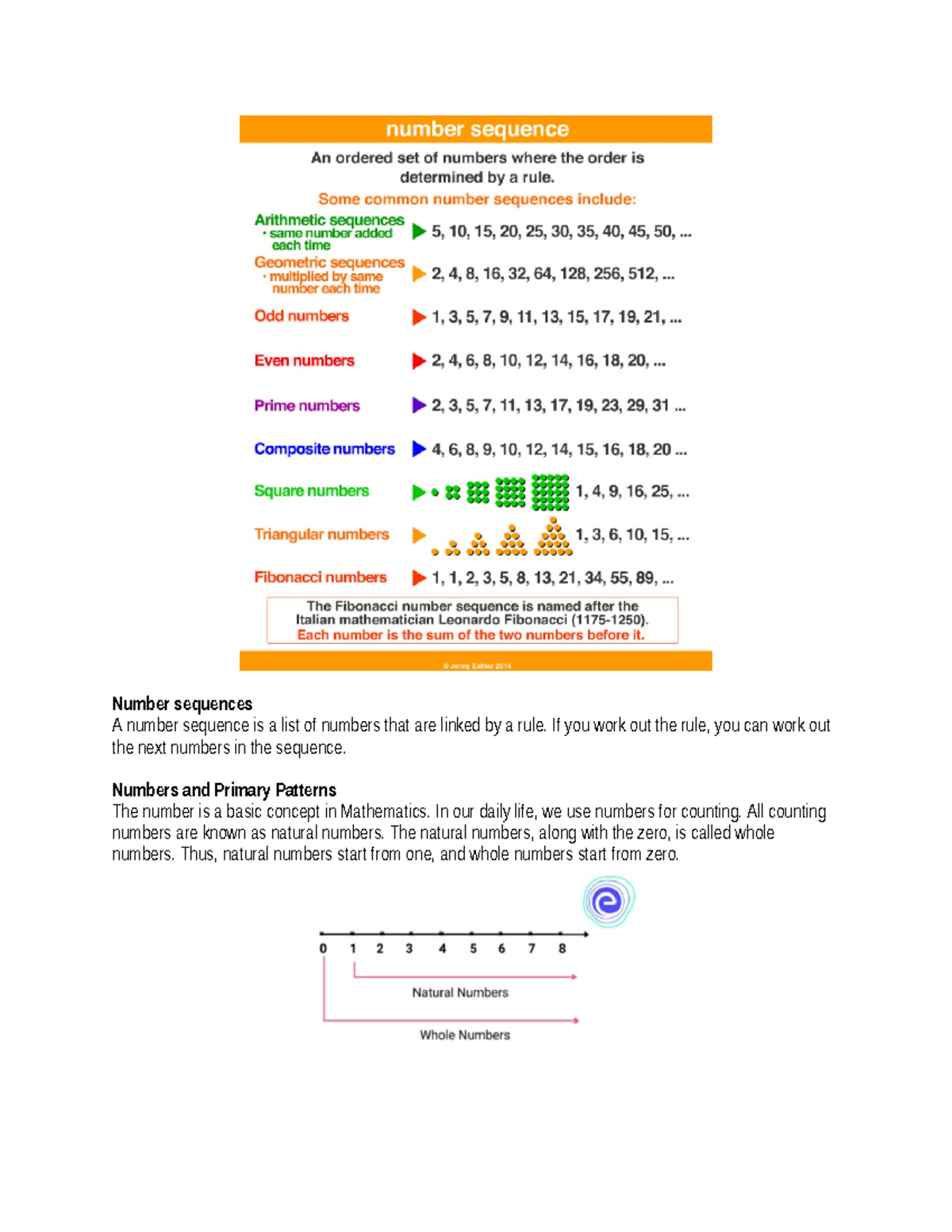
A number sequence is an ordered list of numbers that follows a specific logical rule or mathematical pattern. Common examples include arithmetic sequences like 2, 4, 6, 8 (adding 2), geometric sequences like 3, 9, 27, 81 (multiplying b...
A number sequence is an ordered list of numbers that follows a specific logical rule or mathematical pattern. Common examples include arithmetic sequences like 2, 4, 6, 8 (adding 2), geometric sequences like 3, 9, 27, 81 (multiplying by 3), and the Fibonacci sequence where each number is the sum of the two preceding ones.
Contents
Understanding the Fundamentals of Number Sequences
In mathematics, a sequence is more than just a random collection of figures; it is a function whose domain is a set of countable, ordered numbers. Each individual value in the sequence is referred to as a term. To describe these terms, mathematicians use notation such as a₁ for the first term, a₂ for the second, and aₙ for the nth term.
As of 2026, the study of number sequences remains a cornerstone of algorithmic thinking, data science, and standardized testing. Identifying the "rule" of a sequence allows us to predict future values, which is the basis for everything from financial forecasting to understanding the growth of biological populations. Sequences are generally categorized into two types: finite sequences, which have a specific end point, and infinite sequences, which continue indefinitely.
The ability to recognize patterns is a vital cognitive skill. Whether you are a student preparing for competitive exams or a professional working in software development, understanding how numbers relate to one another through addition, multiplication, or powers is essential for complex problem-solving.
Arithmetic Sequences: The Logic of Constant Addition
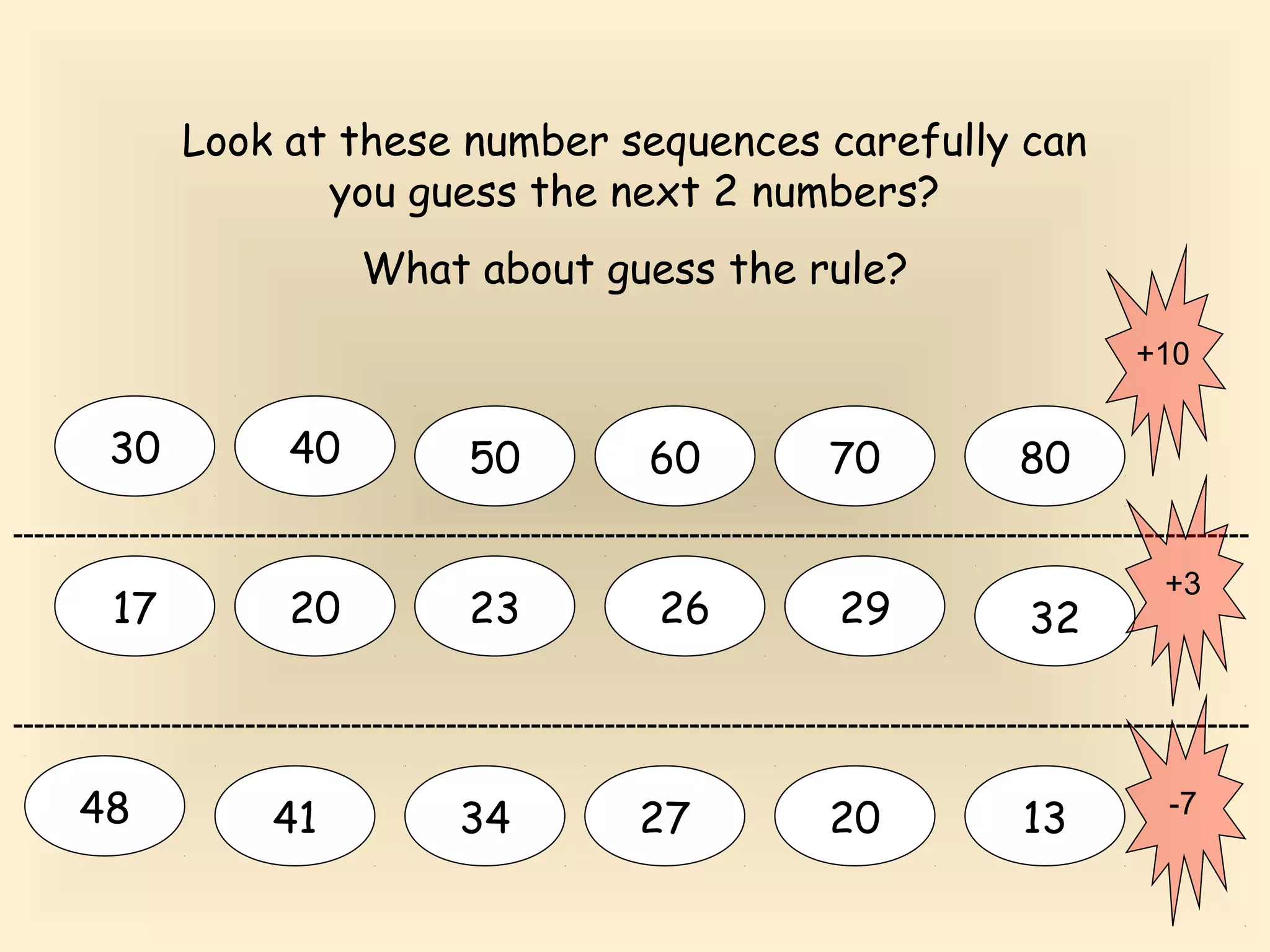
An arithmetic sequence, also known as an arithmetic progression, is perhaps the most straightforward type of number sequence. In this pattern, the difference between any two consecutive terms is a constant value, known as the common difference (denoted as d).
Identifying Arithmetic Patterns
Consider the sequence: 5, 11, 17, 23, 29... To find the rule, we subtract the first term from the second: 11 - 5 = 6. We then verify this with the next pair: 17 - 11 = 6. Because the difference remains constant, this is an arithmetic sequence where d = 6.
The General Formula
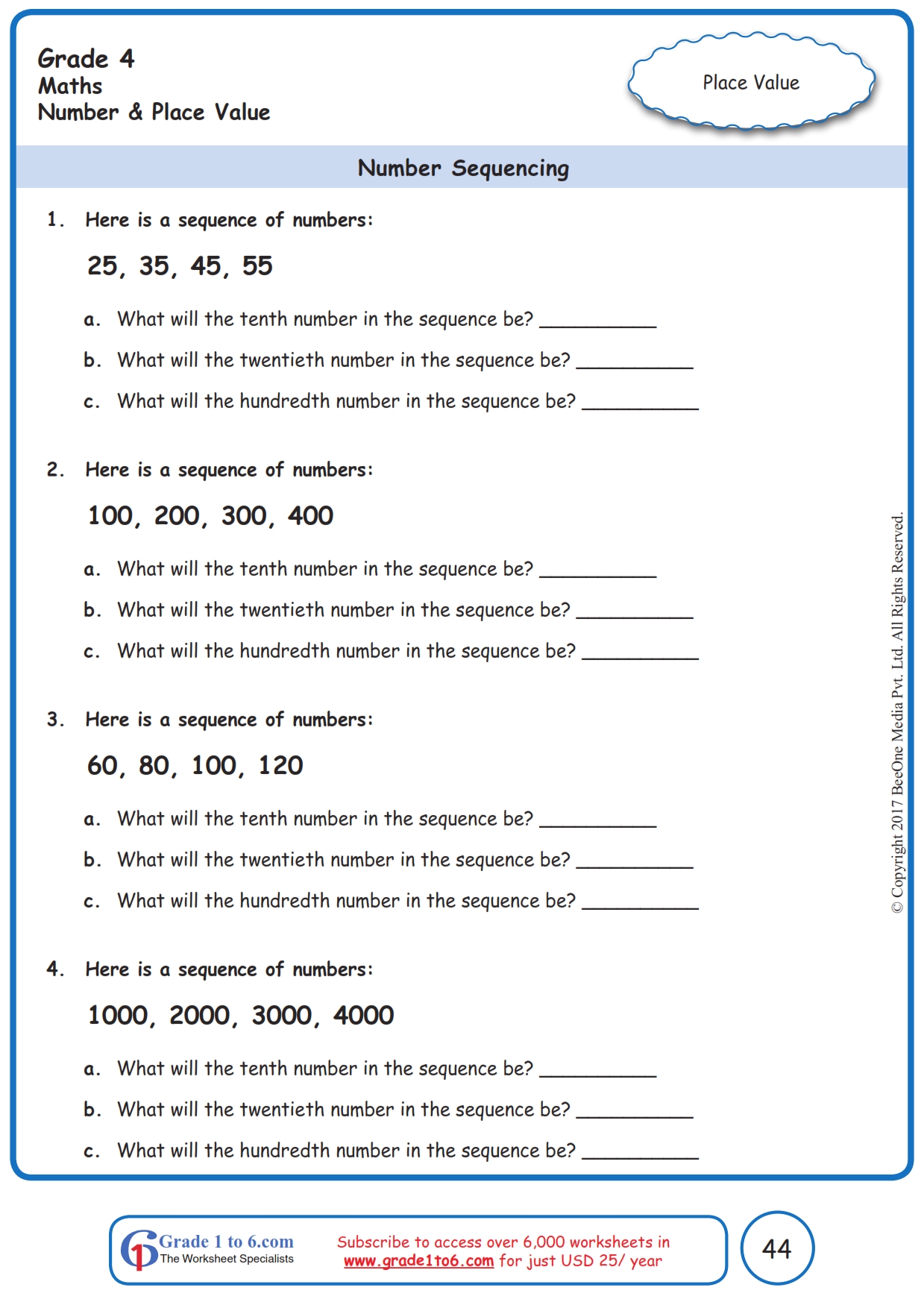
To find any term in an arithmetic sequence without listing every number, we use the formula: aₙ = a₁ + (n - 1)d
- aₙ: The value of the nth term you are looking for.
- a₁: The first term in the sequence.
- n: The position of the term.
- d: The common difference.
For example, if you need to find the 100th term of the sequence 5, 11, 17..., you would calculate: a₁₀₀ = 5 + (100 - 1) * 6 a₁₀₀ = 5 + (99 * 6) = 599.
Arithmetic sequences are used extensively in simple interest calculations, physical measurements (like distance over time at a constant speed), and scheduling.
Geometric Sequences: The Power of Constant Multiplication
A geometric sequence, or geometric progression, occurs when each term after the first is found by multiplying the previous term by a fixed, non-zero number called the common ratio (denoted as r).
Identifying Geometric Patterns
Consider the sequence: 2, 10, 50, 250... Here, 10 divided by 2 is 5, and 50 divided by 10 is also 5. The common ratio is r = 5. Unlike arithmetic sequences, geometric sequences grow (or shrink) at an accelerating rate, leading to what is commonly known as exponential growth.
The General Formula
The formula for the nth term of a geometric sequence is: aₙ = a₁ * r^(n-1)
This formula is critical in 2026 for modeling phenomena such as:
- Compound Interest: How an investment grows over time.
- Viral Spread: How information or biological agents move through a population.
- Technological Scaling: Moore's Law, which historically predicted the doubling of transistors, is a classic geometric sequence.
If r is between -1 and 1 (but not zero), the sequence will "converge" toward zero. If r is greater than 1, the sequence will "diverge" toward infinity.
The Fibonacci Sequence: Mathematics in the Natural World
The Fibonacci sequence is unique because it is defined by a recursive rule rather than a simple common difference or ratio. The sequence starts with 0 and 1, and each subsequent number is the sum of the two numbers preceding it.
Sequence: 0, 1, 1, 2, 3, 5, 8, 13, 21, 34, 55...
The Golden Ratio connection
As the Fibonacci sequence progresses, the ratio between any two consecutive terms (e.g., 55/34) approaches approximately 1.618, known as the Golden Ratio (Phi). This ratio is found throughout nature, including the spiral patterns of shells, the arrangement of leaves on a stem, and the proportions of the human body.
In modern software engineering and algorithm design, Fibonacci sequences are used in "Fibonacci Heaps" (data structures) and in search algorithms that optimize the process of finding items in sorted arrays. They are also popular in "Agile" project management for estimating the complexity of tasks using "Story Points."
Square, Cube, and Triangular Number Sequences
Beyond the standard arithmetic and geometric progressions, several sequences are based on the geometry of numbers or their powers.
Square Numbers
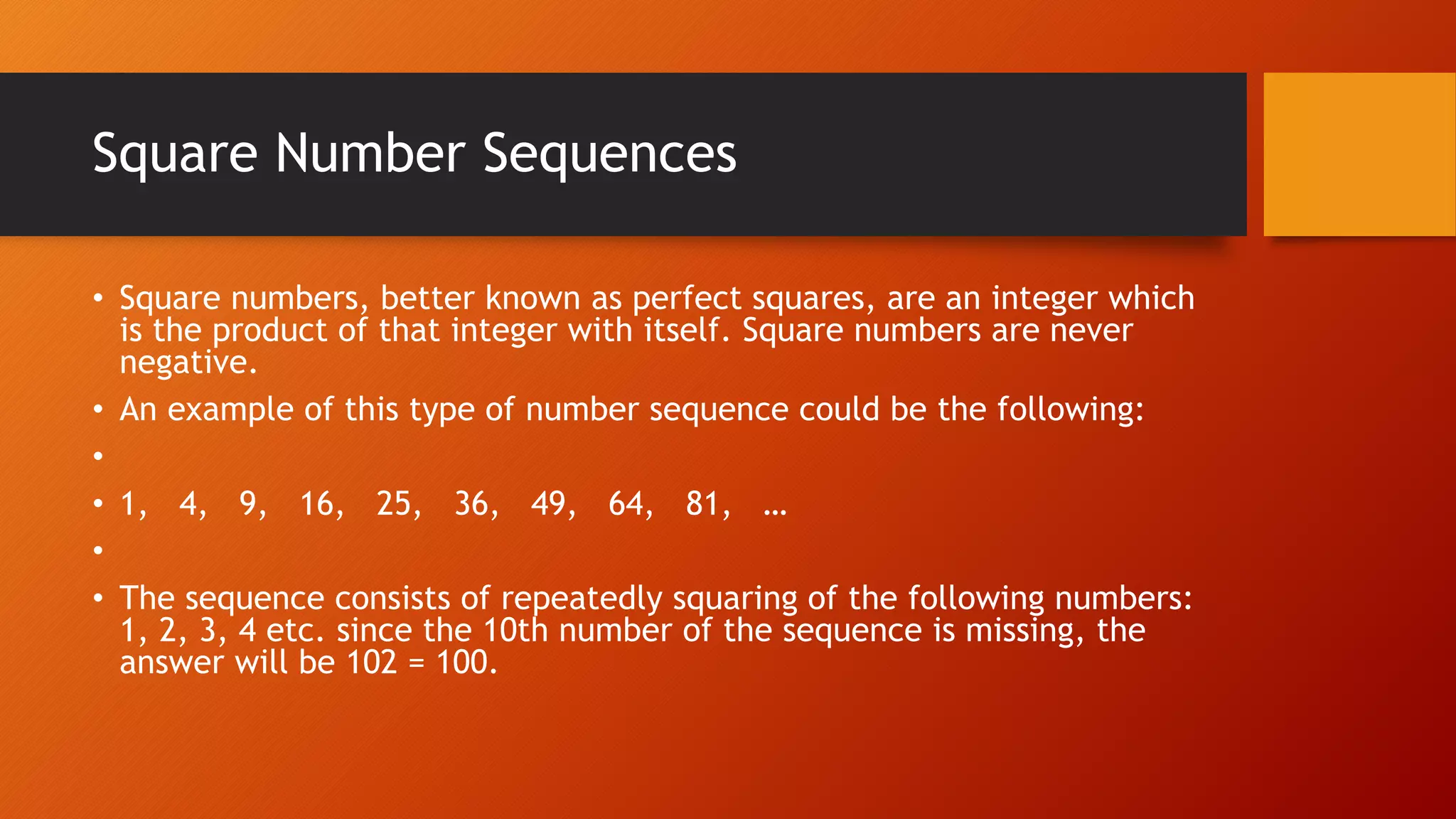
A square number sequence is generated by squaring the position of each term (n²). Example: 1, 4, 9, 16, 25, 36... These represent the area of squares with side lengths of 1, 2, 3, 4, and so on.
Cube Numbers
Similar to square numbers, cube numbers are generated by cubing the position of the term (n³). Example: 1, 8, 27, 64, 125... These represent the volume of cubes with increasing side lengths.
Triangular Numbers
Triangular numbers represent the number of dots required to form an equilateral triangle. Example: 1, 3, 6, 10, 15, 21... The formula for the nth triangular number is n(n + 1) / 2. This sequence is particularly useful in "handshake problems" (e.g., if every person in a room of n people shakes hands with everyone else, how many handshakes occur?).
Harmonic and Prime Number Sequences
For those pursuing higher-level mathematics or computer science, harmonic and prime sequences offer more complex patterns that do not always follow a simple algebraic formula.
Harmonic Sequences
A harmonic sequence is the reciprocal of an arithmetic sequence. Example: 1, 1/2, 1/3, 1/4, 1/5... The arithmetic sequence here is 1, 2, 3, 4, 5... (where d = 1). Harmonic sequences are vital in the study of music (harmonics and overtones) and in physics when calculating the equivalent resistance in parallel electrical circuits.
Prime Number Sequences
Prime numbers are integers greater than 1 that have no divisors other than 1 and themselves. Example: 2, 3, 5, 7, 11, 13, 17, 19... Unlike the other sequences mentioned, there is no simple, known formula that generates the next prime number in a sequence. Prime numbers are the "atoms" of the number system and serve as the foundation for modern cryptography and cybersecurity.
Comparative Analysis of Major Sequence Types
The following table summarizes the key differences between the most frequently encountered number sequences to help you identify them in practice.
| Sequence Type | Core Rule | Example | Primary Formula |
|---|---|---|---|
| Arithmetic | Add a constant difference (d) | 10, 13, 16, 19... | aₙ = a₁ + (n-1)d |
| Geometric | Multiply by a constant ratio (r) | 2, 4, 8, 16... | aₙ = a₁ * r^(n-1) |
| Fibonacci | Sum of two previous terms | 1, 1, 2, 3, 5... | Fₙ = Fₙ₋₁ + Fₙ₋₂ |
| Square | Square the term position (n) | 1, 4, 9, 16... | aₙ = n² |
| Triangular | Add the next integer | 1, 3, 6, 10... | aₙ = n(n+1)/2 |
| Harmonic | Reciprocal of arithmetic terms | 1, 0.5, 0.33... | aₙ = 1 / [a₁ + (n-1)d] |
Practical Applications of Sequences in 2026
Number sequences are not merely academic exercises; they have profound implications in technology and daily life.
- Financial Planning: Banks use geometric sequences to calculate the future value of savings accounts or the amortization schedules for mortgages. Understanding the ratio of growth is essential for long-term wealth management.
- Computer Programming: Iterative loops in code often follow arithmetic sequences (e.g.,
for i from 0 to 10 step 2). More complex algorithms use Fibonacci sequences for efficient data retrieval. - Medical Research: In 2026, epidemiologists continue to use geometric progressions to model the early stages of disease outbreaks, allowing health organizations to allocate resources before a spread becomes unmanageable.
- Signal Processing: Engineers use sequences to sample continuous signals (like audio or video) and convert them into digital data. The patterns within these samples determine the quality and compression of the digital file.
- Logic and IQ Testing: Pattern recognition via number sequences is a standard metric for assessing fluid intelligence and deductive reasoning capabilities.
How to Identify and Solve Number Sequence Patterns
If you are faced with a sequence and do not know the rule, follow these steps to decode it:
Step 1: Check for a Common Difference Subtract the first term from the second, and the second from the third. If the results are identical, it is an arithmetic sequence.
Step 2: Check for a Common Ratio Divide the second term by the first, and the third by the second. If the results are the same, you are dealing with a geometric sequence.
Step 3: Look for Squares and Cubes If the numbers grow rapidly but not by a consistent ratio, check if they are close to 1, 4, 9, 16 (squares) or 1, 8, 27, 64 (cubes). Sometimes the sequence is a square plus or minus a constant (e.g., 2, 5, 10, 17 is n² + 1).
Step 4: Examine the Relationship Between Preceding Terms If the first three steps fail, see if adding the first and second terms results in the third. This indicates a recursive or Fibonacci-style sequence.
Step 5: Check for Two Interleaved Sequences Occasionally, a sequence is actually two patterns alternating. For example, in 1, 10, 2, 20, 3, 30, the odd positions are an arithmetic sequence (1, 2, 3) and the even positions are another (10, 20, 30).
For further technical exploration of complex sequences, the Online Encyclopedia of Integer Sequences (OEIS) serves as a definitive global database. Additionally, Wolfram MathWorld provides deep mathematical proofs for sequence convergence and divergence.
FAQ
What is the difference between a sequence and a series? A sequence is a list of numbers in a specific order (e.g., 1, 2, 3, 4). A series is the sum of the terms in a sequence (e.g., 1 + 2 + 3 + 4 = 10). Sequences identify patterns, while series are used to find totals and cumulative values.
Can a number sequence have a negative common difference? Yes. An arithmetic sequence can decrease, such as 20, 15, 10, 5, where the common difference d is -5. Similarly, a geometric sequence can have a common ratio r that is a fraction (e.g., 1/2), causing the numbers to get smaller.
How is the Fibonacci sequence used in trading? In financial markets, "Fibonacci retracement levels" are used by traders to identify potential support and resistance levels. These levels are based on the ratios found within the Fibonacci sequence (most notably 23.6%, 38.2%, and 61.8%).
Are there sequences that never end and never repeat? Yes. The digits of irrational numbers like Pi (π) or the square root of 2 form an infinite sequence of digits that do not have a repeating pattern. However, these are typically categorized as "non-periodic" sequences rather than those defined by a simple algebraic rule.
What is a recursive sequence? A recursive sequence is one where each term is defined based on the previous terms. The Fibonacci sequence is the most famous example. Unlike arithmetic or geometric sequences, you usually need to know the preceding values to find the next one, unless you use a specific closed-form expression like Binet's Formula.
To master number sequences, start by practicing with basic arithmetic and geometric problems. Once comfortable, move toward identifying combined sequences and recursive patterns, as these are the types most frequently encountered in advanced mathematics and technical interviews.
Image Gallery