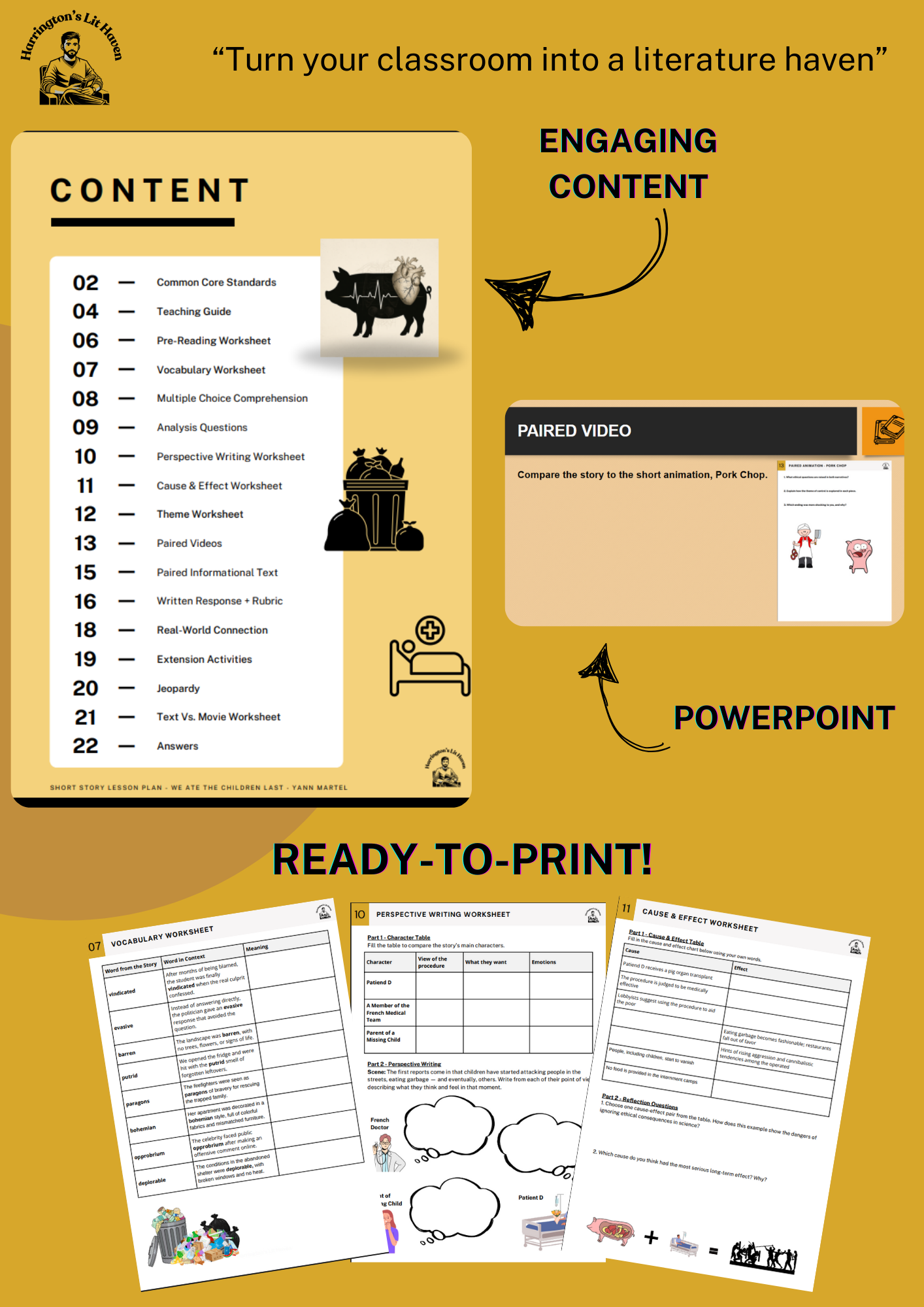
Why the "Why We Ate the Children Last" PDF Remains a Critical Literary Resource in 2026
The "Why We Ate the Children Last" PDF matters because it provides immediate digital access to Yann Martel’s profound 2004 allegory on medical ethics, consumerism, and the fragility of human civilization. In 2026, the story serves as a...
The "Why We Ate the Children Last" PDF matters because it provides immediate digital access to Yann Martel’s profound 2004 allegory on medical ethics, consumerism, and the fragility of human civilization. In 2026, the story serves as a vital pedagogical tool for analyzing the unintended consequences of biotechnological advancement and the psychological collapse of social norms under extreme circumstances.
Contents
The Literary Significance of Yann Martel’s Dark Satire
Yann Martel, best known for his Man Booker Prize-winning novel Life of Pi, published "Why We Ate the Children Last" originally in The New Yorker in 2004. While his more famous work explores themes of faith and survival through a spiritual lens, this short story takes a sharply different turn into speculative, dark satire. The story is presented as a post-mortem clinical or historical report detailing the total collapse of society following a medical "miracle."
The narrative centers on a breakthrough in medical science: a cure for cancer achieved through the transplantation of pig digestive systems into humans. This procedure, initially hailed as a revolutionary success, grants humans an insatiable appetite and an indestructible digestive tract. However, the hunger eventually transcends biological necessity, leading to the consumption of garbage, inanimate objects, and eventually, the next generation. The "Why We Ate the Children Last" PDF is frequently used in 2026 as a primary text in both literature and bioethics courses because it distills complex philosophical warnings into a visceral, unforgettable narrative.
Why the PDF Format is Essential for Academic and Ethical Study
The availability of this story in PDF format is not merely a matter of convenience; it is a technical necessity for modern academic infrastructure. In 2026, digital humanities programs rely on standardized file formats to perform deep-text analysis, comparative linguistics, and curriculum distribution.
Searchability and Textual Analysis
The PDF format allows students and researchers to use Optical Character Recognition (OCR) and text-search functions to identify recurring motifs—such as the transition from medical terminology to primal, predatory language. This technical capability helps scholars map the "linguistic decay" within the story, where the sophisticated language of the "Great Leap Forward" (the medical breakthrough) slowly gives way to the descriptions of the "Great Hunger."
Accessibility and Remote Learning
As global education continues to utilize hybrid and remote models in 2026, the PDF serves as the most stable medium for ensuring all students have equitable access to the text. Unlike physical anthologies, which may be out of print or prohibitively expensive, a PDF version hosted by academic repositories like JSTOR or university libraries ensures that the story’s warnings remain accessible to the next generation of ethicists and scientists.
Core Themes: Why the Narrative Matters in 2026
The relevance of "Why We Ate the Children Last" has only intensified over the decades. In 2026, as we witness rapid advancements in gene editing and xenotransplantation (the transplantation of animal organs into humans), Martel’s fiction feels less like a dark fantasy and more like a cautionary case study.
The Hubris of Medical Science
The story explores the "Frankenstein" trope but updates it for a consumerist society. The scientists in the story solved a fundamental human problem—cancer—but in doing so, they ignored the complex equilibrium of human nature. They treated the human body as a machine to be "upgraded" with pig parts without considering the psychological or social fallout. In 2026, this serves as a framework for discussing the "precautionary principle" in biotechnology.
The Allegory of Consumerism
On a deeper level, the story is an indictment of the modern appetite for consumption. The "hunger" in the story is literal, but it represents the metaphorical hunger of a society that consumes resources, experiences, and eventually its own future (represented by the children) to satisfy immediate desires. By reading the text, 2026 audiences are forced to confront how current environmental and economic policies might be "eating the children" of the future for the sake of present-day comfort.
The Fragility of Civilization
Martel illustrates how quickly the veneer of "civilized" behavior can vanish when biological imperatives are altered. The transition from being "the most advanced city in the world" to a landscape of cannibalism happens with terrifying speed. This theme resonates in 2026 as global societies navigate social pressures and the breakdown of traditional institutions.
Technical Analysis of Narrative Structure
The "Why We Ate the Children Last" PDF allows for a close examination of Martel’s unique structural choices. The story is told through an objective, almost detached narrative voice, which contrasts sharply with the horrific events being described.
- The Clinical Tone: The narrator speaks for a collective "we," providing a sense of shared societal guilt.
- The Chronological Breakdown: The story tracks the progression from medical triumph to social catastrophe, making it a perfect model for studying "falling action" in literature.
- The Epistolary Elements: By mimicking a formal report or a historical retrospective, Martel makes the impossible events seem grounded in a bureaucratic reality.
| Narrative Phase | Description | Social Status |
|---|---|---|
| The Discovery | The implementation of pig-cell transplants to cure cancer. | Peak Optimism |
| The Side Effects | Patients experience "enhanced" digestion and mild hunger. | Scientific Curiosity |
| The Expansion | The procedure becomes a lifestyle choice for the wealthy. | High Consumerism |
| The Hunger | Subjects begin eating non-food items (trash, metal). | Social Instability |
| The Collapse | Traditional food sources are exhausted; children are targeted. | Total Anarchy |
Comparison with Contemporary Speculative Fiction
To understand why this specific PDF matters, it is helpful to compare it to other works in the genre that deal with similar themes of biological or social degradation.
- Never Let Me Go (Kazuo Ishiguro): While Ishiguro focuses on the emotional lives of the "donors," Martel focuses on the psychological breakdown of the "receivers." Both emphasize the dehumanization inherent in viewing bodies as spare parts.
- Oryx and Crake (Margaret Atwood): Atwood’s "Pigoons" are a direct parallel to the pig-cell transplants in Martel’s work. However, where Atwood focuses on environmental collapse, Martel focuses on the collapse of human dignity.
- The Road (Cormac McCarthy): Both stories deal with the end of the world and the ultimate taboo—cannibalism—but Martel’s work explains the logical path taken to get there, whereas McCarthy begins after the end.
Practical Applications for the Text in 2026
Beyond literary enjoyment, the "Why We Ate the Children Last" PDF is used in various professional fields as a discussion starter for ethical dilemmas.
Bioethics Workshops
In 2026, medical professionals use the story to discuss informed consent and the long-term monitoring of experimental treatments. The story highlights the "unforeseeable" side effects that can occur when biological systems are merged with foreign organisms.
Sociology and Psychology
Sociologists analyze the "we" in the story to understand groupthink and the normalization of atrocities. The story provides a safe, fictional space to discuss how a population can collectively decide that "eating the children" is a viable, even necessary, action.
Environmental Science
The story is often used as a metaphor for resource depletion. The children represent the future of the planet, and the insatiable hunger represents the carbon-intensive lifestyles of the present. The PDF format makes it easy to include these readings in digital environmental policy briefs.
Frequently Asked Questions
Is "Why We Ate the Children Last" a true story?
No, it is a work of speculative fiction and dark satire written by Yann Martel. It uses an impossible medical premise—the total transplantation of pig digestive systems—to comment on real-world human behavior, ethics, and consumerism.
Where was the story first published?
The story was first published in the March 2004 issue of The New Yorker. It has since been included in various anthologies and is widely available in digital PDF format for academic use.
What is the significance of using "Pigs" in the story?
Pigs are often used in medical research because their organs are similar in size and function to human organs. In the story, Martel uses this biological reality to create a "slippery slope" where the line between human and animal—and between civilization and primal instinct—becomes blurred.
Why is the PDF version so frequently searched for?
The PDF version is the standard format for academic distribution. It preserves the original formatting of the story, making it easy to cite in research papers and easy to share in digital classrooms without the risk of text-reflow or corruption found in other digital formats.
What is the "Great Leap Forward" mentioned in the text?
In the context of the story, the "Great Leap Forward" refers to the initial medical success of the pig-cell transplants. The term is also a historical reference to Mao Zedong’s campaign in China, which similarly aimed for rapid advancement but resulted in widespread famine—adding a layer of historical irony to Martel's narrative.
Final Recommendation for Readers and Educators
In 2026, "Why We Ate the Children Last" remains one of the most effective pieces of short fiction for challenging our assumptions about progress and morality. If you are accessing the "Why We Ate the Children Last" PDF for academic or personal study, it is recommended to read it alongside current journals on xenotransplantation and environmental ethics. This pairing provides a comprehensive view of how Martel’s fiction mirrors the very real challenges we face in the mid-2020s regarding how we balance our desire for longevity with our responsibility to the future.
Image Gallery