Accurate ICD 10 Code for Diastolic Heart Failure: A Complete 2026 Guide
The primary ICD-10-CM code for diastolic heart failure is I50.3. This category is subdivided to indicate the acuity of the condition: I50.30 for unspecified, I50.31 for acute, I50.32 for chronic, and I50.33 for acute on chronic diastol...
The primary ICD-10-CM code for diastolic heart failure is I50.3. This category is subdivided to indicate the acuity of the condition: I50.30 for unspecified, I50.31 for acute, I50.32 for chronic, and I50.33 for acute on chronic diastolic heart failure. Precise coding requires documentation of the disease's temporal status.
Contents
In the 2026 clinical environment, diastolic heart failure is increasingly documented as Heart Failure with Preserved Ejection Fraction (HFpEF). As medical coding and clinical documentation continue to align, understanding the nuances of the I50.3 code family is essential for accurate medical billing, data integrity, and patient care coordination. Diastolic heart failure occurs when the left ventricle of the heart becomes stiff and loses its ability to relax properly during the diastole phase, preventing the chamber from filling with an adequate volume of blood. While the pumping mechanism (systole) may appear normal, the resulting pressure backup leads to the classic symptoms of heart failure.
The I50.3 Code Family Breakdown
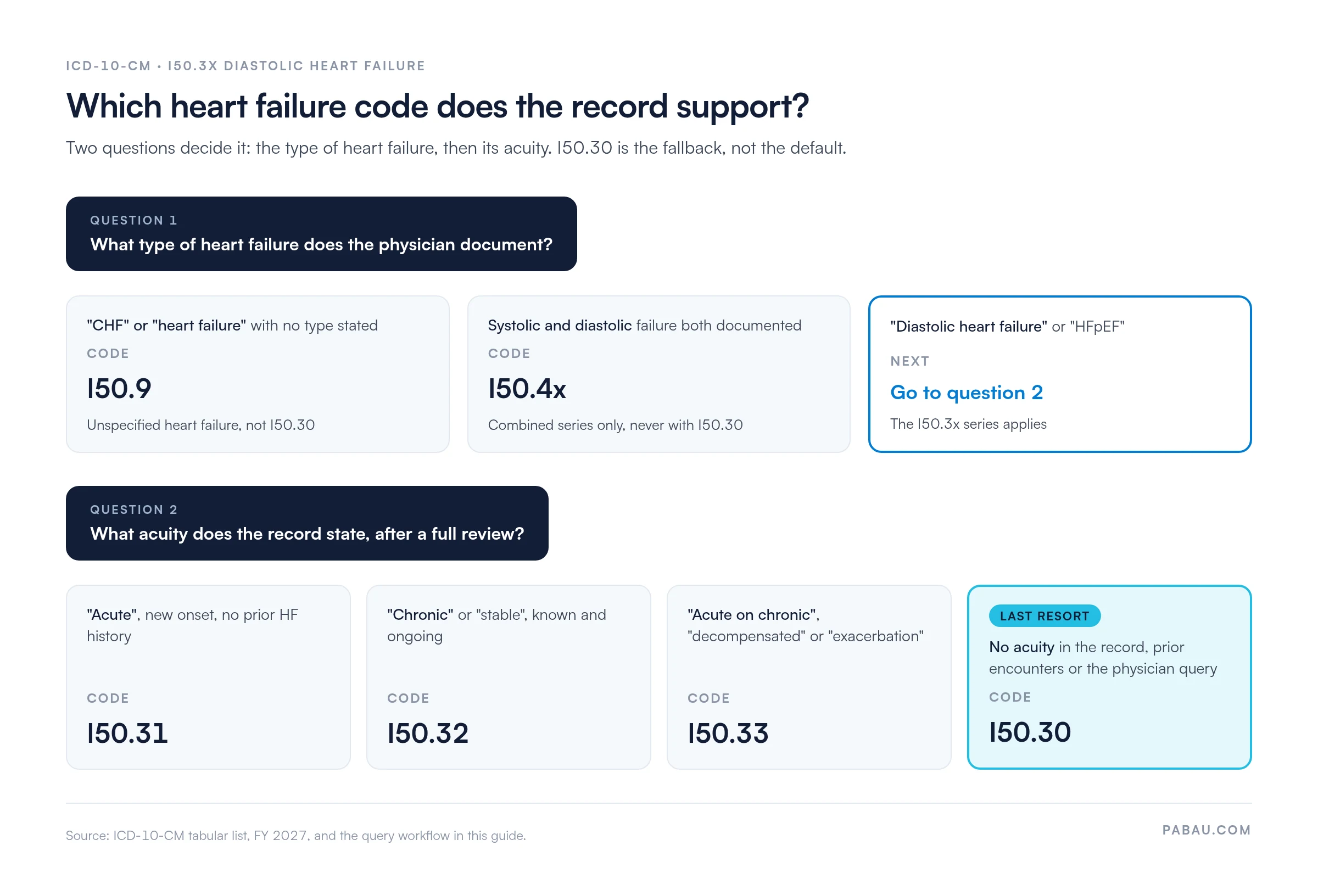
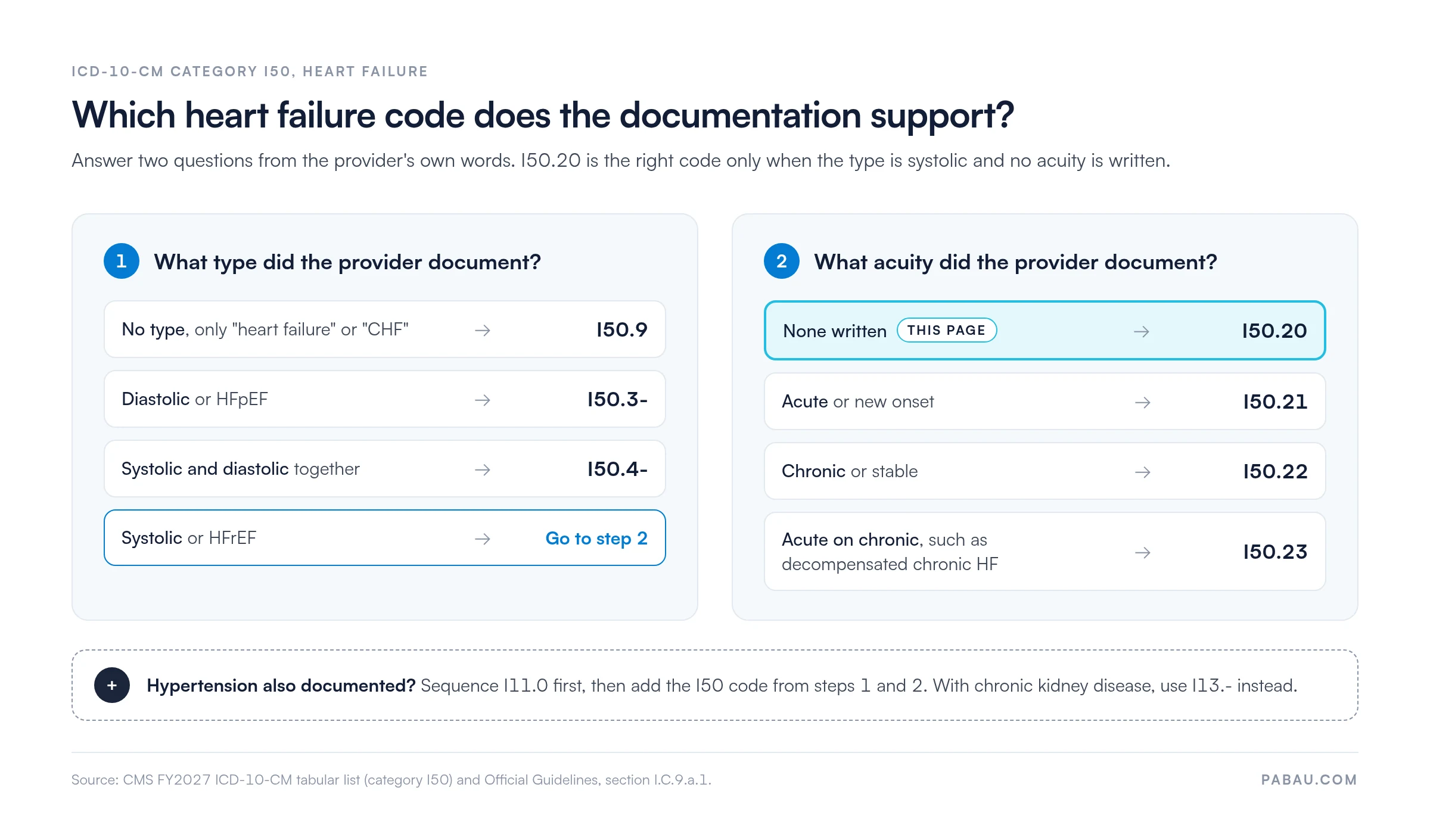
The ICD-10-CM system utilizes a fourth character to identify the type of heart failure (systolic, diastolic, or combined) and a fifth character to define the acuity. For diastolic heart failure, the I50.3 series is the standard. Using an unspecified code like I50.9 is generally discouraged in 2026 as it often leads to reimbursement delays and fails to reflect the complexity of the patient's condition.
I50.30: Diastolic (Congestive) Heart Failure, Unspecified
This code is used when the physician documents "diastolic heart failure" without specifying whether the condition is acute or chronic. In modern healthcare settings, this code is often a "red flag" for auditors. It suggests that the clinical documentation lacks the detail necessary to support high-acuity care. Whenever possible, coders should query the provider to determine if the patient's status is chronic or currently in an acute exacerbation.
I50.31: Acute Diastolic (Congestive) Heart Failure
This code applies to patients experiencing a sudden onset or a rapid worsening of diastolic heart failure symptoms that require urgent medical intervention. Clinical indicators for an acute diagnosis often include severe dyspnea at rest, pulmonary edema, and the need for intravenous diuretics or inotropic support. In the emergency department or inpatient setting, I50.31 is frequently used to justify the intensity of services provided.
I50.32: Chronic Diastolic (Congestive) Heart Failure
Chronic diastolic heart failure represents the baseline state of a patient with known HFpEF. These patients are typically managed in an outpatient setting with oral medications such as SGLT2 inhibitors, mineralocorticoid receptor antagonists (MRAs), or ARNIs, which have become the gold standard of care by 2026. Even if the patient is symptomatic, if those symptoms are at their "normal" baseline, the chronic code is appropriate.
I50.33: Acute on Chronic Diastolic (Congestive) Heart Failure
This code is utilized when a patient with a known history of chronic diastolic heart failure suffers an exacerbation. It is one of the most common codes in inpatient cardiology. Documentation must clearly state that there is an "acute flare," "decompensation," or "exacerbation" of the underlying chronic condition. This code carries significant weight in Risk Adjustment Factor (RAF) scoring and Hierarchical Condition Category (HCC) coding.
Clinical Foundations: HFpEF vs. HFrEF
To code diastolic heart failure accurately, it is helpful to understand the physiological difference between it and its counterpart, systolic heart failure (HFrEF).
- Diastolic Heart Failure (HFpEF): The ejection fraction (EF) is typically 50% or greater. The problem is one of ventricular filling. The heart muscle is often hypertrophied (thickened) or stiffened due to fibrosis.
- Systolic Heart Failure (HFrEF): The ejection fraction is usually 40% or less. The problem is one of ventricular contraction. The heart muscle is often dilated and weak.
In 2026, the term "HFpEF" is almost universally used in cardiology notes. Per the ICD-10-CM Official Guidelines for Coding and Reporting, the terms "diastolic heart failure" and "heart failure with preserved ejection fraction" are considered synonymous for coding purposes. If a provider documents "HFpEF," the coder should automatically navigate to the I50.3- category.
Coding Guidelines for Comorbidities and Sequencing
Heart failure rarely exists in a vacuum. Most patients with diastolic dysfunction also suffer from hypertension, chronic kidney disease (CKD), or both. The ICD-10-CM manual contains specific "instructional notes" that dictate how these codes must be sequenced.
Hypertensive Heart Disease
There is a presumed causal relationship between hypertension and heart failure. In the ICD-10-CM Alphabetic Index, the word "with" implies that if both conditions are present, they should be linked unless the physician specifically states they are unrelated.
- Code I11.0: Hypertensive heart disease with heart failure.
- Secondary Code: Use a code from the I50.- category (e.g., I50.32) to identify the specific type of heart failure.
Hypertensive Heart and Chronic Kidney Disease
When a patient has hypertension, heart failure, and CKD, the I13.- category is required. This is a "combination code" that encompasses all three conditions.
- I13.0: Hypertensive heart and chronic kidney disease with heart failure and stage 1 through stage 4 chronic kidney disease, or unspecified chronic kidney disease.
- I13.2: Hypertensive heart and chronic kidney disease with heart failure and with stage 5 chronic kidney disease, or end-stage renal disease.
In these cases, the coder must also list the specific type of heart failure (I50.3-) and the stage of CKD (N18.-) as additional codes.
Documentation Requirements for 2026
To satisfy the rigorous auditing standards of 2026, clinical documentation must be robust. A diagnosis of "heart failure" alone is no longer sufficient for optimal reimbursement or clinical tracking. Providers should aim to include the following elements in their progress notes and discharge summaries:
- Acuity: Clearly state if the condition is acute, chronic, or acute on chronic.
- Type/Ejection Fraction: Specify "diastolic," "HFpEF," or provide the exact ejection fraction percentage from a recent echocardiogram.
- Etiology: If the heart failure is due to an underlying condition like amyloidosis, valvular disease, or hypertension, this should be noted to allow for proper sequencing.
- Stability: Notes such as "compensated" or "stable" generally point toward chronic status, while "decompensated" or "exacerbation" points toward acute on chronic status.
ICD-10 Codes for Diastolic Heart Failure (Quick Reference)
The following table summarizes the primary codes used for diastolic heart failure and the clinical context required for each.
| ICD-10 Code | Description | Clinical Context / Indicators |
|---|---|---|
| I50.30 | Unspecified diastolic heart failure | Used when documentation lacks acuity details (Acute vs. Chronic). |
| I50.31 | Acute diastolic heart failure | New-onset failure or sudden decompensation requiring urgent care. |
| I50.32 | Chronic diastolic heart failure | Long-term management of HFpEF; patient is at their clinical baseline. |
| I50.33 | Acute on chronic diastolic heart failure | An acute exacerbation of a previously diagnosed chronic diastolic failure. |
| I11.0 | Hypertensive heart disease with heart failure | Must be sequenced before the I50.3- code if hypertension is present. |
| I50.82 | Biventricular heart failure | Used if both right and left-sided failure are documented together. |
Why Specificity Matters: Reimbursement and Quality Metrics
In 2026, healthcare reimbursement is heavily tied to Value-Based Care (VBC) models. Accurate coding of diastolic heart failure directly impacts several financial and quality benchmarks:
- HCC Coding: Diastolic heart failure (I50.31, I50.32, I50.33) maps to Hierarchical Condition Categories that increase the risk-adjusted payment for Medicare Advantage patients. An "unspecified" code (I50.9) often provides a lower weight or no weight at all.
- DRG Assignment: In the inpatient setting, the difference between "chronic" (I50.32) and "acute on chronic" (I50.33) can change the Diagnosis Related Group (DRG) assignment. Acute exacerbations are often classified as a Comorbidity or Complication (CC), which increases the hospital's reimbursement to account for the higher intensity of care.
- Readmission Reduction Programs: Payers track 30-day readmission rates for heart failure. Precise coding allows hospitals to distinguish between a new acute event and a continuation of an existing chronic problem, which is vital for accurate quality reporting.
Frequently Asked Questions
Can I code diastolic heart failure if the doctor only writes "HFpEF"?
Yes. In 2026, the ICD-10-CM index explicitly links "Heart failure, with preserved ejection fraction" to the diastolic heart failure codes (I50.3-). You do not need the word "diastolic" if "HFpEF" is documented.
What if the patient has both systolic and diastolic heart failure?
If both types are documented, you should use the I50.4- series (Combined systolic and diastolic heart failure). For example, I50.43 would be "Acute on chronic combined systolic and diastolic heart failure." Do not report I50.3- and I50.2- separately.
Does an echocardiogram result of "diastolic dysfunction" count as "diastolic heart failure"?
No. Coding guidelines generally state that "diastolic dysfunction" is not the same as "diastolic heart failure." Dysfunction is a precursor or a physiological finding, whereas heart failure is a clinical syndrome. You should use code I51.89 (Other ill-defined heart diseases) for diastolic dysfunction unless the provider specifically confirms a diagnosis of heart failure.
Which code should be primary: hypertension or diastolic heart failure?
If the patient has hypertensive heart disease, code I11.0 (Hypertensive heart disease with heart failure) must be sequenced first, followed by the specific heart failure code, such as I50.32.
Is there a specific code for diastolic heart failure caused by valvular disease?
If the heart failure is due to a non-rheumatic valve disorder, you would code the valve disorder first (e.g., I35.0 for non-rheumatic aortic stenosis) followed by the heart failure code (I50.3-).
Summary and Next Actions
For medical coders and clinicians in 2026, the key to handling "icd 10 code for diastolic heart failure" is specificity regarding acuity. The base code I50.3 must always be expanded to the fifth character (0, 1, 2, or 3) to accurately represent the patient's clinical state.
Next Actions:
- Review the Echo: Check the ejection fraction. If it is >50% and the patient has symptoms of congestion, confirm with the provider if the diagnosis is HFpEF (Diastolic Heart Failure).
- Check for Hypertension: Always look for a concurrent hypertension diagnosis to ensure the proper use of the I11.0 or I13.- combination codes.
- Clarify Acuity: If a patient is admitted, ensure the physician specifies if the failure is "acute on chronic" rather than just "chronic" to ensure the severity of the illness is captured.
Professional Disclaimer: This information is intended for educational purposes regarding medical coding and does not constitute medical or legal advice. Always refer to the most recent ICD-10-CM Official Guidelines and your specific payer policies for final coding determinations.
Image Gallery