Life Insurance for Mom and Kids: Choosing Coverage in a Shifting Landscape
Selecting the right life insurance coverage for mothers and children requires balancing immediate household stability with long-term financial security. In a shifting economic landscape marked by evolving living costs and fluctuating i...
Selecting the right life insurance coverage for mothers and children requires balancing immediate household stability with long-term financial security. In a shifting economic landscape marked by evolving living costs and fluctuating interest rates, securing adequate term or permanent coverage ensures that income, household contributions, and children’s future insurability remain protected against unexpected life events.
Contents
The Modern Landscape of Family Life Insurance
Financial planning for families has evolved significantly. Mothers—whether operating as primary breadwinners, co-earners, or stay-at-home parents—provide critical economic and operational value to the household. Concurrently, parents face a dynamic financial landscape influenced by persistent living cost adjustments, variable interest rates, and expanding policy options. Securing life insurance is no longer just a static safety net; it is an active financial strategy designed to insulate children from economic vulnerability while preserving future wealth.
Historically, life insurance messaging targeted primary income earners, often underrepresenting stay-at-home mothers or single mothers managing multi-faceted households. Today, modern underwriting models explicitly recognize the substantial economic replacement cost of domestic management, childcare, and educational support. Furthermore, options for covering children have expanded beyond basic funeral expense coverage into tools designed to lock in medical insurability early and build modest cash reserves.
Navigating this shifting market requires understanding how macro-economic trends affect premium rates, policy yields, and family budget allocations. With modern policy structures offering flexible living benefits, cash-value accumulation, and modular riders, mothers can customize financial protection to adapt as their children grow from toddlers to financially independent adults.
Disclaimer: Life insurance rules, tax implications, and policy availability vary by jurisdiction and carrier. This guide provides general educational insights. Families should consult with a licensed insurance professional or certified financial planner to tailor coverage to their specific legal and financial circumstances.
Life Insurance for Mothers: Term vs. Permanent Options
Choosing the appropriate policy structure for a mother begins with evaluating household dependency, long-term debts, and available cash flow. Insurance carriers primarily structure coverage under two main categories: term life insurance and permanent life insurance.
- Family Protection Plan
- Mom's Base Policy
- Term Life
- Permanent
- Children's Protection
- Child Rider
- Standalone
- Mom's Base Policy
Term Life Insurance: Cost-Effective High-Volume Protection
Term life insurance provides financial protection for a specified period, typically ranging from 10 to 30 years. If the insured passes away during the term, the policy pays a tax-free death benefit to designated beneficiaries.
For most mothers, term life insurance represents the most efficient mechanism for securing high coverage amounts at affordable monthly premiums. A 20-year or 30-year term policy can effectively cover the critical window during which children are financially dependent—from infancy through college graduation.
- Pros: Highly affordable premiums; simple structure; substantial death benefits for lower costs.
- Cons: No cash value accumulation; coverage expires at the end of the term unless renewed at significantly higher age-adjusted rates or converted.
Permanent Life Insurance: Lifelong Security and Cash Growth
Permanent life insurance—encompassing whole life, universal life, and variable universal life—provides lifelong coverage as long as premiums are paid. Beyond the death benefit, permanent policies feature a tax-deferred cash value component that grows over time and can be accessed via policy loans or withdrawals.
For mothers with permanent estate planning needs, specialized tax strategies, or children with lifelong special needs, permanent insurance provides guarantees that term insurance cannot offer.
- Pros: Lifelong duration; guaranteed or variable cash value growth; potential tax-free loans for college or emergencies.
- Cons: Significantly higher premiums (often 5 to 10 times higher than term for equivalent death benefits); complex fee structures.
Quantifying the Economic Value of Stay-at-Home Mothers
A common misstep in family financial planning is underinsuring non-working or stay-at-home mothers. While a stay-at-home parent may not bring home a direct paycheck, replacing their daily contributions requires substantial capital. If a mother passes away, the surviving parent must fund services including full-time childcare, household management, transportation, meal preparation, and academic tutoring.
When calculating the required death benefit for a mother, planners often use the DIME method:
- Debt: Total non-mortgage consumer debts and medical bills.
- Income: Annual financial contribution multiplied by the number of years until the youngest child reaches adulthood (including estimated replacement costs for domestic labor).
- Mortgage: Remaining principal balance on the primary residence.
- Education: Projected college tuition and living expenses for all children.
Protecting Children: Child Riders vs. Standalone Policies
Securing coverage for children involves distinct goals compared to adult policies. While adult coverage focuses on income replacement and debt payoff, coverage for children primarily centers on locking in future insurability and covering catastrophic medical or burial costs.
Child Term Insurance Riders
A child term rider is an add-on endorsement attached to a parent’s existing term or permanent life insurance policy. A single child rider typically covers all eligible children in the household—including future biological or adopted children—under a single flat premium.
- Cost-Efficiency: Child riders usually cost between $5 and $7 per year per $1,000 of coverage. A $10,000 rider across four children might cost less than $60 per year in total.
- Convertibility: Most child riders allow the coverage to be converted into an individual permanent policy when the child reaches a specific age (typically between 18 and 25) without requiring evidence of insurability. This ensures that even if a child develops a chronic medical condition, they can retain life insurance into adulthood.
Standalone Child Whole Life Insurance
Standalone child whole life policies are separate insurance contracts purchased directly in the child's name, with a parent or grandparent acting as the policy owner. Companies like Gerber Life, Mutual of Omaha, and Globe Life offer these specialized products.
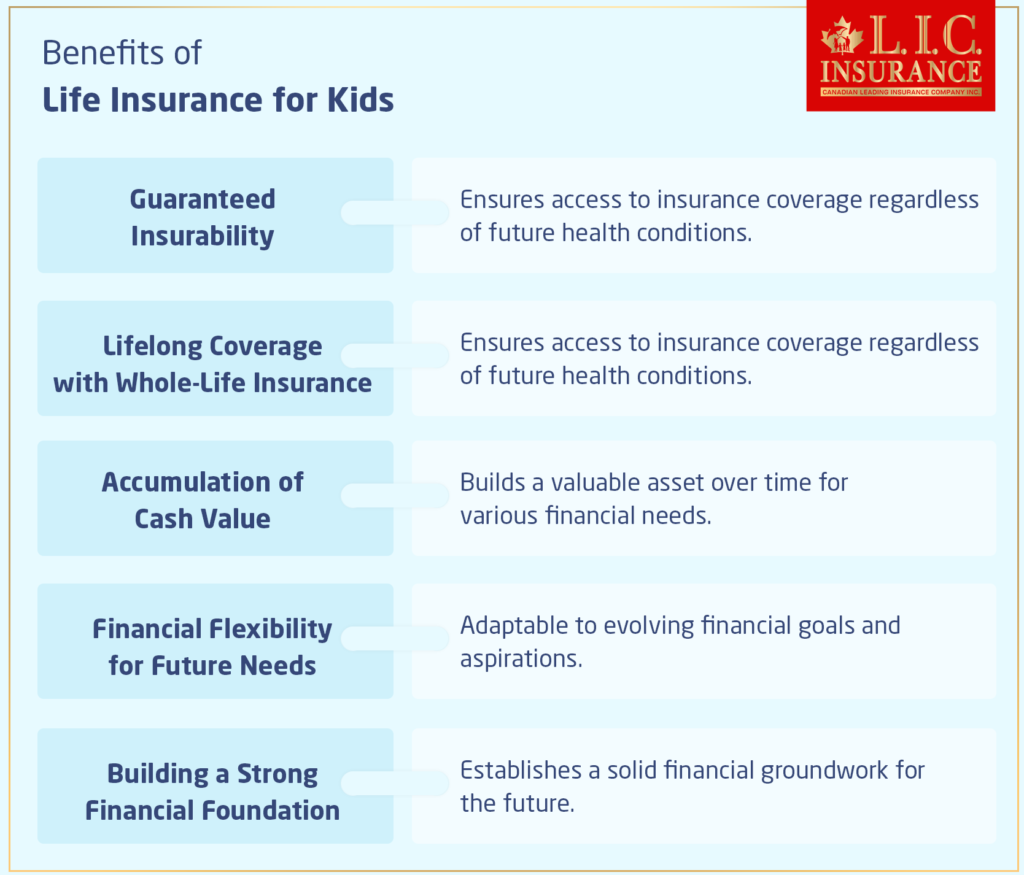
- Guaranteed Insurability: The primary benefit of a child whole life policy is guaranteeing coverage regardless of future health issues, occupations, or lifestyle choices.
- Cash Value Accumulation: A portion of each premium enters a tax-deferred cash account. By the time the child reaches young adulthood, this cash value can be borrowed against to assist with college expenses, a down payment on a home, or starting a business.
- Guaranteed Purchase Options: Many child whole life policies include options allowing the young adult to purchase additional coverage at specific future ages (e.g., ages 25, 30, 35) without undergoing new medical exams.
Crucial Riders and Modern Policy Innovations
Modern insurance policies include specialized riders that add flexibility during market shifts and family changes.
- Accelerated Death Benefit / Living Benefits Rider: Allows the policyholder to access a portion of the death benefit while still living if diagnosed with a qualifying terminal, critical, or chronic illness. This protects family savings if a mother faces catastrophic medical bills.
- Waiver of Premium Rider: Waives future premium payments if the primary policyholder becomes permanently disabled and unable to work, keeping family coverage active during severe hardship.
- Guaranteed Insurability Rider: Enables the policy owner to purchase additional coverage at specified dates without medical re-underwriting.
- Terminal Illness Rider: Provides advance payments if a physician diagnoses an illness with a limited life expectancy (usually 12 to 24 months).
Comparing Family Life Insurance Options
The following matrix compares common insurance structures used by mothers protecting their families:
| Coverage Structure | Primary Target | Average Monthly Cost Range | Key Benefit | Main Limitation |
|---|---|---|---|---|
| Parent 20/30-Year Term Policy | Working or Stay-at-Home Mothers | $20 – $60 (per $500k benefit) | Maximum financial protection during child dependency years | Expires after term; no cash value growth |
| Parent Permanent Policy (Whole/Universal) | High Net Worth / Special Needs Support | $150 – $500+ (per $500k benefit) | Permanent duration; tax-deferred cash value growth | High cost; cash value takes years to accumulate |
| Child Term Rider (Attached to Parent Policy) | All minor children in household | $5 – $15 (flat fee per policy) | Lowest cost; covers all children; convertible to adult plan | Low coverage limits (typically capped at $10k–$25k) |
| Standalone Child Whole Life Policy | Individual Child | $10 – $40 (per $25k benefit) | Locks in childhood health rate; builds cash value | Lower return rate compared to general market investments |
Step-by-Step Guide to Structuring Family Coverage
Coverage Implementation Workflow:
- Step 1: Calculate Total Need
- Combine DIME formula components (Debt, Income, Mortgage, Education)
- Step 2: Select Policy Architecture
- Match term lengths to child dependency windows
- Step 3: Add Essential Riders
- Attach child term riders and living benefit endorsements
- Step 4: Designate Beneficiary Structures
- Establish minor trusts or legal guardians to manage proceeds
- Step 5: Review & Adjust
- Re-evaluate policy every 3-5 years or after major life events
Step 1: Calculate Total Financial Needs
Quantify household obligations. Add up outstanding debts, remaining mortgage balance, projected college expenses, and income replacement values. For stay-at-home mothers, estimate annual replacement costs for childcare and household management, multiplying that figure by the years remaining until the youngest child finishes school.
Step 2: Select the Policy Architecture
Match term lengths to your children's ages. If you have a newborn, a 20-year or 25-year term policy ensures protection until the child completes post-secondary education. Consider a split-ladder strategy (combining a 10-year term and a 20-year term) to adjust coverage down as debts decline over time.
Step 3: Add Essential Riders
Ensure your policy includes living benefits and a waiver of premium rider. If your primary goal for your children is low-cost protection with guaranteed future conversion, add a child term rider to the mother's primary policy.
Step 4: Establish Proper Beneficiary Designations
Avoid naming minor children directly as primary beneficiaries on a life insurance policy. Insurance companies cannot legally pay death benefit proceeds directly to minors. If an adult beneficiary is not named, funds may be tied up in court-supervised probate, requiring legal guardianships that generate unnecessary legal fees.
Instead, utilize one of the following structures:
- Surviving Spouse/Partner as Primary Beneficiary: With adult children or legal trusts named as contingent beneficiaries.
- Revocable Living Trust: Name the trust as the primary or contingent beneficiary. The trustee manages and distributes funds according to your written instructions for the children's healthcare, housing, and education.
- UTMA/UGMA Custodian Designation: Designate a trusted adult relative as custodian under the Uniform Transfers to Minors Act (UTMA) or Uniform Gifts to Minors Act (UGMA).
Step 5: Complete Underwriting and Regular Reviews
Undergo medical underwriting promptly. Modern carriers offer expedited fluidless underwriting for qualified applicants, utilizing digital medical records and prescription database checks to approve policies in days rather than weeks. Review coverage every three to five years or whenever major life milestones occur (such as the birth of another child, a home purchase, or a career change).
Common Pitfalls in Family Coverage Planning
- Underestimating Non-Working Mothers: Omitting coverage for a stay-at-home parent leaves surviving families exposed to massive out-of-pocket expenses for private childcare and domestic care.
- Relying Solely on Employer Group Term Insurance: Group life insurance provided through employers is rarely sufficient. Coverage amounts are typically capped at 1x or 2x annual salary, and policies are usually non-portable—meaning coverage terminates if you change jobs or face layoffs.
- Naming Minors as Direct Beneficiaries: Direct payouts to minor children create administrative hurdles and court delays. Always set up a trust or formal legal custodianship.
- Failing to Track Convertibility Deadlines: If you rely on child term riders or parent term policies, keep detailed records of conversion expiration dates. Missing these deadlines removes the option to convert to permanent coverage without a medical exam.
Frequently Asked Questions
Why should a stay-at-home mother have life insurance?
A stay-at-home mother provides crucial domestic labor, childcare, transportation, and home management. If she passes away, the surviving spouse or family must pay external providers for those daily services. A dedicated policy provides the financial means to hire help, take extended leave from work, or adjust working hours to support surviving children.
Is a child term rider better than a standalone child whole life policy?
A child term rider is generally more cost-effective for providing basic financial protection across multiple children under a single parent policy. However, a standalone child whole life policy is preferred if the primary goal is building dedicated, tax-deferred cash value for the child or guaranteeing lifelong permanent coverage regardless of future health issues.
Can a single mother obtain affordable life insurance?
Yes. Single mothers can secure highly affordable coverage, particularly by opting for term life insurance. By applying early while in good health, a non-smoking woman in her late 20s or 30s can often obtain a substantial term policy for less than $30 to $40 per month.
What happens to a child rider when the child turns 18 or 21?
When a covered child reaches the maximum age specified by the policy (typically between 18 and 25), the child term rider expires. However, most riders include a conversion privilege allowing the child to convert their coverage into an individual permanent policy up to five times the original face amount without proving medical insurability.
How are life insurance payouts taxed for beneficiaries?
In most jurisdictions, death benefit payouts received by life insurance beneficiaries are tax-free income. However, any interest accrued on death benefits retained by the insurance company prior to distribution may be subject to ordinary income taxation.
Strategic Next Actions
To build an effective life insurance portfolio for your family:
- Calculate your exact coverage baseline: Calculate your family's financial needs using the DIME formula, factoring in both income replacement and home management costs.
- Gather medical and household documentation: Collect personal health records, family medical histories, and current family budgets to streamline the underwriting application process.
- Structure beneficiary legal frameworks: Consult an estate planning attorney or qualified legal professional to establish a revocable trust or appoint UTMA/UGMA custodians for minor children before finalizing policy documents.
- Compare independent quotes: Work with an independent insurance broker who represents multiple carriers to compare term lengths, child rider availability, and living benefit options.
Image Gallery