10-30 Code Meaning: Law Enforcement and Radio Protocol Explained
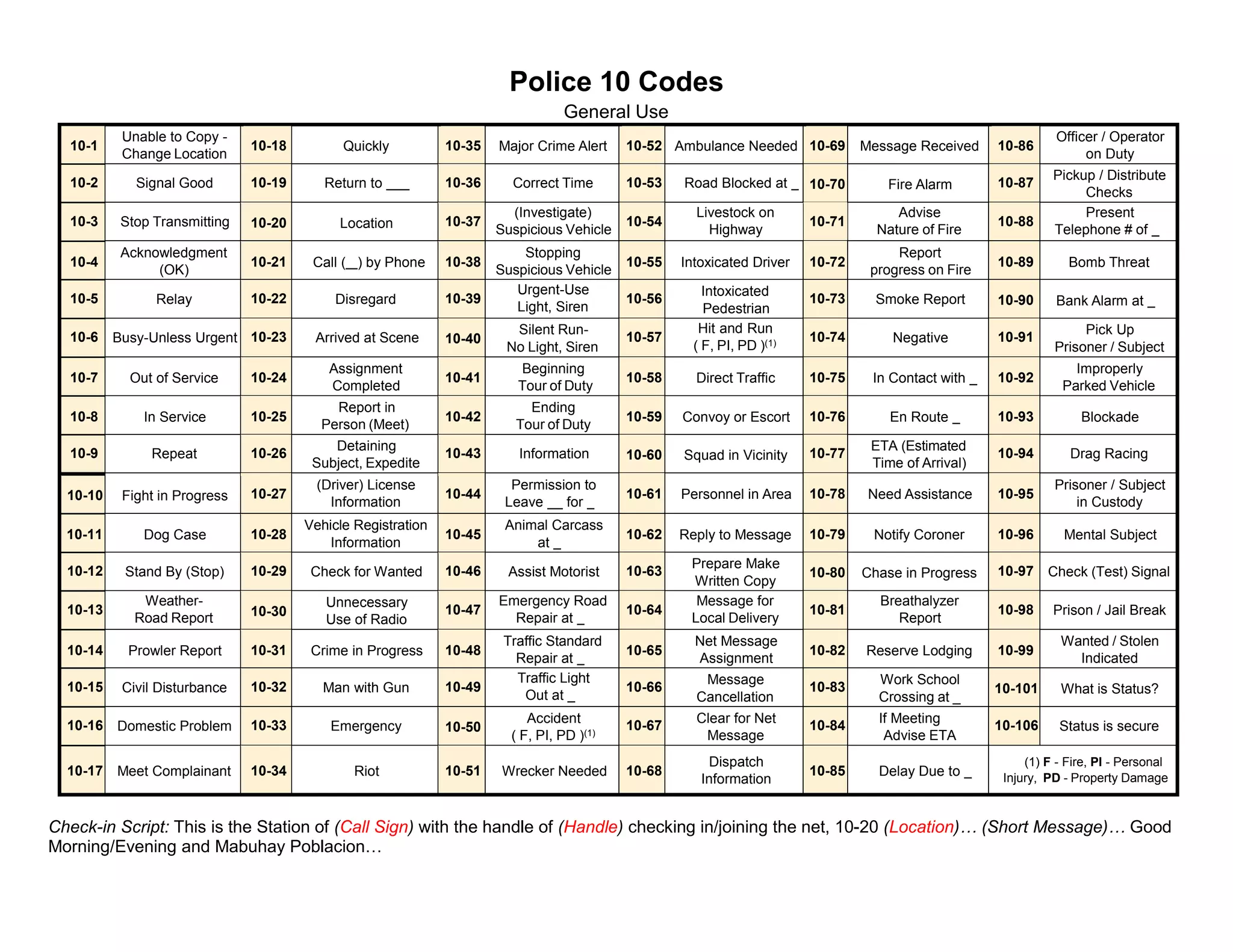
In standard law enforcement and emergency radio communications, a 10-30 code most commonly signifies "unnecessary use of radio" or serves as an operational warning regarding radio etiquette. In certain jurisdictions, however, it denote...
In standard law enforcement and emergency radio communications, a 10-30 code most commonly signifies "unnecessary use of radio" or serves as an operational warning regarding radio etiquette. In certain jurisdictions, however, it denotes an active emergency, such as an armed robbery or an unauthorized use of weapons.
Contents
Because ten-codes (ten signals) are not universally standardized across every public safety agency, the exact operational meaning depends heavily on the issuing jurisdiction and local protocol manuals. Understanding how the 10-30 code functions requires examining historical radio standards, common regional variations, and the ongoing transition across public safety entities toward standardized Plain Language communication.
The Origins and Mechanics of the APCO Ten-Code System
The ten-code communication framework dates back to the late 1930s, developed primarily by Charles "Charlie" Hopper, a communications director for the Illinois State Police. During this era, two-way amplitude modulation (AM) radio systems suffered from limited channels, substantial electrical interference, and significant battery drain. Vacuum tube equipment required brief warm-up times before transmission, which often caused the first syllable of a message to cut out.
To solve this technical limitation, Hopper introduced the prefix "10" followed by a specific numeric identifier. The prefix served two vital purposes:
- It allowed the radio's vacuum tubes to stabilize and the audio circuit to open cleanly.
- It provided an audible alert to the dispatcher or receiving officer that a critical piece of information was coming immediately afterward.
In 1940, the Association of Public-Safety Communications Officials (APCO International) published the first official standardized list of ten-codes to streamline emergency dispatch. Within this original framework, numbers were grouped logically: administrative statuses occupied one range, traffic enforcement codes occupied another, and tactical or disciplinary notices occupied specific numeric blocks.
What Does 10-30 Mean in Law Enforcement?
Across public safety, citizen band (CB) radio, and security dispatches, the 10-30 code carries two distinct operational definitions based on the agency's adopted codebook.
Definition 1: Unnecessary Use of Radio (Disciplinary / Protocol)
In the traditional APCO standard operational manual and widespread CB radio parlance, 10-30 stands for "unnecessary use of radio" or "radio traffic is non-essential."
When issued by a central dispatcher or field supervisor, this code serves as a direct administrative directive instructing an officer, deputy, or field operator to cease transmitting non-urgent chatter. Because radio airwaves during active shifts must remain clear for life-threatening emergencies, hot pursuits, and priority calls, a dispatcher will issue a 10-30 transmission to remind units that channel airtime is reserved strictly for official, necessary updates.
Definition 2: Dangerous Crime in Progress / Armed Robbery (Tactical)
In several large municipal police departments and sheriff's offices across the United States, 10-30 was adapted into a tactical alert code. In these agencies, a 10-30 designates an armed robbery in progress, an illegal weapon offense, or an unauthorized weapons discharge.
When utilized in this context, the code immediately triggers high-priority dispatch protocols:
- Radio silence is enforced on the primary dispatch talkgroup.
- Backup tactical units and perimeter cover are automatically dispatched.
- Secondary units switch to assigned tactical channels (TAC channels) to manage site containment without tying up the primary dispatch channel.
Because of this dual operational meaning, context and departmental agency policies are critical when interpreting the transmission.
Regional Variations: How Jurisdictions Define 10-30
Unlike military tactical jargon, state and local law enforcement agencies throughout the United States maintain autonomy over their operating codes. While many adopt standard APCO guidelines, others rely on custom state patrol signals or county-level variants.
| Jurisdiction / Context | Primary Meaning of 10-30 | Operational Protocol Triggered |
|---|---|---|
| Standard APCO / National Guide | Unnecessary use of radio | Dispatch warning; immediate cessation of non-critical radio traffic |
| Citizen Band (CB) Radio | Unnecessary or improper radio transmission | Reminder to operators to clear the channel from idle chatter |
| Selected Municipal Police Departments | Robbery in progress / Armed suspect | Immediate unit deployment, perimeter setup, Code 3 priority driving response |
| Selected County Sheriff Offices | Unauthorized use of equipment / Weapon offense | Supervisory dispatch investigation and field officer verification |
| Commercial Security Operations | Unauthorized radio transmission / Channel discipline | Supervisor intervention on dedicated commercial frequency talkgroups |
Operational Standard Notice
When monitoring or operating within a public safety agency radio network, officers and dispatchers must never assume standard definitions apply across county or municipal borders. Standard operating procedures (SOPs) issued by the agency's primary communications division govern all radio actions.
10-30 in Context: Neighboring Radio Codes
Understanding how 10-30 fits into standard dispatch workflows requires looking at the adjacent ten-codes commonly deployed alongside it. Within the 10-20 through 10-39 range, codes typically address unit locations, vehicle stops, and channel discipline.
- 10-20: Location inquiry or statement ("What is your 10-20?").
- 10-28: Vehicle registration check (license plate and registration verification).
- 10-29: Wants and warrants check on an individual or vehicle.
- 10-30: Unnecessary use of radio OR active robbery/weapon incident (agency dependent).
- 10-33: Emergency traffic / Officer needs immediate assistance (highest priority alert).
- 10-36: Correct time check.
In environments where 10-30 means "unnecessary use of radio," it frequently precedes or follows a 10-33 transmission. For instance, if an agency is managing an active tactical perimeter under a 10-33 declaration, any uninvolved unit attempting to run routine administrative queries will be swiftly silenced by dispatch with a 10-30 directive.
The Shift from Ten-Codes to Plain Language (NIMS and ICS Standards)
The historical reliance on ten-codes presented significant operational vulnerabilities during multi-agency emergency responses. When mutual aid units from state, county, and federal agencies converge at a major disaster, differing definitions of identical codes can create hazardous miscommunication. For example, if Agency A uses 10-30 to clear the airwaves while Agency B uses it to announce an armed robbery, responding officers risk misallocating defensive resources or misinterpreting lethal threats.
The Federal NIMS Mandate
To eliminate these interoperability failures, the U.S. Department of Homeland Security (DHS) and the Federal Emergency Management Agency (FEMA) integrated the National Incident Management System (NIMS) and the Incident Command System (ICS). Under these federal interoperability guidelines, public safety entities participating in multi-jurisdictional events are required to communicate in Plain Language (also referred to as "clear text").
Under the Plain Language standard:
- Instead of broadcasting "10-30," a dispatcher states: "Clear the air for emergency traffic" or "Maintain channel discipline."
- Instead of declaring a 10-30 for a commercial break-in, an officer states: "Robbery in progress, suspect armed with a handgun."
While routine internal municipal calls still frequently employ codes like 10-30 to conserve bandwidth and prevent civilian listeners from reacting to sensitive information, Plain Language is now the recognized operational standard across federal agencies, major incident response teams, and modern Project 25 (P25) digital radio networks.
Best Practices for Radio Protocol and Channel Discipline
Radio spectrum remains a finite operational resource. Whether using traditional VHF/UHF analog systems, modern digital P25 phase 2 systems, or private trunked talkgroups, communications specialists adhere to four foundational principles often referred to as the "Four Cs" of radio discipline:
- Clarity: Speak at an even, controlled pace using standard agency phrasing. Avoid voice inflection and remain composed regardless of the incident's stress level.
- Conciseness: Plan transmissions before depressing the push-to-talk (PTT) switch. State your unit identification, current position, and core message without superfluous wording.
- Control: Channel discipline must be strictly guarded. Field units must yield to the dispatcher and immediately halt transmissions when an emergency override or channel hold is called.
- Correctness: Double-check license plates, phonetic alphabet usage (such as the standard NATO phonetic alphabet), and location addresses before transmitting to eliminate unnecessary repeat queries.
Adhering to these four fundamentals prevents dispatchers from needing to issue a 10-30 warning in the first place, ensuring channel capacity is preserved for emergency notifications.
Frequently Asked Questions
What does 10-30 mean on a police scanner?
On most police scanners, a 10-30 code means "unnecessary use of radio," indicating that an officer or operator was transmitting non-essential chatter on a secure channel. However, in certain municipal areas, it may indicate a robbery in progress or an unauthorized weapons call. Check your local county or city dispatch guide to confirm the accurate operational meaning for your area.
Is 10-30 the same as 10-33?
No, 10-30 and 10-33 serve distinct tactical purposes. While 10-30 is typically an administrative directive to clear unnecessary talk or a report of a robbery, 10-33 is the universal emergency distress code signifying an officer in immediate danger or a critical event requiring total radio silence across the network.
Why do some police departments use different ten-codes?
Ten-codes were developed independently by local and state agencies before national radio communication standards existed. Because departments built their codebooks based on regional crime types and historical preferences, numeric assignments diverged over time, leading to differences between jurisdictions.
Why are police departments phasing out codes like 10-30?
Departments are moving away from ten-codes to comply with federal NIMS guidelines favoring Plain Language. Using clear, spoken English prevents dangerous misunderstandings when multiple municipal, county, state, and federal agencies respond together to coordinate large-scale disaster responses or mass emergencies.
Can citizens use the 10-30 code on CB radio?
Yes, on Citizen Band (CB) radio channels, 10-30 is widely recognized as "unnecessary use of radio" or "bad radio manners." Operators use it to inform others that their transmissions are cluttering the channel with irrelevant or disruptive conversation.
Mastering standard radio protocols and modern emergency communications frameworks is essential for ensuring operational safety, situational awareness, and effective inter-agency coordination. For departments seeking to modernize dispatch procedures or audit existing radio networks, adopting clear-text messaging frameworks alongside continuous communications training remains the premier standard for public safety excellence.
Image Gallery