How Long Did Job Suffer in the Book of Job?
The Book of Job does not provide an explicit chronological timeline for the total duration of Job’s suffering. However, internal evidence in Job 7:3 mentions "months of vanity," and Jewish tradition within the Seder Olam Rabbah suggest...
The Book of Job does not provide an explicit chronological timeline for the total duration of Job’s suffering. However, internal evidence in Job 7:3 mentions "months of vanity," and Jewish tradition within the Seder Olam Rabbah suggests the trial lasted 12 months. This period followed an initial seven-day period of silent mourning with his three friends.
Contents
The question of how long Job suffered is one that has intrigued theologians, historians, and literary critics for centuries. While the narrative provides a meticulous account of the types of losses Job endured—ranging from his vast wealth and children to his physical health—it remains notably silent on the exact number of days or years the trial spanned. This ambiguity is often seen by scholars as a deliberate literary choice, emphasizing that the nature of suffering is defined by its intensity and the sufferer's relationship with the Divine, rather than the calendar.
Internal Biblical Evidence for the Duration of Suffering
To determine a timeframe for Job's ordeal, one must look at specific linguistic markers and narrative shifts within the text. The Book of Job can be divided into three distinct phases of suffering: the initial catastrophe, the silent mourning, and the prolonged period of dialogue.
The Initial Catastrophe and the Seven Days of Silence
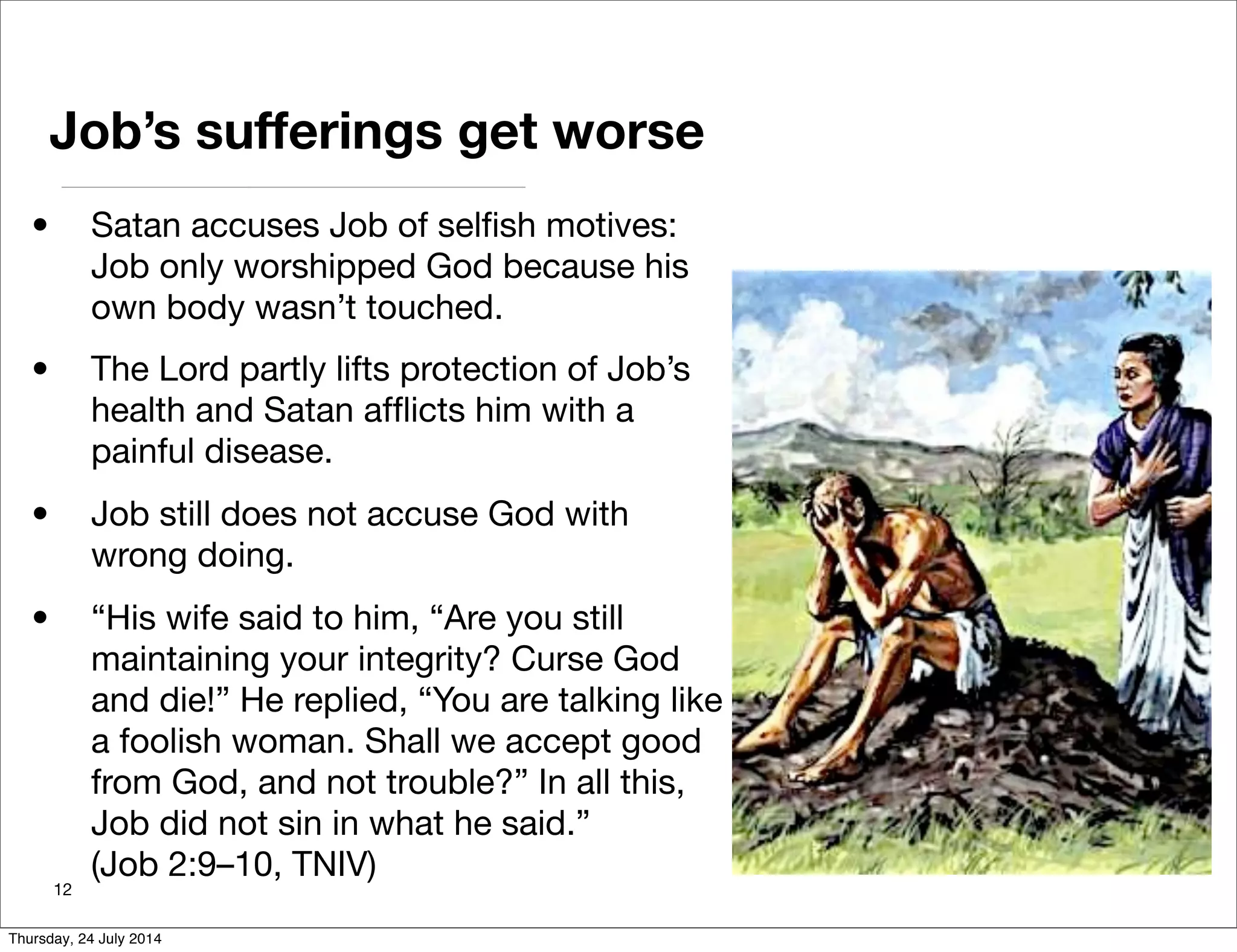
The first stage of Job’s suffering involves the rapid-fire loss of his livestock, servants, and all ten of his children. This is immediately followed by a secondary affliction: "loathsome sores" or boils that covered him from the sole of his foot to the crown of his head.
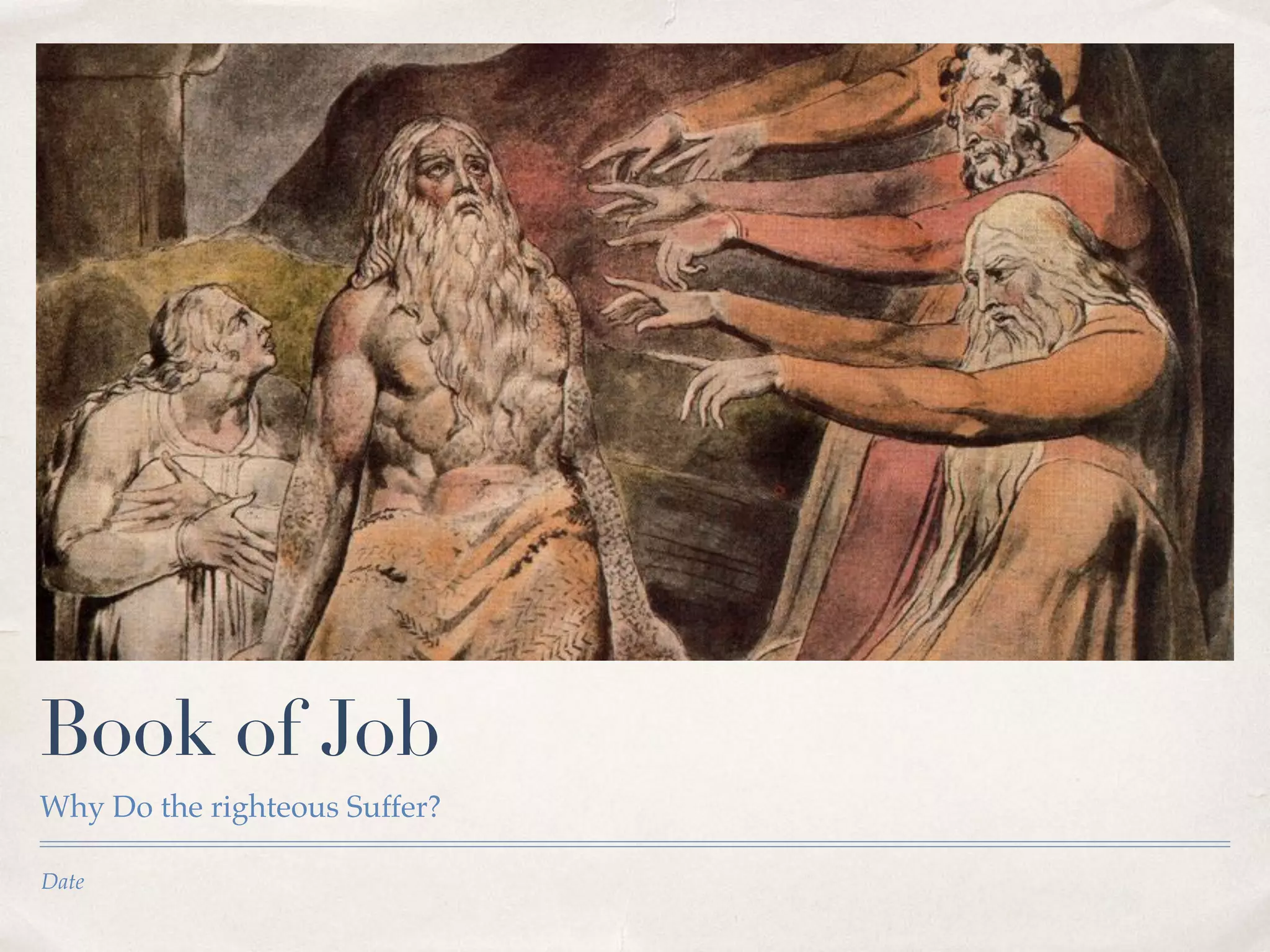
Once Job’s three friends—Eliphaz, Bildad, and Zophar—arrive to comfort him, the text provides its first concrete measurement of time. Job 2:13 states: "So they sat down with him upon the ground seven days and seven nights, and none spake a word unto him: for they saw that his grief was very great." This seven-day period mirrors the traditional Jewish mourning period known as shiva. At this point, the suffering has lasted at least one week plus the time it took for the news to reach the friends and for them to travel to Job’s location.
"Months of Vanity"
The most significant clue regarding a longer timeframe appears in Job 7:3, where Job laments his condition during his first response to Eliphaz. He says, "So am I made to possess months of vanity, and wearisome nights are appointed to me."
The use of the plural word "months" (Hebrew: yarchë-shäv) indicates that the trial was not a brief event. It suggests that by the time the dialogues began in earnest, Job had already been languishing in his physical and emotional agony for a significant period. This plural phrasing rules out the idea that the entire book takes place over just a few days.
The Cycles of Dialogue
The bulk of the Book of Job consists of three cycles of speeches between Job and his friends. While the text reads like a continuous conversation, the depth of the arguments and the shifting locations or moods implied in the poetry suggest these debates could have occurred over several weeks or months.
Job describes his physical deterioration in detail throughout these chapters, noting that his "flesh is clothed with worms and clods of dust" and his "skin is broken and become loathsome" (Job 7:5). Such descriptions of chronic illness and the slow process of social ostracization—where even the youth of the city mock him (Job 30:1)—point toward a prolonged duration of misery.
Extrabiblical Traditions and Scholarly Interpretations
Because the Hebrew Bible is not explicit, various religious traditions and historical commentaries have attempted to fill in the gaps. These interpretations often rely on symbolic numbers or parallels with other biblical events.
The Jewish Tradition (12 Months)
The most widely cited tradition regarding the length of Job’s suffering comes from the Seder Olam Rabbah, a 2nd-century CE Hebrew language chronological work. Chapter 3 of this text asserts that the punishment of Job lasted exactly 12 months.
This duration is theologically significant in Jewish thought, as a year represents a full cycle of seasons and is often associated with the maximum duration of the "judgment of the wicked" or a period of intense purification. This 12-month view is also supported in the Mishnah (Eduyot 2:10), which links the duration of Job's trials to the duration of the generation of the Flood and the future judgment of the unrighteous.
The Testament of Job (7 Years)
An alternative perspective is found in the Testament of Job, a pseudepigraphal work likely written between the 1st century BCE and the 1st century CE. This text, which elaborates on the biblical story with more legendary elements, claims that Job suffered for seven years.
In this version, the focus is on Job’s extreme patience and endurance over a much longer period. While the Testament of Job is not considered canonical by Jews or most Christian denominations, it influenced early Christian hagiography and the popular conception of "the patience of Job" mentioned in James 5:11.
Comparison of Proposed Timeframes
| Source | Proposed Duration | Key Evidence/Reasoning |
|---|---|---|
| Book of Job (Canonical) | Multiple Months | Job 7:3 mentions "months of vanity." |
| Seder Olam Rabbah | 12 Months | Based on the concept of a full cycle of judgment. |
| Testament of Job | 7 Years | Focuses on the perfection of Job's endurance. |
| St. John Chrysostom | Many Years | Argued that the social rejection Job faced required a long time to manifest. |
Why the Duration Remains Hidden
From a literary and theological standpoint, the absence of a specific timeline in the Book of Job serves a functional purpose. As of 2026, many biblical scholars argue that specifying a time would actually weaken the book's universal message.
- Universality of Suffering: By not anchoring the story to a specific year or length of time, the narrative becomes timeless. It addresses the "why" of suffering rather than the "how long."
- The Psychological Weight: For someone in intense pain, time becomes distorted. Job’s "months of vanity" feel like an eternity. The focus remains on the quality of the experience—the feeling of being abandoned by God—rather than a calendar countdown.
- Emphasis on Restoration: The only specific large numbers in the book appear at the very end. Job 42:16 notes that Job lived 140 years after his restoration, seeing four generations of his descendants. This contrast highlights that his period of suffering, however long it felt, was a small fraction compared to the "double portion" of life and blessing he received afterward.
The Physical and Social Progression of Time
The text provides subtle clues that Job’s suffering involved a slow social decline, which necessitates the passage of time. In the ancient Near East, a man of Job's stature would not lose his social standing overnight.
Early in the book, Job is a respected elder who sits at the city gate. By Job 30, he laments that he is mocked by those whose fathers he would have disdained to put with his sheep dogs. This transition from the highest level of social respect to the lowest level of social pariah status typically involves a prolonged period of perceived "divine disfavor." Friends and neighbors would have watched his condition persist for months before concluding that his suffering was a permanent mark of God’s judgment.
Furthermore, the arrival of Elihu in Chapter 32 suggests time has passed. Elihu is a younger man who has been listening to the entire debate between Job and the three older friends. His presence implies that the discussions were public and likely lasted long enough for news of the debate to spread and for a younger generation to gather and observe.
Frequently Asked Questions
How many days did Job's friends sit in silence?
Job's friends, Eliphaz, Bildad, and Zophar, sat with him in silence for seven days and seven nights. This occurred immediately after they arrived and saw the severity of his affliction. According to Job 2:13, they did not speak because they saw his "grief was very great."
Does the Bible say Job suffered for 40 years?
No, the Bible does not state that Job suffered for 40 years. While 40 is a common biblical number representing testing or transition (such as the Israelites in the wilderness), it is never associated with the duration of Job's trials in the text of the Book of Job or other biblical references.
How old was Job when he died?
While the Bible doesn't state Job's age at the beginning of the book, Job 42:16-17 tells us that he lived for 140 years after his restoration. Some traditions suggest he was 70 when the trials began, making him 210 at his death, but this is speculative. The text simply says he died "old and full of days."
Did Job's suffering last only a few days?
Internal evidence suggests it lasted much longer than a few days. Job specifically refers to "months of vanity" in Job 7:3. Additionally, the time required for his friends to hear the news, travel from different regions, and engage in multiple rounds of complex philosophical debate implies a period of several months at minimum.
What was the "double portion" Job received after his suffering?
After his trial ended, God restored Job's fortunes and gave him twice as much as he had before. He previously had 7,000 sheep, 3,000 camels, 500 yoke of oxen, and 500 female donkeys. In the end, he possessed 14,000 sheep, 6,000 camels, 1,000 yoke of oxen, and 1,000 female donkeys (Job 42:12).
Practical Considerations for Readers
When studying the Book of Job in 2026, it is helpful to approach the text as a wisdom literature piece rather than a chronological journal. The primary "task" of the book is to explore theodicy—the vindication of divine goodness in the presence of evil.
For those looking for a definitive answer on the length of his suffering, the most biblically grounded conclusion is that it lasted for several months, while the most historically prominent tradition points to one year. Understanding that Job endured "months of vanity" helps the reader empathize with the exhaustion and hopelessness Job expresses, providing a deeper context for his eventual confrontation with God in the whirlwind.
Image Gallery