How Student Loan Interest Affects Taxes: A 2026 Guide to Eligibility and Deductions
For the 2026 tax year, student loan interest remains a significant adjustment to income, allowing eligible taxpayers to reduce their taxable income by up to $2,500. This "above-the-line" deduction lowers your Adjusted Gross Income (AGI...
For the 2026 tax year, student loan interest remains a significant adjustment to income, allowing eligible taxpayers to reduce their taxable income by up to $2,500. This "above-the-line" deduction lowers your Adjusted Gross Income (AGI) regardless of whether you itemize or take the standard deduction, effectively lowering your overall tax liability.
Contents
Understanding the Student Loan Interest Deduction
The student loan interest deduction is a federal tax benefit designed to ease the financial burden on individuals repaying education-related debt. As we move through 2026, it remains one of the few tax breaks available to taxpayers that does not require itemizing deductions on Schedule A. Instead, it is classified as an "adjustment to income," which means it is subtracted directly from your total income to arrive at your Adjusted Gross Income (AGI).
Lowering your AGI is a critical tax strategy. Because many other tax credits and benefits—such as the Earned Income Tax Credit (EITC) or eligibility for certain IRA contributions—are based on your AGI or Modified Adjusted Gross Income (MAGI), claiming the student loan interest deduction can have a cascading positive effect on your overall tax return. If you fall into a 22% tax bracket, a full $2,500 deduction could translate into a $550 direct reduction in the federal taxes you owe.
The deduction covers both "voluntary" and "required" interest payments. This includes not only the standard interest built into your monthly payment but also capitalized interest (unpaid interest that the lender adds to the principal balance) and even certain loan origination fees, provided they are not for service charges or insurance.
Eligibility Requirements for 2026
To claim the student loan interest deduction in 2026, you must meet four primary criteria established by the Internal Revenue Service (IRS). Failing to satisfy even one of these requirements will disqualify you from claiming the benefit.
- Legal Obligation to Pay: You must be legally obligated to pay interest on a qualified student loan. If you are making payments on a loan that is in someone else’s name (such as a child’s loan where you are not a co-signer), you generally cannot claim the deduction, even if you are the one writing the checks.
- Filing Status: Your filing status cannot be Married Filing Separately. This is a common pitfall for couples who choose separate filing for other student loan repayment strategies (like Income-Driven Repayment plans). For tax purposes, you must file as Single, Head of Household, Qualifying Surviving Spouse, or Married Filing Jointly.
- Dependency Status: You (and your spouse, if filing jointly) cannot be claimed as a dependent on someone else’s tax return. If your parents still claim you as a dependent in 2026, they cannot claim the interest you paid, and you cannot claim it either, regardless of who made the payments.
- Qualified Loan: The loan must have been taken out solely to pay for qualified higher education expenses. This means loans from a family member or a qualified employer plan do not count.
Income Thresholds and Phase-outs
The student loan interest deduction is not available to everyone. It is subject to income phase-outs, meaning the benefit gradually diminishes and eventually disappears as your MAGI increases. The IRS adjusts these limits annually for inflation.
For the 2026 tax year, the phase-out ranges have been adjusted to reflect current economic conditions. If your MAGI is below the starting point of the phase-out, you can claim the full deduction (up to $2,500). If your MAGI falls within the range, your deduction is reduced. If it exceeds the upper limit, the deduction is eliminated entirely.
2026 Student Loan Interest Phase-out Table
| Filing Status | Full Deduction (MAGI) | Partial Deduction (Phase-out Range) | No Deduction (MAGI) |
|---|---|---|---|
| Single / Head of Household | Under $85,000 | $85,000 – $100,000 | $100,000 or more |
| Married Filing Jointly | Under $175,000 | $175,000 – $205,000 | $205,000 or more |
Note: These figures are 2026 estimates based on historical inflation-adjustment patterns used by the IRS.
To calculate a partial deduction, the IRS uses a specific formula: (Actual Interest Paid up to $2,500) × [(Upper Limit - Your MAGI) / (Phase-out Range Window)]. While tax software typically handles this calculation, understanding the taper helps in planning for year-end bonuses or other income that might push you out of eligibility.
Defining "Qualified" Higher Education Expenses
To qualify for the deduction, the loan proceeds must have been used for qualified higher education expenses for yourself, your spouse, or your dependent at the time the loan was taken out. These expenses must have been paid or incurred within a reasonable period before or after you took out the loan.
Qualified expenses include:
- Tuition and fees required for enrollment.
- Room and board, provided the cost does not exceed the greater of the allowance for room and board determined by the school for financial aid purposes or the actual amount charged if the student is living in housing owned or operated by the school.
- Books, supplies, and equipment necessary for the course of study.
- Other necessary expenses, such as transportation to and from the institution.
However, you must subtract any tax-free educational assistance from these expenses before determining the "qualified" amount. This includes Pell Grants, employer-provided educational assistance, and tax-free distributions from a 529 plan or Coverdell Education Savings Account.
The Importance of Form 1098-E
If you paid $600 or more in student loan interest during 2026, your loan servicer is required to send you Form 1098-E, Student Loan Interest Statement. This form is the official record of the interest you paid and is usually mailed or made available digitally by late January 2027.
It is important to note that even if you paid less than $600, you may still be eligible to deduct the interest. In this case, the servicer might not send a 1098-E automatically, and you will need to log into your loan portal to find the exact amount of interest paid during the calendar year.
When reviewing your 1098-E, ensure the amount includes any capitalized interest. When students emerge from a period of deferment or forbearance, the accrued interest is often "capitalized" or added to the principal. The IRS allows you to deduct this capitalized interest as it is paid down over time. More information on how the IRS views these payments can be found on the IRS Student Loan Interest Deduction page.
Common Pitfalls and Special Considerations
While the student loan interest deduction seems straightforward, several nuances can lead to errors on a tax return.
The "No Double Dipping" Rule
You cannot claim the student loan interest deduction for expenses that were paid using other tax-advantaged funds. For example, if you used a distribution from a 529 plan to pay off $10,000 of student loan principal and interest (which is allowed under the SECURE Act), you cannot then deduct the interest portion of that payment on your tax return. The IRS prevents "double-dipping" by requiring that the interest be paid from "after-tax" income.
Refinanced and Consolidated Loans
If you consolidate multiple student loans into a single new loan, the new loan is still considered a qualified student loan, provided the original loans were qualified. However, if you refinance your student loans and take out "cash-out" to pay off credit cards or other debt, only the portion of the interest related to the original education debt remains deductible.
Dependents and Payments
A common point of confusion occurs when parents pay the student loan of a child who is no longer a dependent. If the child is not a dependent, the parent cannot claim the deduction (because they are not legally obligated on the loan, unless they are a co-signer). Conversely, the child can claim the deduction for the interest paid by the parent, as the IRS treats the parent’s payment as a "gift" to the child, followed by the child making the payment.
How to Claim the Deduction on Your 2026 Return
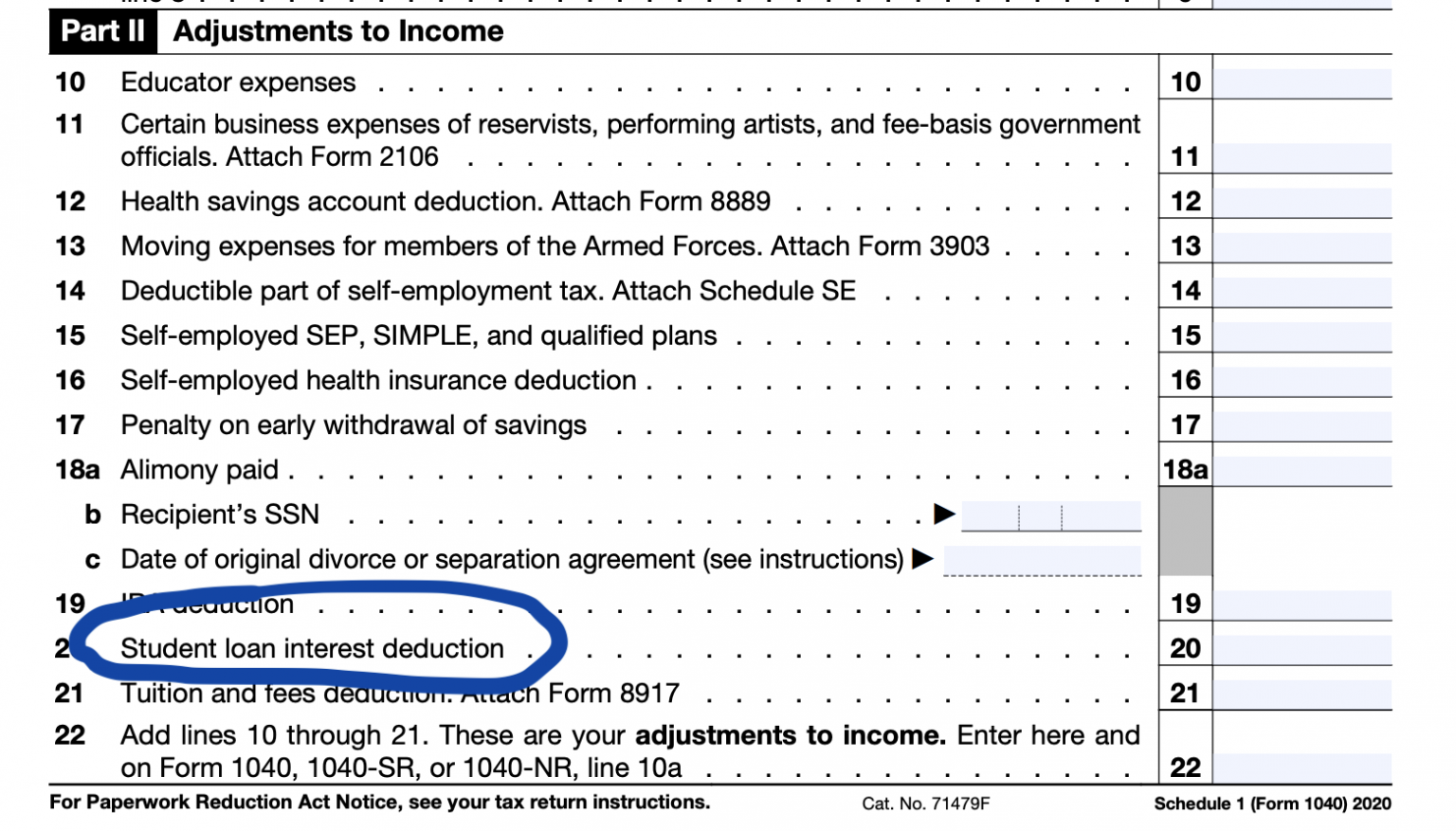
To claim the deduction, you will report the amount on Schedule 1 (Form 1040), under the "Adjustments to Income" section. The total from Schedule 1 is then transferred to your Form 1040 to reduce your total income.
Detailed instructions and worksheets are provided in IRS Publication 970, Tax Benefits for Education, which remains the authoritative source for all education-related tax inquiries.
Frequently Asked Questions
Can I deduct interest on a loan from a private lender? Yes. As long as the loan was used exclusively for qualified higher education expenses at an eligible educational institution, it does not matter if the lender is the federal government or a private bank. However, loans from related persons (like parents or siblings) or from an employer-sponsored retirement plan (like a 401k loan) do not qualify.
What is an "eligible educational institution" for the deduction? An eligible institution is generally any college, university, vocational school, or other post-secondary educational institution eligible to participate in a student aid program administered by the U.S. Department of Education. This includes virtually all accredited public, nonprofit, and proprietary post-secondary institutions. You can verify a school's status through the Federal Student Aid website.
Does the $2,500 limit apply per person or per return? The $2,500 limit is "per return." If you are Married Filing Jointly and both spouses paid $2,500 in student loan interest, the maximum deduction for the couple is still $2,500 total, not $5,000. If you are filing as Single, the limit is also $2,500.
Can I deduct interest if I am still in school? Yes. If you are making interest payments while still enrolled—whether they are required or voluntary—you can claim the deduction, provided you meet the income and dependency requirements. This is often beneficial for students working part-time who wish to reduce their taxable income.
What happens if I paid interest on multiple loans? You aggregate all interest paid across all qualified loans. If you paid $1,000 to Servicer A and $2,000 to Servicer B, your total interest paid is $3,000. However, your deduction on your tax return will be capped at the $2,500 maximum.
Is there a limit on how many years I can claim the deduction? No. Unlike some other tax credits that are limited to the first four years of post-secondary education, you can claim the student loan interest deduction for as many years as it takes to pay off the loan, provided you continue to meet the eligibility and income requirements each year.
Practical Recommendation
As you prepare for the 2026 filing season, the first step is to verify your Modified Adjusted Gross Income (MAGI). If you are close to the phase-out thresholds ($85,000 for singles or $175,000 for joint filers), consider contributing to a traditional IRA or a Health Savings Account (HSA) before the tax deadline. These contributions also reduce your AGI and may bring your income back down into the range where you can claim the full $2,500 student loan interest deduction, effectively providing a double tax benefit.
Image Gallery