Who Owns Marriott Hotels? The Ownership Structure of a Global Hospitality Giant
Marriott International, Inc. is a publicly traded company owned by thousands of individual and institutional shareholders through the NASDAQ stock exchange (ticker: MAR). While the public owns the majority of the equity, the Marriott f...
Marriott International, Inc. is a publicly traded company owned by thousands of individual and institutional shareholders through the NASDAQ stock exchange (ticker: MAR). While the public owns the majority of the equity, the Marriott family remains the company’s most influential stakeholder, holding approximately 15% of the total shares and maintaining significant leadership through board positions as of 2026.
Contents
The Public Ownership Model: Shareholders and the NASDAQ
As a global leader in the hospitality industry, Marriott International operates under a public ownership structure. This means that ownership is not consolidated in the hands of a single individual or a private entity, but is instead distributed across the global financial markets. Being a public company allows Marriott to access vast amounts of capital, which is essential for its aggressive expansion strategies, technological infrastructure, and the maintenance of its 30-plus brand portfolios.
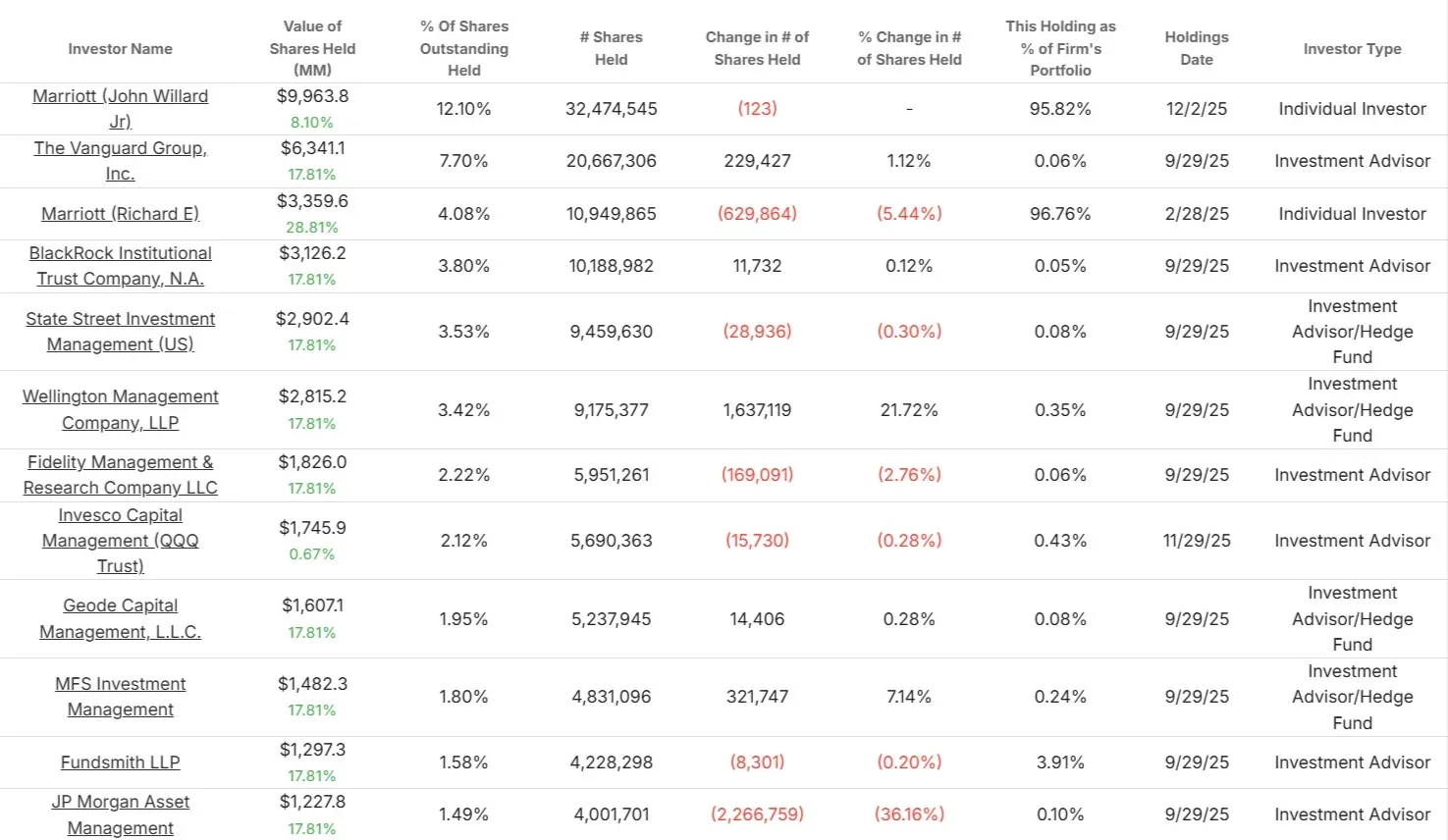
The primary owners are institutional investors. These are large financial organizations—such as pension funds, mutual funds, and insurance companies—that buy significant blocks of shares. As of 2026, the largest institutional holders include The Vanguard Group, BlackRock, Inc., and State Street Corporation. These firms do not "run" the hotels; rather, they hold the stock as part of investment portfolios for their clients. Their influence is felt primarily through proxy voting on corporate governance issues, executive compensation, and sustainability mandates.
The "Why" behind this public structure is rooted in growth. By listing on the NASDAQ, Marriott transitioned from a family-run root beer stand (its 1927 origin) into a multi-billion-dollar enterprise. Public equity allowed Marriott to fund the landmark 2016 acquisition of Starwood Hotels & Resorts, a move that solidified its position as the largest hotel chain in the world.
The Marriott Family’s Enduring Influence
Despite the public nature of the company, the Marriott family name is not merely a legacy brand—it represents an active and powerful ownership block. The descendants of founders J. Willard and Alice Marriott continue to hold a substantial percentage of the company’s stock.
In 2026, the family’s involvement is spearheaded by David Marriott, who serves as the Chairman of the Board. He succeeded his father, J.W. "Bill" Marriott, Jr., who remains Chairman Emeritus. The family’s roughly 15% stake is significant because, in a company with a highly fragmented shareholder base, a 15% block often provides effective control over major strategic decisions.
The family maintains this ownership for several reasons:
- Legacy and Vision: The family views themselves as the stewards of the company culture, famously known as "The Marriott Way," which prioritizes employee well-being as a driver of customer service.
- Long-Term Stability: Unlike institutional investors who may prioritize quarterly earnings, the Marriott family’s presence provides a "long-view" perspective that aids in navigating cyclical economic downturns in the travel industry.
- Brand Trust: The family's name on the door acts as a seal of quality and consistency for franchisees and partners worldwide.
Why the Ownership Structure Matters: The "Asset-Light" Strategy
To understand who owns Marriott, one must distinguish between who owns the company (Marriott International, Inc.) and who owns the physical buildings. Marriott famously utilizes an "asset-light" business model. This means that in the vast majority of cases, Marriott International does not own the real estate where its hotels are located.
Instead, the physical buildings are owned by third-party entities, including:
- Real Estate Investment Trusts (REITs): Companies like Host Hotels & Resorts (which was actually spun off from Marriott in 1993) own hundreds of properties and pay Marriott to manage them.
- Private Equity Firms: Large investment groups buy hotel real estate and sign long-term franchise agreements with Marriott to use their branding and reservation systems.
- Individual Developers: Local business owners may build a hotel and pay Marriott a franchise fee to operate it as a Courtyard or a Fairfield Inn.
This explains "Why" the ownership is structured this way: it allows Marriott to scale rapidly without the massive debt associated with owning real estate. Marriott provides the brand, the "Bonvoy" loyalty program, and the management expertise, while the property owners take on the risks of property maintenance and taxes.
Ownership Comparison and Market Position (2026 Data)
The following table outlines the distribution of ownership and the primary entities involved in the Marriott ecosystem as of 2026.
| Ownership Group | Estimated Stake | Role in the Ecosystem |
|---|---|---|
| Institutional Investors | 65% - 70% | Provide market liquidity and capital for acquisitions. |
| Marriott Family | 12% - 15% | Strategic leadership, board oversight, and brand stewardship. |
| Retail/Individual Investors | 15% - 20% | Public market participants and long-term individual holders. |
| Host Hotels & Resorts (REIT) | N/A (Strategic Partner) | The largest independent owner of Marriott-branded real estate. |
| Franchisees | N/A (Contractual) | Local owners who license the Marriott brand for specific sites. |
The Role of Institutional Giants: BlackRock and Vanguard
It is common for observers to see names like BlackRock or Vanguard at the top of shareholder lists and assume they "own" the company in a traditional sense. In reality, these firms are passive owners. They manage index funds (like those tracking the S&P 500) that are required to hold Marriott stock.
However, their influence has grown in 2026 through the lens of ESG (Environmental, Social, and Governance) criteria. These institutional owners push Marriott to adopt specific carbon-neutral goals and diversity initiatives. Therefore, while the Marriott family directs the hospitality strategy, the institutional owners ensure the company meets the financial and ethical benchmarks required by global capital markets.
Key Historical Milestones in Ownership Evolution
The ownership journey of Marriott is marked by several pivotal moments that explain its current 2026 status:
- The 1953 IPO: Marriott (then Hot Shoppes, Inc.) went public at $10.25 a share, selling out in two hours. This began the shift from private family ownership to public accountability.
- The 1993 Split: The company split into Marriott International (management and franchising) and Host Marriott (real estate). This was a revolutionary move that created the "asset-light" model now emulated by Hilton and Hyatt.
- The 2016 Starwood Merger: Marriott issued millions of new shares to Starwood shareholders, diluting existing owners but creating a powerhouse with over 1.5 million rooms.
- Post-2020 Recovery: During the global pandemic, Marriott relied on its public status to issue debt and equity, ensuring survival when travel halted—a feat that would have been much harder for a purely private family firm.
Common Misconceptions About Marriott Ownership
A frequent point of confusion is the belief that Marriott is owned by a foreign sovereign wealth fund or a massive conglomerate like Berkshire Hathaway. While sovereign wealth funds (such as the Qatar Investment Authority) may own specific physical hotels—like the St. Regis or Ritz-Carlton properties—they do not own the Marriott International parent company.
Another misconception is that the "Marriott" family has retired from the business. As evidenced by David Marriott’s chairmanship in 2026, the family remains the primary architect of the company’s trajectory, even as the "owners" on paper are largely anonymous pension fund contributors.
FAQs About Marriott Ownership
Is Marriott owned by China? No. While many Chinese investors and firms (such as the former Anbang Insurance Group) have purchased individual hotel properties or attempted acquisitions in the past, Marriott International is a U.S.-based, publicly traded corporation. Its primary ownership resides with U.S.-based institutional investors and the Marriott family.
Who is the current CEO of Marriott in 2026? The CEO leads the management team under the oversight of the Board of Directors. As of 2026, the leadership continues to focus on the integration of digital technology and the expansion of the "Bonvoy" ecosystem. (Note: Anthony Capuano was appointed in 2021; checking current 2026 leadership is advised for real-time executive changes).
What is the difference between Marriott and Host Hotels & Resorts? Marriott International is the service provider that owns the brands (Sheraton, Westin, Ritz-Carlton, etc.) and manages the operations. Host Hotels & Resorts is a separate Real Estate Investment Trust (REIT) that owns the actual land and buildings of many Marriott-branded hotels. They are separate companies with separate stocks.
How much of Marriott does the family still own? Collectively, the Marriott family and their related trusts own approximately 15% of the outstanding shares. This makes them the largest single "inside" shareholder group, providing them with more voting power than any other individual entity.
Can I own a piece of Marriott? Yes. Because Marriott International is a public company traded on the NASDAQ under the symbol MAR, any individual with a brokerage account can purchase shares and become a partial owner of the company.
Practical Recommendation for Stakeholders
For investors and travelers looking to understand the stability of Marriott in 2026, the key takeaway is the balance of power. The presence of the Marriott family ensures a commitment to the brand's core values and long-term reputation, while the public ownership by institutional giants ensures financial transparency and rigorous corporate governance.
If you are a traveler, this ownership structure means the "Marriott" experience is standardized through strict management contracts, regardless of who owns the physical building. If you are an investor, the "asset-light" model suggests that the company is a play on global travel demand rather than a play on real estate values. To monitor ownership changes, interested parties should regularly consult the Marriott Investor Relations page and the U.S. Securities and Exchange Commission (SEC) EDGAR database for Schedule 13D and 13G filings.
Image Gallery