Workers Compensation Companies NV: Navigating Nevada’s Insurance Landscape
In Nevada, workers' compensation insurance is a mandatory requirement for nearly all employers with at least one employee. As of 2026, the state operates a competitive private market where businesses must secure coverage through licens...
In Nevada, workers' compensation insurance is a mandatory requirement for nearly all employers with at least one employee. As of 2026, the state operates a competitive private market where businesses must secure coverage through licensed private insurance carriers or meet strict financial criteria for self-insurance. Navigating this landscape involves adhering to the Nevada Revised Statutes (NRS) Chapters 616A through 616D, which dictate employer obligations, employee rights, and the administrative oversight provided by the Nevada Division of Industrial Relations (DIR).
Contents
Understanding the Nevada Workers’ Compensation Framework
Nevada’s approach to workers' compensation underwent a massive shift in 1999 when it transitioned from a monopolistic state fund to a private market system. In 2026, this competitive environment allows Nevada business owners to shop among hundreds of private carriers. However, this flexibility comes with a high degree of regulatory responsibility. The primary governing body is the Nevada Division of Industrial Relations (DIR), specifically its Workers’ Compensation Section (WCS).
The WCS is responsible for ensuring that all Nevada employers provide the necessary benefits to employees who suffer work-related injuries or occupational diseases. Unlike some states where certain industries are exempt, Nevada law is broad: if you have one or more employees, including part-time or seasonal workers, you are generally required to provide coverage from the moment they are hired.
The Role of Private Carriers and Agents
Because Nevada does not have a state-run insurance fund, employers must work with private insurance companies or licensed brokers to obtain a policy. These carriers are not just financial backers; they are integral to the claims management process. They determine the initial medical treatment pathways, handle disability payments, and work with Managed Care Organizations (MCOs) or Preferred Provider Organizations (PPOs) to coordinate care. When selecting a carrier in NV, it is essential to evaluate their network of medical providers within the state, especially in the Reno and Las Vegas metropolitan areas, to ensure injured workers receive timely and specialized care.
Mandatory Coverage and Compliance Requirements
Nevada’s "Compulsory Coverage" rule means that failing to carry insurance is a criminal offense. The law applies to almost every business entity, including corporations, LLCs, partnerships, and sole proprietorships with employees.
Who is an "Employee" in Nevada?
Under Nevada law, the definition of an employee is expansive. It includes:
- All persons in the service of an employer under any appointment or contract of hire.
- Aliens and minors (whether lawfully or unlawfully employed).
- Elected and appointed paid public officers.
- Members of boards of directors while performing duties for the corporation.
There are very few exceptions. For example, some domestic workers (those working in private homes) may be exempt under specific circumstances regarding hours worked or wages earned, but these exceptions are narrow. In 2026, the DIR continues to monitor the "gig economy" and independent contractor classifications closely to prevent "misclassification," which is a common strategy used to avoid insurance premiums. If an employer controls the means and methods of a worker's performance, that worker is likely an employee under Nevada law.
The D-38 Affirmation of Compliance
When a business applies for or renews a business license in Nevada, they must often complete a D-38 form (Affirmation of Compliance). This document serves as a formal declaration that the business is either covered by a valid workers' compensation policy or is legally exempt. Falsifying this form or operating without coverage can lead to significant administrative fines and the immediate issuance of a "Stop Work Order."
Factors Influencing Workers' Comp Costs in Nevada
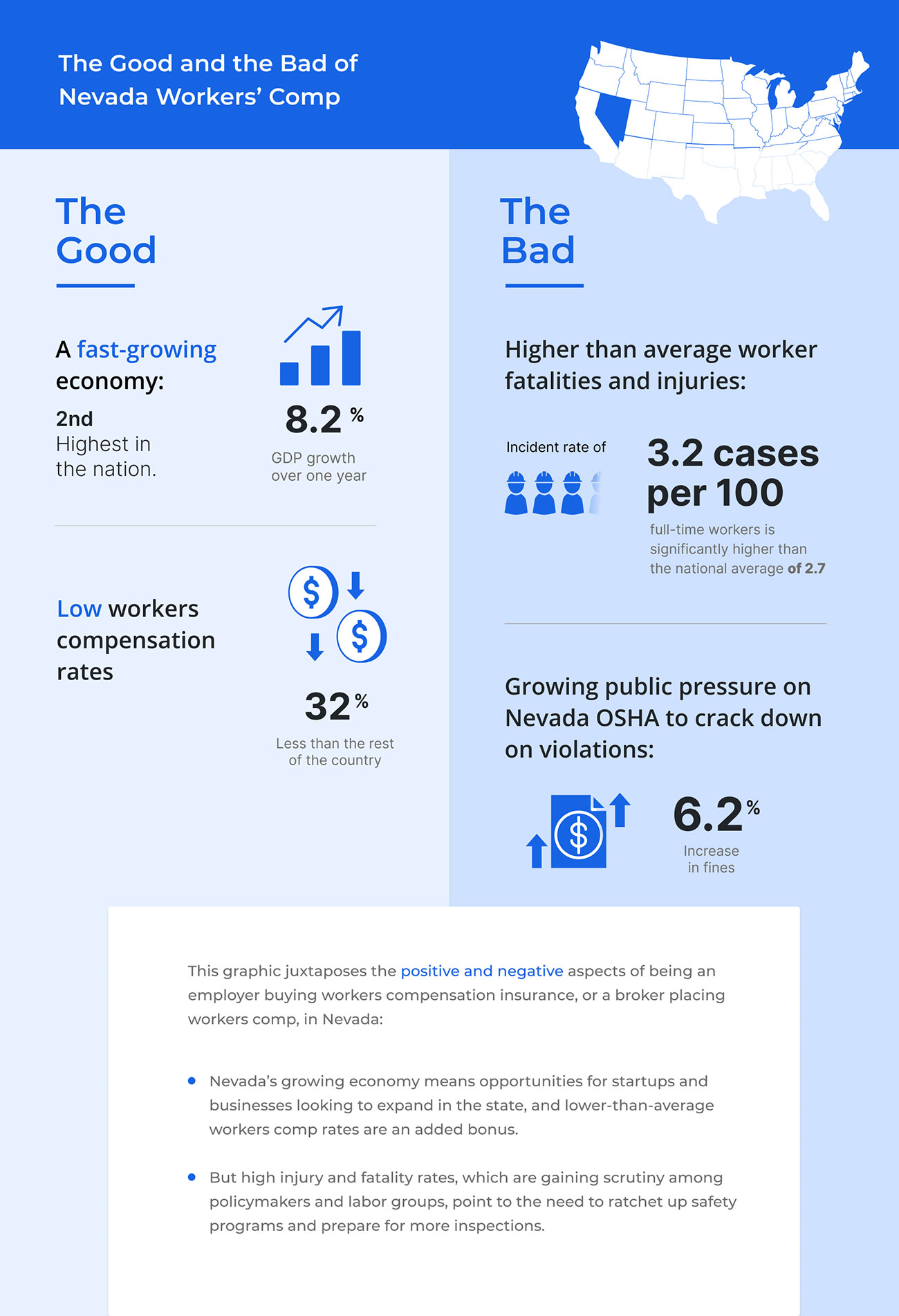
Premiums in Nevada are not arbitrary. They are calculated based on a formula that balances the inherent risk of the work performed with the individual safety record of the company.
1. NCCI Classification Codes
Nevada utilizes the National Council on Compensation Insurance (NCCI) classification system. Each job type is assigned a four-digit code and a corresponding rate based on the historical frequency and severity of injuries in that industry. For example, a clerical office worker (Code 8810) will have a significantly lower rate than a structural steel worker (Code 5040). It is vital for Nevada employers to ensure their employees are classified correctly; misclassification can lead to either overpaying for coverage or facing "premium audits" that result in massive back-payments.
2. Payroll
The premium is calculated per $100 of payroll. As payroll increases, the baseline premium increases. In 2026, Nevada continues to include most forms of compensation in this calculation, including bonuses, commissions, and holiday pay, though certain fringe benefits may be excluded depending on the specific carrier’s filing.
3. Experience Modification Factor (E-Mod)
The Experience Modification Factor, or E-Mod, is a multiplier that rewards safe companies and penalizes those with frequent claims. An E-Mod of 1.0 is considered the industry average. If a company has a better-than-average safety record over a three-year period, its E-Mod might drop to 0.85, resulting in a 15% discount on premiums. Conversely, a poor safety record could push the E-Mod to 1.20, leading to a 20% surcharge. In Nevada's competitive market, maintaining a low E-Mod is the most effective way to lower long-term insurance costs.
Evaluating Nevada Workers’ Compensation Companies
When choosing a provider, businesses should look beyond the lowest premium. The "best" company in NV is one that balances cost with effective claims advocacy and loss control services.
| Feature | Private Carrier | Self-Insured Group/Individual |
|---|---|---|
| Eligibility | Open to all businesses regardless of size. | Requires high net worth or specific industry group. |
| Upfront Cost | Predictable premiums paid monthly/annually. | Requires significant security deposits/surety bonds. |
| Claims Control | Managed by the carrier's adjusters. | Higher degree of employer involvement. |
| Risk Handling | Risk is fully transferred to the insurer. | Employer retains significant financial risk. |
| Administrative Burden | Low; the carrier handles DIR filings. | High; requires specialized internal or TPA management. |
Top Carriers in the Nevada Market
Several major insurers dominate the Nevada landscape due to their specialized knowledge of the state’s legal environment:
- Employers Insurance Company of Nevada: Historically rooted in the state, they specialize in small to mid-sized businesses and have a deep understanding of local NCCI classifications.
- ICW Group: Known for high-touch claims management and helping employers lower their E-Mods through safety programs.
- The Hartford & Travelers: National carriers with robust digital platforms for policy management, popular among multi-state employers operating in Nevada.
- Berkshire Hathaway Guard: Often competitive for a wide range of industries, providing comprehensive packages for Nevada retail and hospitality sectors.
The Claims Process and Managed Care in Nevada
In the event of an injury, the "landscape" of Nevada insurance involves specific forms and timelines that must be strictly followed to protect both the employer and the worker.
The "Notice of Injury" (Form C-1)
When an accident occurs, the employee must complete a Form C-1 (Notice of Injury or Occupational Disease) within seven days. This form is the internal record of the incident. It does not start a formal claim with the insurance company, but it is a legal prerequisite for the employee to preserve their rights.
The "Claim for Compensation" (Form C-4)
The formal claim begins when the injured worker visits a medical provider. The physician completes the Form C-4 (Employee's Claim for Compensation/Report of Initial Treatment). A copy of this form is sent to the insurance carrier and the employer. In Nevada, the insurance company has 30 days from the receipt of the C-4 to accept or deny the claim.
Managed Care Organizations (MCOs)
Nevada allows insurance companies to use Managed Care Organizations (MCOs) or Preferred Provider Organizations (PPOs). This means that, in most cases, the employer or the insurer has the right to choose the "provider list" from which the employee must select a doctor. If a Nevada employer has an MCO contract in place, an injured worker must use a doctor within that network, or the insurer may refuse to pay the medical bills.
Common Pitfalls and Compliance Risks
The Nevada Division of Industrial Relations is proactive in its enforcement. Employers often fall into "compliance traps" that lead to litigation or fines.
- Lapses in Coverage: Even a one-day lapse in coverage can result in a fine of up to $15,000, depending on the number of employees. If an injury occurs during a lapse, the employer is personally liable for all medical costs and lost wages, and the DIR may also assess an additional "uninsured employer" penalty.
- Inadequate Record Keeping: Nevada law requires employers to maintain records of all injuries for a minimum of five years. Failure to produce these records during a DIR audit can result in administrative sanctions.
- Retaliation: NRS 616D.390 prohibits employers from firing or discriminating against an employee for filing a workers' compensation claim. Nevada courts have historically been protective of workers in "retaliatory discharge" cases, often awarding significant punitive damages.
- Failure to Post Required Notices: Every Nevada employer must display the "Brief Description of Your Rights and Benefits if You Are Injured on the Job" (Poster State Form D-1) in a conspicuous place. This poster provides employees with the contact information for the insurer and the Nevada Attorney for Injured Workers (NAIW).
Frequently Asked Questions
Does a business owner need workers' comp for themselves in Nevada?
In Nevada, sole proprietors and partners are generally excluded from coverage requirements but can "elect" to be covered by notifying the carrier. However, officers of a corporation are considered employees and are included in coverage requirements unless they meet specific exclusion criteria (such as being the sole shareholder and officer).
What happens if an employee is injured while working out of state?
Nevada has "extraterritorial" provisions. If an employee hired in Nevada is injured while temporarily working in another state (e.g., a salesperson traveling to California), they are generally covered under their Nevada policy. However, if the employee is permanently stationed in another state, the employer must obtain coverage in that specific state.
How can a Nevada business lower its workers' comp premiums?
The most effective methods include implementing a formal safety program, utilizing a "Return to Work" or "Light Duty" program to reduce lost-wage payments, and conducting regular audits of NCCI class codes to ensure accuracy. Utilizing a Nevada-based broker who understands the local 2026 rate filings can also identify competitive pricing trends.
Can an employer choose the doctor for an injured worker in NV?
Yes, if the employer or their insurer has a contract with a Managed Care Organization (MCO) or a Preferred Provider Organization (PPO). The employee must select a physician from the approved list provided by the insurer. If no such contract exists, the employee may choose any doctor who is authorized by the DIR to treat workers' compensation patients.
What is the Nevada Attorney for Injured Workers (NAIW)?
The NAIW is a state agency that provides free legal representation to injured workers who are appealing a claim denial or a benefit determination. While they do not represent employers, their presence ensures that the Nevada system remains balanced and that insurance companies adhere strictly to the law.
Recommendation for Nevada Employers
To successfully navigate the Nevada insurance landscape in 2026, business owners should prioritize three actions: First, perform a classification audit with a licensed agent to ensure you aren't overpaying based on incorrect NCCI codes. Second, establish a written safety policy and a "Return to Work" program; these are the primary tools for lowering your E-Mod over time. Finally, ensure your C-1 and C-4 reporting protocols are digitized and integrated with your HR system to avoid the administrative fines associated with late reporting. For further guidance on compliance or to verify a carrier's license, consult the Nevada Division of Industrial Relations or the Nevada Division of Insurance.
Image Gallery