Understanding the Shift in U.S. Bank Loan Rates: Drivers, Benchmarks, and Strategic Guidance
Understanding the shift in U.S. bank loan rates requires analyzing how the Federal Reserve's monetary policy, benchmark indexes, bank funding costs, and macroeconomic conditions interact. When central bank policy rates adjust, underlyi...
Understanding the shift in U.S. bank loan rates requires analyzing how the Federal Reserve's monetary policy, benchmark indexes, bank funding costs, and macroeconomic conditions interact. When central bank policy rates adjust, underlying indexes like the Prime Rate and SOFR shift, directly impacting borrowing costs across commercial, real estate, and consumer lending markets.
Contents
Disclaimer: This analysis is provided for informational and educational purposes only and does not constitute formal financial, investment, or legal advice. Borrowers and enterprise decision-makers should consult qualified financial advisors or banking specialists before making debt management decisions.
The Core Dynamics Driving U.S. Bank Loan Rate Shifts
U.S. bank loan rates do not move in isolation. They reflect a dynamic financial supply chain where central bank decisions, market competition, regulatory requirements, and borrower credit risk intersect. Understanding how these factors interact clarifies why loan pricing changes rapidly during monetary policy shifts and why different loan products react at varying speeds.
- Federal Reserve Monetary Policy (Target Federal Funds Rate Range & Balance Sheet)
- Interbank & Benchmark Rates (SOFR, Prime Rate, Treasury Yields)
- Commercial & CRE (Spread + Benchmark)
- Consumer & Retail (Fixed/Variable Debt)
- Interbank & Benchmark Rates (SOFR, Prime Rate, Treasury Yields)
Federal Reserve Monetary Policy and the Target Federal Funds Rate
The foundational catalyst for shifts in U.S. bank loan rates is the policy stance of the Federal Reserve’s Federal Open Market Committee (FOMC). By establishing the target range for the overnight Federal Funds Rate—the rate at which depository institutions lend reserve balances to each other overnight—the central bank directly establishes the baseline cost of short-term liquidity in the financial system.
When the Federal Reserve increases the target funds rate to curb inflationary pressure, the immediate cost of interbank borrowing rises. Conversely, when monetary policy eases to support economic growth, baseline borrowing costs drop. Beyond the federal funds rate, the Fed’s balance sheet policies, such as Quantitative Easing (QE) or Quantitative Tightening (QT), influence longer-term capital market yields by altering the supply of Treasury securities and agency mortgage-backed securities available to private investors.
Bank Cost of Funds and Deposit Competition
While central bank policy establishes baseline conditions, commercial banks price loan products based on their internal cost of funds. A bank’s funding base consists primarily of customer deposits, wholesale borrowings, and capital market instruments.
When interest rates rise across the broader economy, banks face heightened competition for deposits. Retail and institutional depositors demand higher yields on savings accounts, money market deposit accounts, and certificates of deposit (CDs). To maintain liquidity standards and preserve regulatory compliance—such as the Liquidity Coverage Ratio (LCR) enforced by the Federal Deposit Insurance Corporation—banks must increase the yields offered to depositors. This rise in deposit beta (the percentage of a policy rate change passed through to deposit yields) directly increases the bank's operational cost of capital, forcing institutions to adjust their base loan rates upward to defend their net interest margin (NIM).
Credit Risk Premiums and Macroeconomic Volatility
The interest rate charged to a specific borrower includes a credit risk premium added to the baseline benchmark rate. This premium compensates the lender for default risk, loss given default (LGD), and exposure at default (EAD).
During economic shifts, macro factors such as GDP contraction, rising commercial vacancy, corporate revenue volatility, or tight labor markets alter the broader credit risk environment:
- Economic Expansion: Lower perceived probability of default allows banks to compress credit spreads to remain competitive.
- Economic Contraction or Uncertainty: Banks widen credit spreads, imposing stricter underwriting covenants and higher risk premiums regardless of base rate direction.
Historical rate data made available by the Federal Reserve Bank of St. Louis FRED Database illustrates that during monetary tightening or credit distress cycles, credit spread widening frequently amplifies overall borrowing costs for medium- and high-risk commercial borrowers.
Key Interest Rate Benchmarks Explaining Loan Rate Movements
To understand why a specific commercial or consumer credit facility has experienced a price adjustment, borrowers must identify the benchmark rate tied to their debt contract. U.S. banks rely on a few dominant reference rates to price variable- and fixed-rate loans.
The U.S. Prime Rate
The Prime Rate serves as the primary benchmark for short-term commercial loans, small business lines of credit, home equity lines of credit (HELOCs), and credit cards. In U.S. commercial banking practice, the Prime Rate is largely standardized across major money-center banks and is traditionally priced exactly 300 basis points (3.00%) above the upper bound of the Federal Funds Target Range.
Because of this direct link, any change announced by the FOMC results in an immediate, equivalent adjustment in the U.S. Prime Rate. For example, if the Fed lowers its policy rate target by 25 basis points, the U.S. Prime Rate drops by 25 basis points on the same or following business day, translating directly into adjusted monthly interest costs for variable-rate borrowers.
Secured Overnight Financing Rate (SOFR)
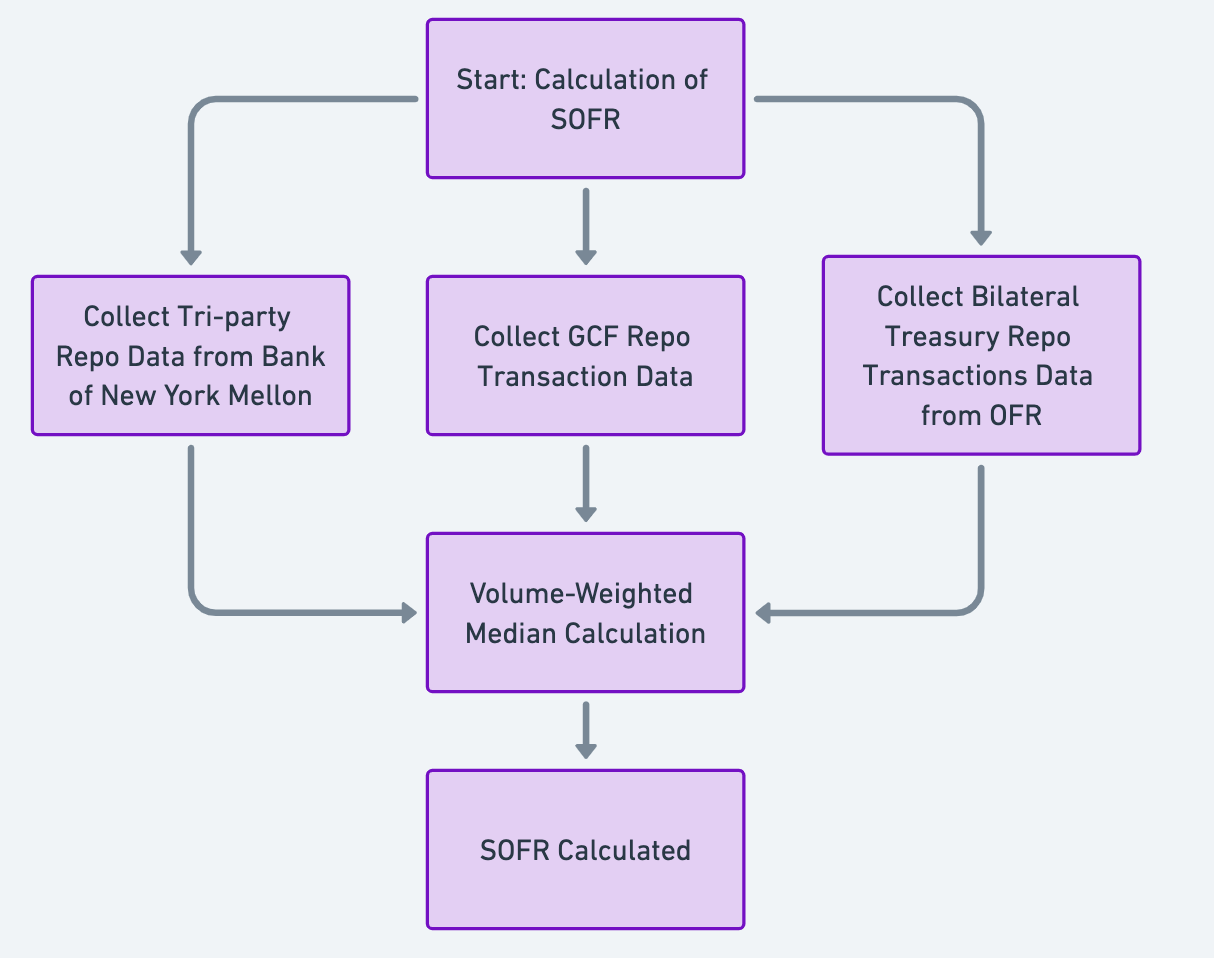
Following the global phase-out of the London Interbank Offered Rate (LIBOR), the Secured Overnight Financing Rate (SOFR) became the primary reference rate for U.S. corporate debt, syndicated loans, commercial real estate loans, and adjustable-rate instruments.
Administered by the Federal Reserve Bank of New York, SOFR measures the cost of borrowing cash overnight collateralized by U.S. Treasury securities. Unlike the uncollateralized LIBOR rate historically used by banks, SOFR is a fully transaction-based rate reflecting actual overnight repo market activity. Lenders offer loans pegged to various SOFR structures:
- Daily Simple SOFR / Overnight SOFR: Resets daily, providing high sensitivity to immediate short-term market fluctuations.
- Term SOFR (1-Month, 3-Month, 6-Month): Forward-looking rates derived from SOFR derivatives markets, offering fixed rate certainty over specific operational periods.
Because SOFR reflects secured wholesale transaction volume exceeding $1 trillion daily, it closely tracks central bank operational target policy while remaining free from credit manipulation risk.
U.S. Treasury Yields and Long-Term Fixed Rates
For long-term fixed-rate instruments—such as commercial mortgages, 15-year and 30-year residential mortgages, and fixed corporate term debt—bank loan rates correlate far more closely with U.S. Treasury yields than with overnight policy rates.
The yield on 5-year, 10-year, and 30-year U.S. Treasury notes is determined by open capital market supply and demand. Treasury yields reflect long-term market expectations regarding future inflation, structural economic growth, sovereign debt issuance, and foreign capital flows. When inflation expectations rise, long-term Treasury yields increase even if overnight rates remain static, driving up long-term fixed-rate bank financing costs across consumer and commercial debt sectors.
How Shifts in Loan Rates Impact Different Sector Borrowers
Rate adjustments do not affect all sector borrowers uniformly. The structure of the debt, collateral backing, maturity profile, and competitive landscape dictate how rate shifts translate into corporate capital expenditure or household borrowing costs.
Commercial and Corporate Lending
Middle-market corporate borrowers and large enterprise entities relying on revolving credit facilities and variable-rate term loans feel rate shifts immediately. Corporate credit agreements are predominantly structured as floating-rate instruments priced at SOFR + Margin or Prime + Margin.
When baseline rates move higher, enterprise balance sheets encounter immediate operational pressures:
- Debt Service Coverage Ratio (DSCR) Compression: Higher annual interest expenses reduce operational earnings, making it harder to comply with bank debt covenants like minimum DSCR or maximum Leverage Ratios.
- Capital Expenditure Retrenchment: Higher hurdle rates for corporate investment force CFOs to pause marginal expansion projects, shift toward internal cash equity financing, or defer capital investments.
Commercial Real Estate (CRE) and Mortgages
Commercial real estate is among the most interest-rate sensitive asset classes due to its heavy reliance on leverage. CRE term debt typically relies on short maturities (often 3 to 10 years) with balloon payments or refinancing requirements, subjecting property owners to significant refinancing risk.
When long-term Treasury yields or SOFR benchmark rates increase significantly during a loan's term, property owners face steep rate reset jumps upon loan maturity. If property net operating income (NOI) fails to grow at a rate sufficient to cover higher debt service, cap rates expand, driving down asset valuations. Property buyers face stricter Loan-to-Value (LTV) limits enforced by institutional lenders, requiring borrowers to inject additional equity capital into refinancings ("cash-in refinancings") to satisfy target coverage thresholds.
Residential mortgage rates, tracked closely through the Consumer Financial Protection Bureau, mirror these long-term yield dynamics, affecting home affordability and market liquidity when fixed-rate mortgage yields move higher.
Small Business Administration (SBA) and Consumer Debt
Small businesses reliant on SBA 7(a) or SBA 504 loan programs face distinct dynamic exposure to interest rate adjustments. SBA 7(a) variable-rate facilities are tied to either the Prime Rate, the 30-day LIBOR replacement, or the SBA Peg Rate, resetting quarterly or monthly subject to statutory maximum spread caps.
When bank rate structures shift:
- Small Business Working Capital: Increased carrying costs on variable credit lines reduce small business liquidity, restricting payroll expansion and inventory procurement.
- Consumer Debt Accumulation: Consumer products like variable-rate credit cards and Home Equity Lines of Credit (HELOCs) adjust almost instantaneously as bank Prime rates change, impacting personal disposable income and consumer demand.
Comparative Overview: U.S. Bank Loan Rate Drivers and Impacts
The following table details the primary benchmark rates driving U.S. bank loan pricing, their structural drivers, typical rate adjustment cadence, and their primary sector loan applications.
| Rate Benchmark | Primary Structural Driver | Typical Adjustment Cadence | Target Loan Products & Sectors |
|---|---|---|---|
| U.S. Prime Rate | Federal Reserve Target Federal Funds Rate Range | Immediate (Upon FOMC policy shifts) | HELOCs, Credit Cards, SBA 7(a) Loans, SMB Revolvers |
| Term SOFR (1M / 3M) | Treasury Repo Market Transactions & Derivatives | Monthly / Quarterly Contract Resets | Middle-Market Corporate Term Loans, Syndicated Credit Facilities |
| 10-Year U.S. Treasury | Inflation Expectations, Economic Growth, Treasury Auctions | Continuous Market Trading | Fixed Commercial Real Estate Mortgages, 30-Year Residential Mortgages |
| SOFR Overnight | Secured Wholesale Treasury Repo Market | Daily | High-Yield Corporate Debt, Specialized Institutional Credit |
| Bank Cost of Funds Index | Local Deposit Competition, CD Rates, FDIC Liquidity Requirements | Monthly / Lags Policy Rates | Community Bank Portfolio Lending, Regional Commercial Lines |
Actionable Strategies for Borrowers to Navigate Rate Fluctuations
Navigating volatile bank loan rate environments requires active corporate balance sheet management and clear risk mitigation frameworks. Enterprise executives, financial managers, and individual commercial real estate investors employ specific financial techniques to buffer against adverse interest rate movements.
- Rate Risk Management Toolkit
- Derivatives & Hedging
- Interest Rate Swaps (Float to Fixed)
- Interest Rate Caps (Max Ceiling Protection)
- Contract & Debt Structuring
- Fixed-Rate Conversion
- Extend Maturity Runways
- Negotiate Floor/Ceiling Rate Terms
- Derivatives & Hedging
Interest Rate Risk Hedging: Swaps and Caps
Commercial borrowers holding variable-rate SOFR debt frequently utilize derivative instruments to insulate cash flows without needing to fully refinance underlying bank debt agreements:
- Interest Rate Swaps: A borrower enters an agreement with a financial counterparty to pay a fixed interest rate while receiving a floating SOFR rate, effectively locking in a fixed debt service obligation.
- Interest Rate Caps: A borrower purchases an option contract that sets a maximum ceiling rate on their variable-rate loan. If SOFR rises above the agreed cap rate, the option seller reimburses the borrower for the excess interest expense, capping total downside risk while allowing the borrower to benefit if rates drop.
Refinancing, Debt Restructuring, and Covenant Management
When benchmark interest rates decrease or stabilize, commercial borrowers should systematically evaluate debt portfolio optimization opportunities:
- Conduct Debt Maturity Audits: Identify upcoming loan maturities 12 to 24 months in advance to evaluate debt service coverage under various rate scenarios.
- Negotiate Rate Conversion Options: Request fixed-rate conversion features during initial credit agreement negotiations to allow shifting from floating SOFR to a fixed rate without incurring early prepayment penalties.
- Optimize Collateral and Covenants: Leverage strong cash-flow assets or unencumbered collateral to negotiate narrower loan margins (credit risk spreads) with lending partners.
- Monitor Loan-to-Value Covenants: Ensure property valuations support mandatory LTV ratios to avoid forced equity infusions or loan pay-downs upon refinance.
Frequently Asked Questions
Why does my commercial loan rate change even if the Fed hasn't changed interest rates?
While central bank policy heavily influences short-term benchmark rates like Prime and SOFR, long-term bank rates (such as fixed commercial mortgages) are pegged to U.S. Treasury yields, which trade continuously on open capital markets. Market expectations regarding inflation, federal balance sheet policies, and corporate credit risk spreads can push bank loan yields up or down independent of immediate Federal Reserve policy rate moves.
What is the structural difference between Prime Rate and SOFR?
The Prime Rate is an administered benchmark index set by commercial banks, historically calculated as the Fed Funds Upper Target + 3.00%. SOFR (Secured Overnight Financing Rate) is a market-derived benchmark based on over $1 trillion in actual overnight repo transactions collateralized by U.S. Treasury debt. SOFR provides a market-driven, transparent reference rate used predominantly in corporate and enterprise commercial lending.
How do banks determine the credit margin added to a baseline rate?
Lenders evaluate a borrower's overall creditworthiness, debt service coverage ratio (DSCR), leverage ratios, collateral value, industry outlook, and overall operational risk profile. High-quality corporate borrowers with strong liquidity may receive floating rates near SOFR + 1.50%, whereas higher-risk commercial real estate or small business loans may carry spreads of SOFR + 3.50% or higher to compensate the lender for credit risk.
How quickly do variable-rate bank loans adjust after a rate change?
Variable-rate loans tied to the U.S. Prime Rate typically adjust within 24 to 48 hours of a Federal Reserve policy rate modification. Variable loans tied to 1-Month or 3-Month Term SOFR reset at the end of each respective interest period (monthly or quarterly), meaning the updated rate applies at the start of the next billing cycle.
What is an interest rate cap, and when should a borrower purchase one?
An interest rate cap is a derivative instrument purchased by a variable-rate borrower that places a hard ceiling on how high their baseline interest rate can rise. Borrowers typically purchase interest rate caps when acquiring short-term construction debt, bridge financing, or commercial real estate facilities during periods of high rate volatility to protect cash flow against rate spikes.
Strategic Guidance for Business Decisions
Managing the effects of shifting U.S. bank loan rates requires proactive planning rather than passive reaction. Borrowers facing variable interest rate exposures or impending credit renewals should implement a clear debt management checklist:
- Perform Sensitivity Analysis: Stress-test cash flows and debt service coverage ratios against prospective baseline rate swings of +/- 100 to 200 basis points.
- Maintain Ongoing Lender Communication: Contact commercial account managers early—at least six to nine months prior to loan maturity—to discuss extension options, benchmark choices, and refinancing terms.
- Evaluate Total Cost of Capital: Look beyond the nominal benchmark rate to assess loan origination fees, yield maintenance clauses, exit fees, and restrictive operational covenants.
By tracking key reference benchmarks, understanding central bank policy mechanics, and using balance sheet hedging strategies, corporate executives and commercial borrowers can navigate bank loan rate shifts while securing sustainable capital structures.
Image Gallery