Bear in the Big Blue House Behind the Scenes: An Insider Look
Exploring the behind-the-scenes production of Bear in the Big Blue House reveals a sophisticated blend of Jim Henson’s traditional puppetry, innovative "Shadow" animation, and a unique architectural set design. As of 2026, the series r...
Exploring the behind-the-scenes production of Bear in the Big Blue House reveals a sophisticated blend of Jim Henson’s traditional puppetry, innovative "Shadow" animation, and a unique architectural set design. As of 2026, the series remains a masterclass in early-childhood media, utilizing a full-body puppet suit and a modular studio set in Queens, New York, to create its immersive, comforting world.
Contents
The Architecture of the Big Blue House
The physical "Big Blue House" was not a miniature or a digital construct; it was a massive, meticulously engineered set located at Kaufman Astoria Studios in Queens, New York. To provide an insider look at how this space functioned, one must understand the "raised floor" system. Because the puppets—aside from Bear himself—were hand-and-rod puppets, the human performers needed to remain out of the camera's sightline while keeping the puppets at eye level with the "floor."
The entire set was built on platforms approximately three to four feet off the ground. Between these platforms were "trenches" or walkways where puppeteers like Peter Linz (Tutter) or Vicki Eibner (Ojo) could stand and move freely. When Bear walked through a room, the puppeteers for the smaller characters were often crouched or standing just inches below the floorboards, viewing their performance on small CRT monitors (and later LCDs) known as "monitors" or "feedbacks." This setup allowed the characters to interact seamlessly with furniture and props that appeared to be sitting on a solid floor, despite the floor being a series of removable panels and gaps.
Engineering the Bear: The Man Inside the Suit
The character of Bear is a "full-body" puppet, a distinct category from the hand puppets like Tutter or Treelo. Performing as Bear required a specialized skill set that combined athletic endurance with delicate motor control. Noel MacNeal, the primary performer for Bear throughout the series, operated the character using a combination of internal controls and external assistance.
Inside the Bear suit, MacNeal’s head was located in the Bear’s neck. To see, he wore a small video monitor strapped to his chest, which showed him the "program feed"—exactly what the television audience would see. This allowed him to navigate the set and make eye contact with other puppets. His right arm was inside the Bear’s right arm, providing the character’s primary gestures, while his left hand operated a "trigger" mechanism that controlled Bear’s mouth and eye blinks.
Because Bear’s left arm also needed to move realistically, a second puppeteer—often referred to as a "right-hand" or "assistant" performer—would dress in a matching blue-screen suit or hide behind Bear to operate the left limb. This coordination required a high level of "sympathetic movement," where both performers had to breathe and move in unison to maintain the illusion of a single living creature.
The Technical Innovation of Shadow
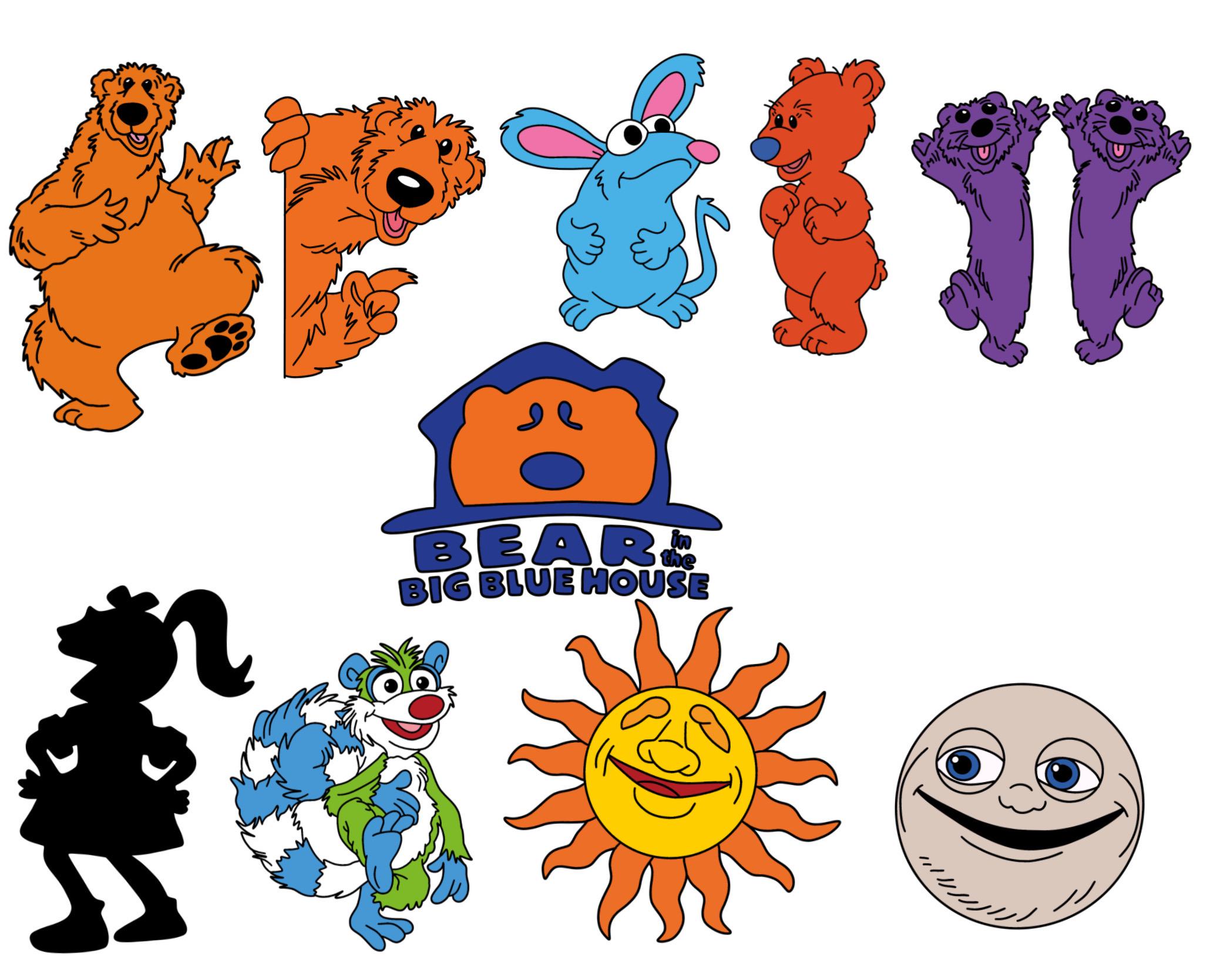
One of the most memorable segments of the show featured Shadow, a traditional shadow puppet who told stories through song. While the rest of the show utilized physical sets and puppets, Shadow was a pioneer in digital/analog hybrid production.
The character of Shadow was performed by Tara Cherry, but the visual effect was achieved through a process called "Chroma Key" compositing combined with 2D animation. The "Shadow" would appear on the walls of the Big Blue House, but in the studio, Noel MacNeal was often talking to a blank, brightly lit wall. The animation for Shadow's stories was created separately and then layered onto the footage in post-production. This required the directors to use precise camera tracking so that when the camera moved, the "shadow" stayed locked to the wall, maintaining the perspective of the room.
The "Bear Way" and Educational Curriculum
Behind the scenes, the show was governed by a specific educational philosophy developed by Mitchell Kriegman and the Jim Henson Company, often referred to as "The Bear Way." Unlike many high-energy children’s programs of the late 1990s, Bear in the Big Blue House was designed to be "slow television."
The insider goal was to create a "safe harbor" for children. This involved:
- Direct Address: Bear looked directly into the lens, breaking the fourth wall to speak to the child at home as a peer.
- Olfactory Engagement: The famous "sniffing" opening was a sensory tool designed to make the digital screen feel three-dimensional and personal.
- Emotional Literacy: The writing staff worked with child psychologists to ensure that Bear modeled "gentle curiosity" rather than "authoritative teaching."
Production Roles and Technical Specifications
The complexity of the show required a large crew that functioned more like a theater troupe than a standard television production. Below is a breakdown of the core technical and performance roles that brought the Big Blue House to life.
| Role | Primary Entity/Person | Technical Detail |
|---|---|---|
| Creator / Executive Producer | Mitchell Kriegman | Developed the "360-degree" set concept. |
| Lead Puppeteer (Bear) | Noel MacNeal | Operated via internal monitor and mouth triggers. |
| Puppetry Style | Jim Henson "Hand-and-Rod" | Characters like Tutter and Ojo used this system. |
| Filming Location | Kaufman Astoria Studios | Used a specialized 10,000+ sq. ft. soundstage. |
| Animation Style | Shadow Projects / 2D Hybrid | Integrated into live-action plates via compositing. |
| Music Composition | Peter Lurye / Tyler Bunch | Focus on jazz, swing, and Broadway-style motifs. |
The Musical Identity: From Jazz to Lullabies
Music was a foundational element of the show's production. Unlike many shows that used synthesized tracks, Bear in the Big Blue House utilized a rich array of live instrumentation, including brass, upright bass, and piano. This gave the show its sophisticated, timeless feel.
The "Goodbye Song," which concluded every episode, was recorded with a specific acoustic resonance to evoke a sense of calm. The interplay between Bear (a deep baritone) and Luna the Moon (a soft soprano, performed by Lynne Thigpen) was mixed to emphasize the "lows" and "highs," creating a balanced soundscape that was scientifically found to be soothing to toddlers. Musicians often recorded the tracks before filming so the puppeteers could "lip-sync" (or "lip-flap") the puppets to the exact syllables of the lyrics, a hallmark of the Henson puppetry standard.
Challenges of Large-Scale Puppetry
Working on the set of the Big Blue House presented significant physical challenges. The puppeteers often spent eight to ten hours a day with their arms raised above their heads. To prevent injury, the production employed physical therapists and ensured that the "trenches" were padded.
Furthermore, the lighting of the set was a complex task. Because the "ceilings" of the rooms were often open to allow for studio lights, the lighting directors had to ensure that no shadows from the puppeteers' arms or heads were cast onto the set walls. They used "soft boxes" and diffused lighting to create the warm, sunny atmosphere of the house, regardless of the actual time of day in Queens.
FAQs
Who actually wore the Bear suit?
Noel MacNeal was the primary performer inside the suit. He provided both the voice and the physical movements for Bear. Occasionally, for wide shots or stunts that required different physicalities, other performers might step in, but MacNeal is credited with the character's soul and personality.
How was Luna the Moon operated?
Luna was a large, wall-mounted puppet located in the "attic" portion of the set. She was operated by a puppeteer who controlled her facial expressions and mouth movements, while her voice was provided by the late Lynne Thigpen. The glowing effect was achieved using internal bulbs and external "fill" lighting to make her appear as though she were reflecting sunlight.
Is the Big Blue House a real house I can visit?
No, the Big Blue House was a functional television set and did not exist as a real building. After production ended, the set was struck (dismantled). However, various puppets and props from the show are occasionally displayed at the Museum of the Moving Image, which is coincidentally located right next to the studios where the show was filmed.
Why did the show end in 2006?
The show concluded primarily due to a combination of factors, including the Jim Henson Company selling the rights to the Muppets and Bear in the Big Blue House to Disney in 2004. Additionally, the passing of Lynne Thigpen (Luna) in 2003 was a significant emotional blow to the production, making it difficult to continue the show’s original format without her iconic presence.
Can you watch the show in 4K today?
As of 2026, many episodes have been remastered for streaming services like Disney+. While the show was originally shot on standard-definition video (the industry standard in the late 90s), AI upscaling and restoration techniques have significantly improved the visual clarity for modern screens, though it does not native 4K "film" resolution.
Final Recommendations for Fans
For those looking to dive deeper into the history of the show, exploring the archives at the Museum of the Moving Image or the Jim Henson Company website offers the best primary-source information. Watching the series on official streaming platforms like Disney+ allows you to see the technical precision of the puppetry in high definition. If you are interested in the craft of puppetry itself, Noel MacNeal’s various workshops and books provide an unparalleled insider perspective on what it was like to bring Bear to life for nearly a decade.
Image Gallery