Capturing and Sourcing Pictures of People in New York: History, Laws, and Techniques
Capturing pictures of people in New York requires a balance of technical camera skill, spatial awareness, and an understanding of public privacy laws. Under New York law and the First Amendment, photographing individuals in public spac...
Capturing pictures of people in New York requires a balance of technical camera skill, spatial awareness, and an understanding of public privacy laws. Under New York law and the First Amendment, photographing individuals in public spaces is legally protected for creative and editorial purposes. Whether documenting candid street life or sourcing historical archives, success depends on adhering to legal boundaries, choosing optimal locations, and employing proper photographic techniques.
Contents
The Cultural Tradition of New York Street Photography
The practice of taking pictures of people in New York forms one of the most documented traditions in modern visual culture. New York City’s sheer density, socio-economic variety, and pedestrian-heavy infrastructure make it a world capital for street photography and social documentary work.
In the mid-20th century, movement pioneers such as Helen Levitt, Garry Winogrand, Diane Arbus, and Paul Strand used the five boroughs as a canvas to define street portraiture. Rather than posing subjects in studio environments, these photographers focused on spontaneous human interactions on sidewalks, park benches, and subway platforms. Their work demonstrated how candid imagery could capture complex socio-economic shifts, subcultures, and daily human emotion.
In recent decades, projects like Brandon Stanton’s Humans of New York transformed public street portraiture into digital narrative storytelling by pairing candid portraits with detailed personal interviews. Similarly, legendary photographers like Jamel Shabazz documented youth culture, street fashion, and community life in Brooklyn and Harlem during the late 20th century. Today, taking pictures of people in New York remains a vibrant visual medium, attracting fine art photographers, photojournalists, stock contributors, and digital creators worldwide.
Legal Rights and Privacy Rules in New York Public Spaces
Before photographing people in New York City, creators must understand the distinction between public spaces, private property, and commercial usage rights. New York State maintains specific statutory provisions governing personal privacy and right-of-publicity claims.
The First Amendment and Public Space Photography
In general, any person standing in a publicly accessible space in New York State—such as a public sidewalk, municipal park, or public plaza—has no legal expectation of privacy regarding being photographed. Photographers standing on public property may freely take pictures of people without obtaining prior verbal or written consent, provided the photography does not cross into unlawful harassment, stalking, or physical obstruction.
New York Civil Rights Law Sections 50 and 51
The primary statutory limitation on street photography in New York stems from New York Civil Rights Law Section 50 and Section 51. These provisions establish a statutory right of privacy and right of publicity. Under these laws, using a person's name, portrait, picture, or voice for commercial advertising or trade purposes without prior written consent (a signed model release) is illegal.
- Editorial and Artistic Protection: The courts in New York consistently interpret Section 50 and 51 narrowly to protect artistic expression, news reporting, and educational works. Publishing a street portrait in a newspaper, photojournalism magazine, documentary film, educational textbook, or fine art gallery print generally does not constitute trade or commercial advertising.
- Commercial Advertising Exception: If a photographer sells a picture of an recognizable person in New York to an advertiser to promote a brand, product, software app, or service without a signed model release, the subject may sue for monetary damages and injunctive relief under Section 51.
Rules Governing Photography on NYC Mass Transit (MTA)
The Metropolitan Transportation Authority (MTA) governs rules for subway stations, platforms, and buses. Under MTA Rules of Conduct (Section 1050.9), photography, filming, and audio recording are explicitly permitted throughout the transit system. However, photographers must strictly adhere to specific restrictions:
- No auxiliary lights, flashes, or spotlights may be used if they interfere with train operation.
- No tripods, monopods, or camera stands may be deployed without an official MTA permit, as they create tripping hazards.
- Equipment must not block transit stairways, turnstiles, or platform boarding zones.
Legal and Operational Framework: Commercial vs. Editorial Street Photography
Understanding when a photograph of a New Yorker requires authorization depends on the intended end use. The table below outlines the regulatory and licensing requirements across common distribution channels.
| Use Case Category | Example Output | Model Release Required? | Legal Basis / Governance | Location Restrictions |
|---|---|---|---|---|
| Fine Art Gallery | Physical prints sold in fine art exhibitions | No | Protected under 1st Amendment & artistic exemptions to NY Civil Rights Law § 50/51 | Must be taken from public property |
| Editorial & News | Newspapers, photojournalism, documentary books | No | First Amendment news-gathering rights; public interest exception | Public space allowed; private spaces require owner consent |
| Commercial Advertising | Billboards, promotional web banners, brand campaigns | Yes | Mandatory under NY Civil Rights Law § 50/51 to prevent trade exploitation | Full property & subject clearance required |
| Stock Photography | Microstock or macrostock agency submission | Depends (Yes for commercial, No for editorial stock) | Licensing agency guidelines and right-of-publicity statutes | Property releases required for private architectural interiors |
| MTA Subway System | Candid subway platform portraiture | No (for non-commercial standard handheld use) | MTA Rules of Conduct 21 NYCRR § 1050.9 | No tripods, external flash units, or flow obstruction |
Prime NYC Locations for Authentic People Photography
Capturing compelling pictures of people in New York relies heavily on choosing locations with dense foot traffic, diverse populations, and dynamic backgrounds.
Top NYC Photography Hubs:
- Washington Square Park: Street Performers & Youth Culture
- Times Square & Midtown: High Density & Tourists
- SoHo & Spring Street: Street Fashion & Architecture
- Chinatown & Lower East: Cultural Life & Vendors
- Brooklyn Bridge Walkway: Pedestrian Motion & Views
1. Washington Square Park (Greenwich Village)
Washington Square Park serves as one of the city's premier hubs for candid human interaction. Because of its proximity to New York University (NYU) and historical status as a bohemian center, the park attracts musicians, chess players, street artists, skateboarders, and political activists. Photographers can work openly here due to the continuous presence of artists and performers.
2. SoHo and Spring Street
For fashion-focused street portraiture, the cast-iron historic district of SoHo offers high aesthetic contrast. Photographers frequently capture visitors, fashion models, and retail shoppers framed by cobblestones, fire escapes, and high-end storefront windows. The natural reflection of sunlight off historic brick facades creates soft daylighting conditions ideal for candid portraits.
3. Chinatown and the Lower East Side
The vibrant street markets along Mott Street, Grand Street, and Mulberry Street showcase authentic local commerce and neighborhood culture. Food market vendors, street stalls, and crowded intersections offer dense, layered compositions. Photographers operating in these neighborhoods should exercise cultural sensitivity and avoid disrupting local merchants.
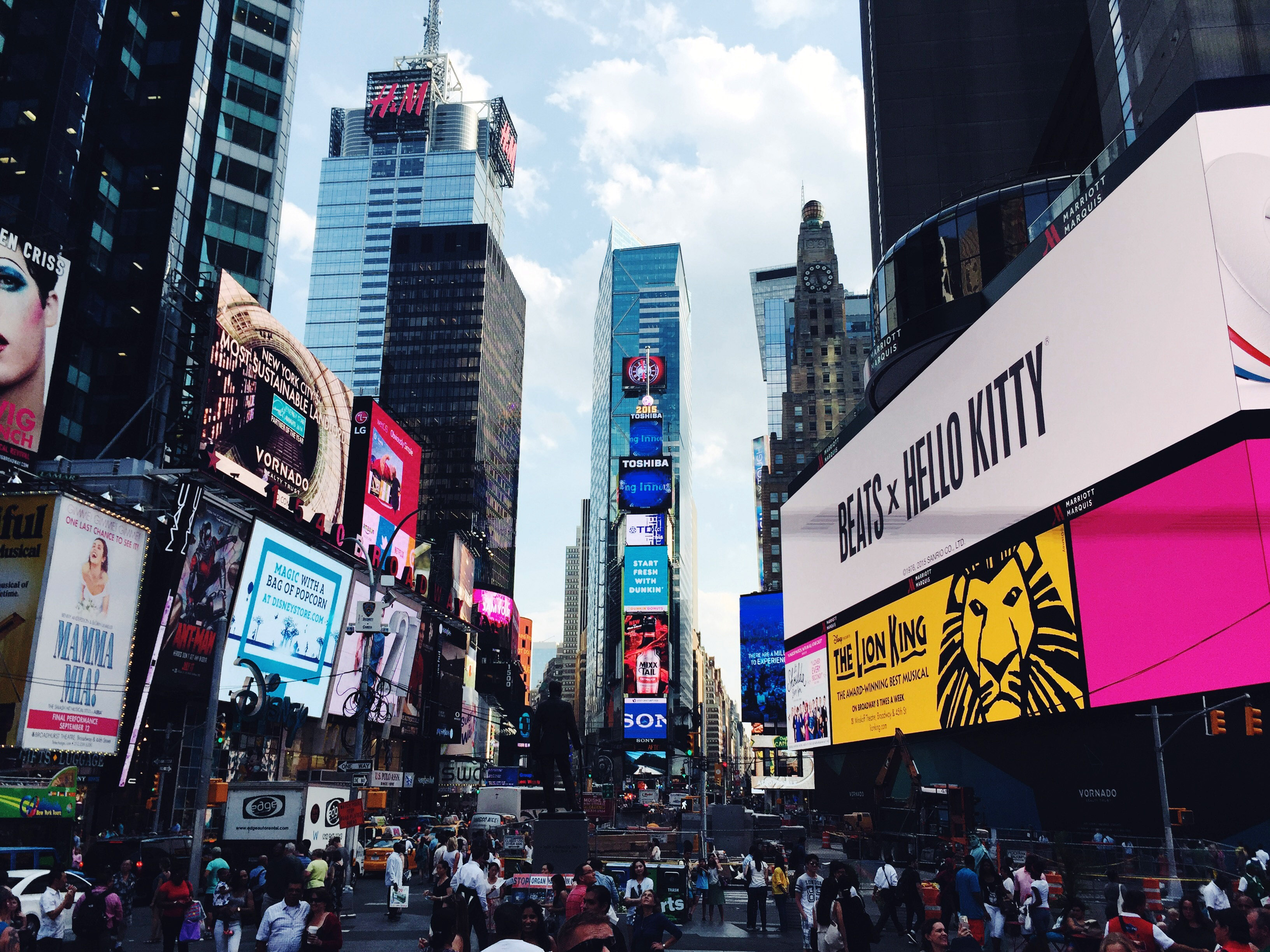
4. Times Square and 42nd Street
For high-energy scenes characterized by neon illumination and intense movement, Times Square is unmatched. The high concentration of international tourists, street performers, and costumed entertainers yields endless subject matter. Nighttime photography benefits from the high ambient light output produced by LED billboards, eliminating the need for high-ISO camera settings or artificial flash setups.
Camera Techniques and Gear Setups for NYC Street Photography
Executing high-quality street photography requires selecting light, versatile equipment paired with fast exposure settings capable of freezing sudden motion.
Optimal Street Camera Settings:
- Shutter Speed: 1/250s to 1/500s (Freezes human movement)
- Aperture: f/4 to f/8 (Maintains depth of field for focus)
- ISO: Auto ISO (100-3200 depending on light/subway)
- Focusing: Continuous AF (AF-C / AI Servo) or Zone Focus
Prime Lenses vs. Zoom Lenses
- 35mm Fixed Prime Lens: The classic focal length for environmental street portraiture. A 35mm lens forces the photographer to work close to the subject, providing context by incorporating surrounding architecture and pedestrian flow without distortion.
- 50mm Fixed Prime Lens: Ideal for tighter street portraits that isolate subjects from cluttered urban backgrounds. A 50mm lens offers a natural perspective similar to human vision and provides shallow depth of field when shot at wide apertures (e.g., f/1.8 or f/2.8).
- 24-70mm Zoom Lens: Provides operational flexibility in fast-changing environments, such as parades or protests, allowing quick transitions between wide group shots and tight portrait framing.
Recommended Camera Settings for Public Street Shooting
- Shutter Speed: Keep shutter speeds at 1/250s or faster during daylight to eliminate motion blur from walking pedestrians. For subjects moving quickly—such as cyclists or skateboarders—increase the shutter speed to 1/500s or 1/1000s.
- Aperture Choice: While wide apertures (f/1.4–f/2.8) isolate individuals with smooth background blur (bokeh), stopping down to f/5.6 or f/8 increases the depth of field. This technique, paired with zone focusing, ensures rapid focus capture when subjects walk into pre-determined target areas.
- ISO Configuration: Utilize Auto ISO with a designated maximum threshold (e.g., ISO 3200 for modern digital sensors) to ensure exposure stability when moving between bright outdoor streets and shaded building shadows.
Ethics, Etiquette, and Managing Street Encounters
While photography in public spaces is legally protected, ethical practice requires respect for individuals and local community etiquette.
- Approaching Subjects Respectfully: If a candid subject notices the camera and appears uncomfortable, making eye contact, smiling, or offering a polite nod diffuses tension. If an individual explicitly asks not to be photographed, deleting the image or moving on immediately prevents unnecessary escalation.
- Street Performers and Buskers: Under NYC guidelines, street performers occupying public plazas or parks operate legally. If you take close-up portraits of a street performer whose act forms the primary subject of your photo, offering a cash tip or digital transfer is standard courtesy.
- Posed Street Portraits: Photographers who prefer posed encounters over candid capture can use a simple approach: "Excuse me, I'm documenting street style in New York today—may I take a quick portrait of you?" Most New Yorkers will give a clear yes or no immediately.
- Sensitive Subjects: Exercise caution and restraint around vulnerable populations, children without parental presence, or individuals experiencing distress. Ethical visual journalism balances public interest with personal dignity.
How to Find and Source Historical Pictures of New York People
For researchers, historians, graphic designers, and filmmakers searching for authentic historical imagery of New Yorkers, several public institutions host digitized collections available under public domain or educational licenses.
Historical Archive Resources:
NYPL Digital Collections: Over 900,000 public items
Library of Congress: FSA/OWI & historic NYC photos
Museum of the City of NY: 20th-century urban collections
Municipal Archives (NYC): Tax records & infrastructure
New York Public Library (NYPL) Digital Collections: The NYPL Digital Collections contain hundreds of thousands of digitized images, maps, and street portraits dating from the 19th through the late 20th century. The portal allows users to filter specifically by public domain status for unrestricted publication.
Library of Congress (LOC): The LOC Prints and Photographs Division holds thousands of historical images of New Yorkers, including Farm Security Administration (FSA) prints from the 1930s, the Bain News Service Collection, and historic street life documentation by photographers like Lewis Hine.
Museum of the City of New York (MCNY): The MCNY digital archives feature specialized curations of NYC street portraiture, historic neighborhood transformations, architectural documentation, and social movements across all five boroughs.
NYC Municipal Archives: Offers access to public employee records, historical crime scene photography, and the landmark 1940 and 1980 Tax Department photographs, which systematically recorded every building and street block in New York City along with bystanders of the era.
Frequently Asked Questions
Is it legal to take pictures of strangers in New York without permission?
Yes. Under federal constitutional law and New York state law, taking photographs of individuals in public places—such as sidewalks, public parks, and plazas—is legal without prior consent. Because people in public spaces have no legal expectation of privacy, candid street photography is legally protected.
Do I need a model release to publish pictures of people taken in New York?
A model release is only legally required if the photograph will be used for commercial trade or advertising purposes, such as product marketing, commercial billboards, or brand sponsorships (under NY Civil Rights Law § 50/51). Fine art sales, gallery exhibitions, news media, textbooks, and personal portfolios do not require a release.
Can security guards or police officers prevent me from photographing people on public sidewalks?
No. Security guards hired by private buildings have no legal authority over public sidewalks or streets. While property owners can prohibit photography inside private buildings or private plazas, they cannot prevent individuals standing on public property from photographing people or structures. Law enforcement officers may only intervene if a photographer is physically obstructing traffic, trespassing on private property, or committing disorderly conduct.
Can I take photos of people inside New York subway stations?
Yes. Under MTA Rules of Conduct Section 1050.9, photography and video recording are allowed in publicly accessible transit areas. However, photographers cannot use tripods, auxiliary flashes, or external lighting rigs without an official MTA permit, nor can they block passenger access corridors.
Where can I find free public domain pictures of historical New Yorkers?
The New York Public Library (NYPL) Digital Collections and the Library of Congress provide extensive online databases of public domain photographs featuring historic New York City street life, immigrant arrivals at Ellis Island, and 20th-century pedestrian portraits.
Actionable Next Steps for Photographers and Researchers
- For Street Photographers: Equip a lightweight mirrorless or 35mm rangefinder camera with a single prime lens (35mm or 50mm). Begin practicing in high-foot-traffic locations like Washington Square Park or Union Square, setting your camera to continuous autofocus and a minimum shutter speed of 1/250s.
- For Commercial Content Creators: Ensure every individual depicted in images intended for corporate websites, advertisements, or promotional branding signs a standard model release form to prevent liability under NY Civil Rights Law Section 51.
- For Historians and Designers: Access the NYPL Digital Collections or the Library of Congress search portals, selecting the "Public Domain" filter to download high-resolution, copyright-cleared historical pictures of people in New York for editorial or commercial projects.
Image Gallery