How to Meet the Requirements for a Stafford Loan
To meet the requirements for a Stafford Loan, you must first complete the Free Application for Federal Student Aid (FAFSA) and demonstrate U.S. citizenship or eligible non-citizen status. You must be enrolled at least half-time in an a...
To meet the requirements for a Stafford Loan, you must first complete the Free Application for Federal Student Aid (FAFSA) and demonstrate U.S. citizenship or eligible non-citizen status. You must be enrolled at least half-time in an accredited degree or certificate program and maintain Satisfactory Academic Progress (SAP) as defined by your institution.
Contents
While many people still refer to them as Stafford Loans, these are officially known as the William D. Ford Federal Direct Loan Program. Despite the name change, the core eligibility criteria remain focused on a combination of citizenship, educational status, and financial standing. Whether you are pursuing a Subsidized loan (based on financial need) or an Unsubsidized loan (available regardless of need), understanding the specific regulatory hurdles is essential for securing funding for the 2026-2027 academic year.
General Eligibility and Citizenship Requirements
The foundational requirements for any federal student loan are established by the U.S. Department of Education. These criteria ensure that the borrower has a legal and documented connection to the United States and is capable of managing federal debt.
U.S. Citizenship and Residency
The most basic requirement is that you must be a U.S. citizen or a U.S. national. If you are not a citizen, you may still qualify as an eligible non-citizen. This category typically includes:
- U.S. permanent residents with a Permanent Resident Card (I-551).
- Individuals with a T-visa (for victims of human trafficking).
- Individuals with "parolee" status or those granted asylum or refugee status by the Department of Homeland Security.
Valid Social Security Number
You must possess a valid Social Security Number (SSN). There are very rare exceptions to this, such as for students from the Republic of the Marshall Islands, the Federated States of Micronesia, or the Republic of Palau. For the vast majority of applicants, a verified SSN is the primary identifier used to track loan history and credit standing within the federal system.
Educational Prerequisites
To receive a Stafford Loan, you must have a high school diploma or a recognized equivalent, such as a General Educational Development (GED) certificate. Alternatively, completing a high school education in a homeschool setting that is recognized under state law is also acceptable. This ensures that federal funds are directed toward students who have reached a baseline level of academic preparedness.
Institutional and Enrollment Requirements
Meeting the personal eligibility criteria is only the first half of the process. Your status at your chosen college or university plays a critical role in whether you can access these loans and how much you can borrow.
Accredited Program Participation
You must be enrolled or accepted for enrollment as a regular student in an eligible degree or certificate program at a school that participates in the Direct Loan Program. Not every vocational school or specialized program qualifies. You can verify a school’s eligibility by checking the Federal School Code List provided by the Department of Education.
Enrollment Intensity
To qualify for a Stafford Loan, you must be enrolled at least half-time. The specific number of credit hours that constitute "half-time" is determined by your individual school, but for undergraduates, it is typically six credit hours per semester. If your enrollment drops below half-time during the semester, you lose eligibility for future disbursements and your grace period for repayment begins.
Satisfactory Academic Progress (SAP)
Once you have received a loan, you must maintain Satisfactory Academic Progress (SAP) to continue receiving aid in subsequent terms. SAP is measured by:
- Qualitative Standard: Maintaining a specific minimum GPA (usually a 2.0).
- Quantitative Standard: Completing a certain percentage of the courses you attempt (often 67%).
- Maximum Timeframe: Completing your program within 150% of the published length of the program.
Failure to meet SAP can lead to financial aid warning or disqualification, though most schools offer an appeals process if extenuating circumstances affected your performance.
Financial Requirements and the FAFSA
The FAFSA is the central mechanism for determining your eligibility for Stafford Loans. In 2026, the FAFSA uses the Student Aid Index (SAI) to measure a family’s financial strength and determine the "need" for subsidized funding.
The Role of the Student Aid Index (SAI)
The SAI is a formula-driven number calculated from the information you provide on the FAFSA, including income, assets, and family size. While the SAI does not affect your eligibility for an Unsubsidized Loan, it is the primary factor in determining if you qualify for a Subsidized Loan. A Subsidized Loan is more desirable because the government pays the interest while you are in school at least half-time.
Financial Standing and Default Status
You cannot meet the requirements for a Stafford Loan if you are currently in default on any existing federal student loans. Furthermore, you must not owe a refund on a federal student grant. If you have defaulted in the past, you must "rehabilitate" the loan or make satisfactory repayment arrangements to regain eligibility for new federal aid.
Credit History
Unlike private student loans, Stafford Loans (both Subsidized and Unsubsidized) do not require a credit check for undergraduate or graduate students. This makes them one of the most accessible forms of credit for young adults who have not yet established a credit history. However, this lack of a credit check does not apply to Direct PLUS Loans, which are a separate category of federal debt.
Comparison: Subsidized vs. Unsubsidized Requirements
While both fall under the Stafford/Direct Loan umbrella, their specific requirements regarding financial need and interest responsibility differ significantly.
| Feature | Direct Subsidized Loan | Direct Unsubsidized Loan |
|---|---|---|
| Financial Need Required? | Yes (Based on SAI) | No |
| Interest Responsibility | Paid by Gov while in school | Paid by Borrower at all times |
| Academic Level | Undergraduates Only | Undergraduates and Graduates |
| Credit Check? | No | No |
| Enrollment Requirement | At least half-time | At least half-time |
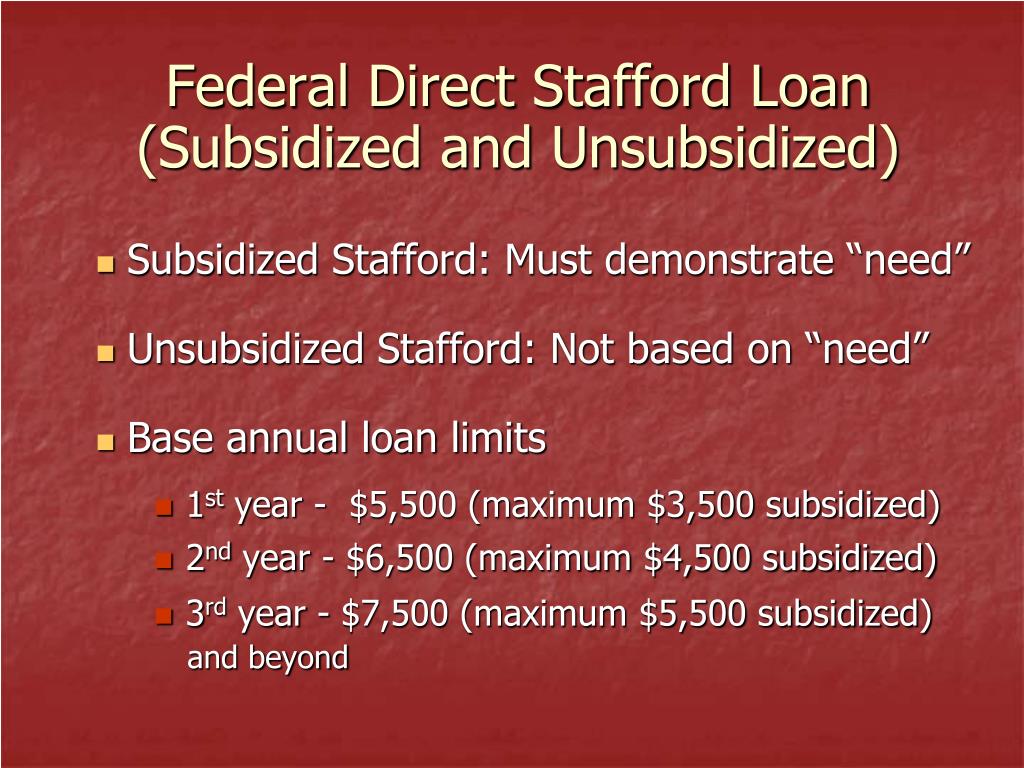
| Maximum Annual Limit | $3,500–$5,500 (depending on year) | $2,000–$20,500 (depending on year/status) |
Steps to Successfully Apply for and Secure the Loan
Simply meeting the requirements is not enough; you must complete the administrative steps required by the Department of Education to "activate" the loan.
1. Complete the FAFSA
Submit the FAFSA at StudentAid.gov. For the 2026-2027 cycle, ensure you use your 2024 tax information, as the FAFSA uses "prior-prior" year tax data.
2. Review Your Student Aid Report (SAR)
After filing, you will receive a SAR or an SAI summary. Review this carefully for any "flags" or requests for verification. If your application is selected for verification, you must provide additional documentation (like tax transcripts) to your school's financial aid office to prove your data is accurate.
3. Accept the Award
Once your school processes your FAFSA, they will send an Award Letter. This letter details the types of aid you are eligible for. You are not required to take the full amount offered; you can choose to accept only what you need.
4. Complete Entrance Counseling
First-time borrowers must complete a mandatory online counseling session. This ensures you understand your obligation to repay the loan and the consequences of default. It covers interest rates, repayment plans, and deferment options.
5. Sign the Master Promissory Note (MPN)
The MPN is a legal document in which you promise to repay your loan and any accrued interest and fees. It is a binding contract that remains valid for up to 10 years at the same institution.
Common Mistakes and Eligibility Pitfalls
Many students fail to meet or maintain their requirements due to administrative oversights or a lack of understanding of the "half-time" rule.
- Missing Deadlines: Federal, state, and institutional deadlines for the FAFSA often differ. Missing the earliest deadline can result in losing out on subsidized funds that are distributed on a first-come, first-served basis.
- Reporting Inaccurate Household Size: Following the FAFSA Simplification Act, household size is often pulled directly from tax returns. If your family situation has changed (e.g., a sibling left the house or a divorce occurred), you may need to file an appeal for a Professional Judgment with your financial aid office.
- Dropping Below Half-Time: Students who withdraw from classes mid-semester may inadvertently trigger a "Return to Title IV" calculation. This can result in the student owing money back to the school immediately and losing loan eligibility for the remainder of the year.
- Ignoring Aggregated Limits: There is a "ceiling" on how much you can borrow in Stafford Loans over your lifetime. For dependent undergraduates, the limit is $31,000. If you reach this limit, you cannot borrow more Stafford Loans, even if you still have years of schooling left.
Frequently Asked Questions
Can I get a Stafford Loan if I have a criminal record?
As of recent legislative changes, having a drug-related conviction while receiving federal student aid no longer automatically disqualifies you from receiving a Stafford Loan. However, certain types of incarceration or specific sexual offense convictions may still limit eligibility for Pell Grants, though loan eligibility is generally more accessible.
Does my parents' income disqualify me if they aren't paying for my school?
Unless you meet the specific criteria to be considered an independent student (such as being over 24, married, a veteran, or having legal dependents), you must provide parental information on the FAFSA. High parental income may disqualify you from Subsidized loans, but it does not prevent you from receiving Unsubsidized Stafford Loans.
Is there an age limit for Stafford Loans?
No, there is no upper age limit for federal student loans. As long as you meet the enrollment, citizenship, and academic progress requirements, you can be a borrower at any age.
Do I need a co-signer for a Stafford Loan?
No. One of the primary benefits of the Stafford Loan program is that it does not require a co-signer, regardless of the student's income or credit history. This is a significant difference from private student loans.
What happens if I move to a different school?
Eligibility does not automatically "transfer." You must add your new school's code to your FAFSA. The new school will then calculate its own financial aid package based on its cost of attendance and your remaining eligibility.
Practical Recommendation
The most critical step in meeting Stafford Loan requirements is completing the FAFSA as early as possible after the application opens. Even if you do not believe you qualify for "need-based" aid, the Unsubsidized Stafford Loan remains one of the most protected and low-cost ways to finance an education. After filing, monitor your student email daily for verification requests from your financial aid office; delays in providing documentation are the leading cause of late loan disbursements.
Image Gallery