Female Famous Book Characters: Icons of Literature and Their Enduring Legacy
Female famous book characters serve as the architectural pillars of literary history, transcending their original pages to influence modern culture, social movements, and psychological archetypes. From the intellectual defiance of Eliz...
Female famous book characters serve as the architectural pillars of literary history, transcending their original pages to influence modern culture, social movements, and psychological archetypes. From the intellectual defiance of Elizabeth Bennet to the survivalist grit of Katniss Everdeen, these figures provide essential frameworks for understanding agency, identity, and resilience in storytelling.
Contents
The Evolution of Female Protagonists in Literature
The trajectory of female famous book characters reflects the shifting landscape of women’s roles in society. In the 18th and 19th centuries, female protagonists were often defined by their relationship to domesticity, marriage, and social standing. However, writers like Jane Austen and Charlotte Brontë began to imbue their characters with internal lives that challenged the status quo.
By the mid-20th century, the focus shifted toward existential struggles and political agency. Characters like Offred in Margaret Atwood’s The Handmaid’s Tale or Clarice Starling in Thomas Harris’s The Silence of the Lambs moved beyond the "marriage plot" to confront systemic oppression and professional ceilings. In 2026, we view these characters not merely as relics of their time but as foundational blueprints for the complex, multifaceted women who lead modern bestsellers.
The transition from "characters who happen to be women" to "characters whose womanhood informs their unique power" is a crucial distinction. This evolution allowed for the rise of the "unreliable narrator" and the "morally grey heroine," expanding the emotional range permitted for female figures in fiction.
Iconic Classic Heroines: The Foundation of Modern Archetypes
To understand the current literary landscape, one must analyze the classic figures who broke the mold during eras of significant restriction. These characters are famous because they possessed a "modern" sensibility long before the social structures existed to support them.
Elizabeth Bennet (Pride and Prejudice)
Elizabeth Bennet remains perhaps the most recognizable female character in the English language. Her fame stems from her refusal to view marriage as a purely economic transaction. In a society where women had limited legal rights, her wit and "fine eyes" were tools of autonomy. She represents the Intellectual Equal, a character who demands respect based on mental merit rather than social pedigree.
Jane Eyre (Jane Eyre)
Jane Eyre introduced the world to the "plain" heroine whose inner fire and moral backbone were her defining features. Unlike the idealized beauties of contemporary Victorian novels, Jane was a figure of intense self-respect. Her famous declaration, "I am no bird; and no net ensnares me: I am a free human being with an independent will," remains a rallying cry for individual sovereignty.
Jo March (Little Women)
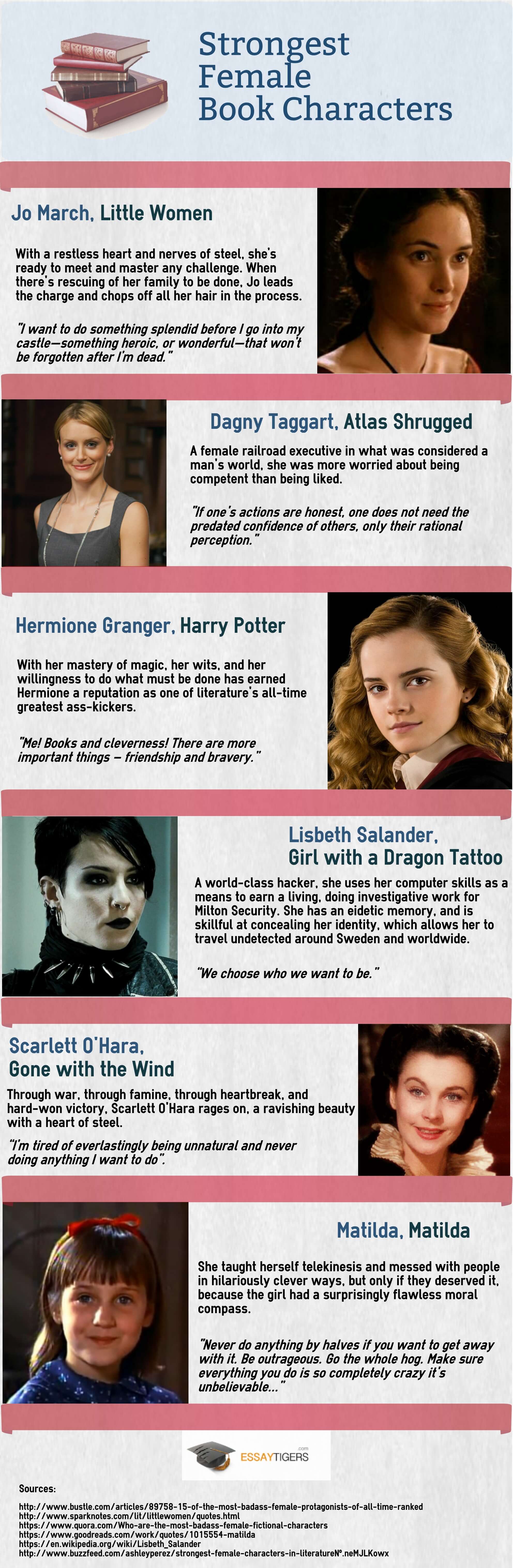
Jo March provided a template for the female artist. By choosing her career and her creative integrity over conventional expectations, she became a foundational influence for generations of women writers. Her struggles with temper, ambition, and grief make her one of the most human and relatable figures in the 19th-century canon.
Modern Icons: Agency and Global Impact
As the 20th century closed and the 21st began, famous female book characters took on roles that were traditionally reserved for men: the warrior, the detective, and the savior. These characters did not just exist within their worlds; they actively reshaped them.
Hermione Granger (Harry Potter)
Hermione Granger fundamentally changed the "sidekick" dynamic in fantasy literature. Her fame is rooted in her unapologetic intelligence. For many readers, Hermione was the first major female character in popular fiction who proved that being the "smartest person in the room" was a heroic trait, not a social liability. Her character arc emphasizes that knowledge is a primary weapon against tyranny.
Katniss Everdeen (The Hunger Games)
Katniss Everdeen redefined the "strong female lead" for the Young Adult (YA) genre. Her character is notable for her lack of traditional "feminine" performativity; she is stoic, pragmatic, and focused on survival. Her impact on 2020s culture is visible in the way modern protagonists are allowed to be angry and unlikable while still being the hero of the story.
Lisbeth Salander (The Girl with the Dragon Tattoo)
Lisbeth Salander represents the Subversive Survivor. As a character who has endured systemic abuse, she does not seek the protection of institutions; she dismantles them using her skills as a world-class hacker. Salander brought a darker, more visceral complexity to female fame in literature, moving the needle on how trauma and justice are portrayed.
Comparative Analysis of Influential Female Characters
The following table summarizes the core attributes and cultural legacies of several prominent female characters, illustrating how their roles have diversified over time.
| Character | Original Work | Primary Archetype | Key Cultural Legacy |
|---|---|---|---|
| Elizabeth Bennet | Pride and Prejudice (1813) | The Wit | Established the "equal partner" romantic dynamic. |
| Jane Eyre | Jane Eyre (1847) | The Individualist | Popularized the internal monologue as a tool of resistance. |
| Jo March | Little Women (1868) | The Creative Rebel | Encouraged generations of women to pursue professional writing. |
| Offred | The Handmaid's Tale (1985) | The Witness | Became a global symbol for reproductive autonomy. |
| Hermione Granger | Harry Potter (1997) | The Intellectual | Normalizes academic excellence as a heroic virtue. |
| Katniss Everdeen | The Hunger Games (2008) | The Revolutionary | Defined the survivalist protagonist in modern YA fiction. |
| Circe | Circe (2018) | The Reimagined Myth | Sparked a trend of retelling classical myths from female perspectives. |
The Psychology of the "Strong Female Character"
In recent years, the term "strong female character" has undergone rigorous scrutiny. Critics and writers now argue that "strength" should not be measured by physical prowess or a lack of emotion, but by narrative agency. A famous female character is successful not because she can fight, but because she makes choices that drive the plot.
Characters like Amy Dunne in Gone Girl or Cersei Lannister in the A Song of Ice and Fire series are famous not for their virtue, but for their complexity. They are allowed to be villains, to be flawed, and to be driven by selfish desires. This expansion into the "morally grey" area is a sign of literary maturity; it acknowledges that women in fiction deserve the same range of humanity as their male counterparts.
Intersectionality and the Future of Literary Icons
As we look toward the literary landscape of 2026 and beyond, the definition of "famous" is increasingly tied to diverse experiences. Characters who represent a broader spectrum of race, sexuality, and disability are moving from the periphery to the center of the global conversation.
- Starr Carter from The Hate U Give became a modern icon by addressing racial injustice and the power of finding one's voice.
- Celie from The Color Purple continues to be a vital study in resilience and the healing power of community and self-love.
- Emoni Santiago from With the Fire on High represents the burgeoning "everyday heroine" who balances motherhood, ambition, and talent.
These characters are essential because they provide "mirrors and windows"—allowing readers to see themselves reflected or to peer into lives different from their own. The most enduring female characters are those who challenge the reader’s preconceptions about what a woman can or should be.
Frequently Asked Questions
Who is considered the most influential female book character?
While "influence" is subjective, Elizabeth Bennet is often cited as the most influential due to her role in shaping the modern novel and the romantic comedy genre. Her emphasis on mental compatibility and mutual respect between partners changed the trajectory of Western literature's portrayal of relationships.
Why are female book characters important for modern readers?
Female book characters provide a medium through which readers explore complex social issues like gender equality, autonomy, and systemic power. They serve as psychological role models, demonstrating various ways to navigate adversity, from the quiet resilience of characters in Project Gutenberg classics to the overt rebellion in modern dystopian novels.
What makes a female character "iconic" rather than just popular?
An iconic character leaves a lasting imprint on the cultural lexicon. This often involves a character becoming a symbol for a specific movement or trait. For example, Offred from The Handmaid’s Tale became a visual symbol for women’s rights protests worldwide, transcending the book's narrative to become a political shorthand.
How has the portrayal of "strength" in female characters changed over the last century?
Historically, "strength" was often portrayed as moral endurance or domestic sacrifice. In the mid-20th century, it shifted toward professional and intellectual defiance. Today, in 2026, strength is often characterized by vulnerability and complexity—the ability of a character to be flawed, make mistakes, and still maintain narrative agency.
Are there many famous female villains in literature?
Yes, and they are increasingly popular. Characters like Lady Macbeth, Cathy Ames (East of Eden), and Nurse Ratched (One Flew Over the Cuckoo's Nest) are famous for their profound impact on their respective worlds. Modern readers are particularly drawn to "morally grey" female characters who challenge the traditional dichotomy of "heroine vs. villainess."
Recommendation for Readers and Writers
If you are looking to explore the depth of female famous book characters, it is recommended to read them in pairs—one classic and one modern—to see how themes of autonomy and identity have evolved. Start with Charlotte Brontë’s Jane Eyre followed by Jean Rhys’s Wide Sargasso Sea to see how a singular female figure can be reinterpreted across different eras and perspectives. For writers, the key to creating a lasting female icon lies in providing your character with internal conflict and clear agency; she should be the driver of her own story, not a passenger to the plot.
Image Gallery