How Many People Have Only Group Life Insurance? Statistics and Risks
According to industry data from the Life Insurance Marketing and Research Association (LIMRA), approximately 47% of insured Americans—representing roughly 50 to 60 million adults—rely exclusively on group life insurance provided by the...
According to industry data from the Life Insurance Marketing and Research Association (LIMRA), approximately 47% of insured Americans—representing roughly 50 to 60 million adults—rely exclusively on group life insurance provided by their employers. This means nearly half of all insured individuals have no individual life insurance policy to cover their families if they change jobs, retire, or face unexpected layoffs.
Contents
Breakdown of Group Life Insurance Ownership Statistics
Understanding how life insurance is distributed across the workforce requires examining both overall coverage rates and the distinction between individual and employer-sponsored plans.
Life insurance ownership in the United States has fluctuated over recent years. While overall coverage hovers around 52% of the adult population, the composition of that coverage reveals a heavy dependence on workplace benefits.
- U.S. Adult Population
- Insured (~52%)
- Rely SOLELY on Group Life (~47% of insured adults)
- Have Individual Policy (Alone or Combined)
- Have BOTH Group & Individual Policies
- Uninsured (~48%)
- Insured (~52%)
Key Statistical Highlights
- Sole Reliance on Employer Plans: Roughly 47% of insured adults (representing about 20% to 24% of the total U.S. adult population) hold zero individual life insurance, depending entirely on group plans.
- Overall Group Coverage Participation: According to the U.S. Bureau of Labor Statistics, over 70% of civilian workers in the United States have access to employer-sponsored life insurance, and the vast majority of eligible employees participate when the basic benefit is fully employer-funded.
- Average Benefit Amounts: Most basic group life policies offer a flat payout (such as $50,000) or a multiple of the employee’s annual salary (typically 1x or 2x salary).
- The Coverage Gap: Financial planners generally recommend maintaining 7 to 10 times annual earnings in life insurance coverage. A basic group plan offering 1x salary leaves a substantial coverage deficit for households with mortgages, children, or long-term debts.
Demographics Most Dependent on Group Coverage
Workplace life insurance serves as an entry point for financial protection, but dependency varies significantly by income and employment structure:
- Middle-Income Workers: Families earning between $50,000 and $100,000 annually report the highest rates of sole reliance on group policies, often assuming workplace coverage is sufficient.
- Younger Professionals: Employees in their 20s and early 30s frequently defer purchasing individual term life policies, relying on automated workplace enrollment during onboarding.
- Single-Earner Families: In households where one partner works for an employer offering robust fringe benefits, families often treat the group policy as their entire safety net, leaving the non-working spouse unprotected.
Group vs. Individual Life Insurance: Key Differences
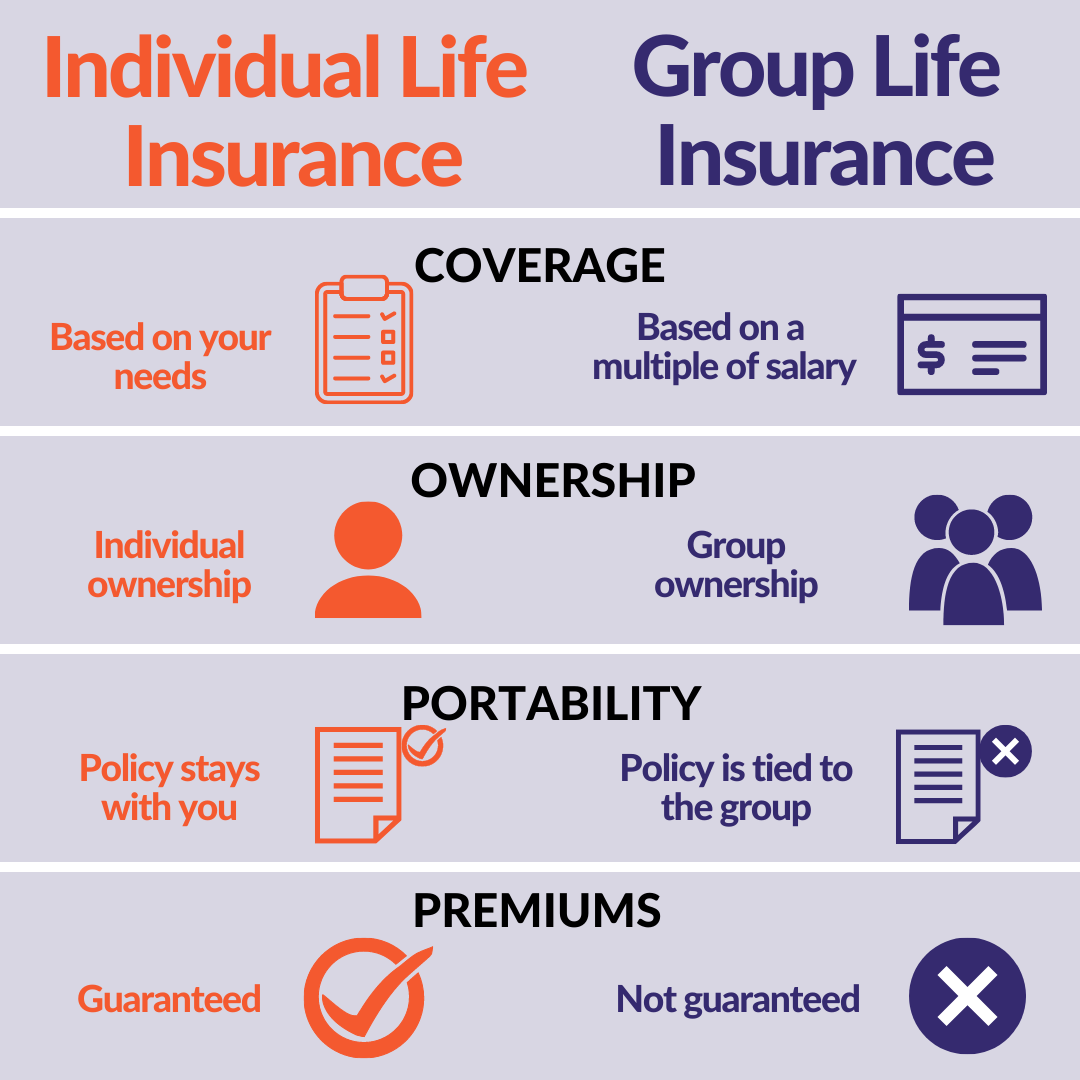
To understand why relying solely on employer-provided protection can create financial vulnerability, it is helpful to compare group policies against private, individual policies.
| Feature | Group Life Insurance (Workplace) | Individual Life Insurance (Private) |
|---|---|---|
| Primary Coverage Limit | Typically capped at 1x–2x salary (or flat $50k) | Customizable (e.g., $250k to $2M+) |
| Portability | Usually terminates upon job change or layoff | Remains active regardless of employment status |
| Medical Underwriting | Guaranteed issue (no medical exam for basic coverage) | Full medical underwriting (exam or simplified issue) |
| Cost Structure | Often free or low-cost for basic tier; tiered age bands for supplemental | Fixed, locked-in monthly premium for term length |
| Policy Control | Employer selects carrier, provisions, and options | Policyholder owns contract and selects riders |
| Retirement Availability | Generally ends at retirement or requires costly conversion | Continues through policy term or lifetime |
The Financial Risks of Relying Solely on Group Life Coverage
While group life insurance is a valuable benefit—especially because basic tiers are frequently subsidized or paid in full by employers—relying on it as your single source of protection exposes your family to several financial vulnerabilities.
- Career Event: Loss of Employment / Retirement
- Group Policy Terminates or Escalates in Cost
- Healthy Employee: Can apply for individual policy, but premium is higher due to age
- Unhealthy Employee: Uninsurable or faces sky-high rates due to pre-existing conditions
1. Lack of Portability During Job Transitions
Group life policies are tied directly to your employment. If you resign, face a layoff, or transition to freelance or consulting work, your coverage typically terminates on your last day of employment or at the end of that calendar month.
While some policies offer a portability provision or conversion option, converting a group policy into an individual policy often comes with sharp premium increases. If you experience unexpected job loss during an economic downturn, losing your life insurance concurrently puts your beneficiaries at risk at the worst possible moment.
2. Inadequate Death Benefit Cap
For a worker earning $75,000 annually, a 1x salary group policy provides a $75,000 benefit. If that worker has a 30-year mortgage of $300,000, credit card debt, and two children preparing for college, $75,000 covers only immediate funeral costs and a few months of replaced income.
Financial advisors stress that group coverage acts as a baseline, not a complete safety net. Relying solely on a workplace policy often leaves a family hundreds of thousands of dollars short of true financial security.
3. Health Changes and Insurability Risks
If you rely on workplace insurance throughout your 30s and 40s and develop a chronic health condition—such as diabetes, heart disease, or cancer—you may find it difficult or prohibitively expensive to qualify for an individual policy later in life.
If you subsequently lose or leave your job, your pre-existing health condition can render you uninsurable on the private market. Purchasing an individual policy while you are young and healthy locks in low rates regardless of future health developments.
4. Rate Hikes on Supplemental Group Coverage
Employers often allow workers to buy supplemental coverage beyond the basic employer-paid amount (e.g., purchasing up to 5x salary). However, supplemental group rates are usually structured in 5-year age bands (e.g., ages 30–34, 35–39, 40–44).
As you move into older age brackets, workplace supplemental rates increase automatically. In contrast, an individual level-term policy guarantees the exact same monthly premium for 10, 20, or 30 years.
Calculating Your Actual Life Insurance Needs
Determining whether your group plan is sufficient requires calculating your total financial obligations versus your available assets. A widely accepted framework used by financial planners is the DIME Formula.
DIME Formula = Debt + Income Replacement + Mortgage + Education
Breakdown of the DIME Formula
- Debt: Sum all short-term and long-term debts excluding your primary mortgage. This includes student loans, auto loans, personal loans, and credit card balances.
- Income Replacement: Multiply your current annual salary by the number of years your family would need income support until dependents are self-sufficient (typically 7 to 10 years).
- Mortgage: Calculate the exact principal payoff amount required to clear your home mortgage balance.
- Education: Estimate future tuition and living expenses for your children (e.g., $100,000 to $150,000 per child for higher education).
Example Calculation
- Current Group Coverage (1x Salary): $80,000
- Debts (Auto + Personal): $25,000
- Income Replacement (10 Years at $80k): $800,000
- Mortgage Payoff: $275,000
- Education (2 Children): $200,000
- Total Need: $1,300,000
- Net Protection Deficit: $1,220,000 short
In this typical scenario, relying solely on the $80,000 employer-provided policy covers less than 7% of the family's total long-term financial obligation.
How to Supplement Workplace Coverage with Individual Life Insurance
If you determine that your current coverage relies too heavily on your employer, you can build a layered insurance strategy to protect your household long-term.
- Total Needed Protection: e.g., $1,000,000
- Employer Group Policy (Baseline: $100k-$200k): Free/Low-Cost Baseline
- Private Individual Term Policy (Locked-In Core: $800k+): Portable, Guaranteed Rate for 20-30 Yrs
Step 1: Review Your Annual Benefits Summary
Examine your open enrollment materials to identify:
- The exact dollar value of your basic employer-paid coverage.
- Whether the coverage is taxable (group term life over $50,000 has imputed income implications under IRS Code Section 79).
- The portability and conversion clauses attached to the policy.
Step 2: Determine Your Core Protection Gap
Subtract your basic workplace coverage and liquid savings from your DIME formula total. The remaining figure is the amount of coverage you should secure through a private, individual policy.
Step 3: Secure an Individual Term Policy First
Before making any changes to optional workplace supplemental coverage, apply for an individual term life policy (such as a 20-year or 30-year term contract). Complete the medical underwriting process to ensure approval and secure a locked-in rate.
Step 4: Optimize Workplace Benefits
Once your private policy is active:
- Retain the free or fully subsidized basic workplace insurance offered by your employer.
- Evaluate whether supplemental group coverage is cost-effective compared to your private policy rates.
- Reallocate any savings toward retirement contributions, emergency reserves, or debt reduction.
Common Misconceptions About Workplace Life Insurance
Misconception 1: "Workplace life insurance automatically follows me when I leave."
Fact: Basic group life insurance policies almost always end upon termination of employment. While some policies allow you to convert your coverage to a private policy within 30 days of leaving, converted policies are usually whole life products with significantly higher premiums than standard individual term policies.
Misconception 2: "1x to 2x my salary is plenty for my family."
Fact: A policy paying 1x annual salary only replaces income for 12 months. It does not account for long-term debts, mortgage balances, childcare, funeral costs, or future education expenses.
Misconception 3: "Supplemental group coverage is always cheaper than private policies."
Fact: While basic group coverage is often free, supplemental group life rates increase every five years based on age brackets. For healthy non-smokers, an individual 20-year or 30-year term policy is frequently cheaper over the life of the policy than voluntary workplace supplemental coverage.
Frequently Asked Questions
What percentage of people rely only on group life insurance?
Industry research shows that approximately 47% of Americans with life insurance have coverage strictly through an employer-sponsored group plan. Overall, about 20% to 24% of all U.S. adults depend solely on workplace life insurance.
Is group life insurance sufficient for a single person with no dependents?
For a single person without children, a mortgage, or co-signed debts, a basic workplace life insurance policy (such as $50,000) may be sufficient to cover end-of-life expenses and final medical bills. However, securing a small individual policy while young and healthy locks in low rates for future needs.
What happens to my group life insurance if I get laid off?
When you are laid off, your group life insurance typically expires at the end of your employment term or month. You generally have a 30-day window to exercise a conversion option, allowing you to turn the group benefit into an individual policy without a medical exam, though premiums will reflect your current age and the policy type.
Can I hold both group life insurance and individual life insurance at the same time?
Yes. Holding both types of policies is a common strategy known as "stacking" coverage. You utilize the free or low-cost group coverage provided by your employer as a baseline while relying on your private individual policy as your primary, portable financial safety net.
Does group life insurance require a physical medical exam?
Basic group life insurance usually features guaranteed issue, meaning no medical exams or health questionnaires are required up to specified benefit thresholds (e.g., $50,000 or 1x salary). However, purchasing high amounts of voluntary supplemental group coverage may require answering simplified medical questions or providing evidence of insurability.
Actionable Next Steps for Policyholders
Relying solely on group life insurance leaves millions of families vulnerable to sudden job losses, health changes, and long-term financial shortfalls. To ensure your household remains protected:
- Audit your current workplace benefit: Log into your HR portal to check your exact coverage limit, tax status, and conversion provisions.
- Calculate your true coverage needs: Use the DIME formula to compute your household's actual financial gap beyond your basic employer benefit.
- Get quotes for a private term policy: Compare 20-year and 30-year term life insurance rates from independent providers to lock in portable, fixed-rate coverage while you are healthy.
Disclaimer: This article provides general educational information regarding life insurance and financial planning. Insurance products, regulations, and tax implications vary by jurisdiction and individual circumstances. Consult a licensed insurance professional or certified financial planner for personalized advice.
Image Gallery