How to Expense Home Office Costs: A Comprehensive Guide to Tax Deductions in 2026
To expense home office costs, you must use a specific area of your home exclusively and regularly for business. As of 2026, you can calculate the deduction using the Simplified Method ($5 per square foot up to 300 feet) or the Actual E...
To expense home office costs, you must use a specific area of your home exclusively and regularly for business. As of 2026, you can calculate the deduction using the Simplified Method ($5 per square foot up to 300 feet) or the Actual Expense Method, which pro-rates costs like rent, utilities, and insurance.
Contents
The landscape of remote work has shifted significantly over the last decade, but the fundamental tax principles governing the home office deduction remain rooted in strict IRS criteria. Whether you are a freelancer, a small business owner, or an independent contractor, understanding how to properly categorize and document these expenses is vital for maximizing your tax return while minimizing audit risks. In 2026, with the sunsetting of various provisions from the Tax Cuts and Jobs Act (TCJA), the eligibility and calculation methods require precise attention to detail to ensure compliance and financial efficiency.
Fundamental Eligibility: The "Exclusive and Regular Use" Rule
Before calculating any numbers, you must determine if your workspace qualifies. The IRS maintains two primary tests for the home office deduction: the Exclusive Use test and the Regular Use test.
Exclusive Use Requirements
The exclusive use rule dictates that a specific portion of your home must be used only for your trade or business. If you work from your dining room table, and that table is also used for family meals, that space does not qualify. However, the space does not necessarily need to be a separate room partitioned by walls; it can be a clearly defined area. The critical factor is that no personal activity occurs within those specific square feet.
Exceptions to the exclusive use rule are narrow but important. They generally apply to:
- Storage of Inventory: If you sell products at retail or wholesale and use a portion of your home to store inventory or product samples, you can deduct that space even if the use isn't exclusive, provided your home is the sole fixed location of your business.
- Daycare Facilities: If you provide licensed daycare services for children, the elderly, or persons with disabilities, you may qualify for a deduction even if the space is used for personal life after hours.
Regular Use Requirements
Regular use means you use the space for business on a continuing basis. Occasional or incidental business use does not meet the threshold. For most professionals in 2026, this means the home office is the principal place of business, where you conduct administrative tasks, meet clients (in person), or perform the core functions of your job. If you have another office elsewhere but choose to work from home for convenience, you must prove that the home office is where you spend most of your time or conduct your most important management activities.
Comparison of Deduction Methods
In 2026, taxpayers continue to choose between two primary methods for calculating the home office deduction. Selecting the right one depends on the size of your office and the total volume of your home-related expenses.
| Feature | Simplified Method | Actual Expense Method |
|---|---|---|
| Calculation | $5 per sq. ft. (up to 300 sq. ft.) | Percentage of actual home expenses |
| Maximum Deduction | $1,500 | Unlimited (based on actual costs) |
| Depreciation | Not allowed | Required (and subject to recapture) |
| Record Keeping | Minimal (proof of square footage) | Extensive (all receipts and bills) |
| Best For | Small offices, renters, low utility costs | Large offices, high mortgage/rent, high utilities |
| Form Used | Schedule C (Line 30) | Form 8829 |
The Simplified Method
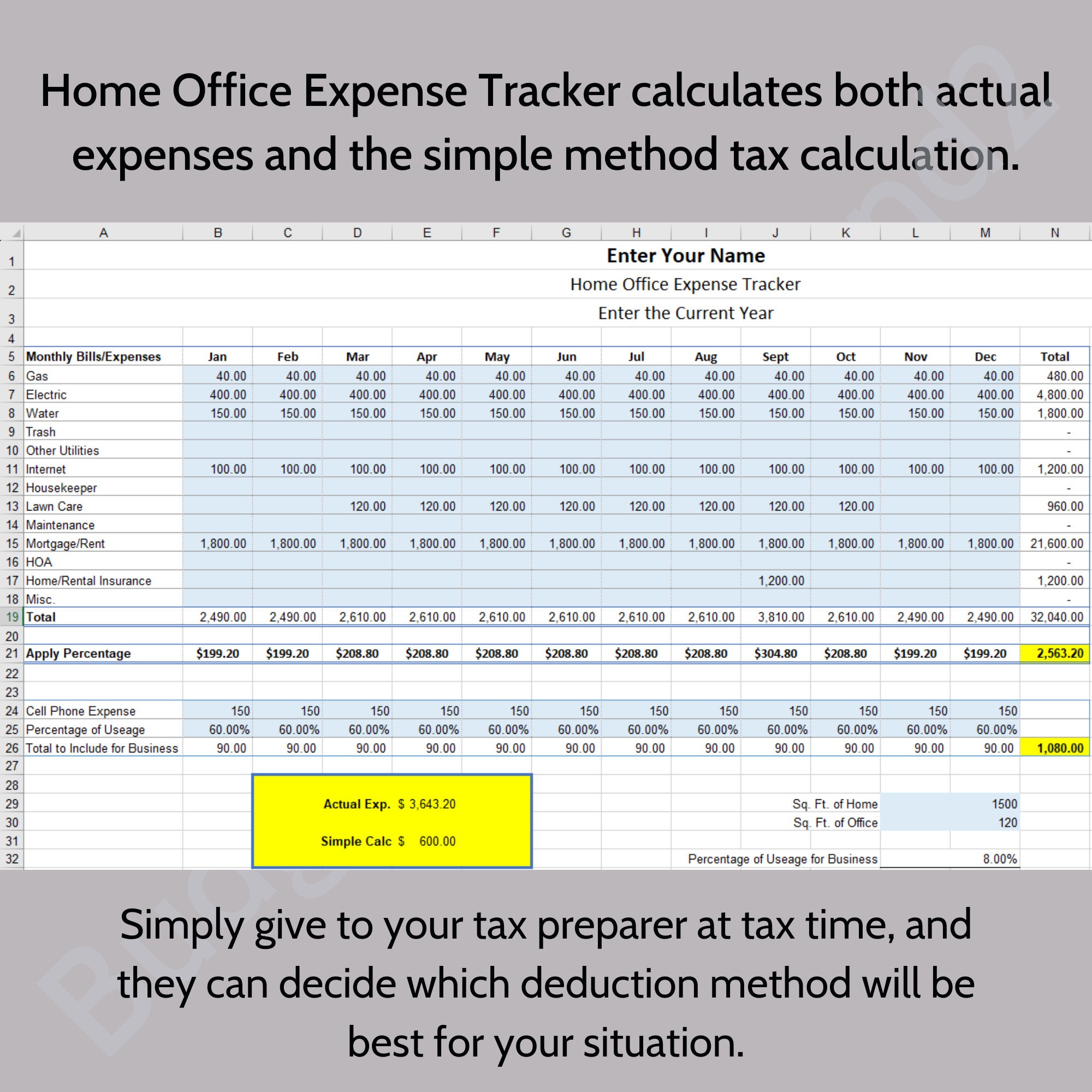
The simplified option was designed to reduce the "shoebox of receipts" burden. You simply multiply the allowable square footage of your office by the prescribed rate (currently $5). For a 200-square-foot office, your deduction is a flat $1,000. While this is easier, it often results in a smaller deduction for those living in high-cost-of-living areas or those with significant home maintenance costs.
The Actual Expense Method
This method is more complex but often more lucrative. It involves determining the business use percentage of your home. To find this, divide the square footage of your office by the total square footage of your home. If your office is 250 square feet and your home is 2,500 square feet, your business use percentage is 10%. You can then deduct 10% of your total qualifying home expenses.
Categorizing Deductible Expenses
When using the Actual Expense Method, you must distinguish between direct and indirect expenses. This distinction determines how much of the cost is actually deductible.
Direct Expenses
Direct expenses are costs incurred solely for the benefit of the home office. For example, if you pay a contractor to paint only the office or install specific lighting in that room, the cost is 100% deductible. These expenses do not need to be pro-rated because they provide no benefit to the personal living areas of the home.
Indirect Expenses
Indirect expenses are costs required to maintain the entire home. These must be pro-rated based on your business use percentage. Common indirect expenses include:
- Real Estate Taxes and Mortgage Interest: While these might be deductible on Schedule A, claiming them as business expenses can be more advantageous for some taxpayers.
- Rent: For those who do not own their home, the business percentage of the monthly rent is fully deductible.
- Utilities: This includes electricity, gas, water, and trash removal. Note that the first telephone line into the home is generally considered a personal expense and is not deductible, though a dedicated business line or a pro-rated portion of a mobile plan may be.
- Homeowners Insurance: Premiums paid for fire, theft, and liability insurance are pro-rated.
- Repairs and Maintenance: A repair to the roof or the furnace benefits the whole house and is therefore an indirect expense. However, "landscaping" or "lawn care" is generally considered a personal expense and is rarely deductible unless you can prove it is necessary for client visits.
The Impact of Depreciation
If you own your home and use the Actual Expense Method, you are required to claim depreciation. This is a non-cash deduction that accounts for the wear and tear on the portion of the home used for business.
Depreciation is calculated based on the lesser of the home’s fair market value or its adjusted basis (cost plus improvements), excluding the value of the land. For residential property, the IRS uses a 39-year recovery period.
Warning on Recapture: One of the most significant drawbacks of the Actual Expense Method is "depreciation recapture." When you eventually sell your home, the IRS requires you to pay taxes on the depreciation you claimed (or could have claimed) at a rate of up to 25%. This "recapture" can result in a surprise tax bill upon the sale of the property. The Simplified Method avoids this issue entirely, as it does not include a depreciation component.
Documentation and Record-Keeping Standards
In 2026, digital record-keeping is the standard, but the requirements for evidence remain stringent. To withstand an audit, you should maintain a digital or physical "Tax Home File" containing the following:
- A Floor Plan: A simple sketch or blueprint showing the total square footage of the home and the specific dimensions of the office space.
- Expense Receipts: Digital copies of all utility bills, rent checks, or mortgage statements.
- Proof of Payment: Bank statements or credit card statements that correspond to the receipts.
- Photos of the Space: Visual evidence that the space is used exclusively for business (e.g., showing a desk, computer, and bookshelves without a bed or television in the frame).
- Usage Logs: While not always required, a log showing the dates and hours the office was used can be helpful for those whose business use is "regular" but perhaps not daily.
Common Pitfalls to Avoid
Many taxpayers lose their home office deductions during audits due to easily avoidable mistakes. One common error is claiming a space that is used for "dual purposes." If your child uses the office computer for homework, or if you exercise in the office, the exclusive use requirement is voided.
Another error is failing to separate Business Equipment from the Home Office Deduction. Computers, printers, office furniture, and specialized software are considered business assets, not home office expenses. These are generally deducted on Schedule C (or via Section 179 expensing) regardless of whether you qualify for the home office deduction. You can deduct the cost of a desk even if it sits in your bedroom, but you cannot deduct the bedroom's rent unless it meets the exclusive use test.
FAQ
Can I claim the home office deduction if I am a remote employee? As of 2026, following the sunset of certain TCJA provisions, some employees may again be eligible for miscellaneous itemized deductions on Schedule A, depending on current federal tax law updates and state-level regulations. However, for the vast majority of workers, the home office deduction remains available only to those who are self-employed or have "unreimbursed partner expenses" in a partnership.
What if I have two different businesses and use the same home office for both? You can still claim the deduction. You would determine the total business use of the room for both businesses. However, you must be careful to allocate the expenses appropriately between the two businesses on your tax return, ensuring the total deduction does not exceed the actual costs or the square footage limits.
Does the home office deduction increase my risk of an audit? While it was once considered a "red flag," the home office deduction is now very common due to the rise of the gig economy and remote work. As long as your deduction is proportionate to your income and you have documentation for the "exclusive use" requirement, the risk is manageable.
Can I deduct my home security system as part of my home office? If the security system protects the entire home, it is considered an indirect expense. You can deduct the business use percentage of the monthly monitoring fees and the depreciation of the system's hardware.
What happens if my business has a net loss this year? You cannot use the home office deduction to create or increase a business loss. If your business expenses (before the home office deduction) exceed your gross income, you may not be able to claim the deduction this year. However, you can often carry over the unused portion of the deduction to the following tax year.
Practical Recommendation
If you are a renter with a small, dedicated workspace, the Simplified Method is often the most efficient choice, as it provides a guaranteed deduction with zero depreciation recapture risk. However, if you own a home in a high-value area and have a large dedicated office, the Actual Expense Method can yield thousands of dollars in additional tax savings. Always consult with a qualified tax professional to perform a side-by-side comparison of both methods before filing your 2026 returns, as the long-term implications of depreciation recapture must be weighed against immediate tax relief.
Image Gallery