Understanding Iowa Minimum Auto Insurance Coverage Requirements in 2026
In 2026, the state of Iowa requires all drivers to maintain minimum liability insurance coverage levels of 20/40/15. This translates to $20,000 for bodily injury per person, $40,000 for total bodily injury per accident, and $15,000 for...
In 2026, the state of Iowa requires all drivers to maintain minimum liability insurance coverage levels of 20/40/15. This translates to $20,000 for bodily injury per person, $40,000 for total bodily injury per accident, and $15,000 for property damage. Drivers must carry proof of financial responsibility at all times while operating a motor vehicle.
Contents
Iowa operates under a traditional "at-fault" or "tort" insurance system. This means that the driver determined to be responsible for causing a motor vehicle accident is legally liable for the resulting damages, including medical expenses, lost wages, and property repairs. While the state mandates specific minimums, these levels represent the floor of legal compliance rather than a recommendation for comprehensive protection. As vehicle repair costs and medical expenses continue to rise in 2026, understanding the nuances of the Iowa Financial Responsibility Law is essential for every motorist.
The Framework of Iowa’s Financial Responsibility Law
Iowa Code Chapter 321A, known as the Motor Vehicle Financial Responsibility Act, dictates how drivers must prove they can pay for damages if they are involved in an accident. Unlike some states that require "no-fault" insurance, Iowa’s system places the burden of proof on the individual to demonstrate they have the means to cover their liabilities.
Most residents satisfy this requirement by purchasing a standard automobile insurance policy from a provider licensed to operate within the state. However, the law technically allows for other forms of financial responsibility, such as posting a bond or depositing cash or securities with the State Treasurer, though these methods are rare for individual consumer use.
The primary purpose of the mandate is to protect the public from the financial ruin that can follow a catastrophic collision. By requiring a minimum level of coverage, the state ensures that victims have at least a baseline of compensation available, regardless of the at-fault driver's personal assets.
Breaking Down the 20/40/15 Requirements
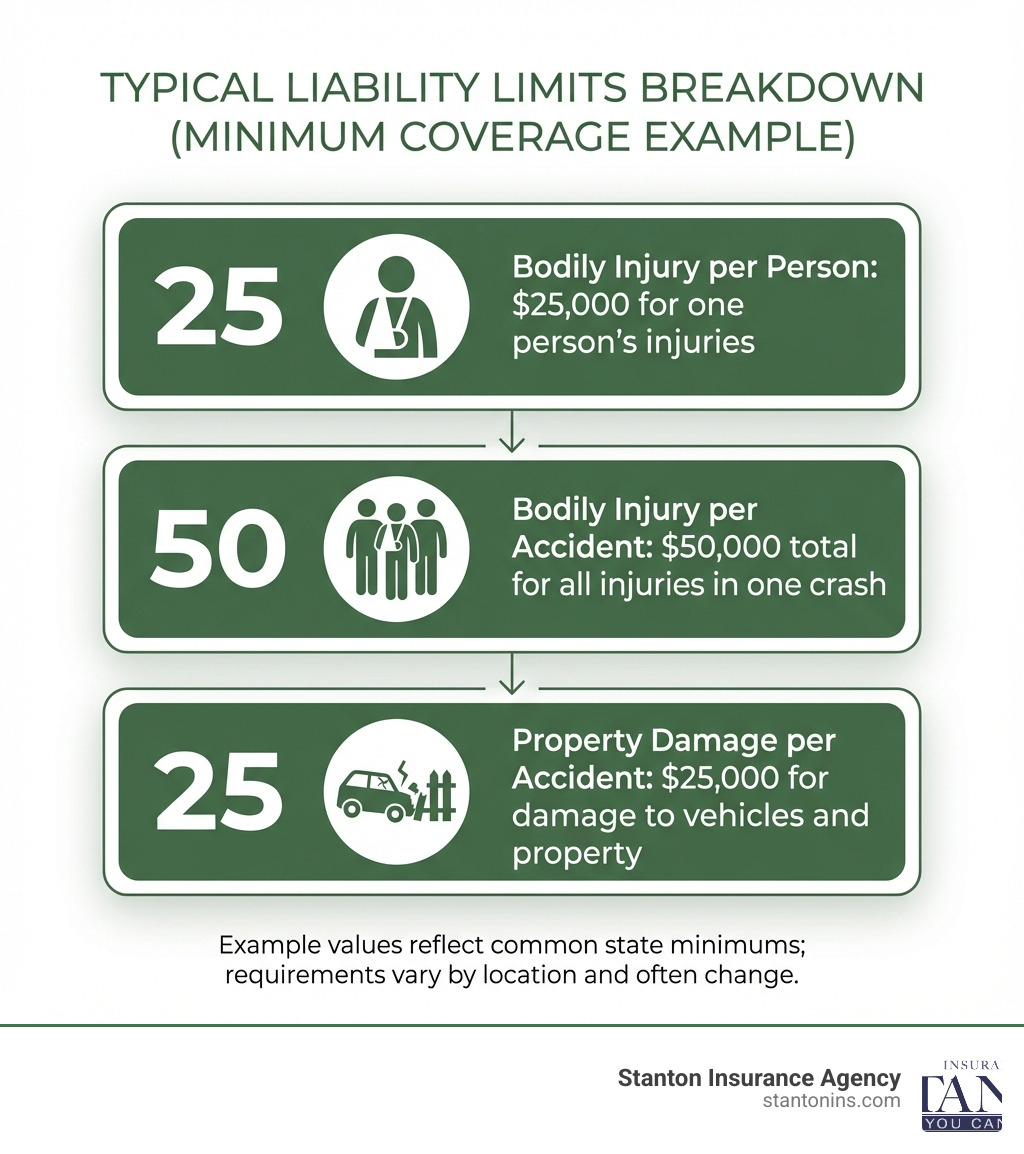
To be legally "road ready" in Iowa, your insurance policy must meet or exceed three specific limit categories. In insurance shorthand, this is frequently referred to as 20/40/15.
$20,000 Bodily Injury Liability (Per Person)
This portion of your policy pays for the medical expenses, rehabilitation, and potentially the pain and suffering of a single person injured in an accident where you are at fault. If you strike a pedestrian or another driver and they require surgery or long-term care, this $20,000 is the maximum your insurance company will pay for that specific individual's claims.
$40,000 Bodily Injury Liability (Per Accident)
This is the aggregate limit for all injuries caused in a single accident. If multiple people are injured in the other vehicle, your policy will pay out a total of $40,000, distributed among the victims. However, the "per person" cap still applies; no single individual can receive more than $20,000 from this pool. In a multi-passenger accident, these limits can be exhausted very quickly, leaving the at-fault driver personally liable for the remaining costs.
$15,000 Property Damage Liability (Per Accident)
Property damage liability covers the repair or replacement of the other party’s vehicle or other property (such as fences, buildings, or utility poles) damaged in the collision. By 2026 standards, $15,000 is considered a very low limit. With the average cost of a new vehicle often exceeding $45,000, a total-loss accident involving even a mid-range sedan could result in damages far exceeding the state minimum.
Iowa Minimum Auto Insurance Coverage Summary
| Coverage Type | Statutory Minimum Limit | What It Covers | Recommended Level for 2026 |
|---|---|---|---|
| Bodily Injury (Individual) | $20,000 | Medical bills/lost wages for one person | $100,000 |
| Bodily Injury (Total) | $40,000 | Total injury costs for all victims | $300,000 |
| Property Damage | $15,000 | Damage to other vehicles/property | $50,000+ |
| Uninsured Motorist (UM) | Must be offered | Your injuries if hit by an uninsured driver | Match BI Limits |
| Underinsured Motorist (UIM) | Must be offered | Your injuries if the other driver's limits are too low | Match BI Limits |
Uninsured and Underinsured Motorist Coverage (UM/UIM)
In Iowa, insurance companies are required by law to offer Uninsured Motorist (UM) and Underinsured Motorist (UIM) coverage with every liability policy. While the state allows drivers to reject this coverage in writing, doing so is generally discouraged by legal and financial experts.
- Uninsured Motorist (UM): This protects you if you are involved in a "hit-and-run" or are hit by a driver who has no insurance at all. Since Iowa has a significant number of drivers operating outside the law, UM coverage ensures that your own insurance company steps into the shoes of the missing at-fault party to pay for your medical bills.
- Underinsured Motorist (UIM): This is arguably more important in a state with low minimums like Iowa. If you are seriously injured by a driver who only carries the 20/40/15 minimum, their $20,000 per person limit may not cover your $100,000 hospital bill. Your UIM coverage would bridge the gap between the other driver’s limit and your actual damages, up to your own policy limits.
The "At-Fault" System and Comparative Fault
Iowa utilizes a "modified comparative fault" rule (specifically the 51% rule). This legal doctrine impacts how insurance claims are paid out. Under this rule, you can recover damages from another driver as long as you are 50% or less at fault for the accident.
If you are found to be 20% responsible for an accident because you were slightly speeding, your total compensation will be reduced by 20%. However, if the investigation determines you were 51% or more responsible, you are barred from recovering any damages from the other party. This makes the accuracy of police reports and insurance investigations critical in Iowa.
Penalties for Non-Compliance in 2026
Driving without the required 20/40/15 coverage in Iowa carries stiff penalties. Law enforcement officers can verify insurance status electronically through the state's verification system during any routine traffic stop.
- Citations and Fines: Drivers caught without insurance typically face a scheduled fine of approximately $250.
- Vehicle Impoundment: If a driver is involved in an accident or stopped for a moving violation and cannot provide proof of insurance, the officer has the authority to have the vehicle towed and impounded.
- Registration Suspension: The Iowa Department of Transportation (DOT) can suspend the registration of the vehicle. To reinstate it, the owner must pay a civil penalty (often around $15) and provide proof of insurance.
- SR-22 Requirement: In cases of serious violations or driving while suspended, the state may require an SR-22 filing. This is a certificate of financial responsibility provided by an insurance company that proves the driver is maintaining the required coverage. If the policy lapses, the insurance company is legally obligated to notify the DOT immediately, leading to an automatic license suspension.
Why Minimum Coverage May Be Insufficient
While the state-mandated limits keep you legal, they often fail to keep you financially secure. In 2026, the cost of medical procedures and automotive technology has outpaced the legislative minimums set years ago.
If you cause an accident that results in a "total loss" of a modern electric vehicle or a luxury SUV, the $15,000 property damage limit will likely only cover a fraction of the cost. The owner of the other vehicle (or their insurance company) can sue you personally for the difference. This can lead to wage garnishment, liens on your property, or the seizure of savings.
Similarly, a single night in an intensive care unit can exceed $20,000. If you are at fault for an accident involving serious injuries, the victims' legal representation will look beyond your insurance policy to your personal assets if your limits are too low. For these reasons, many financial advisors recommend a minimum of 100/300/50 coverage for most drivers.
How to Verify and Maintain Your Coverage
To ensure you are meeting the state requirements, follow these steps:
- Review Your Declarations Page: This document from your insurer lists your specific limits. Ensure "Bodily Injury" and "Property Damage" meet the 20/40/15 threshold.
- Carry Digital and Physical Proof: Iowa allows drivers to show proof of insurance on a smartphone, but keeping a paper card in the glove box is a reliable backup if your phone battery dies or you are in an area with poor cellular service.
- Update the DOT: If you receive a notice from the Iowa DOT regarding a lapse in coverage, respond immediately. The system is highly automated in 2026, and delays in reporting can lead to rapid administrative suspensions.
For official updates on insurance regulations, motorists should consult the Iowa Insurance Division or the Iowa Department of Transportation.
Frequently Asked Questions
Does Iowa require Collision or Comprehensive coverage?
No, the state only mandates liability coverage. However, if you have an outstanding loan or a lease on your vehicle, your lender or leasing company will almost certainly require you to carry both collision and comprehensive coverage to protect their financial interest in the asset.
What happens if I am hit by a driver who only has the minimum 20/40/15 coverage?
If your medical bills exceed $20,000, the other driver's insurance will only pay up to that limit. To cover the remaining costs, you would need to rely on your own Underinsured Motorist (UIM) coverage or health insurance, or file a personal injury lawsuit against the at-fault driver.
Does my Iowa insurance cover me if I drive into another state?
Yes. Almost all standard auto policies include an "out-of-state coverage" clause. If the state you are visiting has higher minimum requirements than Iowa, your policy will typically adjust upward automatically to meet that state's legal minimums while you are driving there.
Is "Full Coverage" the same as the state minimum?
No. "Full coverage" is a common term used to describe a policy that includes liability, collision, and comprehensive coverage. State minimum insurance usually only refers to the bare-bones liability requirements needed to drive legally.
How does Iowa's "No Proof of Insurance" law work?
If you have insurance but simply don't have the card with you during a stop, you may be issued a citation. However, if you can provide proof to the court that you were covered at the time of the citation, the charges are typically dismissed, though you may still have to pay administrative court costs.
Professional Recommendation
While the state of Iowa only requires 20/40/15 coverage, this level of insurance is significantly lower than the national average and poses a substantial financial risk. To properly protect your assets in 2026, you should consider increasing your liability limits to at least $100,000 per person and $300,000 per accident. Additionally, ensure you do not waive the Uninsured/Underinsured Motorist options, as these provide critical protection against the rising number of under-insured drivers on the road.
Image Gallery