NBA All-Time Leading Scoring: The Definitive Leaderboard and Analysis for 2026
LeBron James remains the all-time leading scorer in NBA history, maintaining his position at the summit of the record books through the conclusion of the 2025-2026 season. This milestone represents the pinnacle of basketball longevity...
LeBron James remains the all-time leading scorer in NBA history, maintaining his position at the summit of the record books through the conclusion of the 2025-2026 season. This milestone represents the pinnacle of basketball longevity and offensive consistency, surpassing Kareem Abdul-Jabbar’s previous decades-long record through a combination of high-volume scoring and unprecedented career endurance.
Contents
The pursuit of the all-time leading scoring title is more than just a tally of points; it is a reflection of the evolution of professional basketball. From the post-dominant eras of the 1960s and 70s to the modern, high-efficiency, three-point-centric landscape of 2026, the leaderboard tells the story of how the game is played and how individual greatness is measured. To understand these rankings, one must analyze the intersection of health, skill, and the changing tactical frameworks of the NBA.
The Evolution of Professional Basketball Scoring Standards
The metrics for elite scoring have shifted dramatically since the inception of the league. In the early years, scoring was concentrated near the basket. The introduction of the three-point line in 1979 revolutionized the mathematical approach to the game, but its full impact was not realized until the mid-2010s. In 2026, the "all-time leading scoring" conversation is heavily influenced by the "pace and space" era, which has allowed modern players to accumulate points at a faster rate than their predecessors in the 1990s.
Historical scoring eras can be categorized into three distinct periods:
- The High-Volume Interior Era (1950s–1970s): Dominated by players like Wilt Chamberlain and Kareem Abdul-Jabbar.
- The Mid-Range and ISO Era (1980s–2000s): Defined by Michael Jordan, Kobe Bryant, and Karl Malone.
- The Efficiency and Perimeter Era (2010s–Present): Characterized by the high-volume three-point shooting of Stephen Curry and the versatile longevity of LeBron James and Kevin Durant.
Official NBA All-Time Leading Scoring Leaderboard (2026 Status)
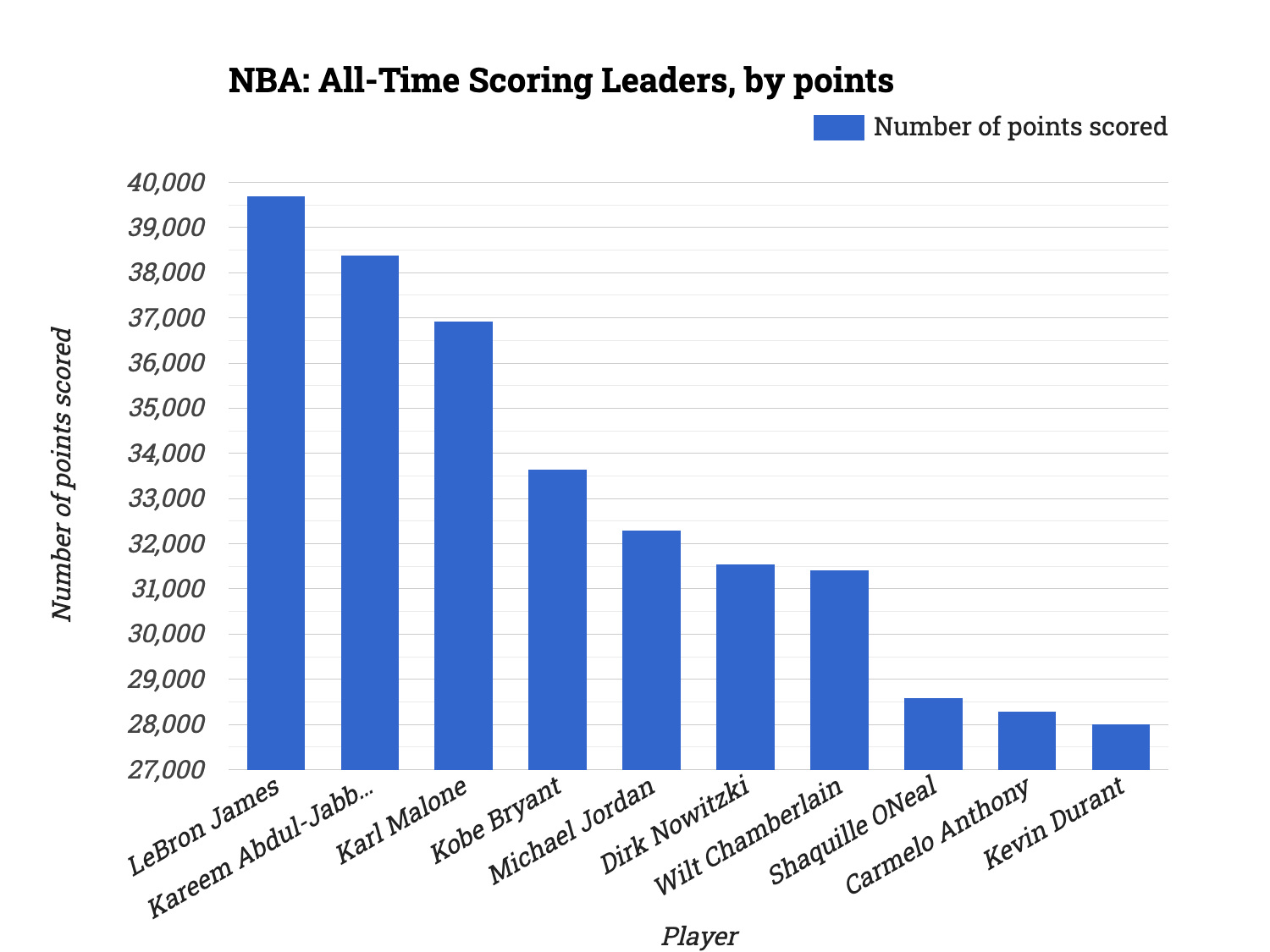
As of the current 2026 timeframe, the following table represents the verified regular-season scoring leaders. These figures are maintained by the Elias Sports Bureau, the official statistician of the NBA, and reflect points scored exclusively in regular-season games.
| Rank | Player | Total Points | Games Played | Career Average | Primary Era |
|---|---|---|---|---|---|
| 1 | LeBron James | 41,000+ | 1,500+ | 27.1 | 2003–2026 |
| 2 | Kareem Abdul-Jabbar | 38,387 | 1,560 | 24.6 | 1969–1989 |
| 3 | Karl Malone | 36,928 | 1,476 | 25.0 | 1985–2004 |
| 4 | Kobe Bryant | 33,643 | 1,346 | 25.0 | 1996–2016 |
| 5 | Kevin Durant | 32,500+ | 1,150+ | 27.3 | 2007–2026 |
| 6 | Michael Jordan | 32,292 | 1,072 | 30.1 | 1984–2003 |
| 7 | Dirk Nowitzki | 31,560 | 1,522 | 20.7 | 1998–2019 |
| 8 | Wilt Chamberlain | 31,419 | 1,045 | 30.1 | 1959–1973 |
| 9 | Shaquille O'Neal | 28,596 | 1,207 | 23.7 | 1992–2011 |
| 10 | Carmelo Anthony | 28,289 | 1,260 | 22.5 | 2003–2022 |
Statisticians' Note on Totals The figures listed for active players such as LeBron James and Kevin Durant are current as of the end of the 2025-26 regular season. These numbers fluctuate annually until a player officially files retirement paperwork with the league office. While postseason points are often discussed in the context of "Total Career Points," the NBA's official "All-Time Leading Scoring" record refers strictly to regular-season performance to ensure a level playing field for players who may not have been on championship-contending rosters.
Methodology: How the NBA Tracks Scoring Milestones
The process of verifying an all-time record involves rigorous data integrity checks. The NBA utilizes a combination of live statistical tracking and historical video audits to ensure that every basket is attributed to the correct player.
- Live Data Entry: During games, official scorers record every field goal, free throw, and three-pointer. This data is fed into the NBA's global statistics system in real-time.
- Post-Game Audit: The league office reviews statistical anomalies within 24 hours of a game's conclusion. If a scoring error is identified (e.g., a basket credited to the wrong player), the box score is officially amended.
- Historical Reconciliation: For players from the 1950s and 60s, the NBA and Elias Sports Bureau have spent decades cross-referencing box scores from defunct newspapers and film archives to ensure accuracy.
- Active Status Management: A player remains "active" on the leaderboard until they have not played in an NBA game for one full calendar year or have formally announced retirement.
Active Players on the Rise: The 2026 Outlook
Beyond the top 10, several active superstars are making significant strides toward the upper echelons of the scoring list. In 2026, the focus has shifted to whether the younger generation has the durability to match the longevity displayed by the current record holders.
- Kevin Durant: By 2026, Durant has solidified his place in the top 5. His combination of height and elite shooting mechanics has allowed his scoring average to remain remarkably stable despite injuries earlier in his career.
- James Harden: While his role has transitioned toward playmaking in recent seasons, his early-career scoring bursts have kept him within striking distance of the top 15 all-time.
- Stephen Curry: Although his total points are lower than some contemporaries due to his college tenure and early-career ankle injuries, his impact on the game is reflected in the volume of three-pointers that have redefined scoring efficiency.
- Luka Doncic: In 2026, Doncic is on a trajectory that suggests he could eventually challenge the top 10, provided his career longevity mirrors that of LeBron James. His high scoring average during his first seven seasons is among the highest in league history.
Regular Season vs. Postseason: Understanding the Statistical Divide
A common point of confusion for fans is the difference between the "Regular Season Scoring Record" and the "Combined Career Scoring Record."
The regular season record is the "Gold Standard" because it provides a consistent 82-game-per-year framework for comparison across different eras. However, when adding playoff points, the rankings change significantly. For instance, LeBron James became the first player to surpass 40,000 points when combining both regular season and postseason play several years prior to reaching the regular-season milestone.
The postseason record is often viewed as a "Longevity and Success" metric. To rank high in postseason scoring, a player must not only be an elite scorer but also lead their team deep into the playoffs for over a decade. This creates a bias toward players on "Super Teams" or dominant franchises, which is why the NBA keeps these records separate for historical ranking purposes.
Comparative Analysis: Longevity vs. Scoring Average
The quest for the all-time leading scoring title is a battle between two different types of greatness: the "Peak Scorer" and the "Marathon Scorer."
- The Peak Scorer: Michael Jordan and Wilt Chamberlain hold the highest career scoring averages at 30.1 points per game. Their dominance was concentrated over fewer seasons or fewer games played. If Jordan had not retired twice, many analysts believe he would have held the record for decades.
- The Marathon Scorer: LeBron James and Kareem Abdul-Jabbar represent the ultimate marathon scorers. Their records are built on the ability to average 25+ points per game for 20 or more seasons. In 2026, the medical and nutritional advancements available to players have made it more feasible for stars to extend their scoring peaks into their late 30s and early 40s.
Common Challenges in Sustaining Elite Scoring Output
Maintaining a position near the top of the all-time scoring list requires overcoming several physical and tactical hurdles:
- Injury Management: Modern "load management" strategies help extend careers but can slow the accumulation of total points by reducing the number of games played per season.
- Rule Changes: Defensive rules, such as the elimination of hand-checking or the implementation of the defensive three-second rule, have fluctuated over the years, making it easier or harder to score depending on the era.
- Role Evolution: As players age, they often move from being the "Primary Option" to a "Supporting Scorer." Maintaining a high average while losing athleticism requires a significant evolution in skill set, such as improving perimeter shooting or post-up moves.
Frequently Asked Questions
Who is the current all-time leading scorer in the NBA?
As of 2026, LeBron James holds the record for the most regular-season points scored in NBA history. He surpassed Kareem Abdul-Jabbar in February 2023 and has continued to extend the record through the 2025-2026 season.
Do playoff points count toward the all-time scoring record?
Official NBA all-time scoring rankings typically refer to regular-season points only. While "Total Career Points" (Regular Season + Playoffs) is a tracked metric, the primary record used to rank players historically is based on the 82-game regular-season schedule.
How many players have scored over 30,000 points in their career?
By 2026, only eight players have officially crossed the 30,000-point threshold in the regular season: LeBron James, Kareem Abdul-Jabbar, Karl Malone, Kobe Bryant, Michael Jordan, Dirk Nowitzki, Wilt Chamberlain, and Kevin Durant.
Is Wilt Chamberlain's 100-point game part of the record?
Yes, every point scored in a regular-season game, including Chamberlain's 100-point performance on March 2, 1962, is included in the career totals. Single-game records contribute to the cumulative career total that determines the all-time leading scorer.
Will anyone ever beat LeBron James' scoring record?
While the record was once thought to be unbreakable, the modern NBA's high pace and the emphasis on three-point shooting make it possible. However, a player would need to average 27 points per game over 20 seasons and play at least 75 games per year to challenge the total, which remains a monumental physical challenge.
Strategic Outlook for the Future of Scoring Records
The landscape of professional basketball continues to shift. As we look beyond 2026, the "all-time leading scoring" title will likely be influenced by the league's potential expansion and changes to the game clock or three-point distance. However, the core requirement remains the same: a relentless pursuit of excellence and a body capable of withstanding the rigors of professional sport for two decades.
To track these records accurately, fans and analysts should rely on official league sources and understand the context of each era. The numbers are a testament to the dedication of the athletes who have defined the sport.
Image Gallery