Understanding How the External IR Blaster Works in 2026
An external IR blaster works by converting digital signals from a control device—such as a smartphone, tablet, or smart home hub—into pulses of infrared light. These light pulses mimic the specific frequency and pattern of a traditiona...
An external IR blaster works by converting digital signals from a control device—such as a smartphone, tablet, or smart home hub—into pulses of infrared light. These light pulses mimic the specific frequency and pattern of a traditional handheld remote control, allowing modern hardware to operate legacy electronic devices like televisions, air conditioners, and audio systems.
Contents
The technology behind the infrared (IR) blaster has remained remarkably resilient despite the rise of Wi-Fi and Bluetooth-connected appliances. As of 2026, many consumers still rely on "legacy" hardware that lacks native internet connectivity. The external IR blaster serves as the essential bridge between the sophisticated, app-driven ecosystem of a modern smart home and the reliable, offline hardware of the past. To understand how these devices function, one must look at the intersection of optical physics, digital signal processing, and software database management.
The Fundamental Components of an External IR Blaster
Every external IR blaster, regardless of its form factor, consists of several core components that work in sequence to translate a user’s touch on a screen into a physical action on a device.
The Logic Controller and Interface
The "brain" of the IR blaster is the logic controller. When you press "Volume Up" on a smartphone app, the phone sends a digital command to the blaster via a physical connection (like USB-C) or a wireless one (like Wi-Fi or Bluetooth). The controller interprets this command and identifies the specific binary sequence associated with that action for a particular brand and model of device.
The Infrared Light Emitting Diode (LED)
The most visible (or technically, invisible) component is the IR LED. Unlike the LEDs used for lighting, these are designed to emit light in the near-infrared spectrum, typically around 940 nanometers. This wavelength is invisible to the human eye but easily detectable by the silicon photodiodes found in electronic appliances.
The Driver Circuit
The driver circuit acts as the power management system. It ensures that the LED receives enough current to pulse at the correct intensity and frequency. Without a precise driver circuit, the signal might be too weak to reach the TV across a large room or might be "noisy," leading the target device to ignore the command.
The Physics of Signal Modulation: How Data Travels on Light
The most critical part of how an external IR blaster works is modulation. If the IR blaster simply turned the light on and off, the target device would likely confuse it with ambient infrared noise from sunlight or household lamps.
The Carrier Frequency
To overcome interference, IR signals are modulated onto a carrier frequency, most commonly 38 kHz. This means the IR LED isn't just "on" for the duration of a pulse; it is actually flickering at 38,000 times per second. The receiver on your TV is specifically tuned to "listen" only for light flickering at this frequency, effectively filtering out all other infrared noise.
Pulse Distance and Pulse Width Modulation
The actual data—the instruction to change the channel or turn off the power—is encoded using specific timing patterns.
- Pulse Distance Coding: The logic controller varies the time between pulses to represent "0" or "1" in binary.
- Pulse Width Coding: The logic controller varies the duration of the pulse itself to represent data.
When the external IR blaster receives a command from your phone, it executes these microsecond-level flickers with extreme precision. The TV’s internal photodetector sees these flickers, strips away the 38 kHz carrier frequency, and sends the remaining binary code to the TV's processor.
Types of External IR Blasters and Their Connectivity
In 2026, external IR blasters generally fall into three categories based on how they interface with the controlling device. Each has a distinct operational flow.
1. USB-C Mobile Plug-ins
These are tiny dongles that plug directly into the charging port of a smartphone. They draw a minuscule amount of power from the phone's battery.
- How they work: The smartphone app communicates directly through the USB-C data pins using a serial protocol. The dongle converts these serial data packets into electrical pulses for the LED.
- Advantage: Extreme portability; it turns any modern phone into a universal remote.
2. Wi-Fi Smart Hubs
These are standalone "pucks" placed in a room, often powered by a wall outlet.
- How they work: You send a command over the internet or local Wi-Fi to the hub. The hub then "blasts" the IR signal in a 360-degree pattern to reach multiple devices in the room.
- Advantage: Integration with voice assistants like Alexa or Google Home and the ability to control devices from anywhere in the world.
3. Bluetooth-to-IR Bridges
Often used for hidden components inside cabinets.
- How they work: A smartphone connects via Bluetooth to the bridge. The bridge then sends the IR signal through a small "emitter" wire taped directly over the TV’s IR receiver.
- Advantage: Does not require a line-of-sight between the user and the TV.
Comparison of External IR Blaster Architectures
| Feature | USB-C Dongle | Wi-Fi Smart Hub | Bluetooth Bridge |
|---|---|---|---|
| Power Source | Smartphone Battery | Wall Outlet (USB) | Battery or Wall Outlet |
| Primary Range | 5–10 Meters | 8–15 Meters | 10 Meters (Bluetooth) |
| Line of Sight | Required from Phone | Required from Hub | Required from Emitter |
| Multi-Device Support | One at a time | Multiple simultaneously | Limited to wired emitters |
| Portability | High | Low | Medium |
| 2026 Standard | USB 4.0 / USB-C | Matter-Compatible | BLE 5.4+ |
The Role of the IR Code Database
Hardware is only half of the equation. For an external IR blaster to work, it must know the "language" of the device it is trying to control. This is managed through an IR Code Database.
Most manufacturers use proprietary codes. For example, a "Power On" command for a Sony TV is different from the same command for a Samsung TV. These codes are usually stored in the cloud. When you select your device brand in the remote app, the software downloads a specific "Key Map."
Learning Mode: The Feedback Loop
High-end external IR blasters include an IR receiver in addition to the transmitter. This allows for "Learning Mode." If a device is not in the database, you can point the original remote at the external blaster and press a button. The blaster "captures" the raw 38 kHz frequency and pulse pattern, saves it, and can thereafter replicate it. This effectively future-proofs the hardware against new or obscure devices.
Technical Prerequisites for Successful Operation
For an external IR blaster to function as intended, several environmental and technical conditions must be met:
- Direct Line of Sight: Infrared light does not pass through walls, sofas, or opaque cabinet doors. The blaster must have a clear "view" of the target device’s receiver.
- Angle of Incidence: While many modern blasters use high-output LEDs with wide-angle lenses, the signal strength is strongest when pointed directly at the receiver. In 2026, "multi-directional" blasters use an array of 6 to 8 LEDs to cover a full sphere.
- Signal Interference Management: Bright sunlight or certain types of high-frequency fluorescent lighting can saturate an IR receiver, making it difficult for the receiver to distinguish the blaster's signal from the background noise.
- App Permissions: On modern mobile operating systems, the controlling app must have permission to access the USB port or local network to communicate with the blaster hardware.
Common Troubleshooting and Optimization
When an external IR blaster fails to work, the issue is rarely the LED itself, which has a lifespan of tens of thousands of hours. Instead, the failure usually occurs in the communication chain.
- Code Mismatch: If the "Volume" button works but "Power" doesn't, the wrong code set is likely selected. Many brands share similar but slightly different code libraries.
- Insufficient Power: USB-C blasters may fail if the phone is in a "Power Saving" mode that limits data port voltage.
- Distance Limitations: Infrared light follows the inverse square law; doubling the distance quarters the signal intensity. If a TV isn't responding, moving the blaster two feet closer often resolves the issue.
Integration with the 2026 Smart Home Ecosystem
In 2026, the primary evolution of the external IR blaster is its integration with the Matter protocol. Matter-enabled IR hubs allow "dumb" devices to appear inside Apple Home, Samsung SmartThings, or Google Home as if they were smart devices.
When you ask a voice assistant to "Turn on the 2015 Plasma TV," the voice assistant sends a command to the Matter-compatible IR hub via Wi-Fi. The hub then executes the specific IR sequence. This creates a seamless user experience where the underlying IR technology is completely abstracted away from the user.
Practical Recommendation
If you are looking to revitalize legacy hardware, a Wi-Fi-based smart IR hub is generally superior to a USB-C dongle for home use. The ability to set schedules, create "scenes" (e.g., turning on the TV, receiver, and AC with one tap), and use voice commands provides significantly more value than the portability of a mobile dongle. Ensure any device purchased in 2026 supports Matter to guarantee long-term compatibility with evolving smart home standards.
FAQ
Does an external IR blaster work through cabinet doors?
Standard IR blasters require a direct line of sight because infrared light is blocked by solid objects. However, you can use an "IR Extender" or "IR Repeater" system, which uses a small wired probe that can be placed inside the cabinet while the main receiver or blaster remains outside.
Can one IR blaster control multiple devices at once?
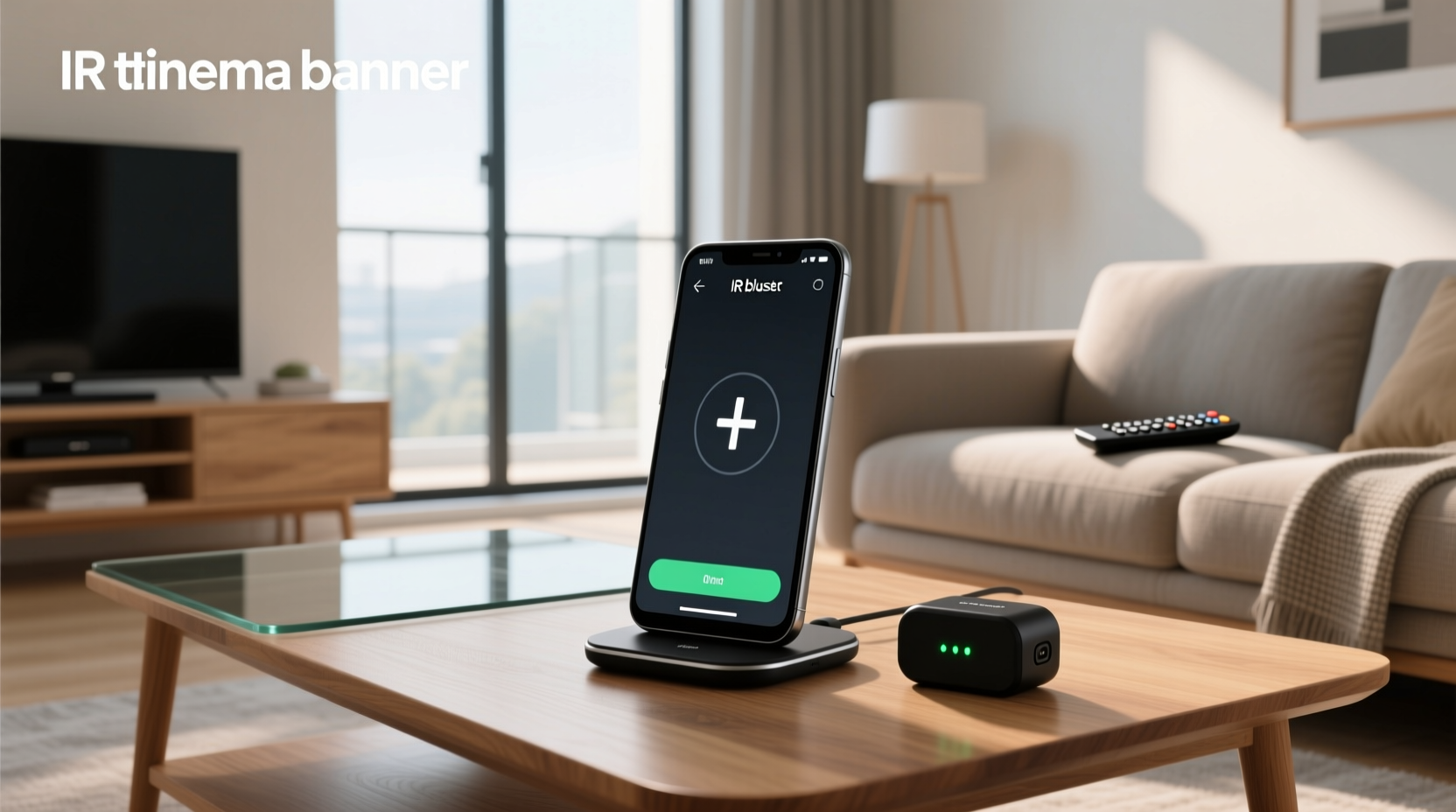
Yes, provided all devices are within the "line of sight" of the blaster's signal. A single Wi-Fi IR hub placed on a coffee table can typically control a TV, a soundbar, and a cable box simultaneously by sending their respective codes in rapid succession.
Why doesn't my smartphone have an internal IR blaster anymore?
Manufacturers phased out internal IR blasters to save internal space for larger batteries and improved camera sensors, and because the industry shifted toward HDMI-CEC and Wi-Fi-based control. External blasters were developed to fill this gap for users who still need to control IR-only devices.
Can an external IR blaster learn commands from any remote?
Most can learn commands from standard IR remotes operating between 30 kHz and 60 kHz. However, they cannot learn commands from RF (Radio Frequency) remotes or Bluetooth remotes (like those used for some modern streaming sticks), as these do not use light signals.
Is there a limit to how many codes an IR blaster can store?
For USB-C dongles, the limit is defined by the storage on your smartphone app. For Wi-Fi hubs, the codes are stored in the cloud, meaning there is virtually no limit to the number of devices or "learned" commands you can manage through a single interface.
Image Gallery