Sell Side vs Buy Side M&A Explained: Core Differences, Roles, and Process Flow
In mergers and acquisitions (M&A), sell-side advisory represents business owners seeking to divest assets or sell their company to maximize valuation and closing certainty. Conversely, buy-side advisory represents corporate acquirers o...
In mergers and acquisitions (M&A), sell-side advisory represents business owners seeking to divest assets or sell their company to maximize valuation and closing certainty. Conversely, buy-side advisory represents corporate acquirers or institutional investors seeking to identify targets, perform due diligence, and negotiate optimal transaction terms. While both sides collaborate to execute deals, their incentives, workflows, and valuation strategies remain fundamentally opposed.
Contents
Understanding Sell-Side M&A: Objectives, Workflow, and Deliverables
The sell-side of an M&A transaction focuses on marketing a company to potential suitors and negotiating the highest possible value under favorable deal terms. Sell-side advisors—typically investment banks, M&A brokerages, or corporate finance boutique firms—act as fiduciaries for the seller. Their primary mandate is to generate competition among buyers to maximize total proceeds and protect the seller against post-closing liabilities.
Core Objectives of the Sell-Side
- Valuation Maximization: Driving transaction pricing through competitive tension, optimized financial presentation, and strategic positioning.
- Transaction Certainty: Selecting buyers with verified financing, regulatory approval pathways, and a high probability of closing without material adverse changes.
- Risk Mitigation: Structuring purchase agreements to limit post-closing indemnities, representation and warranty liabilities, and aggressive working capital adjustments.
- Execution Speed: Maintaining an efficient process timeline to prevent operational distraction, employee attrition, or market rumors during negotiation.
The Standard Sell-Side Advisory Workflow
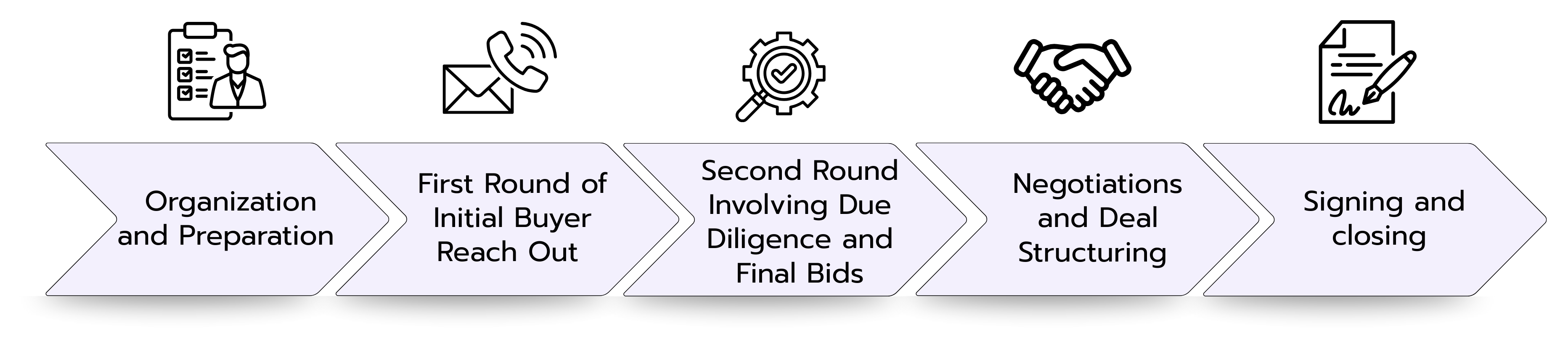
Sell-side engagements follow a structured sequence designed to maintain confidentiality while soliciting multiple bids:
[Preparation & Valuation] ➔ [Marketing Materials] ➔ [Buyer Outreach] ➔ [IOI Evaluation] ➔ [Management Presentations] ➔ [LOI Selection] ➔ [Diligence & Closing]
- Phase 1: Readiness and Preparation: The sell-side team conducts initial financial, legal, and operational reviews. Advisors perform sell-side quality of earnings (QoE) analyses and financial modeling to establish benchmark valuation ranges.
- Phase 2: Collateral Development: The deal team prepares marketing documentation:
- The Teaser: A 1- to 2-page anonymous overview outlining investment highlights, high-level financials, and growth opportunities.
- Confidential Information Memorandum (CIM): A comprehensive 30- to 60-page document providing detailed financial statements, product offerings, operational metrics, and market positioning, distributed only after prospective buyers sign a Non-Disclosure Agreement (NDA).
- Phase 3: Buyer Outreach and Auction Launch: The advisor executes either a broad auction (reaching out to dozens of strategic and financial sponsors) or a targeted auction (focusing on a curated list of high-fit acquirers).
- Phase 4: Evaluating Indications of Interest (IOIs): Non-binding preliminary offers (IOIs) are evaluated based on valuation range, capital structure, and transaction terms.
- Phase 5: Virtual Data Room (VDR) & Management Presentations: Shortlisted buyers receive access to a secure VDR containing confidential documents and participate in structured Q&A sessions with management.
- Phase 6: Letter of Intent (LOI) & Final Contract Negotiation: Final binding or semi-binding offers are evaluated. The seller selects a preferred party, grants exclusivity, and negotiates the definitive Purchase and Sale Agreement (PSA) or Share Purchase Agreement (SPA).
Understanding Buy-Side M&A: Objectives, Workflow, and Deliverables
The buy-side of an M&A transaction represents the acquiring entity—such as a strategic corporate buyer, private equity firm, family office, or search fund. Buy-side advisors assist buyers in deploying capital efficiently, discovering undervalued or highly synergistic acquisition targets, evaluating downside operational risks, and structuring scalable acquisitions.
Core Objectives of the Buy-Side
- Strategic Fit and Synergy Realization: Identifying targets that expand product offerings, grant access to new geographic markets, or yield cost-saving synergies.
- Valuation Protection: Establishing disciplined, intrinsic valuation models (avoiding the "winner’s curse" of overpaying in an auction environment).
- Rigorous Risk Uncovering: Conducting comprehensive diligence to uncover unrecorded liabilities, technical debt, regulatory compliance failures, or high customer concentration.
- Integration Planning: Ensuring post-merger integration (PMI) plans are established before closing to capture projected financial value quickly.
The Standard Buy-Side Advisory Workflow
Buy-side engagements vary based on whether the deal is proprietary or part of an organized sell-side auction:
[Acquisition Strategy] ➔ [Target Screening] ➔ [Valuation & LBO/DCF] ➔ [Submit IOI/LOI] ➔ [Confirms QoE & Diligence] ➔ [Definitive Agreements] ➔ [Post-Merger Integration]
- Phase 1: Investment Thesis and Criteria Definition: Defining industry focus, financial parameters (e.g., revenue ranges, EBITDA margins), target geography, and transaction structures (asset purchase vs. equity purchase).
- Phase 2: Target Identification and Sourcing: Screening databases, cold outreach to prospective founders, and analyzing sell-side teasers distributed by investment banks.
- Phase 3: Financial Modeling and Preliminary Valuation: Constructing Discounted Cash Flow (DCF), Leveraged Buyout (LBO), and Accretion/Dilution models to evaluate target returns and optimal debt/equity financing structures.
- Phase 4: Bid Submission and Negotiation: Submitting tailored IOIs and LOIs that balance aggressive pricing with legal protections (e.g., earn-outs, escrow holdbacks, and representation and warranty insurance requirements).
- Phase 5: In-Depth Due Diligence: Deployment of specialized third-party experts to verify all vendor-provided information:
- Financial & Accounting: Buy-side Quality of Earnings (QoE) report to analyze normalized EBITDA and working capital requirements.
- Legal & Regulatory: Reviewing vendor contracts, IP ownership, employee litigation history, and regulatory standing.
- Technical & Operational: Assessing IT infrastructure, codebase security, factory efficiency, and supply chain fragility.
- Phase 6: Contract Execution and Closing: Finalizing transaction documents, securing senior debt or mezzanine financing, executing funds transfer, and initiating integration.
Key Differences Between Sell-Side and Buy-Side M&A
While both disciplines require corporate finance skills, their analytical mindsets, leverage dynamics, and incentive models differ significantly.
| Dimension | Sell-Side M&A | Buy-Side M&A |
|---|---|---|
| Primary Client | Target Company Owners / Divesting Parent Corp | Strategic Acquirers / Private Equity / Institutional Buyers |
| Main Objective | Maximize valuation, terms, and closing certainty | Secure strategic value, avoid overpaying, mitigate risk |
| Key Deliverables | Teaser, CIM, Financial Model, VDR, Confidentiality Agreements | Target Lists, LBO/DCF Models, QoE Reports, LOIs, Integration Plans |
| Valuation Mindset | Optimistic: Emphasizes future growth, synergies, and adjusted EBITDA | Conservative: Stress-tests assumptions, discounts unproven synergies |
| Process Control | High: Controls timeline, documentation flow, and auction dynamic | Dependent: Must adapt to sell-side timelines or negotiate proprietary deals |
| Primary Risk | Deal failure, deal fatigue, buyer re-trading late in the process | Overpaying (Winner's Curse), undisclosed liabilities, failure of post-close integration |
| Typical Fee Model | Monthly retainer plus large percentage-based success fee | Monthly retainer plus fixed advisory fee or milestone/success fee |
The Dynamic of Negotiation Leverage
Sell-side advisors aim to maintain competitive tension as long as possible. By keeping multiple buyers engaged through Phase 4 and Phase 5, the sell-side prevents any single buyer from lowering their offer price late in the transaction (a tactic known as "re-trading").
Conversely, buy-side advisors seek to secure exclusivity early in the process. Once exclusivity is granted under an LOI, leverage shifts toward the buyer, who can then use detailed due diligence findings (such as deferred maintenance expenses or customer churn) to justify price adjustments or risk-shifting escrow accounts.
Deal Team Roles and Advisory Fee Structures
Executing a mid-market or enterprise M&A transaction requires cross-functional coordination across several key advisory practices.
Investment Banking and M&A Advisory Fees
Advisors on both sides operate under distinct fee structures aligned with their respective goals:
- Sell-Side Fee Structure: Typically consists of a modest upfront engagement retainer (e.g., $10,000–$50,000 per month offset against final fees) combined with a performance-based success fee. Success fees are often structured using the traditional or double-tiered Lehman Formula, or as a scaled percentage fee (e.g., 1.5% to 5% of Enterprise Value, often escalating above a benchmark target valuation).
- Buy-Side Fee Structure: Buy-side advisors often charge structured retainer fees covering market research and modeling, along with milestone fees upon signing an LOI and completing a transaction. Because buyers may deliberately choose not to complete a high-risk deal, pure success fees can create misaligned incentives; thus, buy-side retainer structures are often higher to protect objective judgment.
Auxiliary Advisory Teams
Beyond investment bankers, deal teams rely on specialized institutions:
- Legal Counsel: Sell-side attorneys focus on minimizing exposure through limited representations, indemnification caps, and restrictive covenants. Buy-side attorneys focus on comprehensive representations, covenants, escrow agreements, and non-competes. Legal professionals review regulatory thresholds established by antitrust enforcement authorities such as the U.S. Federal Trade Commission (FTC) or European Commission.
- Quality of Earnings (QoE) Accountants: Independent CPA firms evaluate historical financial statements. The sell-side QoE confirms clean earnings to prevent surprises; the buy-side QoE uncovers accounting anomalies, non-recurring revenues, or understated capital expenditures.
- Tax Strategists: Advisors evaluate tax implications on both sides, comparing asset sales (which may lead to double taxation for C-corporations) versus stock purchases (preferred by sellers for capital gains treatment), as detailed in corporate tax guidance from the Internal Revenue Service (IRS).
Strategic Considerations and Common Execution Pitfalls
Navigating a corporate transaction requires recognizing predictable failure modes on both sides of the deal table.
Sell-Side Pitfalls
- Unrealistic Valuation Expectations: Setting an ungrounded valuation anchor can deter institutional buyers during the IOI stage, leaving the asset tarred as a "shopped" or over-priced transaction.
- Poor Virtual Data Room Hygiene: Incomplete financial records, unorganized customer contracts, or informal employment agreements slow down buyer diligence, creating momentum loss and inviting re-trading.
- Key Person Reliance: If the target company's operational success relies entirely on a departing founder, buy-side valuation models will aggressively discount the asset or demand long-term earn-outs and retention periods.
Buy-Side Pitfalls
- The Winner's Curse: Winning a competitive auction by submitting an overly optimistic bid that requires perfect execution and unachievable synergies to yield an economic return.
- Superficial Due Diligence: Relying solely on seller-provided financial summaries without conducting deep-dive QoE audits, technical stack reviews, or customer interviews.
- Neglecting Post-Merger Integration (PMI): Underestimating the complexity of merging corporate cultures, IT environments, sales incentives, and operational systems after close. Research consistently demonstrates that transaction failure is most frequently caused by poor execution during the PMI phase rather than errors in financial modeling.
Disclaimer: M&A transactions involve complex legal, accounting, and regulatory considerations. Business owners and corporate executives should consult licensed legal, tax, and corporate finance professionals prior to executing binding transaction documents or engaging in corporate restructuring.
Frequently Asked Questions
What is the primary difference between sell-side and buy-side M&A?
The sell-side represents the business owner or seller aiming to maximize sales price and deal terms. The buy-side represents the acquirer or investor seeking to buy a strategic asset, minimize transaction price, verify risks through due diligence, and integrate the target.
Can an investment bank represent both the sell-side and buy-side in the same transaction?
No. Representing both sides in the same transaction presents a direct conflict of interest, as the seller's goal (maximum valuation and low liability) directly opposes the buyer's goal (discounted valuation and strong indemnity protections). Deal advisory mandates require strict separation to maintain fiduciary duties.
What is a Quality of Earnings (QoE) report, and who prepares it?
A QoE report is an independent audit-style analysis of a target company's operational cash flows. It strips away non-recurring income, owner-specific expenses, and accounting adjustments to reveal true baseline EBITDA. Sell-side teams prepare QoE reports to support valuation; buy-side teams commission them to verify vendor claims.
Why do sell-side advisors prefer auction processes?
Auction processes create competitive tension among multiple prospective buyers. When buyers know they are competing against peer institutions, they are forced to offer their best valuation, submit cleaner terms, minimize escrow requirements, and move rapidly to secure the deal.
How are sell-side advisory fees typically calculated?
Sell-side advisors usually receive a monthly retainer to cover upfront operational expenses, offset against a primary success fee paid upon closing. The success fee is calculated as a percentage of the total Enterprise Value, often using a tiered structure that increases the advisor's fee percentage if the sale price exceeds a set threshold.
Practical Next Steps for Transaction Leaders
Whether preparing an enterprise for sale or executing an inorganic corporate growth strategy, successful execution depends on rigorous preparation:
For Prospective Sellers:
- Begin pre-sale financial and operational cleanup 12 to 24 months prior to entering the market.
- Conduct an independent sell-side QoE analysis to identify accounting gaps before buyers inspect the books.
- Work with M&A advisors to structure a clear investment thesis and establish a clean Virtual Data Room.
For Prospective Buyers:
- Define precise acquisition criteria based on proven corporate growth strategies rather than opportunistic deal flow.
- Establish structured risk-screening protocols before issuing binding Letters of Intent.
- Assemble specialized third-party legal, tax, and accounting diligence teams early in the screening process to avoid costly late-stage transaction cancellations.
Image Gallery