The History of Alchemy in Islam
The history of alchemy in Islam represents a foundational chapter in the development of global science, bridging the ancient metallurgical traditions of Egypt, Mesopotamia, and Greece with the empirical methodologies of the European Re...
The history of alchemy in Islam represents a foundational chapter in the development of global science, bridging the ancient metallurgical traditions of Egypt, Mesopotamia, and Greece with the empirical methodologies of the European Renaissance. Far from being a purely mystical pursuit of turning base metals into gold, Islamic alchemy was a sophisticated proto-science that transformed theoretical philosophy into practical laboratory chemistry, pharmacy, and medicine.
Contents
Origins and Cultural Synthesis
The genesis of Islamic alchemy, known in Arabic as al-kīmiyā, began in the 8th century during the expansion of the Umayyad and early Abbasid caliphates. Scholars in urban intellectual hubs such as Damascus, Kufa, and later Baghdad embarked on a monumental translation movement. They systematically gathered, translated, and analyzed Greek philosophical texts, Syriac Christian scientific treatises, and Persian or Coptic metallurgical manuals into Arabic.
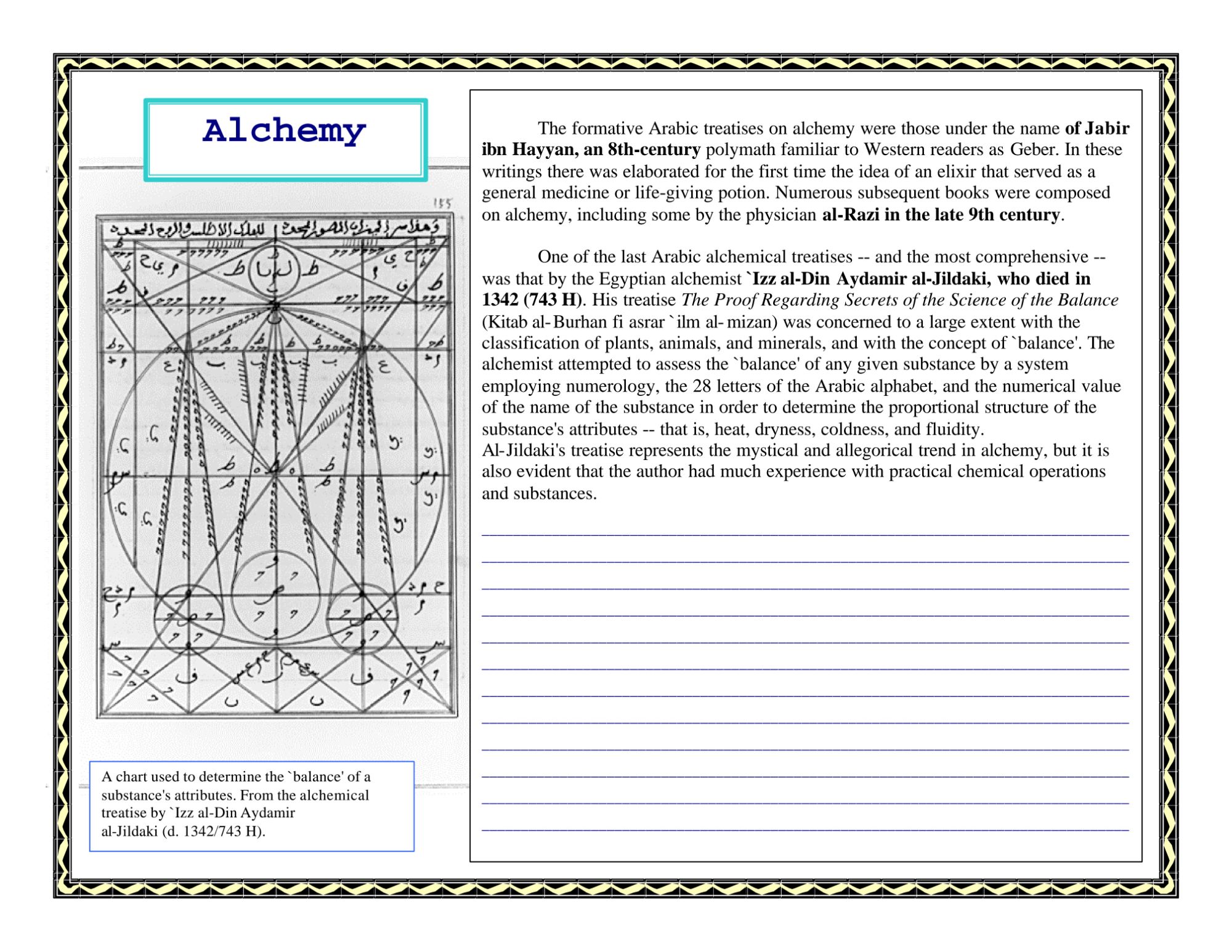
This synthesis was not merely passive transmission. Islamic scholars integrated these disparate traditions into a cohesive intellectual framework. They married the Aristotelian concept of the four elements (earth, air, fire, water) and their underlying qualities (hot, cold, dry, moist) with practical Egyptian techniques of metalworking, glassmaking, and dyeing. This intellectual melting pot provided the necessary theoretical foundation and physical tools for the systematic study of matter, setting the stage for pioneering experimental breakthroughs.
Jabir ibn Hayyan and the Foundations of Experimental Methodology
The undisputed towering figure in the history of alchemy in Islam is Jabir ibn Hayyan, known in the Latin West as Geber. Writing in the late 8th century, Jabir transformed alchemy from an obscure, highly secretive craft into a structured scientific discipline grounded in observation and controlled experimentation.
Jabir introduced the sulfur-mercury theory of metals, which posited that all metals are formed in the earth from varying proportions of sulfur and mercury. While this theory was theoretical, Jabir's practical contributions were revolutionary. He developed or refined numerous fundamental laboratory processes that remain cornerstones of chemistry today, including:
- Distillation: Using the alembic to purify liquids and separate substances.
- Crystallization: Isolating pure compounds from solutions.
- Sublimation: Converting solids directly into vapors and back into solids.
- Calcination: Heating substances to high temperatures to alter their chemical composition.
Furthermore, Jabir is credited with the discovery and preparation of several crucial mineral acids, including sulfuric acid and nitric acid, as well as aqua regia—a mixture capable of dissolving noble metals like gold. His writings emphasized the necessity of rigorous experimentation, famously stating that the true practitioner must test and verify every claim rather than relying solely on philosophical authority.
Muhammad ibn Zakariya al-Razi and Systematic Classification
Following Jabir, the polymath Muhammad ibn Zakariya al-Razi (known to Europeans as Rhazes) advanced Islamic alchemy by steering it further toward medicine and strict empirical classification. Writing in the 9th and 10th centuries, al-Razi stripped away much of the obscure mystical symbolism that had previously dominated alchemical texts, favoring clarity, precision, and methodical reporting.
Al-Razi’s masterpiece, the Kitab al-Asrar (The Book of Secrets) and its companion Kitab Sirr al-Asrar (The Book of the Secret of Secrets), can be considered the world’s first true chemical manuals. In these works, al-Razi categorized chemical substances into distinct groups based on their physical and chemical properties, a direct precursor to modern chemical classification.
| Category | Description | Examples |
|---|---|---|
| Terrestrial Substances (al-Ahjar) | Minerals and rocks mined from the earth. | Pyrites, malachite, iron oxide |
| Salts (al-Amalish) | Soluble compounds derived from mineral or biological sources. | Common salt, sal ammoniac, natron |
| Metals (al-Aflas) | Malleable, fusible elements possessing metallic luster. | Gold, silver, copper, iron, lead, tin |
| Spirits (al-Arwah) | Volatile substances that evaporate or sublime upon heating. | Sulfur, arsenic, mercury, ammonium chloride |
Al-Razi also detailed laboratory equipment, listing furnaces, crucibles, beakers, and alembics, alongside safety protocols and descriptions of procedures like amalgamation and cupellation. His work ensured that alchemy was firmly anchored to practical utility, particularly in pharmacology.
Theoretical Frameworks and the Opposition to Transmutation
While experimental techniques flourished, the theoretical core of alchemy—specifically the transmutation of base metals into gold—faced skepticism from prominent thinkers within the Islamic intellectual community. The pursuit of chrysopoeia (gold-making) was viewed through a lens of philosophical debate and moral hazard.
| Scholar / Thinker | Primary Stance on Alchemy | Key Argument |
|---|---|---|
| Jabir ibn Hayyan | Supportive / Theoretical | Believed transmutation was possible through the balance of sulfur and mercury under divine order. |
| Al-Razi | Pragmatic / Skeptical | Accepted chemical processes and mineral properties, but doubted the literal transmutation of base metals into true gold. |
| Avicenna (Ibn Sina) | Deeply Skeptical | Argued that nature's species (such as gold and silver) are fixed and that artificial processes can only produce clever imitations, not genuine transmutation. |
Avicenna’s critique, articulated in his influential medical and philosophical encyclopedias, argued that alchemists could produce alloys that looked and behaved like precious metals (such as whitening copper to resemble silver), but they lacked the capacity to alter the fundamental internal nature of the elements. This philosophical counterweight helped filter out unscientific speculation, directing scholarly energy toward genuine chemical and medical pharmacology.
Legacy, Transmission, and Impact on Modern Science
The practical achievements and theoretical treatises of Islamic alchemists did not remain isolated within the Islamic world. Beginning in the 12th century, a massive wave of translation—centered in cities like Toledo, Spain, and Palermo, Sicily—brought Arabic scientific texts into Latin. European scholars such as Gerard of Cremona, Robert of Chester, and later figures like Roger Bacon eagerly translated works by Jabir, al-Razi, and Avicenna.
The vocabulary of modern chemistry bears direct witness to this intellectual debt. Numerous fundamental chemical terms are Arabic loanwords adopted through medieval Latin translations:
- Al-kīmiyā became alchemy and later chemistry.
- Al-iksīr (the philosopher's stone or transformative elixir) became elixir.
- Al-inbīq (the still or distillation apparatus) became alembic.
- Naṭrūn gave rise to natron and sodium.
By establishing the methodology of controlled laboratory experimentation, standardizing specialized equipment, and categorizing matter systematically, the practitioners of alchemy in Islam laid the indispensable groundwork for the Scientific Revolution and the birth of modern chemistry.
Frequently Asked Questions
Did alchemists in Islam actually succeed in turning lead into gold?
No. Modern chemical analysis confirms that true nuclear or chemical transmutation of lead into gold was beyond the technological capabilities of medieval science. However, their experiments frequently produced impressive alloys, surface platings, and chemical imitations that deceived observers and advanced metallurgical knowledge.
What is the difference between alchemy and chemistry in this historical context?
In the Islamic tradition, al-kīmiyā encompassed both practical laboratory techniques (which evolved into modern chemistry and pharmacology) and esoteric, philosophical quests for spiritual perfection and material transformation. The hard boundary between science and mysticism did not exist in the medieval period in the same way it does today.
How did Islamic alchemy influence European science?
Through medieval translations of Arabic texts into Latin, European scholars gained access to advanced laboratory equipment (like the alembic), systematic classification of minerals, mineral acids, and the insistence on empirical testing. This literature directly shaped early European chemists and natural philosophers.
Why did scholars like Avicenna reject the claims of alchemy?
Avicenna argued that natural species possess fixed, immutable essences. He maintained that while alchemists could manipulate physical properties to create surface alterations or clever alloys, they could not alter the fundamental identity of a metal created by nature.
What role did pharmacology play in Islamic alchemy?
Pharmacology was deeply intertwined with alchemy. Many alchemical procedures—such as distillation, sublimation, and extraction—were developed and refined primarily to prepare medicinal extracts, distillations, and mineral remedies for use in hospitals and apothecaries.
Conclusion and Next Actions
To further explore the rich history of alchemy in Islam, researchers and enthusiasts should examine translated primary texts such as Jabir ibn Hayyan's The Book of Stones or al-Razi's Kitab al-Asrar. Visiting museum collections featuring medieval scientific instruments, such as historic astrolabes and alembics, provides valuable tangible context for the sophisticated methodologies developed during this era.
Image Gallery