Exploring Georgia Tech’s Online Portfolio on edX: Programs, Costs, and Degree Pathways
Georgia Tech offers a robust selection of graduate-level MicroMasters, professional certificates, and individual MOOCs through the edX platform. These programs focus on high-demand fields like cybersecurity, data analytics, and compute...
Georgia Tech offers a robust selection of graduate-level MicroMasters, professional certificates, and individual MOOCs through the edX platform. These programs focus on high-demand fields like cybersecurity, data analytics, and computer science, often providing a direct credit-bearing pathway into Georgia Tech’s full Online Master of Science (OMS) degrees at a fraction of on-campus costs.
Contents
In the landscape of higher education in 2026, the partnership between the Georgia Institute of Technology (Georgia Tech) and edX (part of 2U) stands as a primary example of "education at scale." Georgia Tech has utilized the platform to democratize access to elite technical education, transitioning from a traditional campus-centric model to a global provider of specialized, career-aligned certifications. Whether you are looking for a singular skill, such as programming in Python, or a comprehensive graduate-level credential, the Georgia Tech offerings on edX are designed to be stackable, rigorous, and industry-recognized.
The Tiered Structure of Georgia Tech’s edX Offerings
Georgia Tech does not simply list random courses on edX; rather, it provides a structured hierarchy of learning opportunities. Understanding this structure is essential for learners to determine which level of commitment matches their career goals and academic background.
1. Individual MOOCs (Massive Open Online Courses)
At the base of the pyramid are individual courses. These cover specific subjects ranging from "Introduction to Computing in Python" to "Supply Chain Fundamentals."
- The Audit Track: Most individual courses allow students to audit for free. This grants access to the video lectures and reading materials but usually excludes graded assignments and a final certificate.
- The Verified Track: For a fee (typically ranging from $50 to $250 per course), learners can earn a verified certificate. This track includes graded assessments and identity verification, which is often required if you intend to use the course for professional reimbursement or academic credit later.
2. Professional Certificate Programs
Professional Certificates are series of courses designed to build proficiency in a specific job function. Unlike MicroMasters, these are generally not for academic credit toward a degree but are highly valued for skill-building. For example, the "Introduction to Computing in Python" certificate is a four-course sequence that takes a beginner from zero knowledge to a foundational understanding of data structures and algorithms.
3. MicroMasters Programs
The MicroMasters programs are the flagship offerings of Georgia Tech on edX. These are graduate-level sequences that represent a significant portion of a full Master’s degree. They are designed to provide deep learning in a specific professional field and are recognized by employers for their rigor. More importantly, they serve as a "performance-based" admissions pathway. If a student completes a MicroMasters with a high enough grade, they may apply to the corresponding full Master's degree at Georgia Tech and receive credit for the work already completed.
In-Depth Analysis: Georgia Tech MicroMasters Programs
As of 2026, Georgia Tech focuses its MicroMasters efforts on three core disciplines where they hold world-class rankings: Analytics, Cybersecurity, and Supply Chain Management.
Analytics MicroMasters
The MicroMasters Program in Analytics: Essential Tools and Methods is perhaps the most popular offering. It consists of three foundational courses that mirror the first semester of the Online Master of Science in Analytics (OMSA).
- Analytical Tools and Methods (ISYE 6501): This course introduces students to a variety of machine learning and statistical modeling techniques.
- Data Analytics in Business (MGT 6203): This focuses on the application of analytics in a corporate environment, covering marketing, finance, and operations.
- Computing for Data Analytics (CSE 6040): A heavy emphasis on Python and SQL, teaching students how to manipulate large datasets and implement algorithms.
Completing this program provides 9 hours of advanced standing credit toward the OMSA degree, significantly reducing the remaining time and cost for the full Master's.
Cybersecurity MicroMasters
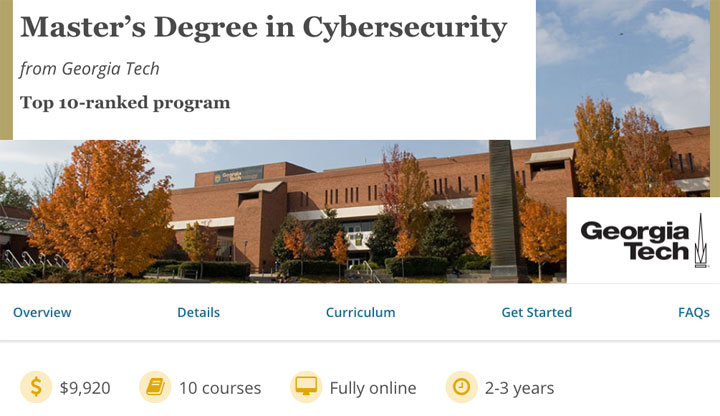
The MicroMasters Program in Cybersecurity provides a multidisciplinary approach to digital security. It is divided into tracks such as Information Security and Energy Systems.
- Information Security Fundamentals: Covers the basics of cryptography, network security, and policy.
- Secure Computer Systems: Dives into the architecture of hardware and software to prevent vulnerabilities.
- Applied Cryptography: A mathematical and practical look at securing data transmission.
Learners who excel in these courses can transition into the Online Master of Science in Cybersecurity (OMS Cybersecurity), applying the MicroMasters credentials toward the degree requirements.
Supply Chain Management MicroMasters
Georgia Tech’s Stewart School of Industrial and Systems Engineering is consistently ranked #1 in the U.S. Their MicroMasters in Supply Chain Management on edX covers the end-to-end lifecycle of goods.
- Supply Chain Fundamentals: Focuses on forecasting, inventory management, and transportation.
- Supply Chain Design: Teaches students how to model and optimize complex logistics networks.
- Supply Chain Technology: Explores the role of ERP systems and emerging tech like blockchain in logistics.
Comparison of Georgia Tech Program Types on edX
To help prospective students choose the right path, the following table compares the key metrics of Georgia Tech’s offerings as of 2026.
| Program Type | Typical Duration | Estimated Cost (Verified) | Academic Credit Potential | Primary Audience |
|---|---|---|---|---|
| Individual MOOC | 4–6 weeks | $50 – $200 | None (usually) | Casual learners/Skill seekers |
| Professional Certificate | 4–6 months | $400 – $800 | None | Career switchers/Entry-level |
| MicroMasters | 8–12 months | $800 – $1,500 | Up to 9-12 Credit Hours | Aspiring Master's students |
| Executive Education | 2–3 months | $1,500 – $3,000 | Varies | Mid-to-senior management |
The Pathway to a Full Master’s Degree
One of the primary reasons students look for Georgia Tech on edX is to test the waters for the Online Master of Science (OMS) programs. Georgia Tech was a pioneer in the "affordable Master's" movement, offering degrees for under $10,000 total.
How the Credit Transfer Works
If you complete a MicroMasters on edX, you earn a certificate from edX and Georgia Tech. However, this does not automatically make you a "degree-seeking student." You must still formally apply to the Georgia Tech Graduate School.
- Performance: Usually, a grade of "B" or "A" in all MicroMasters courses is required for the credit to be considered for transfer.
- Application: During the application process, you indicate your MicroMasters completion.
- Advanced Standing: Once admitted, you can petition for "Advanced Standing." This allows you to skip the foundational courses you already took on edX, effectively shortening your Master’s journey by 25% to 33%.
Benefits of the edX Pathway
- Low Risk: You pay for courses one at a time. If you find the material too difficult or your schedule too busy, you can stop without having committed to a full degree tuition.
- Admissions Edge: For students with a non-traditional background (e.g., a liberal arts degree moving into Data Science), proving you can handle Georgia Tech’s graduate-level rigor via edX is a powerful addition to a graduate application.
- Flexibility: edX courses are largely asynchronous, meaning you can balance them with a full-time job.
Technical Prerequisites and Requirements
Georgia Tech’s reputation for rigor extends to its edX courses. These are not "easy" certificates; they are designed to mirror the difficulty of on-campus courses.
1. Programming Proficiency
Most technical tracks, especially Analytics and Cybersecurity, require a working knowledge of Python. Georgia Tech offers the "Computing in Python" Professional Certificate specifically to prepare students for the more advanced MicroMasters.
2. Mathematical Foundation
For the Analytics and Supply Chain tracks, students should be comfortable with:
- Linear Algebra: Crucial for machine learning and optimization models.
- Probability and Statistics: Necessary for data interpretation and forecasting.
- Calculus: Useful for understanding the underlying mechanics of many algorithms.
3. Time Commitment
A single 3-credit hour equivalent course on edX typically requires 10 to 15 hours per week. This includes watching lectures, participating in forum discussions, completing coding labs, and taking proctored exams.
Frequently Asked Questions
Is a Georgia Tech edX certificate the same as a degree?
No. An edX certificate (whether for a single course or a MicroMasters) is a professional credential. It signifies completion of specific coursework. It is not a diploma. To earn a Master of Science degree, you must be formally admitted to Georgia Tech, complete all degree requirements (usually 10 to 11 courses), and pay the associated tuition.
Can I audit Georgia Tech courses for free?
Yes, most Georgia Tech courses on edX offer a free "Audit" track. This allows you to view most course materials and videos. However, you will not receive a certificate, you likely won't have access to graded assignments, and you cannot use audited courses for future degree credit.
How much do the MicroMasters cost in 2026?
While prices fluctuate, the total cost for a MicroMasters typically ranges from $800 to $1,500. This is calculated by the sum of the individual "Verified" course fees within that program. This remains significantly cheaper than traditional graduate-level credit hours at most institutions.
Are the exams proctored?
For MicroMasters and some Professional Certificates, Georgia Tech requires proctored exams to maintain academic integrity. This usually involves using software that records your webcam and screen while you take the test to ensure you are not using unauthorized resources.
Do employers value these certificates?
Yes, particularly in technical fields. Georgia Tech is a top-tier engineering school, and its name carries weight. Employers recognize that these courses are rigorous. A MicroMasters on a LinkedIn profile serves as a strong signal of both technical competency and the self-discipline required to complete a high-level online program.
Final Recommendation for Prospective Learners
If you are considering a Georgia Tech program on edX, the best first step is to identify your end goal.
- If you want to upskill quickly in a specific tool like Python or Java, enroll in a Professional Certificate.
- If you are aiming for a Master’s degree but are unsure if you can handle the workload or meet the admission criteria, start with the first course of a MicroMasters (such as ISYE 6501 for Analytics). This "try-before-you-buy" approach is the most cost-effective and academically sound way to advance your career with Georgia Tech in 2026.
Image Gallery