Complete Guide to the FDOC Inmate Search System in 2026
Navigating the Florida Department of Corrections (FDOC) inmate search system is the primary method for locating individuals incarcerated within Florida state prisons. Whether you are tracking a family member, conducting legal research,...
Navigating the Florida Department of Corrections (FDOC) inmate search system is the primary method for locating individuals incarcerated within Florida state prisons. Whether you are tracking a family member, conducting legal research, or verifying background information, understanding how to effectively use the official public records database ensures accurate results while avoiding common pitfalls associated with third-party data brokers.
Contents
Understanding the Florida Department of Corrections Public Records Framework
The Florida Department of Corrections operates and maintains an extensive public database designed to provide transparency regarding individuals under state correctional supervision. This system complies with Florida's broad public records laws, notably Chapter 119 of the Florida Statutes, which mandates that most records maintained by public agencies be open for public inspection.
When conducting an FDOC inmate search, you are accessing data collected directly from state correctional facilities, work camps, and community supervision offices. The database updates continuously as individuals are admitted, transferred, released, or assigned to different custody levels. Understanding the architecture of this system helps users interpret search results correctly and recognize the limitations inherent in public database inquiries.
Core Data Points Available in the FDOC Database
Each inmate profile within the Florida Department of Corrections system contains specific administrative markers used for identification and tracking. Knowing these data points in advance significantly refines your search accuracy:
- Florida Department of Corrections (DC) Number: A unique, sequential identification number assigned to every inmate upon intake. This is the most reliable search parameter.
- Full Legal Name and Aliases: The primary name under which the individual is committed, alongside any documented aliases or maiden names.
- Current Facility Location: The specific state correctional institution, private facility, or work release center where the inmate is currently housed.
- Physical Characteristics: Documented height, weight, eye color, hair color, tattoos, scars, and race, which assist in positive identification.
- Offense History and Court Information: Conviction details, including the county of conviction, case numbers, statute numbers, and admission dates.
- Sentence Length and Projected Release Date: The calculated release date based on statutory guidelines, gain-time calculations, and sentence structures.
Step-by-Step Guide to Conducting an Inmate Search
Executing a successful search requires navigating the official FDOC public offender information portal. While the interface is designed for public accessibility, utilizing specific strategies prevents common search errors such as zero-result queries or mistaking one individual for another.
Step 1: Access the Official Portal
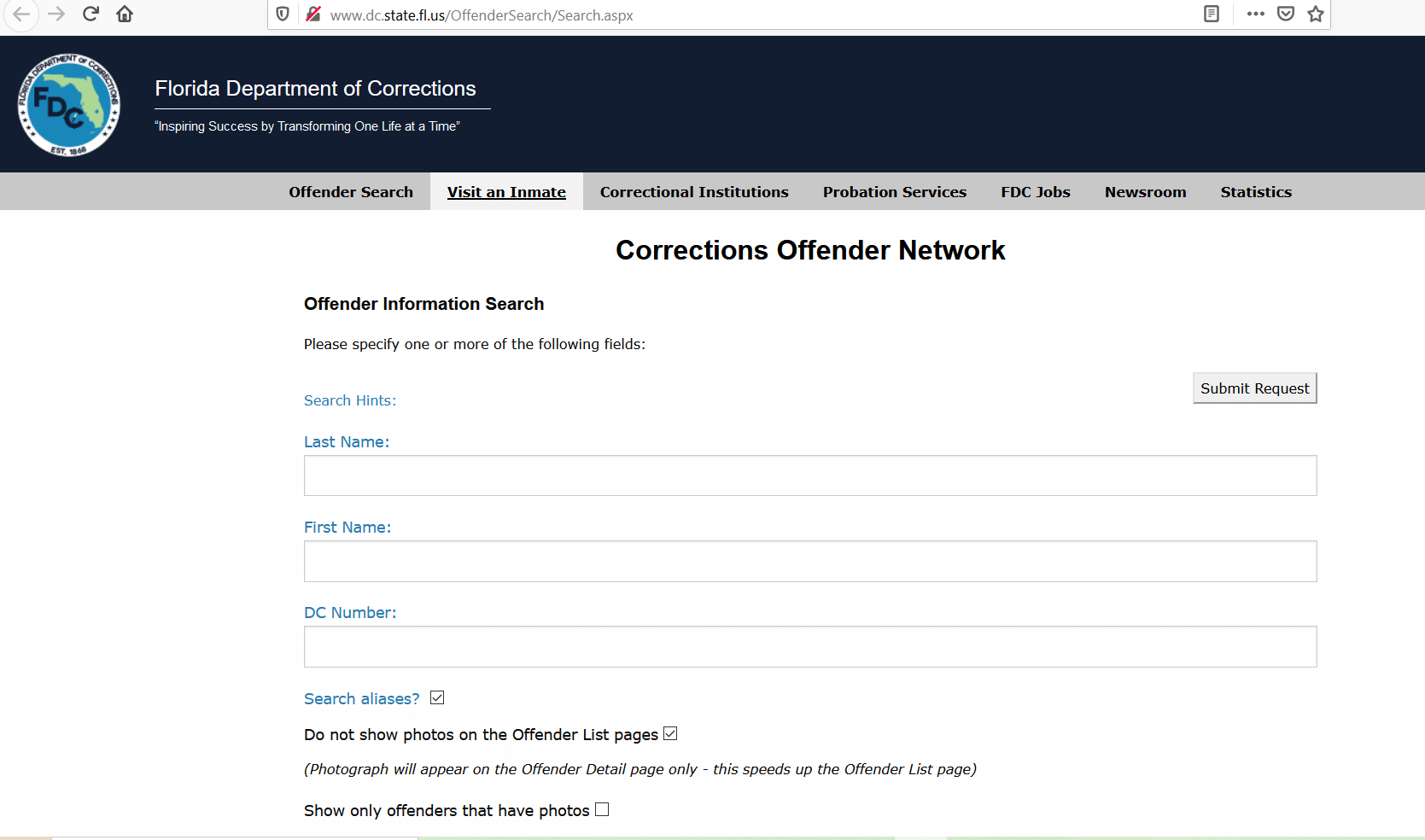
Navigate directly to the official Florida Department of Corrections website via secure domains ending in .gov to ensure data authenticity and protection against malicious third-party scraping sites. Avoid third-party aggregators that charge fees for information that is legally mandated to be free.
Step 2: Choose Your Search Parameters
The search engine allows you to input various criteria. You can search by entering the DC number, or by providing the inmate's first and last name.
- Using the DC Number: If you possess the exact DC number, enter it into the designated field. This bypasses common name-spelling errors and yields an immediate, exact match.
- Using Name Filters: If the DC number is unknown, input the first and last name. To narrow down broad results—especially for common names—utilize optional filters such as race, gender, or age range.
Step 3: Evaluate Search Results
The system will generate a list of matching profiles containing names, DC numbers, races, genders, and current locations. Review the summary data carefully to identify the correct subject. Clicking on an individual's name or DC number opens the comprehensive inmate detail page.
Step 4: Review Detailed Offender Records
Once inside the individual profile, examine the current custody status, historical movement within the system, and detainer information if applicable. Take note of any active detainers from other jurisdictions, as these directly impact potential release dates and transfer statuses.
Evaluating Search Alternatives: Official FDOC vs. County Jails and Federal Prisons
A frequent error made during inmate searches is confusing state prison systems with local county jails or federal correctional facilities. The FDOC database exclusively tracks individuals sentenced to state prison terms—typically felonies resulting in sentences of more than one year served in state-managed institutions.
Jurisdictional Clarification: If an individual has been recently arrested and is awaiting trial, or is serving a misdemeanor sentence of under one year, they are generally held in a local county jail (such as Miami-Dade Corrections, Orange County Jail, or Broward County Sheriff's Office) rather than an FDOC facility. Similarly, individuals convicted of federal offenses fall under the jurisdiction of the Federal Bureau of Prisons (BOP), not the state of Florida.
Correctional Jurisdiction Comparison
| Jurisdiction Level | Governing Authority | Facility Types | Search Platform | Typical Offense Types |
|---|---|---|---|---|
| State Prison | Florida Department of Corrections (FDOC) | State Correctional Institutions, Work Camps | Official FDOC Inmate Search Portal | Felonies resulting in sentences > 1 year |
| Local Jail | County Sheriff's Office or Department of Corrections | County Detention Centers, Holding Facilities | Respective County Sheriff Inmate Lookup | Pre-trial detainees, misdemeanors, short sentences |
| Federal Prison | Federal Bureau of Prisons (BOP) | Federal Penitentiaries, FCI, FPC | BOP Inmate Locator | Federal crimes (drug trafficking, white-collar crimes, immigration violations) |
Common Challenges and Troubleshooting Strategies
Users frequently encounter obstacles when attempting to locate an inmate within the Florida system. Applying systematic troubleshooting techniques resolves the majority of search errors.
Handling Common Name Variations and Spelling Errors
Spelling mistakes or data entry errors during intake can obscure inmate records. If a search yields no results for a common name, try the following adjustments:
- Omit middle names or search using only initials.
- Account for hyphenated last names by searching each surname independently.
- Check for generational suffixes (Jr., Sr., III) which may or may not be indexed uniformly in the database.
Understanding Status Codes and Location Updates
When an inmate is in transit between facilities, undergoing medical evaluation, or appearing in court, their location status within the FDOC database may temporarily display as "In Transit" or reflect a temporary holding facility. During these periods, specific visitation privileges and communication protocols may be restricted until the inmate reaches their permanent assigned institution.
Frequently Asked Questions
What is the fastest way to find someone in the Florida prison system?
Using the inmate's exact Florida Department of Corrections (DC) number is the fastest and most accurate search method. If the DC number is unavailable, entering the full legal first and last name into the official FDOC search portal provides the next most direct route.
Why is an inmate not appearing in the FDOC database?
If an individual is not listed, they may be housed in a local county jail awaiting trial or serving a misdemeanor sentence, held in a federal correctional facility, or have already been released. Additionally, newly admitted inmates may take several days to be processed and entered into the state database.
Does the FDOC database charge fees for inmate searches?
No, searching the official Florida Department of Corrections inmate database is completely free. Users should exercise caution regarding commercial websites that charge subscription fees or request payment to access public correctional records.
How often is the FDOC public database updated?
The FDOC database is updated regularly as administrative changes occur across state facilities. However, data synchronization regarding new admissions, institutional transfers, or release updates can experience brief processing intervals.
Can I track an inmate's release date through the search portal?
Yes, the official FDOC inmate profile displays the projected release date calculated based on the imposed sentence and applicable statutory gain-time provisions. This date is subject to change based on disciplinary actions or legal adjustments.
Practical Recommendations for Families and Legal Professionals
When interacting with the Florida Department of Corrections system, maintaining organized records of an inmate's DC number, current facility assignment, and housing unit streamlines future communication and visitation scheduling. Always verify institutional rules directly through the specific facility's administrative guidelines, as visitation policies, mail procedures, and commissary deposit methods vary significantly across different state prisons and work camps.
Image Gallery