Understanding the Marilyn Monroe Dress Damage Issue: Ethics, Conservation, and Aftermath
The Marilyn Monroe dress damage issue refers to the controversial physical deterioration of the iconic "Happy Birthday, Mr. President" garment following its appearance at the 2022 Met Gala. While owner Ripley’s Believe It or Not! maint...
The Marilyn Monroe dress damage issue refers to the controversial physical deterioration of the iconic "Happy Birthday, Mr. President" garment following its appearance at the 2022 Met Gala. While owner Ripley’s Believe It or Not! maintains the dress remained stable, conservationists and historians documented significant stress, fabric thinning, and crystal loss, sparking a global debate over the preservation of cultural artifacts versus their use in modern media spectacles.
Contents
The Historical Significance of the Jean Louis Garment
To understand the gravity of the damage claims, one must first recognize the dress not merely as clothing, but as a primary historical artifact. Commissioned in 1962 for President John F. Kennedy’s 45th birthday celebration at Madison Square Garden, the dress was designed by Academy Award-winning costume designer Jean Louis, based on an initial sketch by a young Bob Mackie.
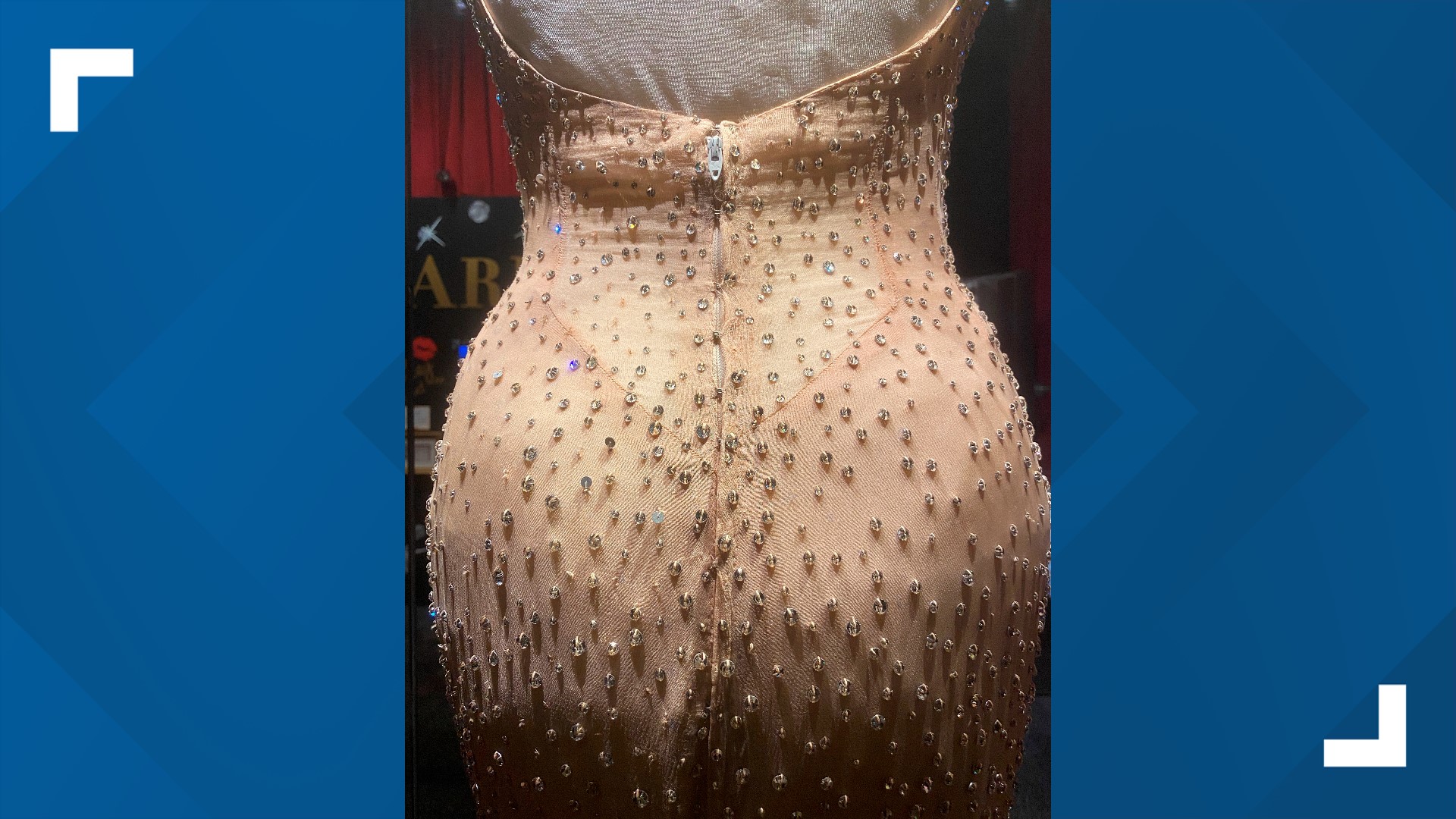
The garment was revolutionary for its time. It was constructed from a delicate, flesh-colored silk soufflé—a fine, gauze-like fabric imported from France—and meticulously hand-stitched with over 2,500 shimmering crystals. The design was so tight that Monroe famously had to be sewn into it, creating the illusion that she was nude and covered only by light. Beyond its aesthetic value, the dress represents a pinnacle of 20th-century pop culture and political history, eventually becoming the most expensive dress ever sold at auction when Ripley’s Believe It or Not! purchased it for $4.8 million (plus fees) in 2016.
The 2022 Met Gala Incident: A Preservation Crisis
In May 2022, celebrity Kim Kardashian wore the original garment on the red carpet of the Met Gala. While Kardashian only wore the authentic dress for a few minutes while ascending the stairs—switching to a replica for the remainder of the evening—the decision was met with immediate backlash from the archival community.
The core of the issue lies in the fragility of 60-year-old silk. Even with a strict diet and the use of a waist cincher, the physical dimensions of a modern wearer differ significantly from the original owner. Furthermore, the environment of a red carpet—with heat, camera flashes, and the physical exertion of movement—is the antithesis of the controlled, dark, climate-stabilized environment required to keep silk soufflé from disintegrating.
The Preparation Process
Ripley’s defended the decision by stating that multiple "fitting" sessions were held and that a conservationist was on-site during the event. However, textile experts noted that "fittings" themselves are damaging to aged fibers. Silk soufflé becomes brittle with age; the natural proteins in the silk break down, making the fabric prone to shattering under the slightest tension.
Technical Analysis of the Alleged Damage
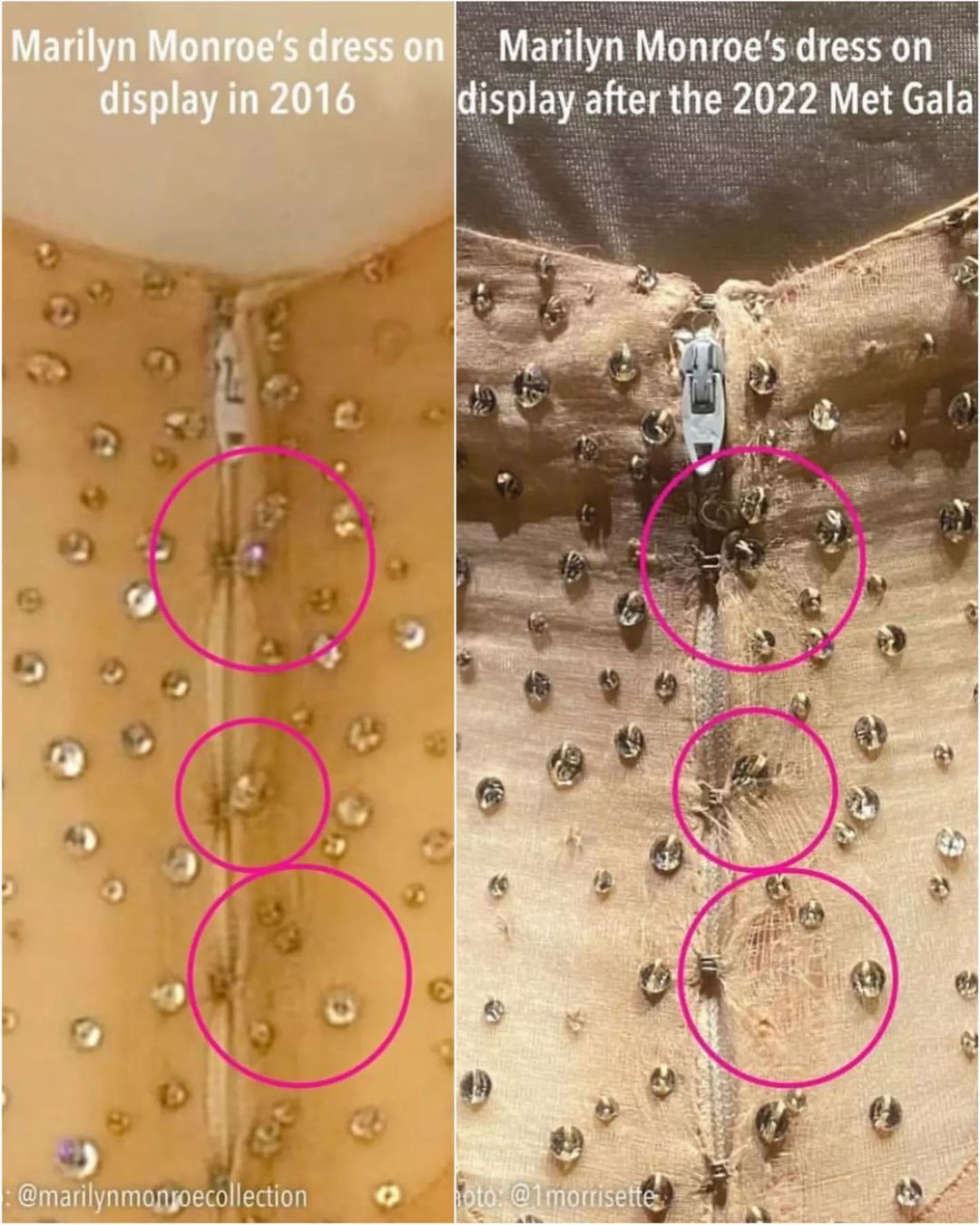
Following the Met Gala, photographs emerged—most notably from collector Scott Fortner of the Marilyn Monroe Collection—comparing the dress’s condition before and after the event. These images sparked a viral investigation into the specific technical failures of the garment's structure.
1. Fabric Stretching and "Shattering"
The most prominent damage was observed near the back zipper. Photos showed the fabric around the hooks and eyes appearing pulled and distorted. In the world of textile conservation, this is known as "shattering" or permanent deformation. Because the silk was under extreme tension to accommodate a different body shape, the delicate weave was forced apart, creating micro-tears that cannot be "healed."
2. Loss of Rhinestones and Crystals
The original crystals were applied with a specific 1960s adhesive and thread work. Post-event imagery showed several areas where crystals were missing or hanging by a single thread. The physical friction of movement against the skin and the weight of the garment while walking up stairs likely caused the aged threads to snap.
3. Structural Integrity at Seams
The dress's construction relied on the tension of the silk to hold its shape. The 2022 incident reportedly resulted in frayed seams. Unlike modern synthetic fabrics, 1960s silk soufflé does not have "memory"; once it is stretched beyond its limit, it remains in that distended state, permanently altering the silhouette of the historical piece.
The Conservation Perspective: Why Wearing History is Prohibited
The International Council of Museums (ICOM) and other professional bodies have clear guidelines regarding "unwearable" collections. These rules exist for several scientific reasons that go beyond mere "fit."
- pH and Chemical Transfer: Human skin, even when cleaned, carries oils and an acidic pH. Perfumes, tanning lotions, and body makeup—common in red carpet events—chemically react with silk fibers, accelerating the aging process and causing yellowing or permanent staining.
- Gravity and Weight: When a dress is displayed on a custom-made form, the weight is distributed evenly. When a human wears it, the weight shifts dynamically, putting immense pressure on the shoulder straps and the waistline, areas where this specific dress showed visible stress.
- Environmental Flux: Museums use specialized lighting and temperature controls to prevent "light rot." Moving the dress into a humid, brightly lit public space for even an hour causes more cumulative damage than decades of proper storage.
Comparison of Dress Condition: Pre-Gala vs. Post-Gala
| Feature | Pre-2022 Condition | Post-2022 Reported Condition |
|---|---|---|
| Back Zipper Seams | Intact, flush with fabric | Visible pulling, frayed edges, gaps in weave |
| Crystal Placement | Primarily secure, minimal historic loss | Multiple missing crystals; loose threads |
| Fabric Tension | Uniform, historically accurate | Distended at the hips and gluteal region |
| Material Integrity | Stable for display | Signs of "shattering" in high-stress areas |
| Shoulder Straps | Aligned and structural | Reported thinning and thread-bare spots |
The Industry Response and Long-term Impacts
By 2026, the "Marilyn dress incident" has become a landmark case study in museum ethics. In the immediate aftermath, ICOM updated its code of ethics to more explicitly forbid the wearing of historic garments by celebrities or influencers for promotional purposes.
Ripley’s Believe It or Not! issued a formal statement in June 2022 claiming that "the garment was not damaged" and that a report from early 2017 already showed some of the issues cited by critics. However, this defense was largely rejected by the archival community, which argued that if the dress was already fragile, it was even more irresponsible to subject it to the stress of a public appearance.
The incident led to a cultural shift in how private museums handle public trust. Critics argued that by allowing the dress to be worn, Ripley's prioritized "clout" and social media metrics over its duty as a custodian of history. This has resulted in tighter loan requirements for costumes housed in institutions like the Smithsonian and the Victoria and Albert Museum.
Preservation Efforts Moving Forward
As we look at the dress in 2026, it remains in a highly specialized, darkened vault at Ripley’s in Orlando, Florida. Conservation efforts since 2022 have focused on "stabilization"—a process that doesn't necessarily fix the damage but prevents it from getting worse. This includes:
- Micro-Stitched Support: Using ultra-fine needles to provide backing to the pulled areas near the zipper.
- Adhesive Stabilization: Re-securing loose crystals using reversible, museum-grade adhesives that do not damage the underlying silk.
- Custom Internal Mannequinry: Developing a form that supports the weight of the crystals from the inside, reducing the pull on the shoulder straps.
Frequently Asked Questions
Why couldn't the dress be altered to fit?
Altering a historical artifact is considered a "cardinal sin" in conservation. Cutting or adding fabric to a 1962 Jean Louis original would destroy its provenance and value. The garment must remain in its original state to maintain its status as a historical record.
Did Kim Kardashian pay to wear the dress?
No official fee was disclosed for the "rental" of the dress. Instead, Kardashian made donations to two charities in the Orlando area as a gesture of goodwill toward Ripley’s Believe It or Not!, the dress's owner.
Is the damage visible to the naked eye now?
In high-resolution photography and under professional museum lighting, the stretching of the silk fibers is visible as a thinning of the fabric's "grid." To a casual observer behind glass, the dress may still look spectacular, but to a textile historian, the structural changes are permanent.
Why did Ripley’s allow it if it was so risky?
Ripley’s is a for-profit "odditorium" rather than a traditional accredited museum. Their mission includes public entertainment, which sometimes conflicts with the conservative preservation standards of non-profit institutions. The move generated billions of media impressions, which Ripley's likely viewed as a successful marketing event despite the professional criticism.
Can the dress ever be worn again?
Following the global outcry and the documented physical stress on the fabric, it is highly unlikely that any reputable organization—including Ripley's—would allow the authentic garment to be worn again. It is now treated as a "static" artifact, meant only for strictly controlled display.
Practical Recommendation for Historical Research
If you are a student of fashion history or conservation looking to study this issue, it is recommended to view the archival footage from the 1962 JFK Gala alongside the 2016 Julien’s Auction catalog. These provide the most accurate "baseline" for the dress's condition. For technical details on the damage, the reports published by the International Council of Museums (ICOM) regarding the Met Gala 2022 incident provide the most authoritative professional analysis of the risks involved in wearing historic textiles.
Image Gallery