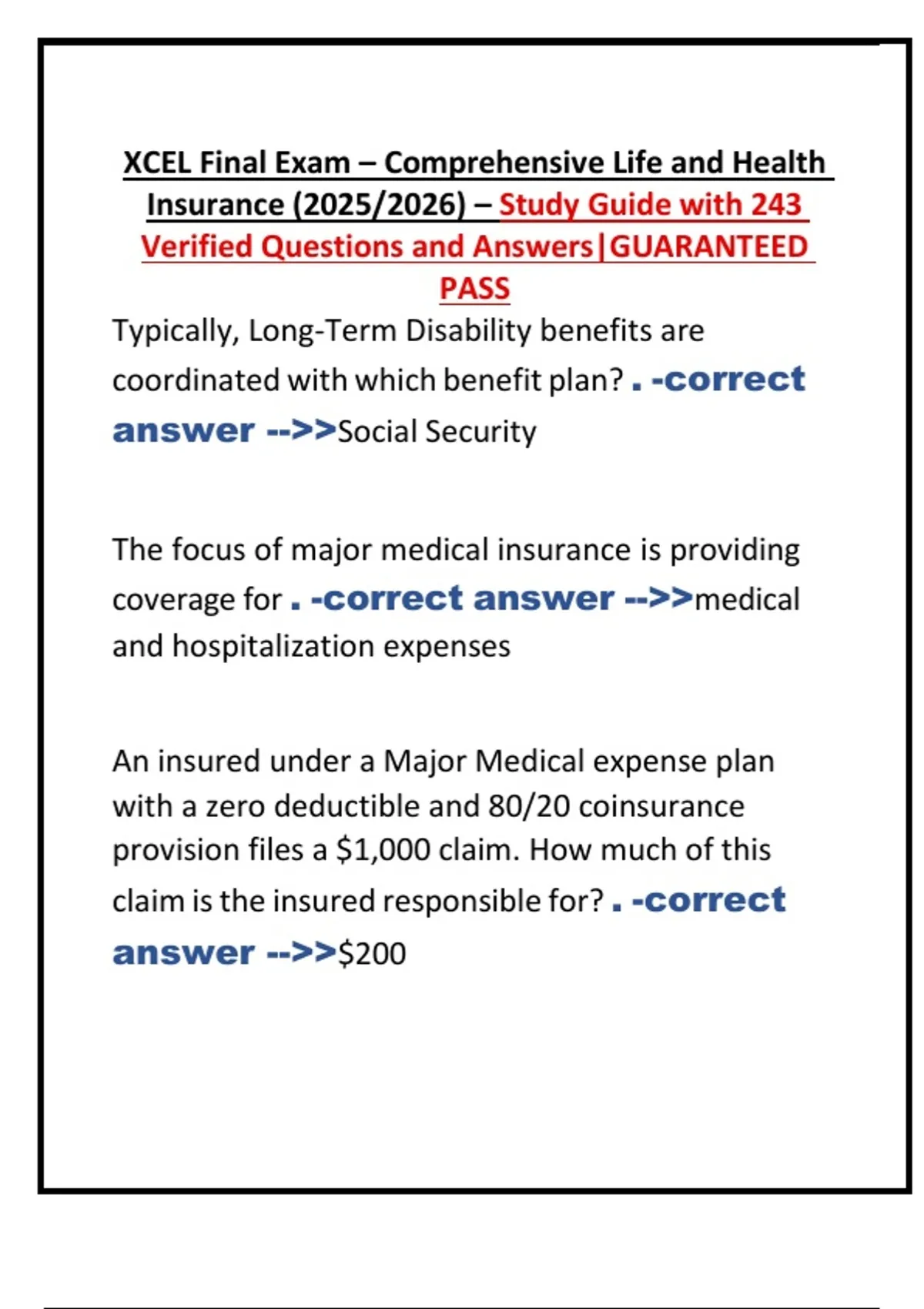
Understanding the Xcel Solutions Group Life Insurance Curriculum for Pre-Licensing Success
To master the Xcel Solutions group life insurance material often found on Quizlet, candidates must focus on three core areas: the legal distinction between master contracts and certificates, the specific participation percentages requi...
To master the Xcel Solutions group life insurance material often found on Quizlet, candidates must focus on three core areas: the legal distinction between master contracts and certificates, the specific participation percentages required for contributory and non-contributory plans, and the rigid 31-day window governing the conversion privilege for departing employees.
Contents
Preparing for a state insurance licensing exam in 2026 remains a rigorous process, and Xcel Solutions is one of the most prominent providers of the required pre-licensing education. Because the volume of information in the life and health insurance curriculum is vast, many students turn to digital flashcard platforms like Quizlet to condense the Xcel curriculum into manageable study sets. However, simply memorizing definitions is rarely enough to pass the exam. You must understand the underlying logic of group dynamics, risk management, and the regulatory frameworks established by the National Association of Insurance Commissioners (NAIC).
The Framework of Group Life Insurance in 2026
Group life insurance differs fundamentally from individual insurance in its structure and legal standing. In the Xcel curriculum, this is typically the first hurdle for students. Unlike an individual policy, where a contract exists between an insurer and a person, group insurance involves a contract between an insurer and a sponsoring entity, such as an employer, labor union, or professional association.
The Master Contract and Certificates of Insurance
One of the most frequently tested concepts is the documentation of coverage. The policyowner is the sponsoring organization (e.g., the employer), and they hold the Master Contract. This document outlines the terms of the coverage, the benefits provided, and the obligations of the sponsor.
The individuals covered under the plan—the employees or members—are not parties to the contract. Instead, they receive a Certificate of Insurance. This certificate serves as evidence of coverage and details the benefit amount and the designated beneficiary. It is a critical distinction in 2026 regulatory environments: the employer owns the policy, but the employee retains the right to name their own beneficiary.
The "Natural Group" Requirement
To prevent "adverse selection," insurance laws require that a group must be a natural group. This means the group must have been formed for a purpose other than obtaining insurance. For example, a business formed to sell software is a natural group; a club formed specifically to help its members get lower life insurance rates is not. This prevents individuals with high-risk health profiles from banding together solely to exploit group underwriting.
Participation Requirements: The 75/100 Rule
Perhaps the most common source of confusion in Xcel study materials is the difference between contributory and non-contributory plans. State regulators enforce participation minimums to ensure that the group remains large and diverse enough to spread risk effectively.
Non-contributory Plans
In a non-contributory plan, the employer pays 100% of the premium. Because the employees are getting the coverage for free, the insurer and state law require 100% participation of all eligible employees. If an employer could choose which employees to cover under a non-contributory plan, they might only cover those who are healthy, or conversely, only those who are sick. Requiring 100% participation eliminates the risk of adverse selection and ensures the "Law of Large Numbers" works in the insurer’s favor.
Contributory Plans
In a contributory plan, the employer and the employee share the premium cost. Because employees must opt-in and pay a portion of the premium, it is unrealistic to expect 100% participation. Consequently, the standard requirement is 75% participation of all eligible employees. This threshold is high enough to prevent the group from being dominated by high-risk individuals (who are more likely to pay for coverage) while allowing for some employees to opt out if they already have sufficient individual coverage.
The Conversion Privilege: The 31-Day Window
The conversion privilege is a mandatory provision in group life insurance that allows an individual to convert their group coverage into an individual policy without providing evidence of insurability (no medical exam). This is a lifesaver for employees with pre-existing conditions who lose their jobs or leave their companies.
Key Rules of Conversion
The Xcel curriculum emphasizes several strict rules regarding this process that are frequently featured in Quizlet study sets:
- The 31-Day Period: The individual has exactly 31 days after leaving the group to exercise the conversion option.
- Type of Policy: The insurer is typically only required to offer a permanent insurance policy (such as Whole Life), not a term policy.
- Premium Rates: The premium for the new individual policy will be based on the individual’s attained age at the time of conversion, making it significantly more expensive than the group rate.
- Death During Conversion: If the individual dies during the 31-day conversion period, the death benefit must be paid by the group policy, even if the individual had not yet applied for the conversion.
This provision ensures that there is no gap in coverage during a career transition. In 2026, many states have further clarified these rights to ensure that employers provide adequate notice of these conversion timelines to departing staff.
Group Underwriting and Eligibility
Underwriting for group life insurance is "wholesale" rather than "retail." Instead of looking at an individual’s medical history, height, weight, and lifestyle, the underwriter looks at the group as a whole.
Characteristics of Group Underwriting
Underwriters focus on the group’s loss ratio (the balance of premiums collected versus claims paid) and the average age and gender distribution of the workforce. If the group is large enough, the insurer can assume that the risk will level out over time. This is why group life insurance is often the only way for individuals with chronic illnesses to obtain affordable coverage.
Eligibility and Probationary Periods
Employers often implement a probationary period (usually 30 to 90 days) for new hires. During this time, the new employee is not yet eligible for the group life insurance. Once the probationary period ends, the enrollment period begins. If an employee joins the plan during the initial enrollment period, they typically do not have to provide a Statement of Good Health. If they wait and try to join later (during a "late enrollment"), the insurer may then require medical underwriting to ensure the employee isn't joining because they recently received a bad medical diagnosis.
Taxation of Group Life Insurance (IRS Section 79)
The Xcel Solutions curriculum aligns closely with Internal Revenue Code Section 79, which dictates how group life insurance is taxed. This is a technical area where many students struggle.
For an employee, the premiums paid by an employer for the first $50,000 of group term life insurance are not considered taxable income. This is a significant tax benefit. However, if the employer provides coverage in excess of $50,000, the "cost" of the coverage above that amount (calculated using IRS "Table I" rates, not the actual premium paid) must be reported as taxable income for the employee.
The death benefit from a group life insurance policy is generally received by the beneficiary income tax-free, which is consistent with the taxation of individual life insurance proceeds.
Comparison: Group vs. Individual Life Insurance
The following table summarizes the primary differences as defined in the 2026 Xcel Solutions pre-licensing materials.
| Feature | Group Life Insurance | Individual Life Insurance |
|---|---|---|
| Evidence of Insurability | Usually not required (during enrollment) | Usually required (medical exam/records) |
| Contract Holder | The Employer (Sponsor) | The Individual (Policyowner) |
| Proof of Coverage | Certificate of Insurance | Actual Insurance Policy |
| Selection of Coverage | Employer/Insurer decides limits | Policyowner decides limits |
| Cost Basis | Group demographics and loss history | Individual health and lifestyle |
| Conversion Rights | Statutory right to convert within 31 days | No conversion (policy is already individual) |
| Taxation of Premiums | First $50,000 tax-free for employees | Generally not tax-deductible |
Effective Study Strategies for Xcel Materials
When using Quizlet or other digital aids to master the Xcel curriculum, it is essential to move beyond rote memorization. The licensing exam often uses situational questions (e.g., "John leaves his job on March 1st and dies on March 15th without having applied for conversion. What happens?") rather than direct definition questions.
- Focus on "The Why": Don't just memorize that 75% participation is required for contributory plans. Remember that it exists to prevent Adverse Selection—the tendency for high-risk individuals to seek insurance more aggressively than healthy ones.
- Learn the Timeframes: The insurance exam is full of specific numbers. Create a separate category for "Time-Based Rules," such as the 31-day conversion period and the 2-year incontestability clause.
- Understand the Parties: Clearly define the roles of the Insurer, the Applicant (Employer), and the Insured (Employee). Note that in group insurance, the applicant and the policyowner are the same entity (the employer).
Frequently Asked Questions
What is the most important rule regarding group life insurance conversion?
The most critical rule is the 31-day window. If an employee fails to apply for an individual policy within 31 days of termination, they lose their right to convert without a medical exam. Furthermore, if they die within those 31 days, the group policy must pay the claim regardless of whether they had started the conversion process.
Can an employer be the beneficiary of a group life insurance policy?
No. In most jurisdictions, and according to NAIC standards used in Xcel materials, the employer cannot be the beneficiary. Group life insurance is designed to benefit the employees' families or designated survivors. Allowing the employer to be the beneficiary would create a conflict of interest and violate the "insurable interest" principles applied to group settings.
What happens if the participation percentage falls below the required limit?
If participation in a contributory plan falls below 75%, or a non-contributory plan falls below 100%, the insurer typically has the right to cancel the master policy or increase the premiums significantly. This is because the risk pool is no longer considered stable or balanced.
Why is group life insurance usually cheaper than individual life insurance?
Group insurance is less expensive due to lower administrative costs (one master policy instead of hundreds of individual ones), reduced marketing expenses, and the absence of individual medical underwriting. The insurer processes the group as a single unit, which is much more efficient than processing individuals.
Is the conversion policy always Whole Life insurance?
While state laws vary slightly, the general rule in the Xcel curriculum is that the insurer must offer a permanent form of insurance, which is typically Whole Life. They are not required to offer term insurance for the converted policy, which contributes to the higher premiums individuals face after converting.
Practical Recommendation
If you are preparing for your licensing exam in 2026, treat the Xcel Group Life Insurance section as a logic puzzle. Master the relationship between the employer (policyowner) and the employee (certificate holder) first. Once you understand who owns the policy and who is covered, the rules regarding participation, conversion, and taxation will fall into place more naturally. Use Quizlet for the final "polish" of your vocabulary, but rely on the Xcel textbook and practice exams to understand how these rules are applied in the scenarios you will face on the actual state exam.
Image Gallery