Consumers Energy Michigan Power Outage Map: 2026 Real-Time Tracking and Reporting Guide
To track or report a service interruption, the Consumers Energy Michigan power outage map provides the most accurate real-time data for the Lower Peninsula. This interactive tool allows customers to view affected areas, check restorati...
To track or report a service interruption, the Consumers Energy Michigan power outage map provides the most accurate real-time data for the Lower Peninsula. This interactive tool allows customers to view affected areas, check restoration progress, and receive estimated time of restoration (ETR) based on current field crew assessments and smart meter diagnostics.
Contents
Navigating the Consumers Energy Interactive Outage Map
The Consumers Energy outage map is a sophisticated GIS (Geographic Information System) interface designed to provide transparency during major weather events and routine maintenance. As of 2026, the interface has been optimized for low-bandwidth mobile performance, ensuring that customers with limited cellular data during a storm can still access critical updates.
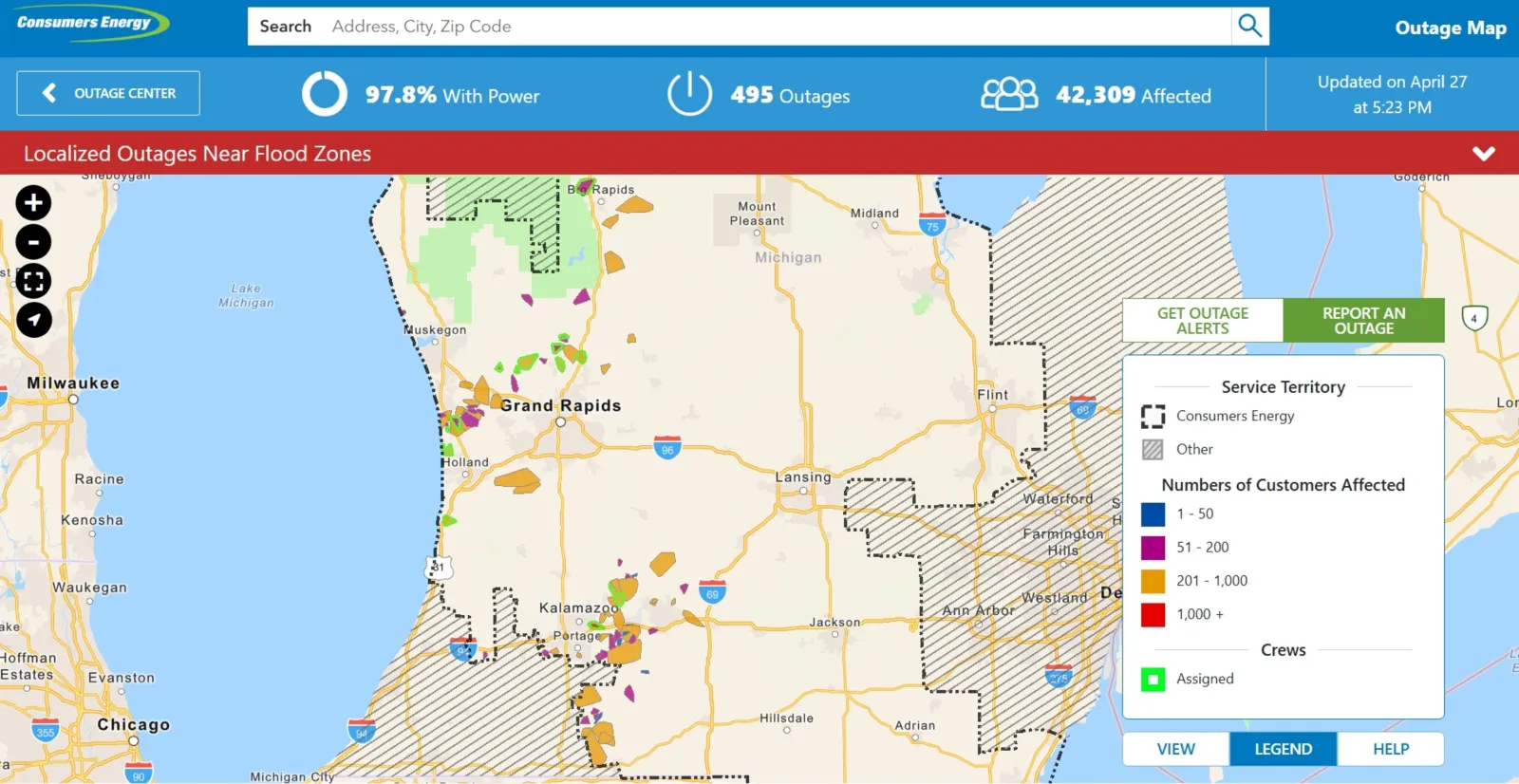
When you first access the map, you are presented with a high-level view of the Michigan Lower Peninsula. The map uses color-coded clusters to indicate the density of outages. By clicking on specific icons, you can drill down to the street level to see the status of your specific neighborhood. The system integrates data from SCADA (Supervisory Control and Data Acquisition) systems and AMI (Advanced Metering Infrastructure), which means the map often updates automatically when a smart meter loses its "heartbeat" signal.
Map Layers and Filtering Options
To get the most out of the tool, users should utilize the layer toggle, typically located in the top-right corner of the interface. In 2026, the following layers are available to provide deeper context:
- Individual Outages: Displays specific points where power is lost. Clicking these points reveals the cause (e.g., equipment failure, fallen tree, or vehicle accident) and the number of customers affected.
- County and ZIP Code Summaries: Provides a broader statistical overview, which is useful for media and emergency management officials to identify regional impact.
- Restoration Status: Icons change color based on the stage of repair, moving from "Reported" to "Crew Assigned" to "Crew On-Site."
- Weather Overlay: A real-time radar layer that allows you to see approaching storm fronts in relation to current outage clusters.
Reporting an Outage in 2026: Digital and Traditional Methods
While smart meters notify Consumers Energy of most outages automatically, reporting your specific outage ensures that the utility company is aware of "nested outages." A nested outage occurs when a main line is repaired, but a smaller fuse or transformer serving a specific home remains damaged.
Critical Reporting Protocols
Immediate Danger Reporting If you see a downed power line, stay at least 25 feet away and call 911 immediately. After contacting emergency services, report the line to Consumers Energy at 800-477-5050. Never use the online map to report a downed wire, as these require immediate human dispatch intervention.
Standard Interruption Reporting For standard loss of power without immediate physical danger, use the digital reporting tool on the outage map page. This requires either your account number or the phone number associated with the account.
Automated Communication Channels
Consumers Energy has streamlined the reporting process through several high-efficiency channels:
- Text Alerts: Text "OUT" to 232273 (CECARE). The system will recognize your mobile number if it is linked to your account and provide an instant confirmation of the outage status in your area.
- Mobile App: The 2026 version of the Consumers Energy app includes "One-Touch Reporting," which utilizes your phone's GPS to pin the outage location even if you don't know your account details.
- Voice Recognition (IVR): Calling the main customer service line uses an automated voice system that can process outage reports in under 60 seconds without needing to wait for a human representative.
The Restoration Process: How Priority is Determined
Following a significant storm in Michigan, Consumers Energy follows a standardized, industry-leading restoration hierarchy. Understanding this process helps manage expectations regarding your Estimated Time of Restoration (ETR).
Restoration Priority Hierarchy
| Priority Level | Infrastructure Type | Description of Action |
|---|---|---|
| Level 1 | Public Safety & Critical Care | Downed live wires, hospitals, police/fire stations, and water treatment plants. |
| Level 2 | Main Transmission Lines | High-voltage lines that feed thousands of customers across entire regions. |
| Level 3 | Substation Circuits | Repairing the "heart" of the local grid to restore power to large neighborhoods. |
| Level 4 | Branch Lines & Fuses | Lines serving individual streets or small groups of homes. |
| Level 5 | Individual Service Drops | The line running from the transformer directly to a single home or business. |
The "Estimated Time of Restoration" shown on the map is a dynamic calculation. Initially, it may show "Pending Assessment." Once a field scout or crew lead arrives on-site and evaluates the damage (e.g., "three broken poles" vs. "one blown fuse"), the ETR is updated to a specific time.
2026 Grid Reliability and the "Reliability Roadmap"
By 2026, Consumers Energy has significantly advanced its "Reliability Roadmap," a long-term capital investment plan designed to reduce both the frequency and duration of outages. This plan is a direct response to the increasingly volatile weather patterns seen in the Great Lakes region.
Infrastructure Hardening and Smart Technology
A major component of the 2026 grid is the deployment of "Self-Healing Grid" technology. This involves automated reclosers—essentially high-tech circuit breakers—that can detect a fault (like a tree branch touching a wire) and automatically reroute power around the damaged section. On the outage map, this might appear as a temporary "flicker" for many customers, while only a small handful remain in the dark, rather than an entire circuit going down.
Furthermore, Consumers Energy has increased its investment in:
- Strategic Undergrounding: Relocating overhead lines in areas with dense tree canopies or high historical failure rates to underground conduits.
- Aggressive Vegetation Management: A rigorous cycle of tree trimming that uses satellite imagery and AI to predict where growth is most likely to interfere with power lines.
- Pole Upgrades: Replacing aging wooden poles with ductile iron or composite materials that withstand higher wind speeds and ice loads.
Essential Safety and Preparation Guidelines
Living in Michigan requires a proactive approach to power interruptions, particularly during the winter months or the peak of the summer storm season.
Home Preparation Checklist
- Emergency Kit: Maintain a kit containing flashlights, fresh batteries, a battery-powered radio, and a 72-hour supply of non-perishable food and water (one gallon per person per day).
- Medical Equipment: If you rely on life-support equipment, ensure you are registered with Consumers Energy’s "Critical Care" list. This does not guarantee immediate restoration, but it assists the utility in prioritizing your area and allows them to provide advance notice of planned outages.
- Generator Safety: Never run a portable generator inside a home, garage, or any enclosed space. Carbon monoxide is odorless and deadly. Always use a transfer switch installed by a licensed Michigan electrician to prevent "backfeeding," which can be fatal to utility workers.
Food Safety During Outages
According to USDA standards followed by Michigan health departments, your refrigerator will keep food safe for about 4 hours if unopened. A full freezer will hold its temperature for approximately 48 hours (24 hours if half-full). If the outage map indicates a restoration time exceeding these windows, consider moving perishable items to a cooler with ice or a friend's house outside the affected zone.
Comparison: Consumers Energy vs. Regional Utility Tracking
Michigan consumers often compare the digital tools provided by the state's two largest investor-owned utilities. In 2026, the technical gap has narrowed as both have adopted advanced GIS platforms.
| Feature | Consumers Energy Map | DTE Energy Map |
|---|---|---|
| Real-Time Refresh Rate | 5 - 15 Minutes | 5 - 15 Minutes |
| Cause of Outage Listed | Yes (Detailed) | Yes (General) |
| Smart Meter Integration | Full (AMI Phase 3) | Full |
| Weather Overlay | Yes (Live Radar) | Yes (Static Forecast) |
| Mobile App Support | Native iOS/Android | Native iOS/Android |
| Crew Status Tracking | Yes (Visual Icons) | Yes (Text Updates) |
Frequently Asked Questions
Why does the map show my power is on when it is actually off?
This usually indicates a "nested outage." The main circuit serving your neighborhood may have been successfully energized, but the specific transformer or service drop connecting to your home remains damaged. If the map shows your area as restored but you are still in the dark, you must report the outage again to trigger a secondary investigation.
How accurate are the restoration estimates (ETR) on the map?
The ETR is an estimate based on average repair times for specific types of damage. In 2026, these estimates are enhanced by historical data and real-time crew feedback. However, if a crew arrives and finds more extensive damage than initially reported, the ETR will be "pushed back" to reflect the actual work required.
Can I get a credit on my bill for a power outage?
The Michigan Public Service Commission (MPSC) mandates that utilities provide credits under specific conditions, such as outages lasting longer than 96 hours under normal conditions or 120 hours during catastrophic conditions. By 2026, these credits are often applied automatically for customers with smart meters, but it is always advisable to check the Consumers Energy "Outage Credit" page to ensure eligibility.
What do the different colors on the Consumers Energy map mean?
The map uses a color spectrum to indicate the number of customers affected in a specific area. Typically, green or yellow represents smaller, localized outages (1-50 customers), while orange, red, and purple represent larger scale interruptions (500+ customers). This allows users to quickly distinguish between a neighborhood fuse issue and a major substation failure.
Does Consumers Energy track outages for other utilities?
No, the Consumers Energy map only displays information for their specific service territory. If you live in a region served by a municipal utility (like Lansing Board of Water & Light) or a rural electric co-op, you must use their specific outage portals. The map will show these areas as "non-service zones."
Actionable Next Steps for Michigan Residents
To minimize the impact of future power interruptions, all Consumers Energy customers should take three immediate actions:
- Update Contact Info: Ensure your current mobile number is linked to your account via the Consumers Energy portal to enable seamless text reporting.
- Download the 2026 App: Having the GIS-integrated app ready on your smartphone ensures you aren't trying to find account numbers in the dark.
- Review Your Surge Protection: With the increased frequency of grid switching during restoration, high-quality surge protection for sensitive electronics is a critical investment for modern Michigan households.
By staying informed through the Michigan power outage map and following official safety protocols, consumers can navigate utility interruptions with minimal risk and clear expectations for a return to normal service.
Image Gallery