How to Read Your State Farm Auto Insurance Card: A Complete Guide
To read your State Farm auto insurance card, locate the policy number, effective and expiration dates, vehicle identification number (VIN), named insured, and NAIC company code on the front of the card. While this card serves as legal...
To read your State Farm auto insurance card, locate the policy number, effective and expiration dates, vehicle identification number (VIN), named insured, and NAIC company code on the front of the card. While this card serves as legal proof of financial responsibility, full dollar coverage limits and deductibles are detailed on your policy Declarations Page or inside the State Farm mobile app.
Contents
Disclaimer: This guide is provided for general informational purposes only and does not constitute formal legal or financial advice. Policy formats and state reporting requirements vary by jurisdiction. For specific questions regarding your auto policy coverage limits or active status, consult your licensed State Farm agent or official insurance policy documents.
What Information Is (and Isn't) on Your State Farm Insurance Card?
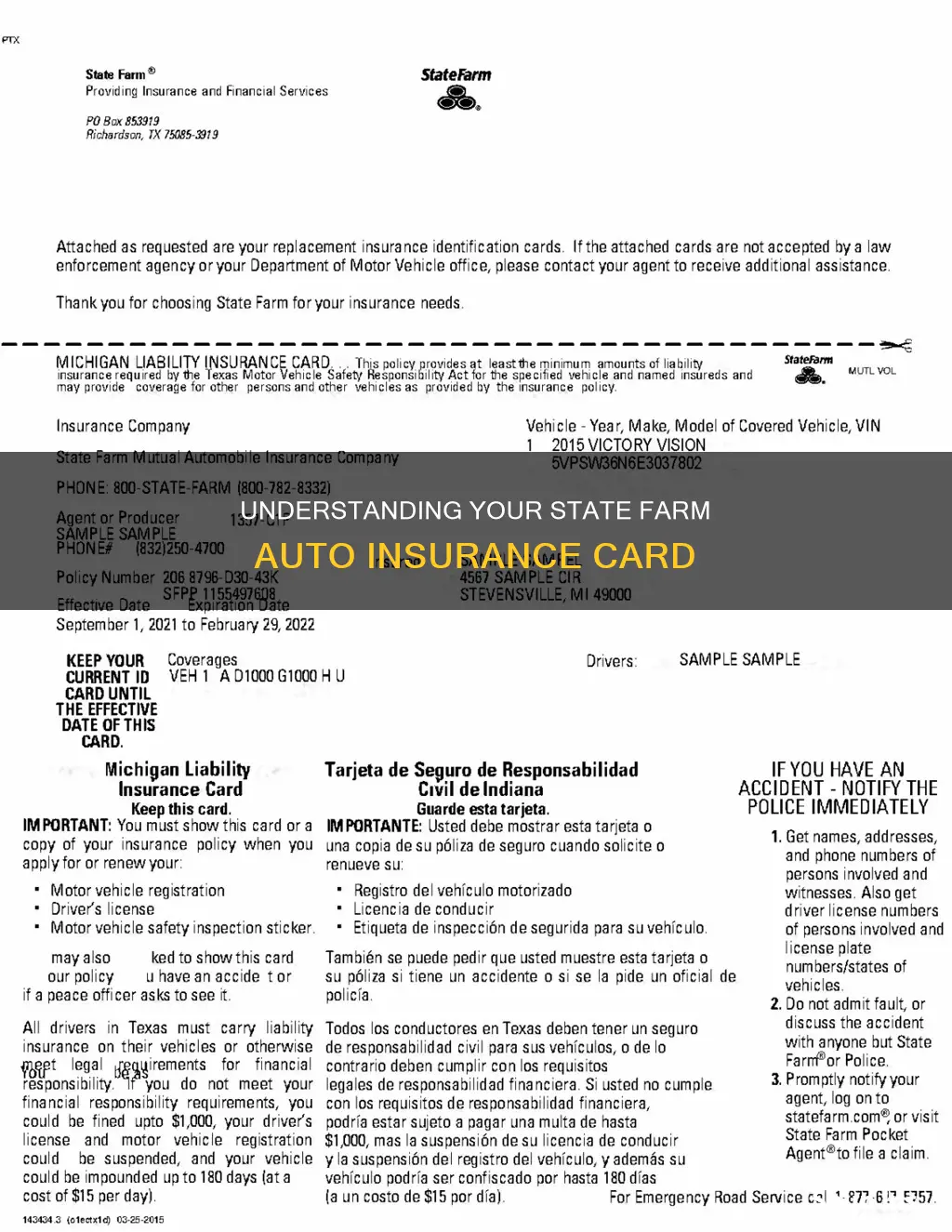
An auto insurance identification card is designed primarily as proof of financial responsibility. State law enforcement officers, state departments of motor vehicles (DMVs), and involved parties after an accident use this card to verify that your vehicle meets minimum state-mandated liability insurance requirements.
Because the physical or digital card must fit easily into a wallet or smartphone screen, it presents a condensed overview of your account details rather than your full insurance policy contract.
| STATE FARM INSURANCE COMPANIES | PROOF OF INSURANCE CARD |
|---|---|
| POLICY NUMBER: 123 4567-A01-12C | EFFECTIVE DATES |
| NAIC NO: 25178 | 01/15/2026 TO 07/15/2026 |
| INSURED:Jane Doe123 Main StreetCity, ST 12345 | VEHICLE:2023 Honda CR-VVIN: 1HGCR2F83HA000000 |
| AGENT: John Smith Insurance Agency Inc | PHONE: (555) 019-2831 |
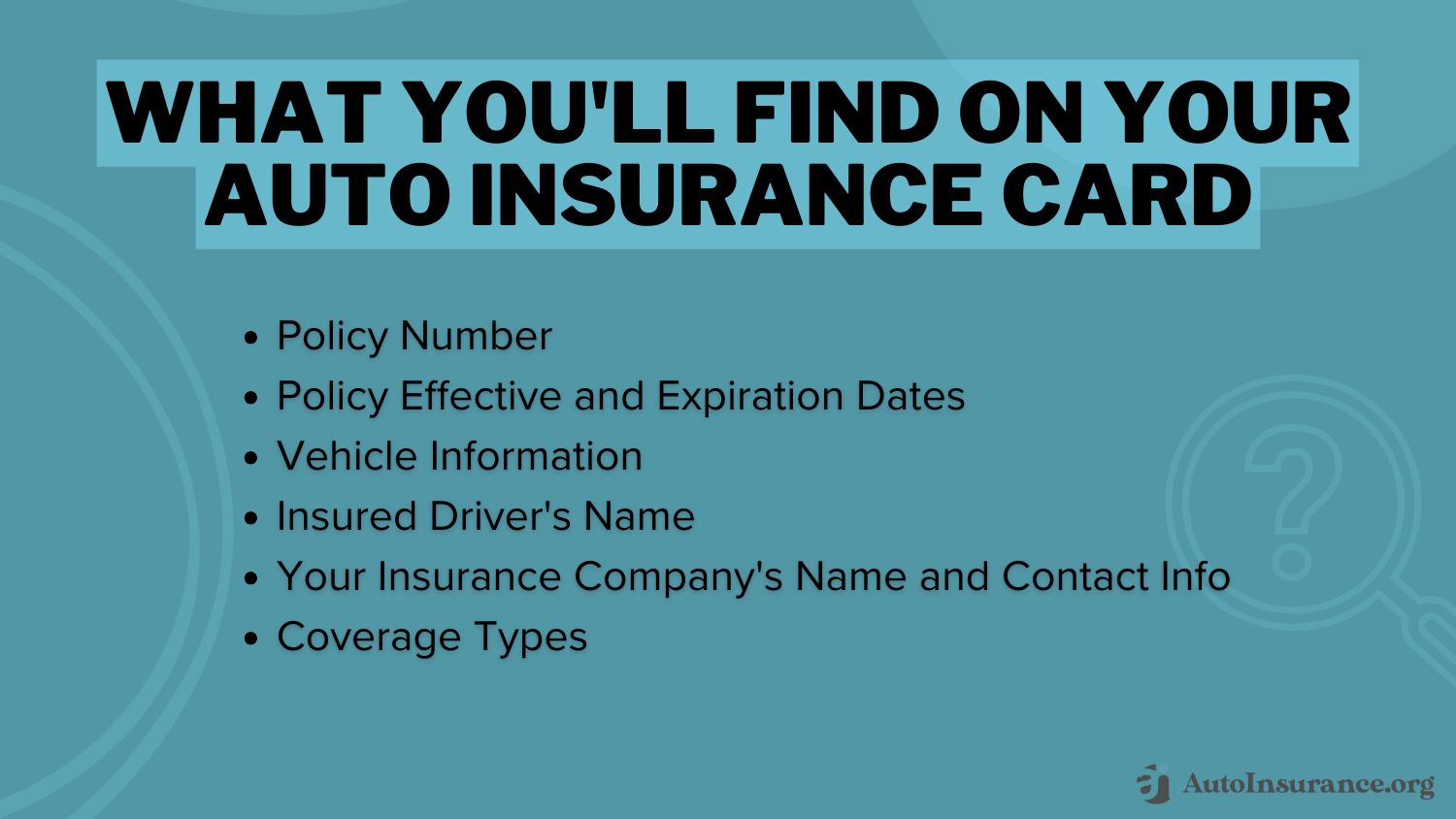
What You Will Find on the Card
- Policy Number: The master identifier for your State Farm auto account.
- Named Insured: The primary policyholder (and sometimes additional listed drivers).
- Vehicle Identification Details: Year, make, model, and 17-digit Vehicle Identification Number (VIN).
- Policy Period: The exact effective and expiration dates of your current policy term.
- Insurance Company & NAIC Code: The specific State Farm underwriting entity and its National Association of Insurance Commissioners identifier.
- Agent Contact Information: The name, office address, and telephone number of your assigned State Farm agent.
- State Compliance Information: State-specific registration numbers, barcodes, or legal notices required by local legislation.
What You Will Not Find on the Card
- Coverage Limits: Specific dollar amounts for Bodily Injury Liability, Property Damage Liability, or Personal Injury Protection (e.g., $100,000/$300,000/$100,000).
- Deductibles: The out-of-pocket amounts you pay before Comprehensive or Collision coverage kicks in (e.g., $500 or $1,000).
- Optional Endorsements: Details regarding roadside assistance, car rental expense coverage, or rideshare add-ons.
- Excluded Drivers: Complete listings of non-covered or excluded household drivers.
To review dollar limits, deductibles, and optional coverages, you must check your policy Declarations Page (also known as the "Dec Page") or access your digital portal.
Step-by-Step Breakdown of a State Farm Auto Insurance Card
Whether you hold a paper card printed by your agent, a card mailed by State Farm, or a digital ID card saved to your smartphone Apple Wallet or Google Wallet, the layout follows a standardized, easy-to-read structure.
- State Farm Auto Insurance ID
- Policy Details
- Policy No.
- Term Dates
- Vehicle Details
- Year/Make
- 17-digit VIN
- Agency & State
- Agent Phone
- NAIC Code
- Policy Details
1. Policy Identification & Policy Number
Your State Farm policy number is the most critical alphanumeric code on the card. It is typically formatted in distinct segments, such as 123 4567-A01-12C or a similar state-specific sequence.
- Base Policy Number (7 digits): Identifies your core account file within State Farm's database.
- Policy Symbol / State Prefix: Indicates the vehicle sequence, type of coverage form, or state jurisdiction governing the policy.
- Term / Amendment Code: Indicates policy renewals or specific revisions made during the policy period.
When calling customer service, filing a claim, or registering your vehicle at the DMV, this is the exact number you must provide.
2. Insured Name and Address
This section lists the primary named insured—the person who owns or leases the policy. If multiple individuals are primary policyholders (such as spouses), both names may appear on the card.
- Address Verification: Ensure the address listed matches your legal residential or garaging address. An outdated address on your insurance card can cause verification delays during traffic stops or vehicle registration updates.
- Driver Listing: The card does not list every secondary driver (such as dependent teenagers). As long as a household driver is listed on the underlying policy contract, they are covered while operating the insured vehicle.
3. Vehicle Information (Year, Make, Model, VIN)
Each insurance card is tied to a specific vehicle.
- Year, Make, Model: Verifies that the card matches the physical vehicle you are driving (e.g., "2024 Toyota RAV4").
- Vehicle Identification Number (VIN): The 17-character unique code stamped on your vehicle. Law enforcement officers cross-reference the VIN on your physical vehicle dashboard or door jamb with the VIN on your State Farm card to confirm that the insurance matches the exact vehicle being operated.
4. Effective and Expiration Dates
The policy period displays the exact timeframe during which your coverage is active (for example, EFF: 01/15/2026 EXP: 07/15/2026).
- Policy Term: State Farm auto insurance policies are typically written in 6-month or 12-month increments.
- Lapse Risks: If a traffic stop occurs at 12:01 AM on the day after your expiration date without a renewed card or active policy status, law enforcement will cite you for driving without valid proof of insurance.
5. Insurance Company Name and NAIC Number
State Farm operates through several subsidiary corporate entities depending on your state and coverage type. The card clearly identifies the underwriting company, such as State Farm Mutual Automobile Insurance Company or State Farm Fire and Casualty Company.
Directly adjacent to or beneath the company name is the NAIC (National Association of Insurance Commissioners) Code.
- What is the NAIC Code? It is a mandatory 5-digit number assigned to licensed insurance companies in the United States (e.g., NAIC #25178).
- Why It Matters: State DMVs and vehicle registration offices require this exact 5-digit code to log your coverage into automated state compliance databases.
6. Agent Information and Phone Number
State Farm operates primarily through a local agent network. Your card includes:
- The agent's legal office or business name.
- The agent's direct telephone number.
- The 24/7 customer service or emergency claim filing phone number.
If you are involved in an accident, this phone number connects you or law enforcement directly to your agent's office to initiate the claim process.
7. State-Specific Codes and Verification Features
Depending on the state where your vehicle is registered, your card may include additional specialized fields:
- New York State: Features a 3-digit DMV code (State Farm is typically identified by code
744) along with a scannable 2D barcode. - Florida / California: Contains specific legal declarations confirming compliance with state-mandated minimum financial responsibility laws.
- Digital Cards: Feature secure digital verification seals or real-time refresh capability within the State Farm app.
State Farm Auto Insurance Card Element Reference Table
The following table summarizes every key field found on a standard State Farm proof of insurance card, what it represents, and where to locate additional details:
| Field Name | Description / Example | Primary Use | Where to Find Dollar Limits / Deductibles |
|---|---|---|---|
| Policy Number | 123 4567-A01-12C |
Unique identifier for claims, billing, and DMV records. | Listed at the top of the Declarations Page. |
| Named Insured | Jane Doe, John Doe | Identifies primary policy owner(s). | Listed under "Named Insured" on the Dec Page. |
| Vehicle Info | 2023 Honda CR-V | Verifies the physical car associated with the policy. | Listed under "Schedule of Covered Vehicles." |
| 17-Digit VIN | 1HGCR2F83HA000000 |
Verifies vehicle identity against state registries. | Dec Page, vehicle title, and vehicle registration. |
| Effective Dates | 01/15/2026 to 07/15/2026 |
Defines active policy start and end dates. | Dec Page header & renewal schedules. |
| NAIC Code | 25178 |
5-digit national carrier code required by state DMVs. | Regulatory filings & policy cover sheet. |
| Agent Details | Agency Name & Phone | Direct contact for claims, changes, and billing queries. | Dec Page footer & State Farm website/app. |
| State Code / Barcode | E.g., NY DMV Code 744 |
Required for state DMV computer registration databases. | Physical ID Card / Official Electronic ID. |
How to Find Your Detailed Coverage Limits Beyond the Card
Because your State Farm insurance card only confirms that active insurance exists, you must access your Policy Declarations Page or mobile application to review exact coverage amounts.
| POLICY DECLARATIONS PAGE | |
|---|---|
| POLICY NUMBER: 123 4567-A01-12C | POLICY PERIOD: 01/15/2026-07/15/2026 |
| COVERAGES & LIMITS OF LIABILITY | PREMIUML |
| A. BODILY INJURY LIABILITYEach Person: $100,000 / Each Accident: $300,000 | $210.00 |
| B. PROPERTY DAMAGE LIABILITYEach Accident: $100,000 | $140.00 |
| C. COMPREHENSIVE COVERAGE$500 Deductible | $65.00 |
| D. COLLISION COVERAGE$500 Deductible | $120.00 |
| E. MEDICAL PAYMENTSEach Person: $5,000 | $25.00 |
Key Coverages to Review on Your Declarations Page
- Bodily Injury Liability (BI):
- What it pays for: Medical expenses, lost wages, and legal defense if you injure another driver or passenger in an accident.
- How it is written: Expressed as split limits like $100,000/$300,000 ($100,000 maximum per person; $300,000 maximum total per accident).
- Property Damage Liability (PD):
- What it pays for: Damage you cause to another person’s vehicle, structure, fence, or public property.
- How it is written: Expressed as a single limit, such as $100,000.
- Comprehensive Coverage (Other Than Collision):
- What it pays for: Damage to your vehicle caused by theft, vandalism, weather events, fire, or animal strikes.
- What to look for: Your chosen deductible (e.g., $250, $500, or $1,000).
- Collision Coverage:
- What it pays for: Damage to your vehicle caused by a collision with another car or stationary object (tree, guardrail), regardless of fault.
- What to look for: Your deductible amount.
- Personal Injury Protection (PIP) / Medical Payments (MedPay):
- What it pays for: Initial medical costs for you and your passengers regardless of who caused the accident. Required in no-fault states.
- Uninsured / Underinsured Motorist Coverage (UM/UIM):
- What it pays for: Your medical expenses and property damage if hit by a driver who has no insurance or insufficient coverage limits.
Accessing Full Coverage Details Online or Mobile
You can view or download your complete Declarations Page at any time:
- State Farm Mobile App: Open the app, select Insurance, choose your vehicle, and tap View Policy Documents or View ID Card.
- State Farm Web Portal: Log in at State Farm's official portal, navigate to Documents, and select your latest Auto Policy Declarations.
Common Issues on Insurance Cards and How to Fix Them
Errors or missing updates on your insurance card can cause complications with law enforcement or vehicle licensing agencies. Review these common scenarios:
1. The VIN Has a Typo
Even a single incorrect letter or digit in your 17-character VIN can lead to a rejected vehicle registration or a delayed insurance claim.
- Fix: Compare the VIN on your driver’s side dashboard or vehicle title against the card. If they do not match exactly, contact your State Farm agent immediately to issue a corrected card.
2. A Newly Added Driver Is Not Listed
It is standard for paper and digital ID cards to show only the primary policyholder's name. As long as secondary household members (such as teenagers or spouses) are added to the master account file, they are fully covered when driving the vehicle.
- Fix: Confirm driver status by viewing the full driver roster on your mobile app or Declarations Page.
3. You Purchased a New Vehicle
When replacing or adding a vehicle, your agent will issue a temporary binder or temporary ID card.
- Fix: State Farm typically grants a brief grace period (often 14 to 30 days depending on state rules and policy provisions) to add a replacement vehicle to an active policy. Ensure you request an updated card reflecting the new vehicle's VIN right away.
4. Expired ID Card
Carrying an expired insurance card is treated as failure to provide proof of financial responsibility in many jurisdictions, resulting in fines or court summonses even if your policy is fully paid and active.
- Fix: Download the latest digital card onto your smartphone via the State Farm app, or print a current replacement card online.
Frequently Asked Questions
Does my State Farm insurance card show my deductibles?
No. State Farm insurance cards serve as legal proof of coverage for law enforcement and DMVs, so they only list basic identifying information (policy number, VIN, effective dates, and policyholder name). To see your Comprehensive and Collision deductibles, check your policy Declarations Page or log into the State Farm mobile app.
Is a digital State Farm insurance card legally acceptable in my state?
Nearly all U.S. states and territories legally permit drivers to present digital proof of insurance on a mobile device during traffic stops or vehicle registrations. You can access an official electronic ID card through the State Farm mobile app and save it directly to Apple Wallet or Google Wallet for offline access.
What is the 5-digit NAIC number on my State Farm card?
The NAIC number is a unique 5-digit identifier assigned to insurance companies by the National Association of Insurance Commissioners. State DMVs require this code (e.g., #25178 for State Farm Mutual Automobile Insurance Company) to verify electronic coverage records in state licensing databases.
Why doesn’t my spouse's or child's name appear on the insurance card?
State Farm insurance cards usually display only the primary named insured(s) due to space limitations. All authorized drivers listed on your policy master file are fully covered when operating the insured vehicle. You can verify all listed household drivers by checking your Declarations Page.
What should I do if the information on my insurance card is incorrect?
If you notice an error in your name, address, policy dates, or 17-digit VIN, contact your State Farm agent's office immediately. Operating a vehicle with inaccurate insurance details can cause delays during claims processing or result in legal citations from local police and DMVs.
Practical Recommendations for Policyholders
- Keep Both Physical and Digital Copies Accessible: Store a current paper ID card in your vehicle's glove compartment, and download a digital copy to your smartphone's wallet app. This guarantees access to proof of coverage even if your phone battery dies or internet connectivity is unavailable.
- Verify the VIN Annually: Double-check every character of your vehicle's 17-digit VIN on your annual renewal cards to prevent administrative issues during vehicle inspections or registration renewals.
- Review Full Coverages at Renewal: Do not rely on your ID card to audit your protection. Review your complete Declarations Page at least once per year with your State Farm agent to ensure your bodily injury limits, property damage limits, and deductibles reflect your current financial needs.
Image Gallery