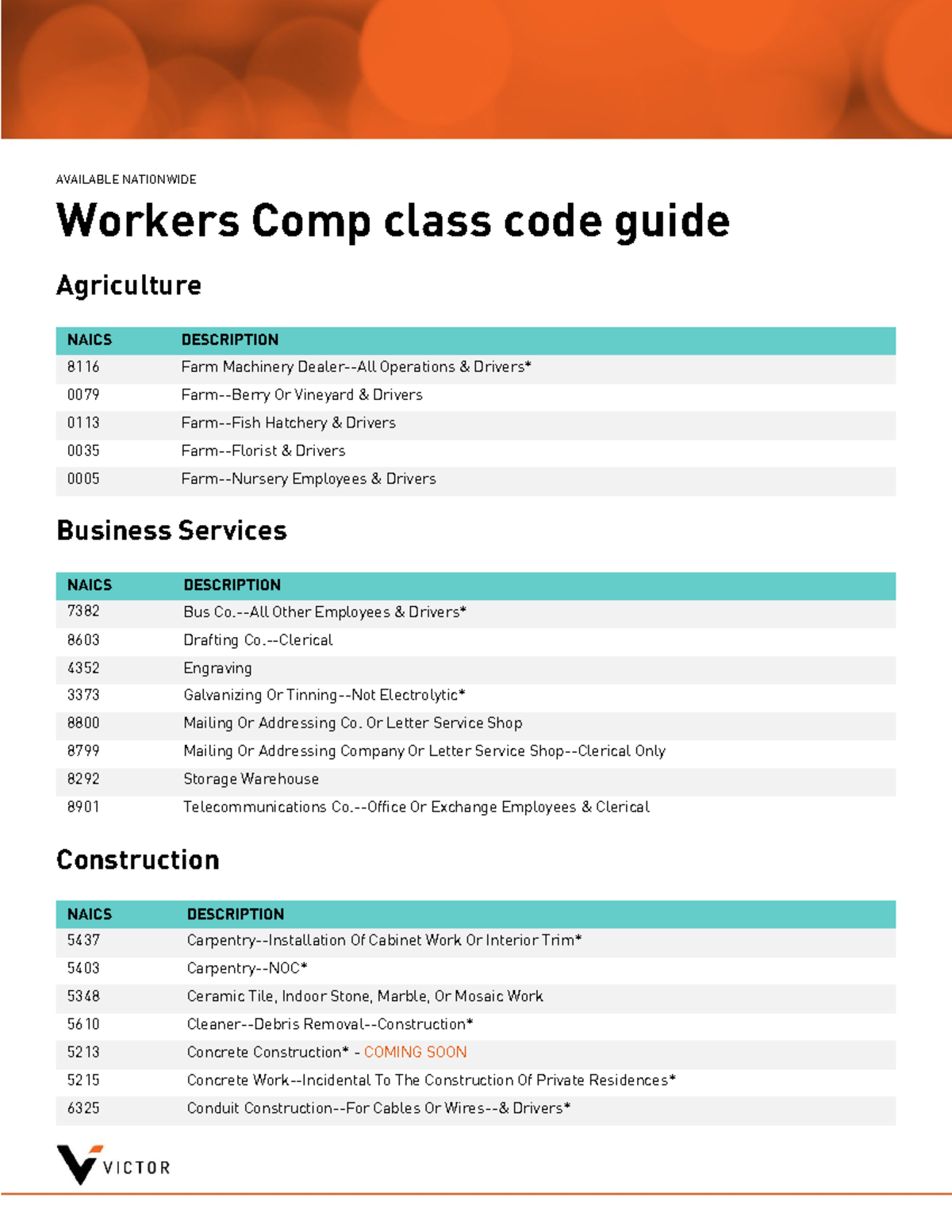
NYC Workers' Compensation Class Codes for Mining Operations and Business Lookup Guide
In New York, the primary workers' compensation class code for underground mining is Code 1164, while surface mining is categorized under Code 1165. Related extraction operations, such as quarrying and sand or gravel digging, fall under...
In New York, the primary workers' compensation class code for underground mining is Code 1164, while surface mining is categorized under Code 1165. Related extraction operations, such as quarrying and sand or gravel digging, fall under Code 1624 and Code 4000, respectively. If you are searching for your individual business’s assigned code, classifications are administered statewide by the New York Compensation Insurance Rating Board (NYCIRB).
Contents
Understanding New York Workers' Compensation Classification Codes
Workers' compensation classification codes in New York State—including New York City—are distinct operational identifiers used by insurance carriers to assess workplace risk and calculate premiums. While most U.S. states follow the classification system managed by the National Council on Compensation Insurance (NCCI), New York operates as an independent jurisdiction. Rates and classification definitions are established by the New York Compensation Insurance Rating Board (NYCIRB) and approved by the New York State Department of Financial Services (DFS).
Each four-digit code represents a specific business operation rather than an individual job title. Every employee in a facility or field operation is typically grouped under the governing classification code of the business, unless specific rules allow for standard exceptions such as clerical office employees (Code 8810) or outside sales personnel (Code 8742).
Accurate classification is critical for regulatory compliance and financial accuracy. Assigning an incorrect code can lead to substantial premium overcharges, unexpected back-audits, or legal penalties from the New York State Workers' Compensation Board for non-compliance or misreporting.
Key Class Codes for Mining, Extraction, and Quarry Operations in NY
The NYCIRB maintains explicit definitions for mining, excavation, and raw material processing. Because extraction work involves significant physical risk, heavy machinery, and underground hazards, the Rating Board strictly enforces operational boundaries between surface, sub-surface, and material processing activities.
- New York Mining & Extraction Classifications
- Underground Mining (Code 1164)
- Shaft sinking
- Sub-surface extraction
- Tunnels & drifts
- Surface Mining (Code 1165)
- Open-pit mining
- Heavy slope digging
- Strip operations
- Quarry & Gravel (Code 1624 / Code 4000)
- Rock crushing
- Sand & gravel pits
- Dredging & screening
- Underground Mining (Code 1164)
Class Code 1164: Mining - Underground - NOC & Drivers
- Scope: Covers all sub-surface mining operations not otherwise classified (NOC). This includes underground excavation, shaft sinking, driving tunnels, drift development, and underground hauling.
- Included Operations: Mine development, timbering, underground transport of ore or minerals, ventilation maintenance, and drivers transporting raw material from the mine entrance.
- Key Exclusions: Surface processing plants or refineries located separate from mine mouth operations, or specialized heavy construction shafts not related to mineral extraction.
Class Code 1165: Mining - Surface - NOC & Drivers
- Scope: Applies to open-pit mining, strip mining, auger mining, and surface mineral extraction operations.
- Included Operations: Removal of overburden, drilling and blasting on surface benches, loading ore or stone into transport vehicles, haulage within the surface pit, and maintenance of pit machinery.
- Key Exclusions: Operations primarily classified as stone quarrying without mineral extraction (Code 1624) or commercial clay/sand pits (Code 4000).
Class Code 1624: Quarry - NOC & Drivers
- Scope: Applies to the extraction of dimension stone, building stone, or rock from open quarries.
- Included Operations: In-pit rock sawing, primary blasting, cutting, crushing, screening within the quarry site, and operation of heavy transport vehicles.
- Key Exclusions: Underground quarrying (which defaults to Code 1164) or secondary stone polishing/manufacturing away from the quarry site.
Class Code 4000: Sand or Gravel Digging & Drivers
- Scope: Covers the extraction, washing, screening, and handling of raw sand, gravel, and clay.
- Included Operations: Operation of draglines, power shovels, conveyor systems, bank digging, washing and grading plants on site, and truck haulage.
- Key Exclusions: Concrete batch plant operations or asphalt manufacturing, which require separate manufacturing class codes.
Detailed Classification Comparison Table
The following table summarizes the primary New York workers' compensation classification codes associated with mining, quarrying, and aggregate extraction operations:
| Class Code | Operation Type | Included Job Functions | Typical Equipment Used | Operational Risk Level |
|---|---|---|---|---|
| 1164 | Mining: Underground (NOC) | Shaft sinking, stoping, underground transport, timbering | Continuous miners, slushers, underground loaders, hoists | High (Sub-surface hazards) |
| 1165 | Mining: Surface (NOC) | Overburden removal, pit drilling, blasting, surface ore loading | Hydraulic excavators, haul trucks, blast hole drills | High (Heavy mobile equipment) |
| 1624 | Quarry (NOC) | Stone extraction, primary rock crushing, bench blasting | Rock breakers, crushers, channelers, wheel loaders | High (Blasting & crushing) |
| 1605 | Rock Excavation | Rock digging, trenching through rock, foundation rock removal | Rock hammers, pneumatic drills, heavy excavators | Moderate-High (Construction site) |
| 4000 | Sand or Gravel Digging | Pit digging, dredging, washing, screening, bank loading | Draglines, suction dredges, screening plants, dump trucks | Moderate (Aggregate handling) |
How to Determine and Verify Your Business’s Class Code
If you are a business owner in New York trying to locate the specific workers' compensation class code assigned to your business (answering "how do I find mine?"), follow these practical steps to ensure accurate identification:
1. Examine Your Policy Information Page
Your current commercial policy document lists all governing class codes assigned to your business. Look at the "Information Page" or "Declarations Page" under section 3.A. This document displays the four-digit code, payroll allocation, rate per $100 of payroll, and total estimated premium.
2. Utilize the NYCIRB Classification Tool
The NYCIRB Classification Manual provides a searchable database of every approved classification in New York. You can search by operational keyword (e.g., "mining," "excavation," "quarry," or "manufacturing") to review official scope phraseologies and exclusions.
3. Conduct a Operations and Payroll Analysis
To prevent misclassification during an annual audit, audit your team's actual work duties:
- Primary Business Purpose: What is the principal product or service of your enterprise?
- Employee Job Duties: Are workers performing distinct operations that qualify for separate classification under NYCIRB rules?
- Physical Location: Does the work take place underground, on a surface pit, or off-site at a secondary manufacturing location?
4. Consult a Licensed Commercial Insurance Broker
Work with an experienced commercial lines broker specializing in heavy industry, construction, or mining. Brokers can submit a formal classification inquiry to the NYCIRB on your behalf to obtain an official written rating determination.
Factors Influencing Workers' Comp Rates for Mining and Extraction
Mining and material extraction carry higher baseline workers' compensation rates due to occupational hazards, severe injury risks, and complex regulatory requirements enforced by the Mine Safety and Health Administration (MSHA). Key factors influencing final premium calculations include:
Experience Modification Rate (EMR)
Your company’s loss history directly influences your annual premium via the Experience Modification Rate (EMR). An EMR of 1.00 represents industry average performance. Employers with strong safety records achieve an EMR below 1.00 (a credit modifier), while companies with frequent or severe claims receive an EMR above 1.00 (a debit modifier). In high-hazard class codes like 1164 or 1165, an elevated EMR can dramatically increase insurance costs.
Payroll Allocation and Split Rules
New York insurance regulations require precise payroll tracking. If an employer fails to maintain detailed, verifiable timecards split by operational task, the insurance auditor may reclassify the entire payroll of affected employees under the highest-rated applicable classification code.
Workplace Safety and Loss Control Programs
Implementing rigorous safety management systems compliant with MSHA and OSHA standards helps reduce workplace injuries. Active safety programs, formal return-to-work protocols, and regular site risk assessments preserve favorable experience ratings over time.
Resolving Class Code Disputes and Audit Adjustments
If an annual payroll audit results in an incorrect class code reclassification or premium billing dispute, take these formal steps:
- Request the Auditor’s Worksheets: Obtain the complete premium audit statement and detailed auditor notes from your carrier.
- Review NYCIRB Scope Guidelines: Compare the auditor's classification choice against the phraseologies listed in the official NYCIRB manual.
- Submit a Formal Audit Dispute: Issue a written dispute notice to your insurance carrier within the timeframe specified in your policy agreement (typically 30 to 60 days post-audit).
- Appeal to the NYCIRB: If the carrier refuses to adjust the code, file a formal dispute petition with the Rating Board. The NYCIRB will review job descriptions, operational records, and site evaluations to issue a binding classification decision.
Frequently Asked Questions
What is the difference between surface mining (1165) and quarrying (1624) in New York?
Surface mining (Code 1165) applies to the extraction of metallic ores, coal, or non-metallic minerals from open pits. Quarrying (Code 1624) applies specifically to the extraction of dimension stone, structural rock, limestone, or granite used for building or industrial aggregate.
Can standard clerical employees at a mining company be classified under a lower rate?
Yes. Under NYCIRB standard exception rules, clerical office employees who perform administrative duties in physically separated office space without exposure to mine or plant hazards are classified under Code 8810 (Clerical Office Employees), which carries a significantly lower rate than field operational codes.
How does New York's workers' comp system differ from NCCI states?
New York uses its own independent rating bureau, the NYCIRB, rather than NCCI. While many four-digit class codes share numerical codes with NCCI, the specific operational definitions, rate calculations, payroll caps, and rating rules are defined solely by New York state law and DFS approvals.
What happens if my business operates without valid workers' compensation coverage in NYC?
Operating without required workers' compensation insurance in New York is a severe violation. The NYS Workers' Compensation Board issues civil penalties under Section 52 of the Workers' Compensation Law, reaching up to $2,000 for every 10-day period of non-compliance, alongside potential misdemeanor or felony criminal charges.
How do I find out what class code my current business uses?
You can identify your assigned code by reviewing Section 3.A of your policy's Information Page, contacting your insurance broker, or requesting your official Loss Run report and Rating Bureau worksheet from your insurance carrier.
Practical Recommendations for Employers
To maintain compliance and control workers' compensation costs in New York:
- Audit Classifications Annually: Review your policy declaration page before every renewal to confirm that assigned class codes accurately reflect current operations.
- Maintain Detailed Payroll Records: Keep precise timecard records separating field extraction personnel from shop maintenance, sales, and administrative staff.
- Enforce Safety Protocols: Invest in workplace safety to minimize loss frequency, protecting your Experience Modification Rate (EMR).
- Verify Subcontractor Coverage: Ensure all independent contractors or sub-contracted haulers provide valid Certificates of Insurance (Form C-105.2) naming your business as a certificate holder.
Image Gallery